




Pool Service
Diagnosing a Pool Leak Isn’t Always So Cut & Dry
Think you may have a pool leak? Finding the source can be a challenge.


Diagnosing a pool leak can put some pool owners in over their head – it’s a fact. No matter what type of pool you own, every swimming pool naturally loses some water due to evaporation, splash-out and backwashing. However, when you find yourself watering your pool way too often, it’s cause to stop and think. If you find yourself routinely adding more than two inches of water to your pool, you may just have a pool leak, according to experts.
A pool leak is a very common problem but does require some time and effort to diagnose properly. Swimming pools are designed to be waterproof, but sealants can and do deteriorate over time. Components inside of your pool can shift, settle, or just plain wear out. It’s not uncommon for older swimming pools to have multiple leaks in multiple locations.
Early Pool Leak Detection Can Prevent Costly Repairs
Pools can leak through any of the fittings, equipment, plumbing, or even the pool shell itself. Neglecting to fix a pool leak can cause incredible damage in both inground and above ground pools. Pool leaks are serious business and can actually compromise the sub structure of the pool itself. It’s not common for a leak to systematically wash away the backfill which supports the pool walls and deck.

Diagnosing a Pool Leak is a Specialty Service for Pool Contractors
The process of identifying and diagnosing pool leaks come and how to fix them is a highly specialized area in the pool industry. While many pool service technicians may specialize in cleaning and maintaining pools, only a portion actually specialize in leak detection. You need specialized equipment and training to properly perform a leak inspection.
Pool Leaks Can Cost Homeowners Thousands
A pool leak can ultimately result in a slew of bills and repairs if not addressed quickly. One thing homeowners notice right away is a surge in their water or electric bill. Rising utility costs could suggest the need for a repair elsewhere in your home, but your pool should be towards the top of your list of things to look into. If you do have a pool leak, the surge should be obvious and significantly higher than the general spike in utility costs seen throughout pool season.
Just to put things in perspective, a pinhole leak can waste up to 970 gallons of water each and ever day. In terms of water consumption that is roughly four times the amount of water that an average family consumes each day.
DIY Pool Leak Detection Methods
Bucket Method
If your swimming pool, spa, or fountain is losing half an inch of water each day, it could be due to evaporation or it very well could be a leak. Evaporation and splash out is the most likely cause of a quarter-inch to a half inch of water loss each day. Any more than that, and you may want to do the bucket test to make sure you don’t have a leak.

Leak Detection – Bucket Test
- First, start off by filling your swimming pool to it’s standard level.
- Next, fill a 5 gallon bucket with water up to 1 inch from the top.
- Submerge the bucket in the pool to a depth of about 5 inches, place it on the first or second step of the swimming pool.
- Mark the water level inside of the bucket with a magic marker as well as the water level outside the bucket.
- Return in 24 hours to compare the inside to the outside water level. If the water level outside of the bucket has substantially dropped more than the water level inside the bucket, it’s quite possible you could have a pool leak.

Dye Method
Using the dye method will involve using a pool leak detection kit. This method is really only effective if you have a pretty good idea of the general vicinity where the leak may be.

To perform this test, all you do is squirt the dye close to where you suspect the leak is. If the leak is there, you should notice the dye being sucked through the source of the leak. This test may require being underwater for some time. You may want to use a pair of goggles to see better. You’ll also have to stay pretty still so as not to disrupt the dye during the test.

8 Questions To Ask If You Think You Have a Pool Leak
appears to be a crack, put some pool leak test dye near it while the pump is turned off and the water is still running to check if the dye gets sucked into the crack. Underwater lights can and do leak as well. One of the most common leaks occur around the conduit that connects the light niche to the junction box.
Is the soil around the pool area damp all the time?
Do a thorough inspection of the perimeter around the pool deck and between the pool and the equipment pad. Examine the ground for moist soil and deterioration. If your pool slopes down hill, stroll around to see if there is any water weeping down the hillside.
Is the shell leaking?
Some sources of leaks are the result of structural design flaws. These types of pool leaks are the most serious type of leak and most expensive to repair. Leaks can cause settling of the pool shell. A leak can create conditions for unpredictable ground movement that is likely to produce cracks in the walls, floor, or both. In concrete pools – high slump concrete, low cement content, or poor craftsmanship and curing are all likely to generate low quality concrete that allows water to travel right through it. Thermal or shrinkage stress cracks can occur. Cold joints or weak construction joints can create leaks as well. Improperly sealed joints can create conditions for structural pool leaks as well.
Is the skimmer leaking?
The most common pool leak usually occurs in the skimmer throat at some point. The skimmer does has a tendency to move somewhat when the pool and deck expand and contract. This movement can break the sealant between the pool wall and the skimmer over time. The skimmer can be dye tested (with the pump turned off) to see if there is a leak pulling water into the cracks surrounding the skimmer opening.
Is the pool leak coming from underground plumbing?
Honestly, it’s very rare that a pool leak is going to happen in the subsurface plumbing. That’s not to say that it doesn’t happen though. From time to time a leak can occur at a pipe junction beneath the pool deck or beneath the skimmer. These types of repairs rarely necessitate having to hire a team of pool builders to dig up the entire backyard in order to find the source. The simplest approach to check if the pipes are leaking is to turn off the pump and stop all of the lines. If it continues to leak, it’s probably not the pipes. If the leaking does stop, the plugs can be removed separately to determine if the leaking resumes, though some pools only leak when the pump is running. Once a complete leak inspection has been performed, a pool plumbing pressure test on the pipes themselves can be conducted to determine if any are leaking.
If there is an underground leak, in 90% of cases a very small 3’x3′ hole in the deck can be cut to fix the break, but it’s rarely ever necessary to replace a complete run of pipe.
Is the pool leaking when the pool equipment is running?
If you find that the pool is leaking when the equipment is running, this could be a very good indication that there is a pressure-side return leak. The piping on the pressure side (after the pump) is under pressure when the filter pump is turned on. This can cause little drips to turn into spraying gushers. Checking the waste or backwash line for water that is constantly flowing can tell you if you have a leak.
One inch of pool water is equal to 500 gallons. Look for weepers where subsurface leaking is trickling downhill from the pool. Examine the yard for soft or moist places, particularly on the pool’s side where the plumbing returns water to the pool.

Does the pool leak when the pool equipment is turned off?
If the pool is leaking when the equipment is completely turned off this usually implies a suction-side leak or a problem with the plumbing itself. When the pump is turned on, air can be brought in via voids that would otherwise leak. If you have a clear lid, you usually see air bubbles in the pump basket. You’ll also observe air bubbling out of the return lines, or air repeatedly building up inside the filter tank.
Cost for Pool Leak Detection
Testing an average residential pool, including both the plumbing and the structure, typically costs $400-$500.It’s not always necessary to empty the pool in order to diagnose and repair many types of pool leaks. However, expect to pay upwards from $500 if a scuba dive is required in order to properly detect the source of the leak.

Cost of Pool Leak Inspection & Repairs
Labor and materials for most basic leak repairs typically start anywhere from $500 to $1,500, not including the expense of draining and refilling (if needed). If the problem is determined to be coming from the pipes themselves or the structure of the pool, anticipate opening up your wallet for major repair costs. The entire cost of repairing a major structural leak in the shell or in underground plumbing is determined by the severity of the damage, the location of the leak, and the difficulty of the repair work.

Pool Leak Detection Equipment
It’s not always necessary to hire a pool contractor to diagnose a leak. Use the tools the pros use for finding out where a leak is coming from in your own swimming pool.
Pool Leak/Pool Plumbing Pressure Tester/Pool Leak Detector/Swimming Pool Leak Detector
Pops Pool Tools – Swimming Pool Pressure Tester Kit is a quality, affordable leak detection tool for the do-it-yourself homeowner. This kit allows pool owners to test their own swimming pool plumbing with the same results the pros get. This kit will confirm whether or not you have a pipe leak causing water loss or air bubbles in the filtration system. Great kit that comes with step-by-step photos and instructions that makes this tool easy to use.

Atlas Pool Leak Detection Kit – Swimming Pool Leak Dye (Yellow) Syringe & 8oz Refill Bottle – Atlas White Putty Epoxy Sealer
Now you can easily locate precise swimming pool leak locations and fix them yourself with the Atlas all-inclusive pool and hot tub leak tester kit for DIYers
- ENOUGH LEAK DYE FOR THE WHOLE POOL
- PROFESSIONAL-GRADE POOL LEAK SEALER
- STEP-BY-STEP INSTRUCTIONAL VIDEOS

Fix a Leak – Pool Sealer
FIX-A-LEAK is a blended concentrated material designed to seal leaks in virtually any material. It can be applied for leaks in the shell and works equally well in plumbing. Will seal holes 1/8″ in diameter. Will form a permanent seal. Use 1 quart per pool up to 22,000 gallons. Do not use in excess of 1 quart per 5,000 gallons of water.

All Fix H20 Underwater EPOXY Putty Pool Marine Repair Cracks Leaks Seal Bond (48 oz. Unit)
- Permanent repairs to filters, PVC, skimmer boxes, inlets, jets, lighting, drains, cracks, splits or chips.
- All-Fix Premium Pool & Marine Epoxy Putty can be applied above or below the water line, or in wet environments.
- Cures Underwater! – Great For Underwater & Wet Areas Rock Hard Cure – Drill – Sand – File – Sculpt – Shape Tintable To Infinite Number Of Colors !
- All-Fix will adhere to just about any surface or material: Concrete, Tile, Plastic, Gunite, Wood, Ceramic, Metal, Stone…and just about any other material!

Featured Photo Credit: Gulfcoast Pool Pros


Pool service companies rarely grow all at once.
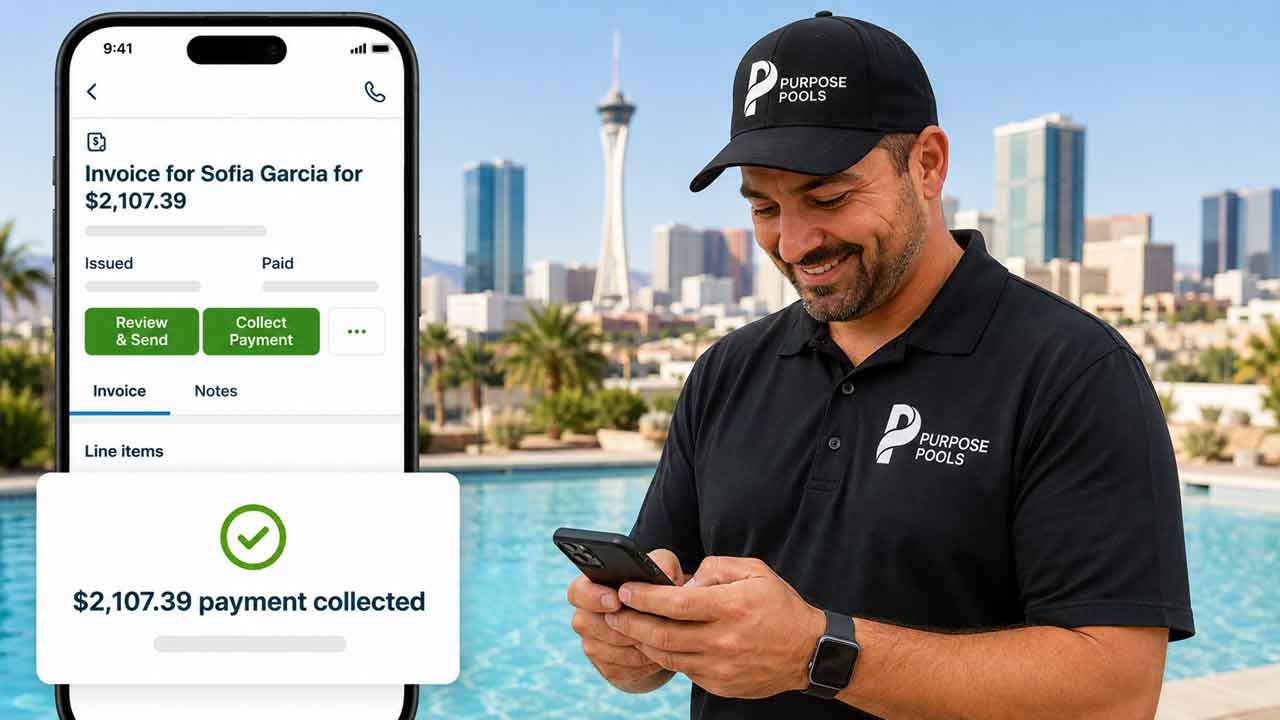
A manageable weekly route becomes a larger customer base. Then comes another technician, another truck, repair work, equipment installations, office staff, sales and marketing. Eventually, the owner is no longer just managing pools—they are managing a growing organization.
That was the progression for Scott Reynolds, owner of Purpose Pools in Las Vegas.

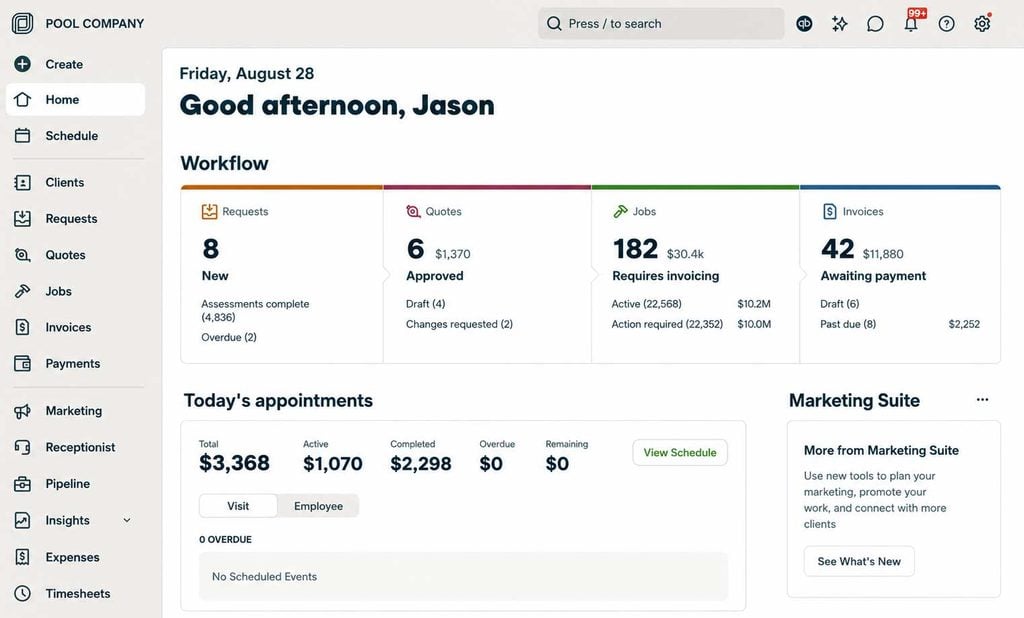
Jobber, a field-service management platform for scheduling, customer communication, estimates, invoicing and related operations, has become part of the company’s operating infrastructure as Purpose Pools has expanded. More recently, Reynolds has focused on a different challenge: using the company’s data to make smarter decisions about marketing, profitability and growth.
His experience reflects a broader shift among service contractors.
Software Is Becoming a Business Essential
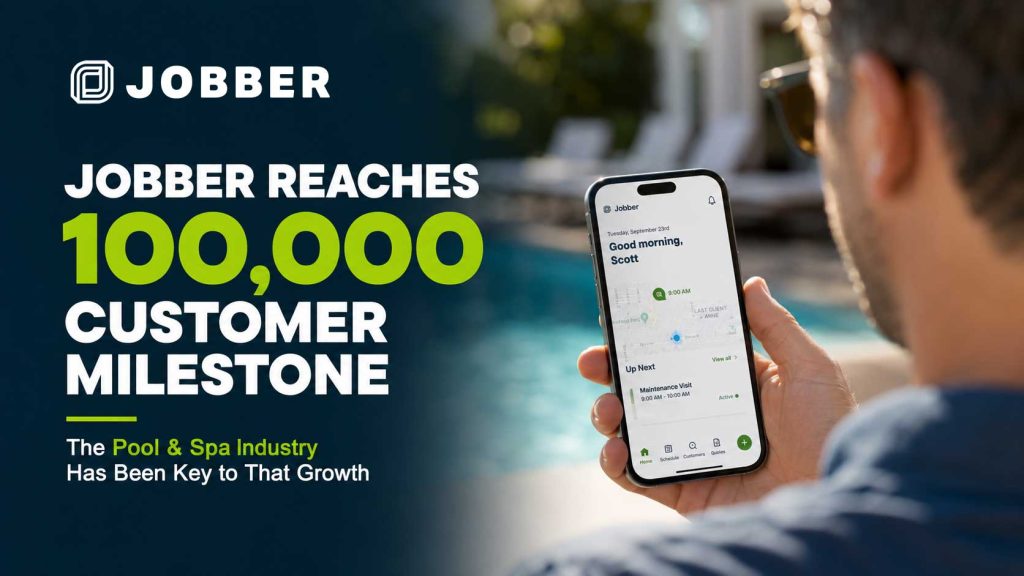
Jobber recently surpassed 100,000 paid customers. Moly Milosovic, Jobber’s Head of Community, says service professionals in the pool and spa industry have been a key part of their growth story.
“I’ve been going to trade shows for years, including a lot of pool industry shows, and back then the rebuttal I always heard was, ‘I want to learn more, but I don’t think I need it yet,’” Milosovic said. “I don’t hear that anymore.”
Milosovic said contractors increasingly recognize that operational software is not something to postpone until the company reaches a certain number of employees, trucks or accounts.

“There’s so much more awareness that software doing work and tracking work for you is a smart investment as soon as you can afford it,” Milosovic said. “It’s become more like table stakes.”
For Purpose Pools, that investment has supported a transition from a relatively simple cleaning route to a more complex service and repair operation.
Choosing a System That Can Scale
Reynolds began his search for field management software in 2022. He had prior experience with enterprise software and knew that a platform with extensive functionality was not necessarily the easiest system to operate.
“I came from a corporate background where we relied heavily on Salesforce, so I’m used to all the bells, whistles and features, but it’s extremely complex,” Reynolds said.
Before adopting a new system, Purpose Pools had worked through other solutions and developed a clearer understanding of its needs.
“I was looking for a really robust platform, and we finally landed on Jobber,” Reynolds said. “It was super straightforward and easy to use.”
For a service business, usability matters because the platform needs to work for office staff, salespeople, technicians and management—not just the person responsible for implementing it.
Support Beyond Onboarding
Reynolds said the company’s rapid adoption of Jobber has also been shaped by the personal attention he receives from his account specialist.
“Probably what has impressed me most has been the support,” he said.
He initially expected a typical onboarding period, followed by a more self-directed relationship with the platform. Instead, Jobber continued to provide assistance as Purpose Pools added people, services and workflows.
“I thought it might just be that first 90 days of, ‘Let’s get you started and make sure you’re successful,’ but since we signed up in 2022, that support has continued all the way through today,” Reynolds said.
Growth Creates More Moving Parts
“When we first started out, we were just doing weekly cleanings,” Reynolds said. “Now we push about 100 customers a week through the platform between service calls, cleanings and repairs.”
The team has grown alongside the customer base, with employees now working across sales, administration and operations.
“As we’ve grown our customer base, we’ve also grown the team and added people to sales, administration and operations,” Reynolds said. “Jobber makes it easy to get them up to speed and onboarded because the tool set continues to be straightforward and simple.”
Avoiding Costly Operational Gaps
The need for an integrated system usually becomes apparent when information starts falling through the cracks.
A technician may forget a follow-up. An estimate may not receive a response. A repair could be completed without an invoice being sent. A customer note may exist only in a text message or handwritten file.
“Think about when you lost track of something you wrote down, or when you literally forgot to invoice someone for a job worth thousands of dollars,” Milosovic said.
Those breakdowns become more expensive as a company handles greater volume.
“One of the biggest things Jobber helps us with is avoiding that memory lapse,” Reynolds said.
Faster Repair Follow-Up
At Purpose Pools, Jobber helps centralize customer communication and task management across recurring service and repair work.
That structure has helped the company reduce its repair sales cycle.
“Our entire sales cycle is less than 40 hours,” Reynolds said. “From the time someone submits a request or makes a phone call, we can be completing the repair.”
The system allows customers to respond when it is convenient for them instead of forcing every interaction into a phone call or office-hours conversation.
“They can answer the text when they want, or log into the Client Hub when they’d like to,” Reynolds said. “Jobber is always working for us, but it’s also working on the customer’s timetable.”
Empowering Pool Pros To Answer Bigger Questions
Once Purpose Pools established stronger systems for managing jobs and customer communication, Reynolds turned his attention to marketing efficiency.
“For us, the shift probably happened about a year ago,” Reynolds said. “We went from, ‘Let’s just spend. The top line looks really good,’ to asking how we could become more efficient.”
For many pool companies, advertising platforms provide useful—but incomplete—data. They can show impressions, clicks, calls and submitted forms, but they do not always reveal whether those leads became paying customers or generated meaningful revenue.
“We wanted to know where the lead was coming from, what channel produced it and what that lead cost us,” Reynolds said. “Ultimately, we wanted to know what revenue it generated.”
Connecting Ad Spend to Revenue
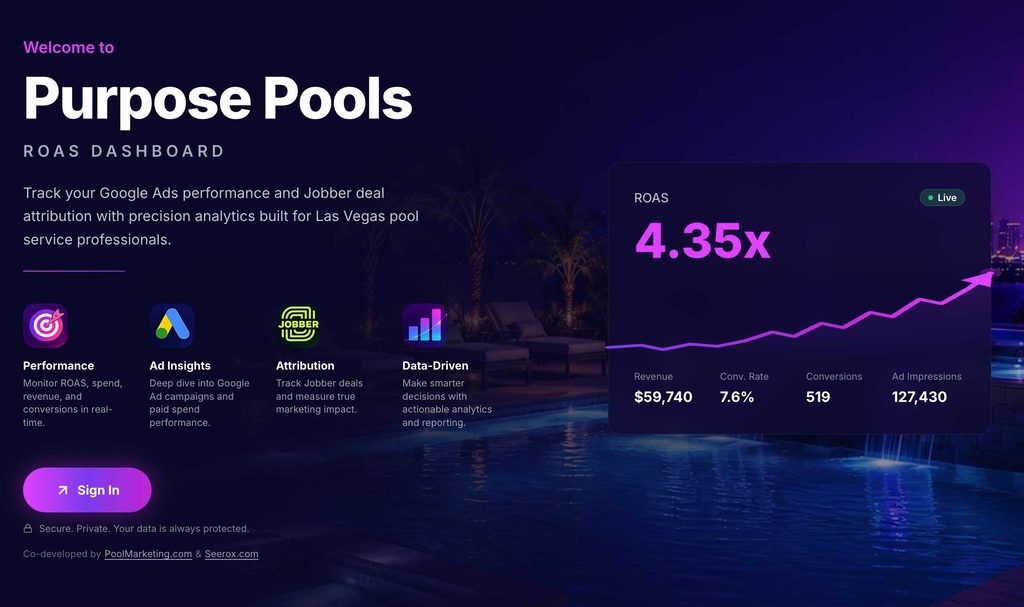
Working with digital agency PoolMarketing.com, Purpose Pools developed a custom return-on-ad-spend dashboard that connects advertising performance with customer, sales and revenue data flowing through Jobber’s API.
The dashboard is a custom integration built by PoolMarketing.com, rather than a native Jobber reporting feature. It allows Reynolds to track a lead after it enters the business, including the source, current sales stage and outcome.
“Now I’m able to tell when a lead hit the system, what stage it’s in and what the response was,” Reynolds said. “That allows us to make more efficient decisions.”
Better Data Creates Better Decisions
At scale, modest improvements in advertising efficiency can have a significant impact.
“As you grow, even being able to save a couple of percentage points on ad spend and reallocate that money somewhere else is a really big deal,” Reynolds said.
A channel that produces low-cost leads is not necessarily the best channel if those leads do not become profitable jobs. On the other hand, a higher-cost source may warrant greater investment if it consistently produces valuable repair work, installations or recurring service accounts.
The objective is not simply to identify wasted spend. It is also to invest more heavily in the channels that consistently generate worthwhile customers.
“I think that’s what a lot of owner-operators miss out on—really working through the efficiency of their costs and expenses and knowing where the money goes and why it goes there,” Reynolds said. “In our case, we can double down and spend more on the channels that are working because we have the data in front of us.”
Turning Operational Data Into Insight
Jobber occupies an important place as the source of truth in the attribution process because the ultimate value of a marketing lead is determined by what happens after the initial inquiry.
Customer records, estimates, jobs, invoices and revenue data provide the operational information needed to evaluate whether an advertising source actually produces profitable work.
For Jobber, that represents an evolution in the role of field-service software. The platform is not only a scheduling and communication tool; it can also become a source of business intelligence.
“It takes that kind of discipline—knowing your numbers and making those percentage-type decisions,” Milosovic said. “You need that visibility.”
Demand for Better Reporting
Milosovic said the Purpose Pools dashboard illustrates the type of analysis that a growing number of contractors want.
“That dashboard looks amazing,” she said. “I would love to see a dashboard like that in Jobber. We’re investing in helping customers understand their numbers better so they can make those kinds of high-growth decisions.”
Jobber has seen similar demand since introducing its own marketing tools.
“When we launched our marketing suite, the response was immediate: ‘How do you give me more information to make smarter decisions?’” Milosovic said. “We’ve continued investing in those marketing tools to give people that kind of visibility because there absolutely is demand for it.”
Revenue Alone Does Not Equal Success
For Reynolds, marketing attribution is part of a broader shift in how he measures the health of Purpose Pools.
“I think when most pool companies start out, we generally chase that vanity top line of, ‘Hey, I’m doing X amount of revenue,’ but we’re not really understanding the profit margins,” Reynolds said.
He said he often hears similar stories from other contractors who have built significant revenue but still struggle financially.
“I’ll hear, ‘We’re doing X amount a year or X amount a month, and that’s really good—but I’m also kind of going broke,’” Reynolds said.
A company can look successful on paper while dealing with poor pricing, escalating labor costs, weak material markups, excessive overhead or unprofitable marketing spend.
Knowing the Cost of the Work
Purpose Pools has responded by becoming more intentional about job costs and pricing.
“We need to understand our costs,” Reynolds said. “We’ve created a tiered cost ladder so we know what a job costs and what markup needs to go with it. That helps make sure we’re hitting our bottom-line numbers at the end of the week, quarter or year.”
That level of discipline becomes increasingly important as a business grows. More jobs do not automatically create more profit. In some cases, growth can magnify inefficiencies that were less noticeable when the company was smaller.
Jobber’s reports and operational data can support that analysis by giving contractors a clearer view of the work being performed, the revenue being generated, and the processes behind it.
Pool Service: A Key Piece of the Puzzle
Across Jobber’s customer base, the volume of operational information has grown substantially. The company says its 100,000 customers have completed nearly 90 million jobs representing more than $100 billion in services.
Pool service and repair represent an important piece of that growing field-service economy. Unlike businesses built primarily around one-time projects, pool companies often combine recurring maintenance with repair and installation work, sending technicians into the field day after day while managing an ongoing relationship with the customer. It’s a model Milosovic sees as particularly well aligned with the platform Jobber has built.
“Pool service is huge. It’s growing. It’s year-round outdoor work, and it’s exactly who Jobber was built for — people who are going to homes and commercial properties,” Milosovic said.
As those companies grow, the information generated through their day-to-day operations can become increasingly valuable. For Milosovic, the opportunity is to turn that data into actionable business guidance.
“We have this exciting opportunity because you’re already doing your work in Jobber and all of those numbers are in there,” she said. “The question becomes: How do we surface that information so you can get advice that helps you make more money?”
For Jobber, that is the larger opportunity: becoming more than a platform for scheduling and job management.
“We want to be your most trusted partner, your most trusted employee and your most trusted advisor,” Milosovic said. “We want to help surface those opportunities.”
Ready to take a deeper dive?
Listen to the full conversation with Moly Milosovic and Scott Reynolds for a practical look at how Purpose Pools uses Jobber and custom reporting to manage service work, track marketing results, improve operational follow-through and make more informed decisions about growth and profitability.


If you run a pool service business, chances are you’ve lost customers without ever knowing why. Most pool customers don’t post a bad review. They won’t call to complain. They don’t provide you a chance to make it right. They just leave.
According to a comprehensive 2025 survey from PissedConsumer.com, this is not an anomaly. It’s the norm. More than half of the 40,000+ consumers surveyed said they never received any response at all from the companies they contacted for help. And that silence—on both sides—can be costly.
For pool professionals, where reputation, referrals, and reliability are everything, these findings are a wake-up call. This isn’t just a customer service issue—it’s a customer retention issue. When pool companies fail to respond to issues or follow through on service complaints, they lose more than just a sale—they lose trust, loyalty, and long-term revenue.


The Silent Goodbye: A Threat to Pool Businesses
One of the most striking insights from the PissedConsumer.com study is how often consumers don’t bother to complain. They simply vanish.
In a service industry like ours, that silence is deadly. Pool customers rarely fire off a warning shot. They’re busy people. If they don’t feel heard or valued, they’ll ghost your business just as fast as they hired you. The data shows that 58.3% of consumers never hear back from customer service after submitting a concern. No phone call. No email. No effort.
That kind of disengagement is a huge red flag. It shows how easy it is to lose a client simply by failing to follow up. And yet, many pool businesses don’t even know it’s happening.
Why Pool Customers Aren’t Complaining
Think about it from the customer’s perspective. They’ve already paid you. You’re in their backyard. Their expectations are high, and their tolerance for inconvenience is low. If something goes wrong—whether it’s cloudy water, a missed service day, or an unexplained charge—they may give you a chance to fix it. But if you don’t respond quickly or respectfully, you’re probably not getting another shot.
According to the survey, only 26.1% of consumers said companies offered a resolution to their issue. Even when a response was provided, 61.18% were still unsatisfied with the solution.
So it’s not just about showing up—it’s about how you show up. Half-hearted responses, passing the buck, or ignoring issues altogether drives even loyal customers to leave quietly—and potentially tell others to do the same.
The Real Cost of Ignored Complaints
Ignoring a customer doesn’t just mean losing that one person’s business. It means risking negative word-of-mouth, bad reviews, and missed referrals—all critical components of a successful pool business.

More than 31% of negative online reviews happen because customers want to warn others about their bad experiences. They aren’t venting for the sake of it. They’re trying to protect their neighbors, friends, and communities from having the same issue.
And in a hyperlocal service market like pool cleaning, maintenance, and repair—reputation is currency.
On the flip side, when companies do respond and resolve issues, the effect is dramatic. According to the same study:
30% of respondents said they’d consider staying with a company that resolved their complaint.
41% of customers who received a satisfactory email support experience said they’d definitely use the company again.
So, responsiveness isn’t just a matter of courtesy. It’s a measurable business decision that can either fuel retention—or kill it.
What Pool Companies Can Learn from This
There’s a tendency in the pool industry to focus on the visible stuff: clean water, working equipment, a sparkling backyard. But what’s not visible can be just as important.
The customer who stops answering your texts? They’re not too busy. They’re probably done.
Here’s what pool companies need to do to prevent quiet attrition:
1. Respond to Every Inquiry—Fast
No excuses. Whether it’s a voicemail, email, or social media message, every touchpoint needs to be acknowledged promptly. The PissedConsumer.com report found that email responses were only received by 42% of customers, yet those who did receive timely email replies were more satisfied and more likely to remain customers.
Automated email acknowledgments can help, but they’re not enough. Personal follow-ups are key. If you can’t solve the problem right away, let the customer know you’re working on it and when they’ll hear from you next.
2. Train for Empathy and Resolution
It’s not enough to show up and do the job—you have to listen. And you have to care.
The report revealed that 45% of consumers were unsatisfied with the customer service rep they spoke to over the phone, even if the problem was resolved. That tells us resolution alone isn’t enough—it has to be paired with respect, patience, and professionalism.
Pool techs and office staff need basic customer service training, especially in conflict resolution and de-escalation.
3. Use Preferred Communication Channels
Consumers still prefer old-school methods: phone and email. In fact, these two alone reach 65% of customers, according to the study.
That’s important context in a time when many businesses are investing heavily in live chat, AI, and social messaging. While those tools have value, pool companies shouldn’t overlook the basics. If your customers want to talk on the phone, be available. If they email, respond the same day.
4. Make the First Move
Even if a customer doesn’t reach out to complain, businesses can proactively monitor satisfaction. A follow-up message after a service visit—“Hey, how did everything go today?”—can reveal hidden dissatisfaction before it turns into lost revenue.
Likewise, monitoring online reviews (especially on platforms like Google, Yelp, and yes, PissedConsumer.com) gives you a chance to respond publicly, show accountability, and potentially win customers back.
Stop Thinking of Service as a “Support” Role
In many companies, customer service is treated like a cost center. But in service-based industries like pools, it’s your retention engine. Without it, you’re constantly chasing new customers to replace the ones silently walking away.
Service is sales. Service is marketing. Service is your brand promise in action.
Here’s how to make that shift stick:
- Empower field techs to make on-the-spot fixes without having to “check with the office.”
- Create a shared inbox for all customer communication so nothing slips through the cracks.
- Set internal KPIs for response times—email within 24 hours, phone calls within the hour.
- Celebrate “save stories” internally—when someone wins back an unhappy customer, treat it like a sale.

Final Thoughts: Silence Doesn’t Equal Satisfaction
The biggest mistake a pool business can make is assuming no news is good news. In the pool industry, silence shouldn’t be mistaken for satisfaction. Reach out, connect, and you’ll turn quiet customers into loyal ones—and loyal customers into lasting growth.

Renowned Pool Franchise Celebrates Growth Milestone Fueled by Multi-Revenue Stream Model and Proven System
DALLAS, TX. (September 18, 2025) — Poolwerx, the world’s leading pool service and retail franchise, proudly announces the opening of its 100th active territory. With more than 400 territories awarded across the globe and a proven U.S. model built on recurring revenue streams, premium retail experiences, and high-touch support, Poolwerx continues to strengthen its position as the only true one-stop solution in the pool care industry.
“Reaching 100 units is a tremendous accomplishment for our team and our franchise partners, but it’s just the beginning,” said Andrew Kidd, CEO of Poolwerx USA. “Our success comes from providing a premium, full-service pool care solution and building a culture where franchise partners feel supported to grow. We’ve proven this model works across markets, and we’re excited to bring Poolwerx to hundreds more communities.”
Founded over 30 years ago in Australia, Poolwerx entered the U.S. in 2015. Today, Poolwerx’s franchise partners operate across 17 states, coast to coast, with growth fueled by both mobile and brick-and-mortar retail stores. With over 100 units now operating, Poolwerx is positioned for a new era of growth and expansion, targeting 300 U.S. territories by 2027.
Poolwerx operates with a multi-revenue stream model that combines retail, service, chemical products, and diagnostics. Its retail stores function as trusted community hubs, offering free water testing, expert advice, and product sales, while its professional service teams deliver reliable maintenance and care. This integrated approach generates recurring, recession-resistant revenue and firmly positions Poolwerx as reliable experts in the industry.
“Pool ownership can be a chore, and our goal is to make it fun, easy, and reliable,” said Jeff Powell, Vice President of Sales at Poolwerx. “Our franchise partners benefit from a proven system, a brand with three decades of legacy, and a commitment to innovation that keeps us ahead of the curve.”
With mobile options and territories still available across the U.S., Poolwerx is actively seeking franchise candidates who are growth-minded, entrepreneurial leaders — ideal for empire builders, multi-unit operators, and veterans. For more information about Poolwerx and its franchise opportunity, please visit https://poolwerxfranchising.com.
# # #

Poolwerx is the largest global franchise pool retail and service brand with over 650 service vehicles and 180 retail stores across the U.S., Australia, and New Zealand. Offering recurring maintenance, repair, retail, and delivery services, the brand’s success stems from its cutting-edge technology, thorough training, and scalable business model. For more information, visit poolwerx.com. For franchise opportunities, visit poolwerxfranchising.com.
Read the Fall Issue of Pool Magazine

See more of our coverage in your search results

 Cover Care Names Greg Conner Executive VP and General Manager
 Master Pools Guild Welcomes Red Rock Design Build as Newest Member
 Luciana Amaro Joins Franklin Electric as Chief Human Resources Officer
 iGarden K Series Review: What We Learned After Months in a Customer’s Pool
 Sacred Geometry: Where Architecture, Mathematics and Mosaics Collide
 Anatomy of a Botched Remodel: What Sank the Lincoln Memorial Reflecting Pool Restoration?
 RB Retail & Service Solutions Launches RB Propel

 Winter is for Strategy: Build Your 2026 Business Plan Now
 Landmark Aquatic Taps Britton Nielsen and Tim Garner to Lead Utah Growth
 WITI Announces 3rd Annual Walk for Water Safety
 Thursday Pools’ Dealer Conference, Kicks Off Learning Series for Builders-Dealers
 Inside Latham’s Playbook To Keep Winning In A Tough Pool Market
 The Acrylic Pool Authority: How Jason Jovaag and HammerHead Aquatics Became a Go-To Name
 Ownership Group Acquires Shasta Pools, Announces Expansion Plans to Offer Complete Home Services
 Sponsored Advertisement

 Sponsored Advertisement

 Pool News4 weeks ago
Leslie’s Files Chapter 11, Lenders Set to Take Control in Major Restructuring

 Pool Equipment4 weeks ago
AquaLink® EDGE™ and trackr iO Signal a New Direction for Pool Automation
 Pool News6 days ago
Sacred Geometry: Where Architecture, Mathematics and Mosaics Collide

 Features4 weeks ago
A New Era at POOLCORP: John Watwood Focuses on Customers and the Fundamentals

 Pool News3 weeks ago
Shasta Pools Hires 30-Year Builder to Head Residential Construction

 Industry News4 weeks ago
Watershape University Announces Fall 2026 Session in San Diego

 Retail4 weeks ago
Nasdaq to Suspend Trading in Leslie’s Stock on October 6
 Pool News6 days ago
Anatomy of a Botched Remodel: What Sank the Lincoln Memorial Reflecting Pool Restoration?
You must be logged in to post a comment Login