





Pool News
Leslie’s Files Chapter 11, Lenders Set to Take Control in Major Restructuring


After months of mounting financial pressure and weeks of speculation over its future, Leslie’s Inc. has officially filed for Chapter 11 bankruptcy protection, beginning a court-supervised restructuring that is expected to eliminate approximately $685 million in debt and ultimately hand majority ownership of the company to its lenders.
The Phoenix-based pool and spa retailer filed voluntary Chapter 11 petitions Wednesday in the U.S. Bankruptcy Court for the Southern District of Texas. The filing was widely anticipated after Leslie’s disclosed substantial doubt about its ability to continue as a going concern in August and reports surfaced last week that the company was preparing for bankruptcy.
What happens from here, however, is important to understand.

Leslie’s is not shutting down.
This is a prearranged restructuring designed to dramatically reduce the company’s debt while allowing the underlying business to continue operating. More than 80% of Leslie’s existing lenders have already agreed to support the restructuring plan, giving the company a significant head start as it enters Chapter 11.
Under the Restructuring Support Agreement, Leslie’s expects to eliminate approximately $685 million — roughly 90% — of its outstanding funded debt. The company has also secured commitments for $90 million in new debtor-in-possession financing and another $60 million in equity financing. Leslie’s is separately seeking approval for a fully committed $225 million asset-based DIP facility from its existing ABL lenders.
In practical terms, Leslie’s is using Chapter 11 to perform a massive financial reset.
Leslie’s CEO: “Leslie’s Is Here to Stay”
Leslie’s CEO Jason McDonell characterized the restructuring as an opportunity to remove debt from the balance sheet and redirect resources back into the business.

“Today’s announcement marks an important milestone in our commitment to our customers and our business,” McDonell said. “With a stronger balance sheet and greater financial flexibility, Leslie’s can reinvest across the business to strengthen operating execution and deliver an even better experience for our customers, both in-store and online.”
McDonell added, “Leslie’s is here to stay, and I am deeply grateful to our employees, customers, and partners for their continued support as we work to position Leslie’s for a strong future.”
What Chapter 11 Means for Leslie’s
Chapter 11 is often interpreted by consumers as synonymous with a company going out of business. That is not what Leslie’s has announced. The company intends to continue operating throughout the bankruptcy process while restructuring its balance sheet, store footprint and ownership.
Most Leslie’s stores will remain open, its website will continue operating, employees are expected to continue receiving wages and benefits, and the company says gift cards and loyalty benefits will continue to be honored. Leslie’s has also asked the bankruptcy court for authority to continue honoring obligations to vendors in the ordinary course.
There will, however, be a smaller Leslie’s on the other side.
The company announced another 76 store closures as part of the restructuring and said it will continue evaluating its real estate portfolio during Chapter 11. Leslie’s currently operates more than 900 locations nationwide.
What Happens to Leslie’s Now?
The easiest way to understand the transaction is to separate Leslie’s operating business from the financial structure sitting above it.
The problem Leslie’s is attempting to solve through Chapter 11 is not simply whether people still need chlorine, pumps, filters, chemicals and other pool supplies. Millions of swimming pools still require those products every year.
The larger problem has been carrying an enormous debt burden while trying to navigate declining sales, changing consumer behavior and a difficult post-pandemic pool market.
In its fiscal third quarter, Leslie’s reported sales of $458.5 million, down 8.4% from the prior-year period, while comparable sales declined 6.2%. For the first nine months of fiscal 2026, sales declined 7.3% to $790.4 million. Adjusted EBITDA for the third quarter fell to $55.7 million from $81.6 million a year earlier.
Chapter 11 gives Leslie’s an opportunity to address that debt problem directly.
Rather than lenders potentially recovering only a portion of what they are owed through a liquidation or prolonged financial deterioration, the restructuring converts their position into ownership of a substantially less leveraged company.
Upon emergence from bankruptcy, Leslie’s expects a group of its existing lenders to become the company’s majority owners.
That means Leslie’s will essentially emerge with a new capital structure, new majority ownership and approximately $685 million less funded debt hanging over the business.
That is a very different company financially.
The lenders taking control are not simply buying hundreds of pool stores in the traditional sense. They are effectively exchanging a significant portion of the debt they already hold for ownership of the underlying business.
For Leslie’s, removing that debt potentially frees up capital that otherwise would have been consumed servicing it. That money can instead be directed toward inventory, pricing, technology, e-commerce, store improvements and other operational priorities.
It does not, however, solve every problem facing the company.
Leslie’s still has to convince consumers to shop there.
The company still has to compete with independent pool retailers, service professionals, mass merchants and online sellers. It still has to determine the right number of physical stores to operate. And it still has to demonstrate that the underlying business can produce sustainable results once the debt problem has been substantially removed.
Bankruptcy can fix a balance sheet. It cannot, by itself, fix customer traffic, pricing strategy or execution.
That is where the next chapter of this story will ultimately be decided.
What Happens to Existing Shareholders?
Existing Leslie’s shareholders are in a much different position than Leslie’s customers, employees or vendors.
The restructuring agreement calls for lenders to become majority owners of the reorganized company. Exactly what existing shareholders ultimately receive will be determined through the Chapter 11 process and confirmed restructuring plan, but equity sits behind secured and unsecured creditors in bankruptcy priority.
Leslie’s entered Chapter 11 reporting approximately $722.2 million in assets and $1.21 billion in liabilities, according to bankruptcy filings reported by The Wall Street Journal.
That disparity helps explain why the restructuring is centered around creditors rather than preserving the company’s existing ownership structure.
For anyone watching Leslie’s stock, that distinction is critical: keeping Leslie’s stores operating does not mean preserving the value of Leslie’s existing publicly traded shares.
The business can survive while the existing capital structure does not.
Why the Bankruptcy Is Happening in Houston
Although Leslie’s is headquartered in Phoenix, the company filed its Chapter 11 cases in the Southern District of Texas. The case has been assigned to U.S. Bankruptcy Judge Alfredo Perez under Case No. 26-90795.
Houston has become a major venue for large corporate restructurings, with a bankruptcy bench and professional infrastructure accustomed to handling complicated Chapter 11 cases.
Leslie’s has retained Simpson Thacher & Bartlett and Haynes and Boone as legal advisers, BRG as financial and restructuring adviser, and Centerview Partners as investment banker.
What Pool Professionals Should Watch Next
For the pool and spa industry, the most immediate concern will be how aggressively Leslie’s reshapes its retail footprint.
The 76 announced closures may not necessarily represent the final number. Leslie’s specifically said it will continue evaluating its real estate portfolio during Chapter 11, giving the company an opportunity to reject leases and exit locations that no longer make economic sense.
That could create opportunities for independent pool retailers and service companies in markets where Leslie’s reduces its presence.
Vendors will also be watching closely. Leslie’s says it intends to continue paying vendors and operating normally during the proceedings, subject to court approval of its first-day motions. Maintaining supplier confidence will be important for a retailer whose business depends heavily on keeping stores stocked during the pool season.
The company is targeting an emergence from Chapter 11 in early 2027.
If that timetable holds, the Leslie’s that emerges will look considerably different financially from the company entering bankruptcy today.
The familiar orange-and-blue stores are not disappearing. Leslie’s is not being liquidated, and the company is making it clear that it intends to remain one of the largest players in the pool and spa aftermarket.
What is disappearing is much of the debt structure that became increasingly difficult for the company to carry.
The bankruptcy process will now determine exactly how that restructuring is implemented, which stores survive the continuing portfolio review, how creditors are treated and what ultimately happens to existing shareholders.
For the pool industry, the more important question is no longer whether Leslie’s will file for bankruptcy.
It has.
The question now is what Leslie’s looks like when it comes out the other side.





Pool News
Leslie’s Reportedly Prepares for Chapter 11 Bankruptcy as Possible Nasdaq Delisting Looms
The nation’s largest specialty pool retailer reportedly seen preparing to file for Chapter 11.
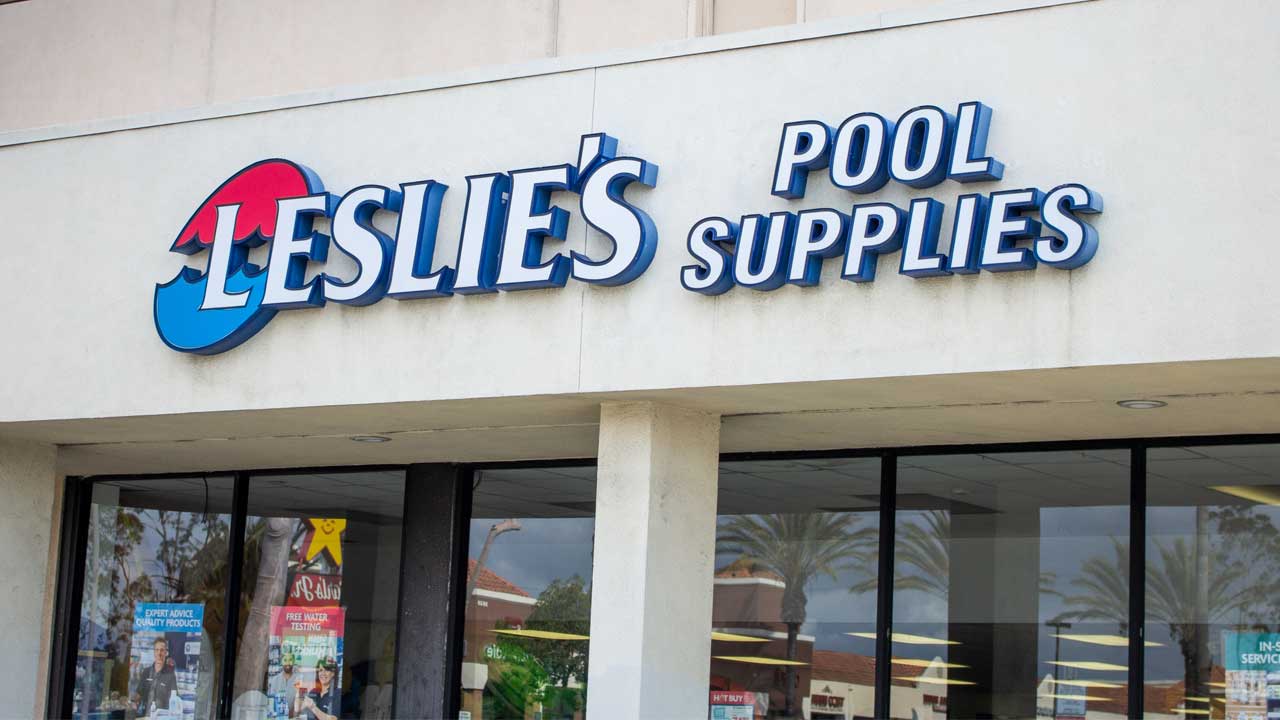
Leslie’s, Inc. (NASDAQ: LESL) is reportedly preparing to file for Chapter 11 bankruptcy protection as soon as next week, potentially handing control of the 63-year-old retailer to its lenders. The news comes as the company faces the prospect of being delisted from Nasdaq following a prolonged collapse in its share price.
According to September 24 reports from Bloomberg and The Wall Street Journal, Leslie’s is working toward a restructuring agreement that would transfer ownership to its creditors. Lenders are reportedly prepared to provide approximately $100 million in financing to keep the business operating through bankruptcy, while roughly $750 million in debt could be exchanged for equity.
For existing shareholders, the implications could be devastating. If the restructuring proceeds as reported, their investments could be substantially diluted or wiped out entirely.

Leslie’s has not formally announced a bankruptcy filing, but the possibility is hardly unexpected. In its August quarterly SEC filing, the company acknowledged substantial doubt about its ability to continue operating and warned that bankruptcy could become necessary if it was unable to restructure or refinance its debt.
The latest developments suggest that efforts to stabilize the business through store closures, lower prices and aggressive cost-cutting have not been enough to overcome its mounting financial problems.
A Second Trip to Wall Street That Could End in Bankruptcy
This isn’t Leslie’s first time as a publicly traded company.
After previously operating as a public company before being acquired by private equity, Leslie’s returned to Wall Street in October 2020, during an unprecedented boom in swimming pool construction and backyard spending.
With millions of Americans investing in pools, outdoor living and home improvements, the company appeared well positioned for continued growth.

Instead, the years that followed proved considerably more difficult.
As pandemic spending faded, inflation and higher interest rates squeezed household budgets. New-pool construction slowed, consumers became more selective about discretionary purchases, and the extraordinary demand that had fueled the industry began returning to normal.
Leslie’s was also facing growing competition from Walmart, Home Depot, Lowe’s, Amazon and numerous online pool supply retailers. Customers who once relied on their local pool store could now compare prices and purchase many of the same products without leaving home.
The company responded by closing 80 underperforming stores and one distribution center, reducing inventory and introducing lower prices to attract customers.
For a brief period, those efforts appeared to be working.
According to its second-quarter earnings report, revenue increased 4.3%, comparable sales improved 6.6%, and customer counts rose 8% compared with the previous year. Investors cautiously welcomed the improvement, hoping it signaled the beginning of a turnaround.
Unfortunately, that optimism proved short-lived.
Summer Sales Tell a Different Story
Leslie’s third-quarter earnings, released August 12, revealed that the company was still struggling during what should have been its strongest selling season.
Revenue declined 8.4% to $458.5 million, compared with $500.3 million during the same quarter a year earlier. Comparable sales fell 6.2%, while adjusted EBITDA dropped from $81.6 million to $55.7 million.
Gross margins also deteriorated, falling from 39.6% to 36.5%, illustrating the difficulty of maintaining profitability while lowering prices to compete for customers.
For the first nine months of fiscal 2026, Leslie’s reported a net loss of $87.7 million. Management subsequently withdrew its full-year financial guidance as the company explored alternatives to address its debt.
The problem wasn’t simply that Leslie’s was selling fewer pool supplies. It was that declining sales were making an already difficult financial situation considerably worse.
As of July 4, Leslie’s reported approximately $1.21 billion in total liabilities against $722.2 million in assets, including roughly $753 million in long-term debt.
Closing stores and reducing expenses can help preserve cash, but those measures alone cannot resolve a debt burden of that magnitude.
The reported restructuring would effectively exchange much of that debt for ownership of the company, giving Leslie’s an opportunity to continue operating without the same financial obligations hanging over its head.
For its existing shareholders, however, that opportunity could come at a substantial cost.
Nasdaq Delisting Could Be Next
Bankruptcy isn’t Leslie’s only immediate concern. The company also faces the prospect of being removed from Nasdaq, and the timing of its previous reverse stock split could accelerate that process.
Leslie’s completed a 1-for-20 reverse stock split in September 2025, consolidating every 20 existing shares into one in an effort to address its declining stock price. Split-adjusted trading began September 29, but the stock has since fallen back below Nasdaq’s $1 minimum bid-price requirement.
Normally, a company whose closing bid price remains below $1 for 30 consecutive business days receives 180 days to regain compliance. However, Nasdaq’s rules prohibit that grace period for companies that completed a reverse stock split within the preceding year.
Leslie’s reverse split became effective September 26, 2025, making the timing of its latest share-price decline particularly significant.
If Leslie’s has closed below $1 for 30 consecutive business days while that one-year reverse-split restriction remains in effect, it would not be eligible for Nasdaq’s ordinary compliance period. Under Nasdaq’s rules, staff would issue a Staff Delisting Determination rather than provide the usual 180-day period to regain compliance.
The company could request a hearing to appeal such a determination, although an appeal would not guarantee that its shares remain listed.
A Chapter 11 filing would create another potential obstacle. Nasdaq has discretionary authority to delist companies undergoing bankruptcy, particularly when a restructuring could eliminate existing shareholder equity.
As of September 24, a new Nasdaq delisting determination related to the company’s current share-price performance or reported bankruptcy preparations has not been publicly confirmed.
What Bankruptcy Would Mean for the Pool Industry
A Chapter 11 filing wouldn’t necessarily mean Leslie’s is going out of business.
The process allows companies to continue operating while restructuring their debts, renegotiating contracts and developing a plan to emerge from bankruptcy. The reported $100 million in financing could provide the cash necessary to pay employees, purchase inventory and keep stores open while the restructuring moves through court.
For pool owners, the immediate impact may be relatively limited. Leslie’s could continue selling chemicals, equipment and replacement parts while providing the water testing and technical advice that have long been central to its retail business.
For manufacturers and distributors, however, the implications could be considerably greater.
Leslie’s remains one of the industry’s largest retail distribution channels. A bankruptcy could force suppliers to renegotiate payment terms, reconsider credit arrangements and adjust inventory or production plans. Additional store closures could also affect manufacturers that depend heavily on the retailer to get their products in front of consumers.
Independent pool stores and competing retailers could potentially gain customers if Leslie’s reduces its footprint, particularly in markets where the company has historically maintained a strong presence. However, disruptions to supplier relationships and distribution could also create challenges for businesses throughout the industry.
The bigger question is how much of Leslie’s existing business will survive the restructuring. Its nationwide store network, established customer base and professional water testing services still have value, but those advantages haven’t been enough to offset declining sales and the company’s substantial debt.
Can Leslie’s Survive?
For Leslie’s, Chapter 11 could provide an opportunity to address financial problems that store closures and cost-cutting have been unable to resolve. Exchanging debt for equity could substantially reduce its obligations and allow the retailer to continue operating under new ownership.
That doesn’t mean the underlying challenges disappear. Leslie’s would still have to compete with big-box retailers and online sellers, rebuild customer traffic and find a way to operate profitably with a potentially smaller retail footprint.
For existing shareholders, the reported restructuring presents a different situation. If lenders take ownership in exchange for forgiving debt, there may be little or nothing left for current equity holders.
The coming days should provide a clearer picture of the company’s future. A formal bankruptcy filing would reveal the proposed restructuring terms, financing arrangements and any additional changes to its retail operations.
For the thousands of employees, manufacturers and suppliers that depend on Leslie’s, the immediate concern will be whether the company can maintain normal operations while reorganizing its finances.
For a retailer that has served American pool owners since 1963, the next chapter could look considerably different from the business that returned to Wall Street six years ago.


New department will expand technical support for reinforced PVC membrane systems across North America
RENOLIT has established a dedicated U.S. engineering department within its North American Pool business unit to support the continued growth of reinforced PVC membrane systems in the North American swimming pool market.
Led by Brandon Mays, the new department will serve as a technical link between architects, aquatic consultants, builders, installers, RENOLIT’s North American commercial team and the company’s engineering and manufacturing resources in Europe. It will provide project-specific technical support, including system recommendations, specification guidance, submittal packages, technical drawings, accessory selection, and installation details.
A primary focus for the department will be developing standardized construction details and installation guidelines that reflect North American construction methods, codes and field conditions. These resources are designed to help architects and aquatic consultants incorporate reinforced PVC membrane systems into project specifications with greater clarity and consistency, while giving builders and installers more complete guidance in the field.
The department will support commercial pool projects from the earliest design and specification stages through installation, helping project teams identify and address potential technical challenges before construction begins. It will also coordinate the adaptation and development of complete systems for the North American market — including membranes, terminations, transitions, drainage components and other accessories — and will contribute to installer training, technical education and the development of qualification standards and best practices, including research into North American testing, certification and code requirements for commercial aquatic facilities.
“For years, we have heard a consistent need from architects, consultants, builders and installers for stronger technical resources in North America,” said Tony Jordan, Business Development Manager. “The creation of this department is a direct response to that need and an important step in supporting the market’s long-term growth.”

Mays brings extensive experience in commercial aquatics, reinforced PVC membrane systems, and project coordination to his new role. He will collaborate closely with RENOLIT’s North American sales, business-development, training and customer-service teams while maintaining a direct technical connection with the company’s Pool engineering team headquartered in Spain. “My priority is to make technical support easier to access and more useful throughout the life of a project,” said Mays. “That means working closely with architects, consultants, builders and installers to develop solutions that are technically sound and practical to execute.”

The establishment of the engineering department reflects RENOLIT’s broader effort to advance reinforced PVC membranes as complete, engineered waterproofing systems rather than treating the membrane solely as a pool finish. By expanding its technical resources in the United States, RENOLIT aims to reduce uncertainty and construction risk while giving architects, builders, installers and facility owners greater confidence in how these systems are designed, specified and installed — representing the next stage of RENOLIT’s ongoing commitment to technical support, professional education and the long-term development of reinforced PVC membrane systems throughout North America.
More information about RENOLIT’s partnership and products can be found here:

New public resources focus on helping pool owners understand water-test results as a connected system rather than a collection of isolated numbers.
AvenBlu, a digital pool-care platform for homeowners and pool professionals, has expanded its free public resource library with a new Pool Chemistry Guide and a companion Pool Calculator designed to turn confusing test results into clearer next-step decisions.
For many homeowners, the hardest part of pool care begins after the test strip. They have numbers, but not context. AvenBlu’s latest launch is built around that gap, helping users understand how readings influence one another and what should be addressed first instead of simply handing them another chart of “good” numbers.
“A chlorine reading by itself doesn’t tell the entire story. We wanted to build something that helps people understand the context before they start adding products.” TY — AVENBLU
Moving Beyond Individual Test Numbers
The Pool Chemistry Guide explains the measurements homeowners encounter most often when testing residential water: free chlorine, combined chlorine, pH, total alkalinity, cyanuric acid, calcium hardness, salt, and water temperature.
Its core premise is simple: these readings are not independent pass-or-fail grades. They are connected signals. A pool may have chlorine that looks acceptable on paper while still underperforming because pH, stabilizer, temperature, recent swimmer load, or general water condition are pulling the system in another direction.
The guide also clarifies a distinction that often gets blurred in consumer-facing pool content: the difference between public-health baselines, commonly used industry operating methods, and AvenBlu’s own conservative planning recommendations.
Instead of encouraging users to chase every number at once, AvenBlu frames pool care as a deliberate sequence: test, interpret, correct, circulate, and retest.

- Explains why free chlorine needs CYA and pH context.
- Shows how alkalinity affects pH stability.
- Connects calcium, temperature, and balance to scale or aggressive water.
- Clarifies that saltwater pools still require complete chlorine and water-balance management.

For homeowners overwhelmed by conflicting online advice, that framing can reduce guesswork. For service providers, it can mean conversations start with better information and more realistic expectations.
From Education to Practical Pool Decisions
The chemistry hub connects directly with AvenBlu’s free Pool Calculator, which lets homeowners enter pool volume and current test results to better understand what those numbers mean and estimate conservative starting adjustments. The calculator is intentionally designed around a test-correct-circulate-retest workflow rather than encouraging several overlapping corrections at once.
- Test: Start with a current sample and a clear set of readings.
- Interpret: Read chlorine, pH, stabilizer, and balance together.
- Correct: Make one deliberate adjustment rather than several guesses.
- Circulate: Let water mix fully before treating old numbers like current reality.
- Retest: Use the new reading to choose the next move.
That same philosophy carries into issue diagnosis. For green water, cloudy water, strong chlorine odor, staining, scaling, rapidly disappearing chlorine, or unstable pH, AvenBlu presents symptoms as investigative clues rather than definitive diagnoses.
“The goal isn’t to make every number move at once. It’s to understand the relationships and make the next deliberate move.”
It also draws clear safety lines, advising homeowners to stop and seek appropriate help when facing fumes, spills, burns, major overdoses, uncertain chemical combinations, severe contamination, or circulation failures.

A Growing Pool-Care Knowledge Library
The Pool Chemistry Guide is part of a broader expansion of AvenBlu’s public educational resources. The goal is not to publish disconnected articles, but to create a connected user journey that mirrors the way real homeowners think about their pools.
Someone researching a strong chlorine odor can move from an issue-specific guide into broader chemistry education, then use a calculator or retesting workflow to evaluate their own pool. A homeowner dealing with scale can move from identifying the symptom to understanding how calcium, pH, alkalinity, temperature, and overall balance may contribute.
Pool Calculator
Helps homeowners enter pool volume and test results, understand what the numbers mean, and estimate conservative starting adjustments.
Pool Chemistry Guide
Explains chlorine, pH, alkalinity, stabilizer, calcium, salt, testing, water-balance interactions, and correction order in plain language.
Pool Care Guides
Issue-specific resources covering cloudy and green water, saltwater care, stain and scale clues, seasonal maintenance, retesting, and safety.

About AvenBlu
AvenBlu is a digital pool-care platform built to help homeowners better understand, manage, and maintain their pools while also giving pool professionals tools for business visibility, customer management, documentation, and ongoing service operations.
Its platform combines pool-care education, water-test interpretation, maintenance planning, troubleshooting resources, and professional-service connections in one system.
Read the Summer Issue of Pool Magazine

See more of our coverage in your search results
 Sponsored Advertisement
 AquaLink EDGE and trackr iO Signal a New Direction for Pool Automation
 Leslie’s Reportedly Prepares for Chapter 11 Bankruptcy as Possible Nasdaq Delisting Looms
 CCEI Taps Benoit Masse for Sales
 JED Pool Tools Offers New 14-Inch Pro Vacuum Head
 FSPA and PHTA Reunite Through Historic Affiliation
 RENOLIT Establishes U.S. Engineering Department for Pool Business
 Magic Plastics Redesigns MagicVac Cutting Freight Costs

 Best Pool Cover Pumps of 2024
 Florida Swims Foundation Announces “Swim For Life” License Plate
 Measures to Perfect Pool Pad Effectiveness
 Thursday Pools’ Dealer Conference, Kicks Off Learning Series for Builders-Dealers
 America’s Swimming Pool Company Launches New Construction Division
 Leslie’s Urges Pool Owners to Stop Using Chlorine Tabs Without EPA Labels
 Pool360 PoolService Is Evolving To Help Pool Companies Scale Faster and Operate Smarter


 Sponsored Advertisement
 Products4 weeks ago
5 Ways Jandy’s New AquaLink® EDGE™ Is Changing the Game for Pool Pros
 Pool News6 days ago
Leslie’s Reportedly Prepares for Chapter 11 Bankruptcy as Possible Nasdaq Delisting Looms

 Pool News3 weeks ago
Inside the 2026 Million Dollar Pool Design Challenge

 Press Releases2 weeks ago
Soake Pools Launches Dual Pool Packages

 Industry News4 weeks ago
Why Pools Matter: Pool Horizons Takes Its Message Global

 Pool News3 weeks ago
RENOLIT Launches ONE Augmented Reality Pool Design App

 Pool News3 weeks ago
SafeSplash Highlights Early Water Safety During Baby Safety Month

 Pool Equipment2 weeks ago
Hayward Issues Recall for Universal Pool Heaters Over Carbon Monoxide Risk
You must be logged in to post a comment Login