




Pool News
This Summer, A Pool Floats in NYC: Update on + POOL Project

When + POOL first captured global attention, it did so with a deceptively simple idea: New York City is surrounded by water—why can’t New Yorkers swim in it?
Years later, that question has evolved into one of the most ambitious waterfront projects in the country. In a recent interview with Pool Magazine, Kara Meyer, Managing Director of + POOL, provided a comprehensive update on the project’s progress, regulatory breakthroughs, construction milestones, and long-term vision for reconnecting New Yorkers with their waterways.
What began as an artist-driven concept is now mid-construction.

From Concept to Movement
Meyer traces + POOL’s origins to a group of architects and artists who observed the paradox of New York’s geography. “New York City’s surrounded by water and we can’t access it for swimming,” she explained. “What if we could, instead of cleaning the entire river, carve out a small piece of it?”

The early vision proposed a plus-shaped, floating pool that would filter river water directly through its walls—cleaning the water while creating a safe, contained swimming environment. The concept resonated globally. “It was really just a concept in its early design phases that just captured the imagination of the world,” Meyer said. “People all around the world were like, yes, this is awesome, this is great.”
But inspiration alone doesn’t build infrastructure. To move the idea forward, the founders created a nonprofit organization to serve as the development arm of the project.

A Mission Bigger Than a Pool
Over time, + POOL evolved from a singular design concept into a mission-driven organization focused on access, education, and stewardship.
The nonprofit was founded “with a mission to provide free and safe access to urban waters for swimming, to educate the public on the issues affecting our water quality, and to promote water stewardship and water safety education,” Meyer said.

While the iconic plus shape remains central to the brand, Meyer emphasized that the organization’s purpose extends far beyond geometry. “Plus Pool is an organization, right? But it’s also a community of people that are driving that organization and driving the idea forward,” she noted.
The brand was intentionally designed to be “inclusive and celebratory and positive and, quite literally, a plus—to the waterfront, to New Yorkers’ quality of life.”

Building the Pilot: Why the First Pool Is Different
Today, construction is underway on the first + POOL installation—a pilot facility designed to operate within a newly created regulatory framework.
“We are currently building the first + POOL, which is a pilot facility that we are developing against new regulations that we’ve ignited to even allow for this kind of innovation to exist,” Meyer explained.

Because no regulatory pathway previously existed for a floating, river-fed public pool, + POOL had to work with state and city health departments to shape new policy. After that framework was established, the project received capital funding from the Governor of New York to pilot the facility.
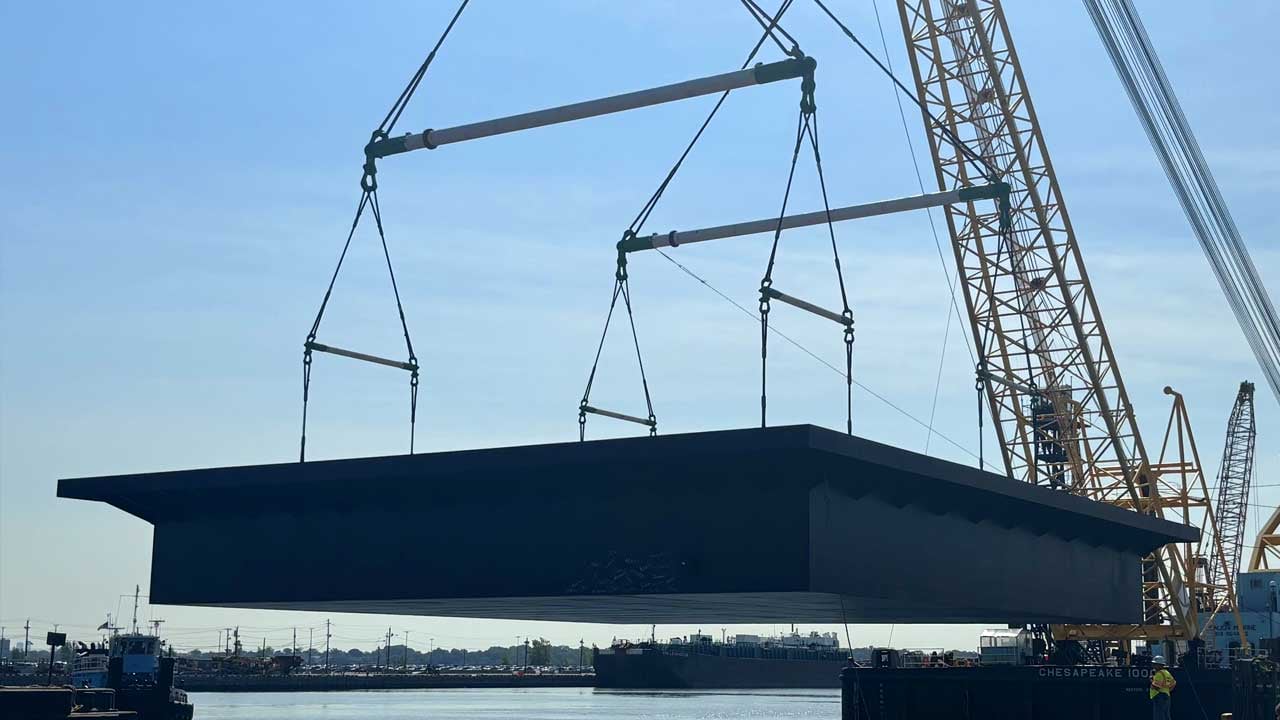
Rather than constructing the full plus-shaped configuration immediately, the team is building one “arm” of the plus—a lounge pool portion—to demonstrate operations, safety, and regulatory compliance.
“We took one arm of the plus to do that with that funding,” Meyer said. The intent is to allow city and state officials to understand how such a facility “would be permitted, would be regulated, would operate” before expanding further.
How the + POOL Filtration System Works
What distinguishes + POOL from traditional pools is its direct relationship with the East River.
“The difference between a traditional swimming pool is that the pool is being fed with the East River water,” Meyer said.
Rather than drawing from municipal water sources, the pool pulls water directly from the river. Filtration equipment—housed within a customized barge structure—treats the water on-site. Meyer describes the structure as a vessel: “If you think of the pool as a boat… the filtration equipment lives in the hull of that boat.”
The system continuously pulls in river water, filters it, and discharges clean water back into the river. Notably, the pilot pool will not rely on chlorine as a disinfectant. “The idea is that you’re really having a natural swimming experience in the natural waters,” Meyer explained.
Water turnover rates are significantly faster than those of traditional pools, ensuring safety while leveraging an effectively endless surrounding water source.
The result is both a recreational facility and an environmental intervention. “It’s actually filtering and cleaning the water while you’re swimming in it,” she said.
Regulatory Hurdles and Policy Breakthroughs
For nearly a decade, regulatory barriers represented the project’s biggest obstacle.
“There was no process,” Meyer stated plainly. Existing health codes recognized only two categories: pools and beaches. A floating, river-fed filtration pool fit neither.
In addition, many areas of the East River were not classified as “bathing” waters under state environmental regulations, prohibiting the construction of swimming facilities.
Through data collection, policy advocacy, and collaboration with agencies, + POOL helped establish new regulatory pathways. The updated framework allows for waivers and demonstrations of safety compliance, even in proximity to combined sewage overflow (CSO) systems—an issue common to many older cities.
“This has been kind of an interesting case study… in how you can really innovate alongside government in a way that will shift the needle,” Meyer reflected.

Funding a Public Vision
From its inception, + POOL adopted a public-benefit model inspired by projects like the High Line. Meyer explained that the nonprofit structure was chosen to ensure the pool would be equitable and accessible—not a members-only amenity.
“We wanted to make sure that was equitable and accessible to all and not reserved for… a members-only type private facility,” she said.
The project has relied heavily on private donations, volunteer expertise, and pro bono services to sustain operations and programming. Ultimately, state capital funding unlocked the ability to construct the pilot installation.
The public-private partnership model is designed to demonstrate feasibility so that future investments—public or private—can scale similar projects.

Construction Timeline: What Happens Next
As of early 2026, the floating barge structure has been constructed, and the team is preparing to install the pool liner, piping, and filtration systems.
“We’re mid construction,” Meyer said.
The plan is to float the operational structure into the river this summer to demonstrate full-scale operations to health officials. After testing and regulatory review, the team hopes to complete above-deck amenities—including decking, railings, bathrooms, showers, and locker rooms—and officially open to the public in summer 2027.
Education and Community Programs
Even before the physical pool is complete, + POOL has invested deeply in community programming.
Recognizing that many New Yorkers lack access to swim education, the organization launched a Learn to Swim program focused on low-income youth. “Data really has shown that low-income New Yorkers are the least likely to have the ability to take swim lessons or learn to swim,” Meyer noted.
To date, the program has served more than 1,500 youth across the city, later expanding to adult learners.
In parallel, + POOL has developed STEM curricula and public data initiatives to demystify water quality. From classroom instruction to interactive dashboards—and even a floating light sculpture that changes color based on real-time water conditions—the organization has worked to make water science accessible.
“We’ve really taken a role in making sure that people understand what is safe about their water,” Meyer said.
Reconnecting a City to Its Water With + POOL
At its core, + POOL represents a cultural shift.
New York has spent decades revitalizing its waterfronts—adding parks, bike paths, and boat launches. Meyer sees + POOL as the next step: not just bringing people to the water’s edge, but into the water itself.
“We’re taking that kind of waterfront revitalization one step further and getting people into the water,” she said.
Success, in her view, isn’t just a single floating pool. It’s a new regulatory landscape, additional urban swim facilities, and a generation of residents who see their waterways not as barriers—but as assets.
New York City boasts more than 520 miles of waterfront, yet only 14 miles of beaches. “We have lots of untapped potential,” Meyer observed.
If all goes according to plan, by summer 2027 a floating pilot pool will mark the first tangible realization of a vision that began as a sketch—and a question.
What if you could swim in the East River?
Thanks to years of advocacy, engineering, and persistence, New Yorkers are closer than ever to making that dream a reality.
On a More Personal Note
At Pool Magazine, we support the + POOL initiative. Over the years, we’ve watched this project evolve from an inspired concept into a policy-shifting movement—fueled not by a single entity, but by a coalition of passionate grassroots supporters, designers, engineers, educators, legislators, and advocates who refused to let the idea fade.

Now, as the first incarnation of + POOL moves from blueprint to floating reality, it represents more than a public swim facility for New Yorkers. It represents the power of community-driven progress and a reimagining of how cities can reconnect people with their natural resources.
We’re proud to have been supporters from the beginning—and we’re excited to see this landmark public works project finally coming to fruition.
Photo Credits: + POOL – http://pluspool.com/
Ready to Take a Deeper Dive?
Listen to our entire conversation with Kara Meyer, Managing Director of + POOL on the Pool Magazine Podcast.








Flowood, MS, October 1 – The National Tile Contractors Association (NTCA) is pleased to announce the addition of Jennifer Ibe as Membership and Sponsorship Sales Manager and Rachel Smith as Membership Marketing Manager. The two new positions strengthen NTCA’s focus on membership growth, retention, engagement, and delivering greater value to members.
“Growing and strengthening our membership is a key priority for the NTCA, and Jennifer and Rachel bring the experience and expertise to help us do that,” said Jeremy Sax, Deputy Director of NTCA. “Their complementary skills will allow us to take a more strategic approach to both membership development and the overall member experience.”
Jennifer Ibe, Membership and Sponsorship Sales Manager

Ibe brings more than 10 years of experience in association events, sales, sponsorships, relationship management, and strategic growth. Most recently, she served as Director of Sponsorship and Sales for the Global Workspace Association, where she led major conferences, sponsorship development, budgets, and initiatives that increased attendance by 33% and profitability by 30%.
At the NTCA, Ibe will lead membership recruitment, retention, re-engagement, and relationship development while supporting sponsorship and partner revenue opportunities. She will also represent the NTCA at major industry events and help strengthen relationships with members and prospective members.
Ibe holds a B.A. in Communications from the University of Illinois at Chicago.
Rachel Smith, Membership Marketing Manager
Smith brings extensive association experience in membership, communications, digital engagement, and member programming. Most recently, she served as Digital Communications Manager for the Association of Electric Companies of Texas. Previously, as Director of Membership for the Texas Economic Development Council, she managed more than 1,000 members and developed programs to increase member engagement and networking. She also served as Membership Coordinator for the Texas Association of Community Health Centers, where she managed more than 5,000 members and led new-member onboarding and retention initiatives.

At NTCA, Smith will focus on member onboarding, retention campaigns, communications, digital engagement, webinars, events, and community development. She will also support membership analytics and digital initiatives aimed at strengthening the member experience.
Smith holds a B.A. in Communications with a minor in Social Justice from West Virginia Wesleyan College.
“Jennifer’s focus on relationship-building and membership development, combined with Rachel’s experience in member communications and engagement, gives us a strong team focused on every stage of the member journey,” Sax added. “We’re excited about what this means for our members and for the future growth of NTCA.”
About NTCA
Established in 1947, the National Tile Contractors Association (NTCA) is a nonprofit trade association dedicated to the professional installation of ceramic tile and natural stone. It is widely recognized as the largest and most respected tile contractors’ association in the world. For those seeking to improve their tile business, NTCA provides unparalleled educational experiences, supportive peer interaction, unique cost-savings programs, and a commitment to help develop the skills needed to improve your work, recruit, train, and manage your employees, and ultimately, make your business more profitable. Find out more at www.tile-assn.com.

DAVENPORT, Fla., Darlly Filtration, one of the largest filter cartridge manufacturers in the world and a private label supplier to well-known names in pool and spa, has partnered with The Grit Game (TGG) to represent its pool and spa filtration line across seven states: Florida, Georgia, South Carolina, Alabama, Mississippi, Louisiana and Texas.
A filter program with the dealer’s name on it
For most pool stores, the replacement cartridge is the most shoppable item on the shelf. A customer brings in a dirty filter, the counter team identifies it, and the customer finds the same part number online before reaching the parking lot.
Darlly’s private label program is built to close that gap:
- Private label at no upcharge. The dealer’s logo goes on the cartridge label for the same price as a Darlly labeled filter.
- Custom part numbers. Dealers can assign their own part numbers, so the filter on their shelf is not a line-for-line price comparison online.
- No order minimums. No minimums on orders or on private label, so a dealer can start with their two or three highest-volume SKUs.
- Same ship timeline. Product is labeled when the order is picked, so private label ships as fast as stocked product.
“Every pool store we walk into has the same story. Their team does the work of identifying a filter, and the sale walks out the door to an online seller. Darlly gives dealers a real answer to that: their own name and their own part number on a cartridge built to the original spec, with no upcharge and no minimums. That is the kind of line we want to put in front of pool professionals, because it helps them run a better business,” Laci Davis, Co-Founder and CEO, The Grit Game.
Built to the spec of the original cartridge
Every Darlly pleated cartridge is built to the specification of the original equipment cartridge, with:
- Single-layer tri-lobal spun bonded polyester media that resists chlorine and bromine
- An ABS injection molded center core made with NSF certified material
- Reinforced end caps with screen mesh molded in during production
- Pleat bands for pleat stability
- A screw thread guaranteed for life
What the partnership means across the seven states

TGG’s reps will work with pool professionals market by market, starting with the filters each account moves most.
- Florida. A cartridge-heavy market where price pressure is constant. The focus is private label and custom part numbers that take the price comparison off the table.
- Texas and Louisiana. Larger filters are the norm. Reps will cross-reference the large Hayward, Pentair, Jandy and Waterway cartridge sets that dominate the region.
- Georgia, South Carolina, Alabama and Mississippi. Wide-open ground where D.E. filtration is still common, making universal grid kits a simple, single-line-item add alongside cartridges.
“Darlly Filtration is excited to partner with The Grit Game. The professionalism, integrity and high standards of The Grit Game Team embody what Darlly stands for,” Brad Schneider, Director of U.S. Sales Pool & Spa Division.
Pool builders, service route companies and retail store owners interested in a Darlly private label program can contact their The Grit Game rep here.
About Darlly Filtration
Hangzhou Darlly Filtration has manufactured filter cartridges for more than 25 years and is one of the largest filter cartridge manufacturers in the world, producing more than 35 million filters a year for customers in over 100 countries. Beyond pool and spa, Darlly serves the biopharmaceutical, microelectronics, medical, food and beverage, petrochemical and drinking water industries. Darlly is an OEM and private label supplier to established brands in the pool and spa industry and offers more than 600 replacement cartridge part numbers, universal D.E. grids and filtration systems. US operations run from warehouses in Ontario, California and Loveland, Colorado. Learn more at darllyfilter.com.
About The Grit Game
The Grit Game is an award-winning manufacturer rep firm and marketing agency serving the pool, spa and backyard industry across the United States and Canada. Founded in 2023 by Laci Davis and Johnny Davis, TGG works on an “education before transaction” model, connecting a vetted line of manufacturer partners with the pool professionals who build, service and sell to backyard owners. TGG was named Pool Nation Sales Rep Group of the Year in 2024. Learn more at thegritgame.com.

For John Watwood, taking the helm of POOLCORP represents something of a full-circle moment.
More than two decades before becoming President and CEO of the world’s largest distributor of swimming pool supplies, equipment and related outdoor living products, Watwood was learning the business from the ground up as a young participant in POOLCORP’s Manager in Training program.
“Right out of college, POOLCORP was my first career move,” Watwood told Pool Magazine. “I came in as an MIT. I was young. Loved the industry.”

His career would eventually take him outside the pool industry and into the bearing, power transmission and fluid power sector, but Watwood continued following both POOLCORP and the industry he had left behind.
“I always kept up with it. I always kept up with POOLCORP and what they were doing and where they were going, because I just thought it was such a unique industry, and it just kind of fit who I really was.”
One piece of advice from his first stint with the company proved particularly prophetic.
“My boss at that time, a guy named Bill Adams, who’s still with us, he told me, ‘Once you’re in the pool industry, you never get out,’” Watwood recalled. “And I guess that ended up coming true after 20-plus years, and I found my way back.”
From Management Trainee to CEO
Watwood certainly wasn’t thinking about eventually running the company during those early days. Asked whether becoming CEO had ever crossed his mind while participating in the MIT program, his answer was immediate.

“No. At that point, I think I was just trying to make sure I got to work on time,” he said.
The experience nevertheless left a lasting impression. Watwood spent roughly 90 days working in the warehouse, learning products and becoming familiar with the nuts and bolts of the distribution business.
“There are still a lot of part numbers that stuck with me from that original stint to this very day that I can easily rattle off,” he said. “Somebody comes in, they’re asking for a two-inch 90 slip. Man, I know exactly what that is and where to go.”
Decades later, Watwood returned to a dramatically larger organization and an industry facing a very different set of circumstances.
He stepped into POOLCORP’s top leadership position following several difficult years for the pool industry. Elevated interest rates, reduced housing turnover and a slowdown in new pool construction have placed pressure on builders and the broader supply chain, while the large installed base of existing pools has made service, repair and renovation increasingly important areas of the market.
Watwood doesn’t minimize those headwinds.
“We’ve got some challenges here for sure in the industry, and we’ve got some things we’ve got get better at POOLCORP for sure,” he said. “But overall it’s been great.”
Rather than arriving with a sweeping transformation plan, Watwood said his first months have largely been spent listening.
“My focus is to listen more than I talk,” he said. “I spend a lot of time in the field with our teams, at our sales centers, on calls with customers.”
Those conversations have centered on understanding what POOLCORP already does well, but perhaps more importantly, identifying where customers encounter friction.
“There’s just nothing you can do to replicate being in front of a customer and just listening to what their pain points are and what they need from us,” Watwood said.
That connectivity, he said, won’t simply be part of an introductory listening tour.
“The organization just has to be super connected to the industry, to our customers, to our employees, so we’re really listening to what they need us to be and where we need to go.”

Moving Beyond the Supplier Relationship
For a company whose scale has long been one of its defining competitive advantages, Watwood sees operational execution as a strength POOLCORP needs to preserve.
“We’re really good at the hard stuff,” he said, “when it comes to the operations, the four walls, POOLCORP’s really good at that, and has been for many years.”
But being an effective distributor is only part of what Watwood believes customers will require from POOLCORP moving forward.
“Can we be a better partner to the industry and the businesses out there? Of course we can,” he said. “Not just being a supplier, but being a business partner is just critical to the success of POOLCORP now and in the future.”
That distinction runs throughout Watwood’s strategy.
When considering what success should look like over the next 12 to 24 months, he isn’t pointing toward one massive initiative designed to reinvent the company. Instead, he describes himself as a “fundamentals guy,” with an emphasis on sales excellence, pricing and supply chain, operational execution and strategic M&A.
“I don’t think there’s any big super transformational thing POOLCORP needs to do here,” Watwood said.
From the customer’s perspective, however, he identified several straightforward benchmarks.
“We’ve got to be easier to do business with,” he said. “We need to find new ways to help them grow their business, not just supply them, and we have to continue to build trust with them.”
Reliability remains central to that equation.
“If they need something from us, they have to know it’s there. They’ve got to know we can get it to them and get it out the door quickly because time is money in this industry.”
Finding Opportunity in a Difficult Market
Exactly where those opportunities lie varies considerably across POOLCORP’s customer base.
New construction remains the most obvious trouble spot.
“That’s been the most challenged,” Watwood said. “It’s been a really tough environment for the last few years. Higher rates, less housing turnover. We all know the reasons why. It’s really slowed down new pool starts.”
The issue, from Watwood’s perspective, is larger than any single manufacturer, distributor or builder can solve independently. Getting the middle-market consumer back into the market will require cooperation throughout the industry.
“I think it’s gonna take a collective effort of all of us, supplier, distributor, dealer, builder, to really talk about what we can do and what we can impact,” Watwood said.
Those discussions are already happening. Watwood said conversations with large pool builders have focused on how POOLCORP can become a better partner and help move more pools, including addressing costs that may be keeping middle-market consumers on the sidelines.
Service and retail present a considerably different picture.
“Service and retail, that’s probably the most near-term opportunity I see,” he said. “There’s millions of pools already out there, already in the ground. The repair and remodel business has been pretty strong for us. The service business remains strong as well.”
For those businesses, Watwood sees opportunities for POOLCORP to expand its programs for chemicals and construction building materials while finding additional ways to help customers become more sustainable and profitable.
“We’ve got lead generation and joint marketing programs, really being linked up on the supply chain side,” he said. “That’s what everybody’s looking for as a partner right now, and they should be.”
Still, Watwood makes no secret of the fact that a healthier new construction market would benefit virtually every corner of the pool and outdoor living sector.
“We all wish the industry would be a little more robust, right?” he said. “It would really help us out if we could get that new pool construction 20, 30% more than what it is right now.”
New pools built today eventually become tomorrow’s service, repair and renovation customers, making construction an important feeder for the industry’s long-term installed base.
When that rebound arrives, however, remains difficult to predict.
“I honestly don’t have a crystal ball to say when the market is going to turn yet,” said Watwood.
Helping Pool Professionals Grow
Against that backdrop, Watwood believes POOLCORP’s responsibility extends beyond keeping products on the shelves.
He pointed to the company’s Retail Summit as one example of how POOLCORP can help dealers improve their businesses rather than simply sell them more inventory.
“We bring dealers in, we teach them how to run a more profitable business, how to merchandise better, how to think about their season differently,” Watwood said. “That’s us, really investing in their success, not just moving product.”
Technology represents another component of that strategy.
Watwood highlighted Pool360, which gives customers visibility into POOLCORP’s broader distribution network and the ability to check inventory beyond their local sales center.
“It’s not just an ordering tool,” he said. “It gives dealers visibility into our entire network so they can access inventory, manage their business, serve their own customers better than they could by just working off the local supply.”
Product training and marketing support also factor into the equation. Watwood said POOLCORP wants customers to have the knowledge needed to confidently sell and install new products while helping them compete more effectively in their local markets.
The objective is to identify the particular challenges confronting each type of customer rather than treating every business the same.
“It doesn’t matter if it’s retail or service or builder,” Watwood said. “They all have, as we were saying earlier, different friction points there that they’re trying to work through and we typically have a way to help them work through that.”
POOLCORP intends to continue refining the platform and reducing what Watwood described as user experience friction. At the same time, he stressed that some of the company’s most important improvements may be considerably less visible.
“How easy is it to place an order? How fast somebody gets an answer when they call in? How simple it is to check pricing or account information? How do we remain consistent in those areas?” he said.
“None of that’s flashy, but when it comes to distribution, the basics matter. The foundations matter. That’s the stuff that builds trust over time.”
Ultimately, Watwood said, customers want consistency. Technology can help create that experience, but Watwood’s view of distribution remains decidedly grounded in fundamentals.
“You got to be in the right areas. You got to have the right product in those areas. You got to have knowledgeable people working the counters, and just build upon those relationships.”
Authenticity, Transparency and Listening
Watwood’s approach to leadership follows a similar philosophy.
Among the first messages he delivered internally was the importance of authenticity.
“You’ve got to be authentic,” he said. “Who you are is who you are, and you can’t act one way towards one person and another way towards another person.”
Closely connected to that is transparency, something Watwood believes becomes increasingly important as both POOLCORP and its customers adjust to changes in the marketplace.
“The industry’s changing, we’re changing, customers are changing,” he said. “We need to be open and honest about what those changes are, where we’re going, and what we need to do to get there.”
That also means being willing to question practices simply because they’ve worked historically.
“Whatever we’ve done in the past for 20 years, maybe that’s not what we do moving forward.”
Watwood has asked the company’s executive leadership team to encourage that transparency internally, and he wants the same candor from POOLCORP’s customers.
In fact, some of the conversations he values most are with companies that don’t currently do much business with POOLCORP.
“I go and visit customers that don’t buy a lot from us because I learn a lot about the reasons why,” he said. “Probably I learn as much from those customers as I would any customer that does buy more volume from us.”
It’s an approach that requires hearing criticism as readily as praise.
“If we made some missteps in the past, I need to know those things,” Watwood said.
For an executive whose career with POOLCORP began at the warehouse level, that willingness to listen may ultimately define his tenure more than any individual initiative.
His message to builders, service professionals, retailers and dealers is that POOLCORP ultimately has to prove its value by adapting to what its customers need.
“POOLCORP is their business. It’s their company,” Watwood said. “This is a business that needs to adjust to be what they need it to be, and that’s being a true business partner.”
There are areas where POOLCORP already excels, he acknowledged, and others where the company has work ahead.
“But at the end of the day, if we don’t meet the customer’s needs, how and where they need to be met, then what’s our value proposition?”
For Watwood, the path forward comes back to the same principle that has shaped his first months in the job.
“We’re going to continue to listen. We’re going to continue to adjust and adapt,” he said. “And I think you’ll see a POOLCORP that gets even better as we move into the future.”
Ready to take a deeper dive?
Listen to our entire conversation with John Watwood, President and CEO of POOLCORP on the Pool Magazine Podcast.
Read the Summer Issue of Pool Magazine

See more of our coverage in your search results
 Sponsored Advertisement
 NTCA Welcomes Jennifer Ibe and Rachel Smith to the Team
 Darlly Filtration Partners With The Grit Game on Private Label Pool Filters
 A New Era at POOLCORP: John Watwood Focuses on Customers and the Fundamentals
 King Technology Opens $17M Manufacturing and Distribution Center
 Landmark Aquatic Partners With AngelEye on Drowning Detection Technology
 POOLCORP to Distribute Blue Mar Nova Light Series in North America
 Nasdaq to Suspend Trading in Leslie’s Stock on October 6

 Flipping Home Equity Into a Swimming Pool
 Fluidra Continues to Accelerate Growth With Acquisition of S.R. Smith
 BUBLUE Premiers BuHybrid L6 Cord/Cordless Cleaner and BuVortex V5 Skimmer
 World Sauna Group Acquires Minnesota Facility for Custom Sauna Production
 Stray Voltage in Swimming Pools Can Be Dangerous
 Women Survive Maui Fire By Jumping in Swimming Pool
 Ultraviolet Pool Systems
Sponsored Advertisement
 Sponsored Advertisement
 Products4 weeks ago
5 Ways Jandy’s New AquaLink® EDGE™ Is Changing the Game for Pool Pros

 Pool News7 days ago
Leslie’s Reportedly Prepares for Chapter 11 Bankruptcy as Possible Nasdaq Delisting Looms

 Pool News3 weeks ago
Inside the 2026 Million Dollar Pool Design Challenge

 Press Releases2 weeks ago
Soake Pools Launches Dual Pool Packages

 Industry News4 weeks ago
Why Pools Matter: Pool Horizons Takes Its Message Global

 Pool News3 weeks ago
RENOLIT Launches ONE Augmented Reality Pool Design App
 Features11 hours ago
A New Era at POOLCORP: John Watwood Focuses on Customers and the Fundamentals

 Pool Equipment2 weeks ago
Hayward Issues Recall for Universal Pool Heaters Over Carbon Monoxide Risk
You must be logged in to post a comment Login