





Contractors and Builders
Adding a Fire Feature to your Backyard Pool

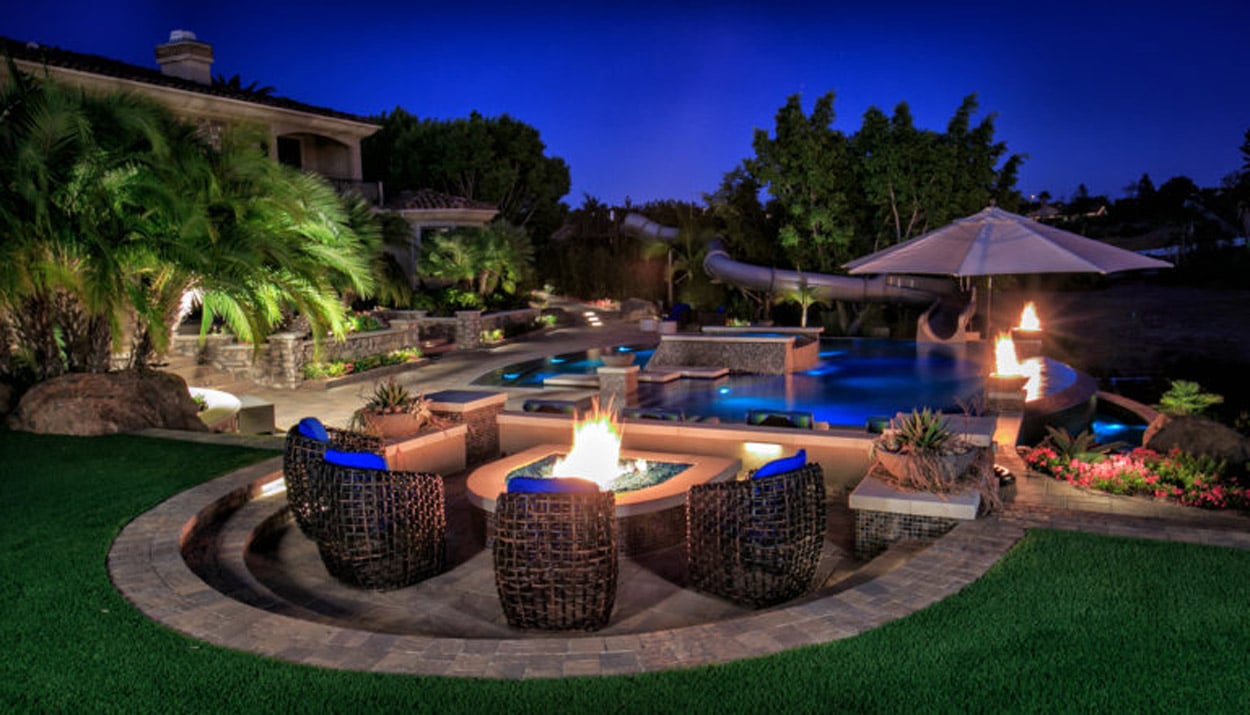
Imagine this, spending the night amidst a sky full of stars accompanied by the perfect atmosphere. These are the most relaxing and intimate moments you will ever have. The glimmering of fireflies and a warm, soft breeze can make your day worthwhile. If you intend to make such moments even more unique, you can additionally construct and position a fire feature.
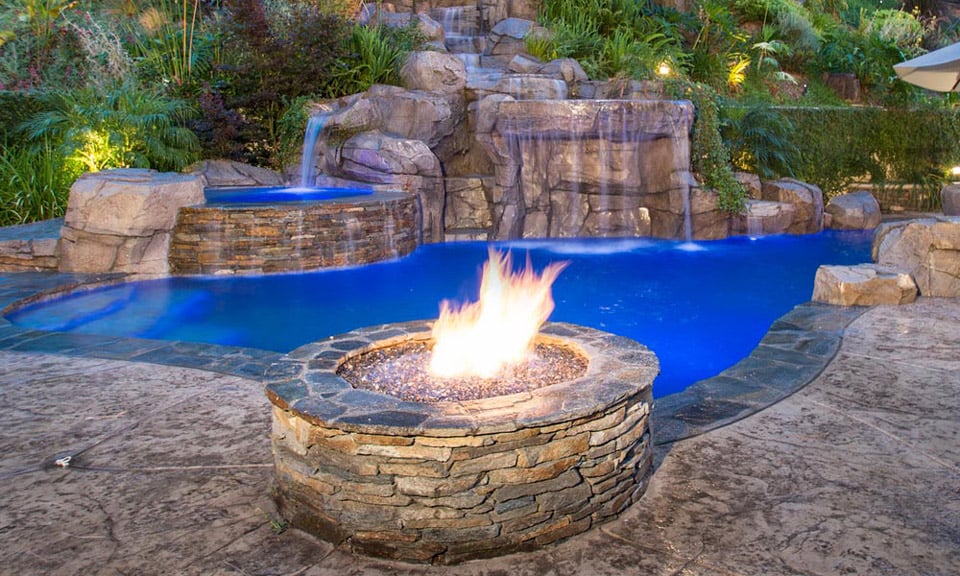
As a pool builder, this means you can anticipate more customers willing to incorporate fireplaces into their outdoor spaces. However, with numerous designs and contemporary style options, one has to be prudent before settling for a particular model. Moreover, different outdoor spaces require different kinds of fire features.
In this article, we will discuss several fire features and how you can implement them well to create a cozy and relaxing environment.

Anchor or accent?
There are a variety of alternatives to choose from if you wish to create a comfortable, enthralling aura to your backyard space. Modern fire bowls, urns, firewalls, and fire tables are the perfect options for limited space.
For pool contractors to choose the appropriate fire feature, they have to comprehend its use. If your primary objective is to make your pool area more attractive, fire bowls or urns are the proper types of fireplaces for you. These features also work well with a Greco- or Tuscan-inspired pool layout that demands an antique design.
The pool area will be even more attractive. Fire bowls and urns can contain tiny outlets, allowing water to flow into the pool, thus creating a sight to behold. Various types of fire features have mobility. You do not have to restrict them to the pool. Consider elements that contain a propane tank; you can position them anywhere compared to those fixed to a gas line.
Customers like the aspect of mobility in fire feature to position it in different places, depending on the nature of the occasion. However, in case you desire to improve the attractiveness of a neglected section in your environment, a fireplace would be a good option.
Fireside talk
While creating a fire feature section, do not forget that the swimming pool remains the center of attention. Please do not make the mistake of creating such a glamorous fireplace that captures the user’s attention compared to the swimming pool. Consequently, pool owners, primarily commercial owners, do not want a fireplace that’s unpleasantly overpowering.

Additionally, a fire table is a fantastic alternative. It’s not overbearing, but it’s attractive enough to offer a relaxing and serene surrounding. Similar to a fireplace, a fire table provides a place where people can sit. They contain a quality outside table with a uniquely designed fire bowl at the center. They are manufactured by glass fiber and supported by concrete.
As a pool builder, it is essential to identify the suitable size for a fire table. Pool owners prefer fire tables with a smaller width due to specific attributes. Low fire tables are more comfortable than high fire tables. You can use a low fire table to relax your feet as you get nearer the source of heat, thus feeling warmer. The disadvantage with a low fire table is it’s limited to contain a propane tank; therefore, requiring you to fix it to a gas line.
Once customers are aware of this disadvantage, they get discouraged about purchasing it. However, improvising is possible. In such a case, I suggest that the low table be a secondary table to a bigger fire table. The tank, regulator, and hose are in the larger fire table and serve as a source of fuel to the lower fire table. In this case, the dining-style fire table will serve as a common eating area. On the other hand, the low fire table would be a relaxation and enjoyment area, mostly after meals. But ensure your customer knows that both types of the table require high positioned sits for the larger table and low positioned seats for resting at the lower fire table.
The shape of a fire table is a crucial factor to consider when constructing fire tables. Square-shaped tables are best for a contemporary, regulated pool. However, a round the fire table is best for an irregular-shaped pool.
Note that all these considerations do not mean that building a fire feature should be expensive. Ready-made units are suitable for any layout a customer prefers. Most clients would rather know what to anticipate from the builder.
Furthermore, several measures should be undertaken when selling fire features that are already manufactured. As a pool builder, ensure you appropriately present them in your saleroom to attract more customers. Ultimately, you can also employ creativity when selling your services to portray a picture of what customers should expect in their backyards.





Every pool builder or contractor has heard it—or said it—at some point:
“But it passed inspection.”
Those words often come up in courtrooms, after a project has gone sideways and litigation is underway. It’s a phrase meant to shift blame, to suggest that because an inspector signed off, everything must have been done correctly. Unfortunately, that’s not how the law works.
Passing inspection does not equal being code-compliant. And when problems arise, it’s the builder or designer, not the inspector, who carries the legal and financial responsibility for non-compliance. Understanding how building standards are adopted, enforced, and referenced is critical for every professional in the pool and spa industry.

Understanding How Standards Become Law
Most contractors know that building codes exist, but fewer understand how those codes are structured. Many of the technical details that govern your work are not printed in the state building code itself. Instead, they’re part of what’s known as “adopted by reference”—external standards that are legally binding even though they aren’t printed word for word in the codebook.
For example, the International Code Council’s International Swimming Pool and Spa Code (ICC-ISPSC) is one of the most widely adopted pool construction standards in the country. Many states have formally adopted the ISPSC by reference through their residential or building code appendices. That means that even though you won’t find every detail of the ISPSC spelled out in the printed state code, it carries the full weight of law.
How “Adopted by Reference” Works
When you look at your state’s residential building code, you’ll often find an appendix titled “Referenced Standards.” This section lists all of the national and international standards the state has chosen to adopt for that code cycle.
Most of the larger, more populous states are on a three-year code revision cycle, staying current with the ICC and IAPMO (International Association of Plumbing and Mechanical Officials) updates. Smaller states tend to move on longer cycles, sometimes adopting every six or nine years.
Instead of reprinting the full ISPSC document, the state code typically includes a short statement that ties the local law directly to that standard.

For example:
•. In the 2015 Texas Residential Code, section 326.1 states: “The design and construction of pools and spas shall comply with the International Swimming Pool and Spa Code.”
•. The 2018 Tennessee Residential Building Code uses nearly identical language in its own section 326.1.
This simple line means that the entire ISPSC—every clause, every diagram, every standard—becomes part of that state’s enforceable building law.

What’s Inside the ISPSC?
When a standard is adopted by reference, you’re bound to comply with all of it. That includes requirements for:
•. Water circulation rates and line velocities
•. Floor contours, slope transitions, and steps
•. Handholds and ladder spacing
•. Anti-entrapment and anti-drowning features
•. Safety barriers, fencing, and alarms
•. Structural load and shell integrity
•. Equipment placement, bonding, and electrical standards
In short, “adopted by reference” brings the entire ISPSC—and all of its subsections—into play for every new pool or spa construction project in that jurisdiction.
When Local Jurisdictions Modify the Code
Local municipalities do have some authority to modify state codes, but they can’t do it informally. To avoid enforcing specific portions of the state building code, a local government must pass a formal resolution listing every section of the state code that they are choosing not to adopt.
This is rare, but it happens. For example, California and Florida both have their own pool-specific codes that go beyond the ISPSC. These state-level codes are considered more stringent than the ICC’s model code, so they don’t need to reference it directly.
However, for the vast majority of states, the ISPSC—or another comparable standard—is part of the law by reference.
Inspectors Are Not the Final Authority
Here’s where many builders get tripped up: local inspectors do not routinely read or study the building codes in full detail.
Most inspectors rely on experience and precedent. It’s not until they review a set of plans that cites a specific code section or standard that they realize a particular provision applies. That’s why a project can “pass inspection” even though it’s not fully compliant with the adopted standards.
In these situations, ignorance of the code is not a defense—for the inspector or the builder. But while inspectors are largely protected by sovereign immunity, meaning they can’t be sued for missing violations, builders and designers are not.
If a defect later leads to injury or property damage, the responsibility lands squarely on the contractor or design professional. Courts have consistently ruled that “passing inspection” does not exempt a builder from liability if the work fails to meet applicable codes and standards.

The Legal and Financial Reality
In personal injury or construction defect litigation, one of the first questions attorneys ask is: “Was the work code-compliant?”
If the answer is no, it doesn’t matter that the project was approved by a local inspector. The standard of care in these cases is what the law requires, not what the inspector accepted.
Builders and designers are legally responsible for:
•. Knowing which codes apply in their jurisdiction
•. Keeping current with code updates and revisions
•. Ensuring that all referenced standards are followed
•. Documenting compliance throughout the project
Failing to do so can expose contractors to claims of negligence, breach of contract, or professional misconduct, even years after the project is complete.
“It Passed Inspection” Is Not a Defense
The concept of sovereign immunity exists to protect public officials, including building inspectors, from lawsuits when they make honest mistakes. That protection does not extend to private builders.
In the eyes of the law, you’re the expert. You’re expected to know the applicable codes and standards. When a violation exists, you can’t rely on an inspector’s oversight as a shield.
Saying, “But it passed inspection,” is equivalent to admitting you didn’t understand your own obligations under the law.
Staying Ahead of the Curve
So, where should builders go to stay informed? The most accessible resource is UpCodes, an online library that provides searchable access to state-specific building codes and referenced standards.
UpCodes makes it easy to:
•. Search your state’s adopted code cycles
•. Review appendices for referenced standards
•. Track amendments or local modifications
•. Stay up to date on pending revisions
It’s also a good practice to maintain a copy of the current ICC-ISPSC or your state’s equivalent pool code in your office or jobsite trailer. Regularly reviewing it with your design and field teams helps prevent costly oversights.
A Builder’s Responsibility
Complying with building codes and referenced standards isn’t about passing inspections—it’s about protecting lives, property, and your professional reputation.
Builders who study their codes, document compliance, and communicate clearly with inspectors and clients show the kind of professionalism that defines true craftsmanship.
Codes aren’t arbitrary red tape; they’re the accumulation of decades of engineering, safety research, and field experience. When you follow them—not just the parts you know, but the full scope of what’s adopted by reference—you’re doing more than meeting legal requirements. You’re building with integrity.
Final Thoughts on the Subject
The next time you hear someone say, “But it passed inspection,” remember this: inspections are a checkpoint, not a certification of compliance. The responsibility—and the liability—always comes back to the builder.
Do your homework, know your state’s adopted standards, and make compliance a cornerstone of every project. It’s not just good business—it’s the law.


New Peel & Stick Sheet Membrane Accessories and Modular Shower Pans Deliver Economical Options for Installation Flexibility
Bethany, CT – LATICRETE, a manufacturer of globally proven construction solutions for the building industry, announces expansions to its HYDRO BAN® Shower System. New peel-and-stick sheet membrane accessories, modular shower pans, and preformed curbs make their debut. The new products are specifically designed to deliver streamlined waterproofing installation options for tile professionals and contractors.
Professional-Grade Peel & Stick Waterproofing Accessories
Seven new HYDRO BAN Peel & Stick Sheet Membrane Accessories are now available, delivering industry-first innovation for mess-free wet area installations. Each features a non-organic adhesive to circumvent the mold and mildew concerns that can arise with organic chemistries in wet areas. The expansion includes sealing tape in three sizes, preformed inside and outside corners, a pipe collar, and nail circle patches. Whether sealing around pipes, corners, or wall seams, the new accessories eliminate the need for additional adhesives or mortars for membrane installation.

“These accessories are designed to make waterproofing as intuitive as possible,” said Dustin Prevete, senior group product manager at LATICRETE. “Both experienced tile setters and those new to waterproofing will find a fast and reliable application delivered through a simple installation method: just peel, stick, and seal.”
The peel-and-stick format ensures consistent adhesion and flexibility that minimizes user error. When used in conjunction with other vapor resistant waterproofing solutions, they are an ideal choice for steam rooms, steam showers, bathrooms, and other high-humidity environments.
Modular, Pre-Waterproofed Pans for Efficient Shower Installations
The new HYDRO BAN Modular Pre-Sloped Shower Pan and HYDRO BAN Preformed Curbare compatible products engineered to significantly reduce shower installation time and complexity. The pans, available in seven common sizes with both center and off-center train options, feature a pre-applied waterproof coating and ship in a flat-packed, multi-piece format for flexible jobsite handling and field customization. They offer a more economical solution than the one-piece pan, allowing for additional design possibilities and less shipping and storage hassle. The new flat-edge curb is available in 24″, 48″, and 72″ lengths for enhanced compatibility and installation versatility.
“These are the only pre-waterproofed, modular, multi-piece shower pans available on the market today,” added Prevete. “They meet the growing demand for prefabricated shower pans that are easier to install, store, and ship, all while providing compatibility and warranty.”
The new modular pans and compatible flat-edge curbs offer a simplified alternative to custom pre-sloped units, offering an easier dry fit, and allowing contractors to adjust sizing on-site using built-in grid lines. These new products are fully compatible with the HYDRO BAN Shower System, allowing for cohesive, code-compliant installations.

System-Driven Simplicity, Proven Performance
The launch of both products represents the latest innovations from LATICRETE, the most trusted name in the industry. They echo the brand’s ongoing commitment to purpose-driven innovation, offering trusted waterproofing solutions that adapt to the needs of today’s jobsite. The HYDRO BAN line expansion in particular lets users select the premier solutions for a complete shower installation that align with their specific installation preferences.
All components comply with ANSI A118.10 standards and are fully compatible with the HYDRO BAN Shower System. When used together, these high-performance products also maintain the industry-leading LATICRETE system warranty, all while saving time and reducing labor.
For more information on the HYDRO BAN Shower System and its latest additions, visit www.laticrete.com/newproducts.


When the financial crisis of 2008 threatened to strain River Pools, Marcus Sheridan made a decision that not only saved his business but also reshaped how an entire industry thinks about marketing. Today, Sheridan is recognized as one of the foremost voices in digital sales and marketing strategy, a sought-after keynote speaker, and the author of They Ask, You Answer—a book that has become required reading for business owners looking to thrive in the digital age.
Sheridan co-founded River Pools in 2001 with two partners, starting with modest ambitions and a broad focus that included above-ground pools, hot tubs, and a retail store. Things were steady, but when the recession hit, the future of the company looked bleak.
“It looked like we needed to file bankruptcy,” he recalled. “It was during this time though, that I really started to just learn more about the way the digital buyer was evolving.”
The Strategy That Changed Everything
Instead of retreating, Sheridan dove into inbound marketing, drawing from resources like HubSpot, and quickly realized the path forward was through answering every single question potential buyers had ever asked.
“We said, ‘We’re gonna become like the Wikipedia of fiberglass pools. If anybody has a question, good, bad, or ugly, we’re gonna address it. We’re gonna own it with text and with video. We’re just gonna go full send on this.’”
That approach transformed River Pools into the most visited swimming pool website in the world. One of the most impactful moments came when he addressed the question most pool companies avoided: pricing.
“This is literally the first question everybody wants to know,” he said. “We were the first pool company in the world to address how much an in-ground pool costs on our website.”
That one article, written in 45 minutes at his kitchen table, has generated over $35 million in revenue.

Why the Industry Still Resists
Even with proof in hand, many contractors still avoid talking about pricing. Sheridan says it comes down to three myths: every job is different, competitors will use it against them, and customers will be scared off by the cost.
“Just doing that [explaining cost variables] induces a ton of trust,” he said. “And if your competitors don’t already know your pricing, they’re asleep at the wheel.” But perhaps the most critical insight is this: “What we know scares people away is when they can’t find any information on pricing.”
Creating Tools for the Modern Buyer
Today’s buyer doesn’t want to speak to a salesperson until they’re ready. Sheridan calls them the “self-service buyer,” and he built PriceGuide.ai to address their expectations.
He shared a case study from AE Pools & Landscape, which added a pricing estimator to its website in early 2024. “Last year they got 400 leads for the entire year. This year, they’ve gotten 1,200 leads so far. They closed 300 sales and have $5 million in the pipeline.”
That $200 tool, he said, took the company from $3 million to a projected $10 million in one year.

Where AI Is Taking Us Next
Sheridan believes AI will soon be a standard part of how consumers shop for contractors. “Homeowners are going to tell their AI assistant, ‘We want a swimming pool. Research the local companies, give us estimates, and tell us who you’d choose and why.’”
And the contractors who don’t have price estimators? “You don’t get the recommendation.”
He’s confident in his prediction: “Within five years, 90% of all swimming pool companies will have a pricing estimator on their website. Mark my words.”
Missed Opportunities in Video
Asked about the most common marketing mistake contractors make, Sheridan didn’t hesitate: “Video, lack of. It’s not close.”
He believes YouTube may soon be more important than a company website. One-to-one video, project documentation, and consistent short-form content all help create trust.
“The first time the homeowner sees the salesperson’s face shouldn’t be when they walk up the driveway. Shame on you if that’s the case.”
He emphasized the need to document every job. “We’re one of the most visual products in the world. If you’re not taking video of every job—before and afters, showing the process—you’re missing the boat.”
Why You Should Talk About the Competition
Sheridan doesn’t shy away from comparison content, even if it means steering a prospect toward a different product or competitor.
“If somebody asks, ‘Are there other pool builders you’d recommend?’—am I gonna ignore it? No, because they’re not ignoring it.”
River Pools even built a quiz tool that sometimes recommends vinyl or concrete—though they only sell fiberglass. “Why would we do that? Because that’s what buyers want. And I generate way more leads because of it.”
Becoming a Trusted Brand
In Sheridan’s view, being known and trusted isn’t optional—it’s survival. “The most important thing you can do for long-term success is build a known and trusted brand in your market. If you’re not known, and if you’re not trusted, you will fail.”
He urges contractors to stop outsourcing everything and start participating directly in brand-building.
“Stop waiting for somebody else to build your brand. You gotta have a dog in the fight. You gotta be the one to hit record often.”
Looking back, Sheridan says the tactics he used in 2009 wouldn’t be enough today. Text-based blog posts and a few YouTube videos were groundbreaking then, but social media, short-form video, and AI tools are now essential.
“You can’t just answer your customer questions on your website and think that will be enough. It’s not. You’re gonna have to do more than that. If you wanna scale to big numbers, you’ve gotta think more like a media company.”
But even as the tools evolve, the philosophy stays the same: meet buyers where they are.
“Everything your buyer wants—those are the same things you want. You wanna watch video when you’re researching? Meet the consumer where they are. It doesn’t matter if you think you have a face for video or not. You’re still gonna ask them for money, so you better hope they trust you.”
For Sheridan, the future belongs to pool companies that embrace that mindset. “You’re not just a construction company. You’re a sales and marketing company. If you’re not known and trusted, you won’t last. But if you lean into what your buyers really want, you’ll be amazed at how much your business can grow.”
Ready to take a deeper dive?
Listen to our entire conversation with Marcus Sheridan on the Pool Magazine Podcast.
Read the Summer Issue of Pool Magazine

See more of our coverage in your search results
 Sponsored Advertisement
 Soake Pools Bolsters National Growth With Four Key Hires
 Hayward Holdings Names New Chief Accounting Officer
 Daldorado Names Marcia Gyles Director of Sales
 Landmark Aquatic Brings Poolside Adventures Attractions Nationwide
 Shasta Pools Hires 30-Year Builder to Head Residential Construction
 Watershape University Announces Fall 2026 Session in San Diego
 NTCA Welcomes Jennifer Ibe and Rachel Smith to the Team

 Fluidra Predicts 6% Growth in Coming Years
 Aiper Debuts Smart Solar Robotic Pool Surface Skimmer
 PHTA Announces Newest Strategic Partner: LYON FINANCIAL
 Leslie’s, Inc. Names Jeff White As New CFO And Treasurer
 Backyard Pool: Opening for Business
 Poolwerx Eyes San Antonio for Continued Texas Expansion
 Measures to Perfect Pool Pad Effectiveness
Sponsored Advertisement


 Pool News3 weeks ago
Leslie’s Reportedly Prepares for Chapter 11 Bankruptcy as Possible Nasdaq Delisting Looms

 Pool News2 weeks ago
Leslie’s Files Chapter 11, Lenders Set to Take Control in Major Restructuring

 Features2 weeks ago
A New Era at POOLCORP: John Watwood Focuses on Customers and the Fundamentals

 Pool Equipment2 weeks ago
AquaLink® EDGE™ and trackr iO Signal a New Direction for Pool Automation

 Pool Equipment4 weeks ago
Hayward Issues Recall for Universal Pool Heaters Over Carbon Monoxide Risk

 Press Releases4 weeks ago
Soake Pools Launches Dual Pool Packages

 Press Releases3 weeks ago
FSPA and PHTA Reunite Through Historic Affiliation

 Press Releases4 weeks ago
Automatic Pool Covers Expands National Sales Team
You must be logged in to post a comment Login