





Pools
What Makes an Olympic Pool… Olympic?


Ever wondered what sets an Olympic swimming pool apart from your standard backyard pool? It’s not just about the size—though they are impressively large. When it comes to competitive swimming, not all pools are created equal. What makes an Olympic pool truly “Olympic” is its adherence to strict standards set by the International Swimming Federation (FINA). To be classified as an Olympic pool, a facility must meet stringent specifications and requirements to ensure a consistent and fair competition environment for all athletes.
How Are Olympic Swimming Pool Different From Other Types of Pools?
An Olympic pool stands out from other types of pools due to several key features and standards designed to ensure a high level of competition and fairness. Here’s a detailed look at what separates an Olympic pool from the rest:
Precision in Construction
Olympic pools are constructed to exact specifications, with precise measurements required for length, width, and depth. An Olympic pool must be exactly 50 meters in length and 25 meters in width, with a minimum depth of 2 meters, though many are deeper. This precision ensures uniform conditions for all swimmers and a standardized environment for international competitions.

Advanced Wave Reduction
To minimize wave interference and provide a consistent swimming experience, Olympic pools incorporate advanced wave reduction technologies. This includes features such as deeper pool depths, wave-dampening lane lines, and sophisticated overflow gutter systems. These elements work together to reduce turbulence and provide a smoother, more predictable swimming surface.
State-of-the-Art Starting Blocks
Olympic pools are equipped with high-tech starting blocks designed to enhance swimmers’ performance. These starting blocks have adjustable settings to accommodate different athletes’ preferences and are engineered to provide maximum grip and stability during the start of a race.
Standardized Environmental Conditions
Maintaining optimal conditions is crucial for performance, and Olympic pools are designed to meet stringent environmental standards. The water temperature is regulated to stay between 25°C and 28°C (77°F to 82.4°F), and the pool must be kept chemically balanced and free from contaminants. Lighting in Olympic pools is also carefully managed to ensure clear visibility for both swimmers and spectators, and to provide accurate television broadcasts.
Electronic Timing Systems
Olympic pools are equipped with sophisticated electronic timing systems, including touchpads at both ends of the pool. This technology ensures precise timing of each race, with minimal chance for error. These systems are crucial for recording split times and final results with high accuracy.
Uniformity Across Venues
One of the key features of Olympic pools is their uniformity. Each pool used in the Olympics adheres to the same set of regulations and standards, ensuring that every competition is held under identical conditions. This consistency helps to maintain fairness and allows swimmers to compete on a level playing field.

| Feature | Requirement |
|---|---|
| Length | 50 meters |
| Width | 25 meters |
| Depth | Minimum 2 meters (commonly 3 meters) |
| Number of Lanes | 10 lanes |
| Lane Width | 2.5 meters |
| Water Temperature | 25°C – 28°C (77°F – 82.4°F) |
| Timing System | Electronic with touchpads |
| Water Volume | Approximately 660,000 gallons |
| Lighting | Sufficient for visibility in all conditions |
| Water Quality | Clear, chemically balanced, free of contaminants |

Early History and the Birth of Competitive Swimming
The history of swimming in the Olympics dates back to the first modern Olympic Games in 1896 in Athens, Greece, where swimming was one of the original nine sports. The events were held in open water, specifically the Bay of Zea, with competitors swimming freestyle and breaststroke races. The introduction of purpose-built pools for the Olympics came in 1908 during the London Games. This marked a significant shift towards standardized competition environments, laying the foundation for the highly regulated Olympic pools we see today.
Development of Standardized Pools
1908 London Olympics: The first Olympics to feature a pool. A 100-meter long pool was built within the athletics track at White City Stadium.
1924 Paris Olympics: The swimming events were held in an Olympic pool built to more modern standards, a 50-meter pool with marked lanes.
Standardization and Technological Advances
1956 Melbourne Olympics: Introduction of underwater viewing windows for officials to judge swimmers’ strokes more accurately.
1960 Rome Olympics: The first Olympics to use electronic timing, ensuring precise measurement of swimmers’ performance.
1972 Munich Olympics: The introduction of anti-wave lane lines, which helped reduce water turbulence and improve swimmer performance.
Modern Era Pools
2000 Sydney Olympics: The Sydney International Aquatic Centre featured advanced filtration and heating systems, maintaining ideal water conditions.
2008 Beijing Olympics: The iconic Water Cube (National Aquatics Center) featured a state-of-the-art design with the use of ETFE (ethylene tetrafluoroethylene) to create a lightweight, translucent structure that improved natural lighting.
2012 London Olympics: The London Aquatics Centre, designed by Zaha Hadid, became known for its striking architecture and innovative design.

10 Notable Facts About Olympic Swimming Pools
- World Records: Olympic pools are the only pools where official world records are recognized. These records are meticulously tracked and often set under the most stringent conditions.
- High-Tech Filtration: To maintain crystal-clear water, Olympic pools use some of the most advanced filtration systems, which can process the entire pool’s volume multiple times a day.
- Lane Markings: The lane markings in Olympic pools are designed to be highly visible and to minimize water resistance. Each lane has a colored line that helps swimmers stay in their designated lanes.
- Depth for Diving: The minimum depth of 2 meters (6.6 feet) in Olympic pools is specifically designed to ensure safety for diving starts and to prevent injury during high-speed entries.
- Adjustable Starting Blocks: Starting blocks in Olympic pools are equipped with adjustable features to accommodate swimmers of different heights and to ensure a consistent start for all competitors.
- Water Quality: The water in Olympic pools is tested frequently for quality and chlorine levels to ensure it meets strict standards set by the International Swimming Federation (FINA).
- In-Pool Cameras: Some Olympic pools are equipped with underwater cameras that provide live feeds and detailed views of swimmers’ techniques, which can be used for judging and training purposes.
- Temperature Control: The temperature of the water is carefully regulated to stay between 25°C and 28°C (77°F to 82°F), optimizing conditions for athletes and helping to prevent muscle cramps.
- Floating Lane Dividers: The lane dividers are designed to float on the surface of the water and are made from materials that reduce wave turbulence, allowing for smoother and faster swimming.
- Changing Designs: Each Olympic Games features a unique pool design that often incorporates local cultural or architectural elements, making each pool a distinct landmark of the host city.

The 2024 Olympic Games in Paris
The 2024 Olympic Games, scheduled from July 26 to August 11 in Paris, will feature state-of-the-art aquatic facilities. The centerpiece of swimming events will be the newly constructed Paris Aquatics Centre, designed to meet and exceed FINA standards. This modern venue will host a range of swimming competitions, including freestyle, backstroke, breaststroke, butterfly, and medley events.
The Paris Aquatics Centre is not only designed for optimal performance but also for sustainability, incorporating eco-friendly technologies to minimize its environmental footprint. With an expected attendance of thousands of spectators and millions of global viewers, the 2024 Olympic swimming competitions are set to be a highlight of the Games, showcasing the world’s best swimmers in a premier, purpose-built facility.
We hope this article has shed light on the meticulous details and high standards that define an Olympic pool, offering you a deeper appreciation for the precision and technology behind these world-class facilities. As the excitement builds for the 2024 Summer Olympics in Paris, we trust that you’ll enjoy witnessing these remarkable pools in action and celebrate the incredible feats of athletes competing in them. Here’s to a thrilling and memorable Olympic experience—may the Games inspire and entertain as they showcase the pinnacle of aquatic sports!
Featured Photo Credit: @HereNow


BREVARD COUNTY, FL — For swimming pool builders along Florida’s Space Coast, Monday, November 2, was anything but business as usual. An extraordinary rainfall event inundated portions of Brevard County, flooding neighborhoods, closing roads and turning active swimming pool construction sites into muddy reservoirs.
According to The Washington Post, portions of Florida’s Space Coast received as much as 28 inches of rain in approximately 36 hours, equivalent to nearly half the region’s typical annual rainfall. The relentless downpours overwhelmed drainage systems, flooded residential neighborhoods and brought construction activity to a standstill.
In some of the hardest-hit communities, nearly two feet of rain fell as a slow-moving weather system repeatedly delivered heavy downpours across the region. The National Weather Service characterized rainfall in portions of southern Brevard County as a 1-in-1,000-year event, a statistical designation indicating a 0.1% probability of rainfall of that magnitude occurring in any given year.
By Tuesday, November 3, the storm had claimed at least two lives. Joshua Bennett, 34, was found dead in his truck in a flooded area of southeastern Palm Bay, while Archie Richards, 78, was discovered inside his Toyota Tacoma in a canal near his home in Malabar. Emergency crews rescued hundreds of people as rising water inundated residential neighborhoods and left vehicles stranded.
Preliminary rainfall reports showed 23.69 inches in Grant-Valkaria, 23.44 inches in Malabar and 19.75 inches in Palm Bay. The extraordinary rainfall overwhelmed drainage systems, flooded homes and brought construction activity to a standstill in affected neighborhoods.
For Jeff Jones, owner and builder at Spacefront Pool & Spa, the storm struck directly at the communities he serves. Several of his active construction projects were caught in the flooding.

From Active Construction Sites to Underwater Excavations
Before the storm, Jones’s crews had been progressing through the normal stages of swimming pool construction. Excavations had been completed, plumbing installed and, at some locations, steel reinforcement and forming were already underway.
“Today was one of those days that reminds you just how unpredictable the construction industry can be, especially here on Florida’s Space Coast,” Jones said. “Today we had multiple swimming pool construction sites flood, freshly excavated pools filling with water and surrounding soil washing back into the pools.”
For a pool builder, an open excavation represents considerably more than a hole in the ground. By the time plumbing, rebar, and forms are installed, crews have already invested substantial labor and materials into preparing the site for the next phase of construction.
Flooding at this stage can undo days of work and leave contractors facing costly repairs. But before Jones could begin assessing the damage, there were more immediate concerns.

A Builder’s First Priority: Safety
“Even with roads closed due to flooding, I made it out to our job sites to assess the situation and address immediate hazards,” Jones said. “One of my biggest concerns was the electrical equipment associated with our pumps.”
With floodwaters rising, he worked to disconnect electrical power safely and remove pumps where conditions allowed.
“Some of my pumps were a foot below water.”
The danger wasn’t limited to electrical equipment. Submerged excavations concealed steel reinforcement, unstable soil and other hazards that could pose serious risks to anyone attempting to recover materials or equipment.
Jones understood there was a point where the effort to protect a construction site just had to stop.
“You can rebuild a swimming pool. You can’t replace someone’s life.”
But the damage to his construction sites wasn’t the only thing weighing on Jones.
“What made this situation even more devastating was that some of our customers’ homes were flooding as well,” Jones said.
“As a business owner, your first instinct is to protect your work and your investment. But you quickly realize there’s a much bigger picture.”
The flooding had turned what began as a construction emergency into something far more personal, with Jones balancing the responsibility of protecting his business against the immediate needs of the families he serves.

Weeks of Recovery Ahead
With the immediate danger beginning to subside, Jones faces the difficult task of assessing what can be salvaged from his flooded construction sites.
The damage to an unfinished swimming pool can extend well beyond the water visible in an excavation. Heavy runoff carries soil, sand, and debris into the work area, potentially compromising excavation walls, displacing forms, and undermining surrounding ground. Plumbing and steel may also require inspection or repair before construction can resume.
Some projects may need little more than pumping and cleanup. Others could require extensive excavation repairs, re-forming and additional inspections. Saturated soil and elevated groundwater levels can further complicate recovery, making it necessary to evaluate site conditions before removing accumulated water.
“This is going to set us back weeks,” Jones said.
The setbacks come with additional labor costs, equipment expenses and the challenge of coordinating crews and subcontractors around work that must now be repeated. For a pool builder managing several projects at different stages of construction, those disruptions can ripple through the entire schedule.
Florida contractors are accustomed to dealing with unpredictable weather, but the magnitude of this event illustrates how even experienced builders can find themselves facing circumstances beyond their control.
Jones has spent years working in an industry where weather is an unavoidable part of the business. His experience has taught him the importance of job-site drainage, protecting equipment and preparing crews to respond when conditions improve. Yet even those precautions have their limits.
“Preparation is everything, but even the best preparation can’t prevent Florida from being Florida on a random Monday in November.”
For now, the work ahead involves assessing the damage, restoring affected construction sites, and getting projects moving again. The financial consequences have yet to be fully determined, but the delays are already a certainty.
As Jones put it, “Mother Nature doesn’t care about your construction schedule.”
Photographs courtesy of Jeff Jones, Spacefront Pool & Spa.


Artificial rock waterfalls, grottoes, and slides can be some of the most impressive features in a backyard swimming pool. Properly designed and constructed, they can support thousands of pounds of concrete while creating spaces meant to be climbed, walked across and enjoyed for years.
But when the structure hidden beneath that concrete is built incorrectly, the consequences can be far more serious than a few cosmetic cracks.
That became startlingly clear when Jason Lewis of Rockworks Inc. was called to inspect an artificial rock water feature at a home in Arizona. The homeowner had initially contacted Lewis after noticing deterioration in the structure. Lewis warned him that the feature appeared to be approaching failure, but other work was being done around the property and repairs were postponed.
Then the homeowner called again.
“My son fell through the top of it,” the homeowner told Lewis.
Fortunately, the child wasn’t seriously injured. The incident, and the videos Lewis subsequently shared showing what was happening inside the structure, attracted hundreds of thousands of views online.
What viewers saw was alarming. Reinforcing steel that should have been supporting thousands of pounds of concrete had deteriorated so badly that pieces of rebar could be broken apart by hand.
“That was only six years old,” Lewis said. “We opened it up, and he reached his hand in there and just started knocking number three-inch rebar into dust.”
For Lewis, who has spent more than three decades building real and artificial rock features, the failure itself wasn’t particularly unusual. Today, he estimates approximately 70% of his work involves structural repairs, demolition, or rebuilding existing features rather than new construction.
What concerned him was how quickly this particular structure had deteriorated—and how little indication homeowners may have of what’s happening underneath the surface.
How a Pool Feature Can Rot From the Inside Out
The fundamental problem Lewis encounters repeatedly is improperly protected reinforcing steel.
Artificial rock structures rely on steel reinforcement to carry and distribute the tremendous weight of their concrete shells. That steel isn’t supposed to simply sit inside an open cavity. It needs to be properly positioned and encased in concrete.
“The steel has to be encased in concrete, or there’s no long-term structural integrity,” Lewis explained. “I’m not saying anybody’s doing this on purpose, but if you don’t know, you don’t know.”
When rebar remains exposed inside a hollow artificial rock feature, moisture can reach it. Small cracks in the concrete make the situation worse.
“These things do crack. The earth moves, you get hairline cracks,” Lewis said. “You build up some moisture inside there, and you add a lot of water to that if it does crack, and that rust takes off like cancer.”
As steel corrodes, it expands and flakes apart. Eventually, the reinforcement that was intended to support the concrete can effectively disappear.
“They’re holding up thousands of pounds of concrete,” Lewis said. “So when that steel is gone, the concrete just falls in on itself.”
Continuous operation of waterfalls can also contribute to the problem when moisture finds a path into the structure. Lewis advises homeowners to operate these features when they want to enjoy them rather than automatically running them for long periods every day.
“No matter how much you seal it, it’s a big giant concrete sponge,” he said.
On one recent inspection, Lewis drilled two holes into the bottom of an artificial rock feature and estimated that roughly five gallons of trapped water drained out.
Warning Signs Homeowners Shouldn’t Ignore
The difficulty is that an artificial rock feature can still look relatively normal from across the pool while significant deterioration is occurring internally.
Lewis said slides are among the features where he most frequently sees structural problems.
Ordinary hairline cracking doesn’t necessarily mean a structure is about to collapse. Concrete moves, and minor cracking can occur. The warning becomes more serious when those cracks begin separating or when adjoining surfaces move onto different planes.
“When you see those cracks heave, like split and become on two different planes,” Lewis said, “that’s a huge indication that you have a structural problem.”
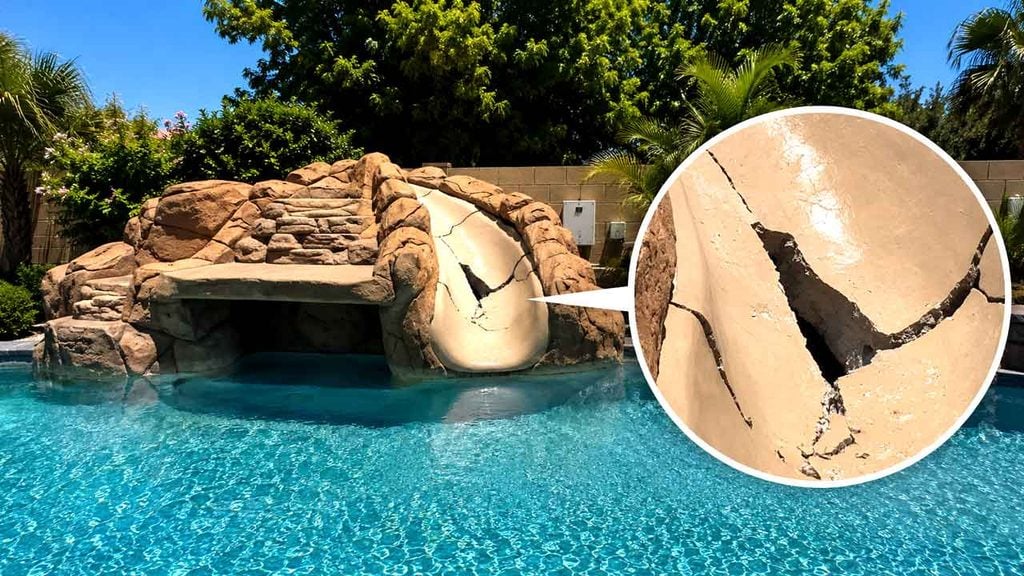
On artificial rock slides, homeowners should pay particular attention to the areas where the slide trough meets the surrounding rockwork. Lewis frequently sees consistent cracking develop along the inside and outside radiuses as the underlying reinforcement begins deteriorating.
In severe cases, gaps may become obvious, stairs may begin separating, or pieces of concrete may loosen or fall away.
His advice to homeowners is straightforward.
“Use your common sense. If it looks dangerous, it’s dangerous. It’s not perfect one day, and then it just falls apart. You can see the degradation over time.”
If cracking begins changing noticeably, sections are separating, concrete is falling away, or a step or walking surface feels compromised, the feature shouldn’t continue being used while everyone waits to see what happens next.
“Let’s stay off this. Let’s just be careful. Let’s call somebody to come and look at it,” Lewis said.
The challenge is that even an experienced contractor may not be able to determine the full condition of the reinforcement from the exterior.
“I don’t know until I open it up,” Lewis said.
On some inspections, Rockworks creates access openings specifically to examine the structure from inside. In one case, stairs had already failed, yet the adjoining slide still appeared remarkably sound. Once the structure was opened, Lewis discovered virtually none of the original reinforcing steel remained.
When a Repair Isn’t Really a Repair
Not every crack requires demolition. Rockworks routinely repairs and refinishes artificial rock features when the underlying structure remains viable.
The distinction is whether the problem is cosmetic or structural.
“When the slide is heaving, when you have chunks of concrete falling off, and you can look inside and there’s not a stitch of steel left, it needs to be torn down,” Lewis said.
That can leave homeowners facing a difficult financial decision. Some choose to remove the unsafe feature and replace it with simpler rockwork rather than reconstructing the original waterfall or slide. Others elect to demolish everything and build a new feature correctly.
What Lewis won’t do is disguise a known structural failure with a cosmetic repair.
He learned how problematic that can become through a project several years ago. Lewis inspected a slide where part of the surrounding rockwork had settled approximately three inches away from the trough. He advised that patching it wouldn’t solve the structural problem.
The homeowner nevertheless wanted it cosmetically repaired for the summer and signed a waiver acknowledging the repair wasn’t structural.
When the feature subsequently failed, the entire matter went before the Arizona Registrar of Contractors. According to Lewis, the pool company he was subcontracted to was ultimately required to correct the problem despite the homeowner’s waiver.
“You guys as contractors should know better,” Lewis recalled the ROC telling the pool builder. “You can’t be fixing things that you know are gonna fail, then ask the homeowner to take the responsibility.”
The experience changed the way Lewis approaches compromised structures.
“You couldn’t give me $100,000 to patch a job that I know it was gonna fall apart in six weeks,” he said. “It’s not ethical to do, and you’re still liable for it. I don’t want anybody getting hurt.”
What Proper Construction Looks Like
Avoiding those failures starts long before anyone applies the final texture and color that make concrete resemble natural stone.
It starts with engineering.
Rockworks spaces material behind the reinforcing steel so concrete can completely surround the structural rebar when gunite or shotcrete is applied. Lewis compares the concept to constructing a swimming pool shell, where reinforcing steel is elevated from the soil rather than lying directly against it.
“We make sure we encase all the structural rebar, so it has the strength that the engineering requires to hold up the load,” Lewis said.
On a recent San Tan Valley project, Rockworks used approximately 34 yards of shotcrete before the finish coat was applied. The grotto incorporated No. 4 rebar in a double mat, with the structure formed, poured and vibrated in an effort to ensure the reinforcement was completely encased.
The additional effort isn’t always obvious once the project is finished. In fact, that’s part of the problem when homeowners or even pool builders compare bids. Two completed artificial rock structures can look similar while being constructed very differently underneath.
Lewis said proper construction can require several additional days of labor compared with competing approaches.
“A lot of builders, again, people don’t know what they don’t know,” he said. “The price point ends up being more important than the structure itself because they don’t know if it’s being done incorrectly.”
For pool builders vetting a rockwork contractor, Lewis recommends asking specifically how the structure will be built, whether engineering requirements will be followed and how the reinforcing steel will be protected. He also photographs his projects during construction so there is a record of what’s behind the finished surface.
One project demonstrates what can happen when that attention to structure is combined with collaboration and ambitious design.
Working alongside Arizona pool builder Premier Paradise, Rockworks helped create an elaborate backyard featuring a perimeter-overflow pool, grotto, slide, jumping area and extensive artificial rockwork.

“The most important thing is we followed the engineering and built it correctly,” Lewis said.
The grotto lid was supported by engineered columns and heavily reinforced before the surrounding rockwork was constructed.
“The amount of steel and concrete they put in that lid, that thing is a helicopter landing pad on steroids,” Lewis said. “So he poured it, vibrated it, and then I came in and built my rock work around it and then did the texture coat. So it definitely was a collaboration between the two of us.”
Several years later, the feature continues to perform as intended.
“The homeowners are happy. To this day they don’t have any problems with it,” Lewis said.
That contrast—between a feature still being enjoyed years later and another only six years old with reinforcement crumbling into dust—illustrates why what’s underneath artificial rock matters as much as what homeowners see from the pool deck.
Waterfalls, grottoes and slides aren’t merely decorative sculptures. They’re engineered structures supporting substantial loads, often in environments where people climb, jump, sit and play.
For homeowners who already have one, visible deterioration shouldn’t be dismissed as simply an aging finish. Cracks that are widening or heaving, separating sections, failing stairs and loose concrete all warrant closer inspection.
For homeowners considering a new feature, the questions asked before construction ever even begins may prove even more important.
Ready to take a deeper dive?
Listen to our entire conversation with Jason Lewis of Rockworks Incorporated on the Pool Magazine Podcast.
There is a point in luxury pool design where the materials stop functioning merely as finishes and begin defining the character of the space.
For Frank Vitori, co-founder of AquaBlu Mosaics and designer of the new Sand Pearl Series, the opportunity was to rethink some of the patterns currently influencing pool and architectural design without relying on the contrasting colors traditionally used to create them.
When Pool Magazine spoke with Vitori about the collection, he explained that the idea behind Sand Pearl began with a deceptively simple question: What if the pattern could be created by light instead of color?

“The concept behind Sand Pearl was to take patterns we’re seeing throughout contemporary design—checkerboards, stripes and offset stripes—and reinterpret them through finish and light,” Vitori explained. “Instead of using contrasting colors to define the pattern, we’re using the same color in matte and iridescent glass. As the light changes, the pattern reveals itself.”
That distinction is central to understanding Sand Pearl, the latest AquaBlu Signature Collection from AquaBlu Mosaics.
Rather than simply assembling existing tile into a new assortment, AquaBlu developed Sand Pearl as an original, coordinated design collection. Each colorway brings together monochromatic glass, complementary finishes, contemporary patterns, coordinating field tile and curated grout selections to create a complete material system for pools and architectural spaces.
It is a concept rooted in what Vitori describes as a quieter approach to luxury.
“Luxury doesn’t always need to announce itself,” Vitori said. “Sometimes it’s the detail you notice as you move through a space—the way a surface changes in the light or the way water completely transforms the material.”


Reinventing Pattern Through Light
Pattern is hardly new to tile.
Checkerboards, stripes and running patterns have appeared in architecture and interior design for generations. What has changed is how designers are using them.
As contemporary tile trends move toward more intentional patterns and sophisticated material combinations, Sand Pearl approaches those familiar geometries from a different direction.
The collection does not need a dark tile beside a light tile to create a checkerboard. It does not require two opposing colors to make a stripe visible.
Instead, matte and iridescent versions of the same color work together to create the pattern.
From certain angles, the distinction can appear subtle. Then sunlight moves across the installation, the viewing angle changes or water begins flowing over the surface, and individual sections of iridescent glass catch the light differently from their matte counterparts.
Suddenly, the pattern becomes more pronounced.
The effect allows a surface to remain monochromatic while still having considerable visual depth and movement. Rather than placing the emphasis on color contrast, Sand Pearl uses reflection itself as a design element.
That becomes particularly compelling in a swimming pool, where very little about the visual environment remains static.
Sunlight changes position throughout the day. Ripples continuously alter reflections. Water depth influences perceived color. Landscaping, coping, interior finishes and surrounding architecture all contribute additional tones and reflected light.
Sand Pearl was designed to interact with those variables rather than compete with them.
The collection draws its palette from sun-bleached beaches, shallow coastal water, sea glass and other subdued coastal tones, but the coastal influence provides the backdrop rather than defining the entire concept.
The real story is what happens when pattern, finish, and changing light intersect.
Contemporary Patterns, Reinterpreted
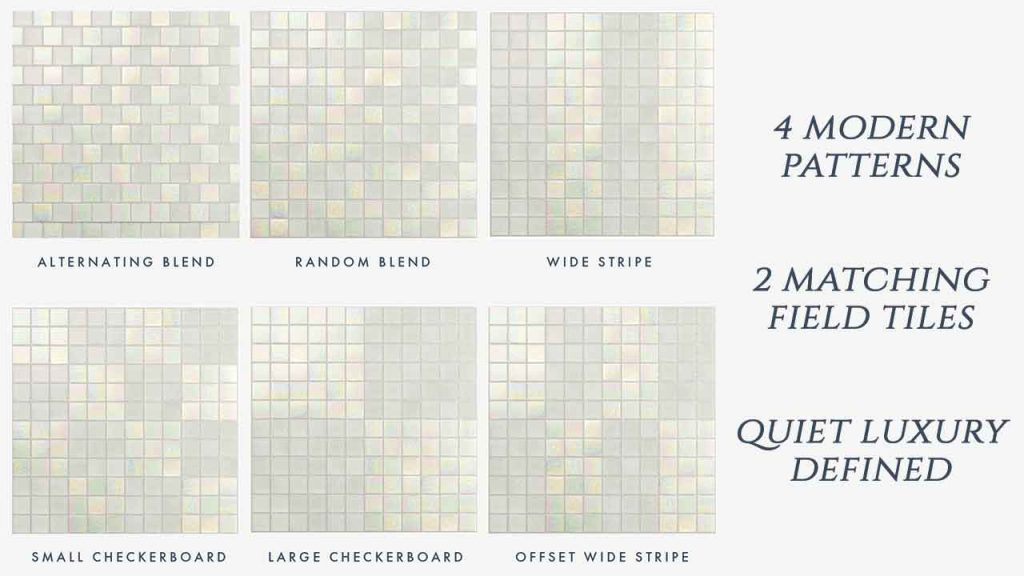
Sand Pearl takes several of today’s most recognizable tile patterns and reconstructs them using matte and iridescent finishes.
The checkerboard pattern provides perhaps the clearest demonstration of the concept. Instead of alternating contrasting colors, the pattern alternates finishes within the same color family. The checkerboard may appear subdued under one lighting condition and considerably more pronounced under another.
The striped pattern applies the same principle in a more linear composition, creating alternating bands of matte and reflective glass. It can introduce direction and rhythm across a waterline, raised spa, feature wall or other architectural surface without introducing another color into the palette.
The offset stripe pattern adds another level of movement by shifting that linear geometry, creating a more dynamic arrangement while retaining the collection’s monochromatic character.
These patterns are complemented by two coordinating field-tile formats: stacked and staggered.
That addition gives designers considerably more flexibility when specifying the collection across an entire project.
A checkerboard, stripe or offset stripe might be used to establish a focal point on a raised spa, water feature or architectural wall, while the coordinating stacked or staggered field tile can finish the surrounding space in the same color and material language.
Alternatively, the field tile can be carried across a larger surface where a quieter treatment is desired.
The result is not simply a selection of individual mosaics. It is a coordinated collection that allows designers to change pattern and visual intensity while maintaining continuity of color and material.

Six Coastal-Inspired Colorways
Sand Pearl is offered in six primary colorways—Marelle, Caspia, Brisa, Calista, Marea and Aurelia—ranging from luminous whites and soft sand tones to aqua, sea-glass greens and deeper coastal blues and grays.
Caspia provides one of the collection’s lightest treatments with a pearlescent white appearance suited to bright contemporary environments. Brisa moves toward tropical aqua, while Marea introduces softer sea-glass tones. Marelle and Calista bring cooler, deeper shades into the collection, while Aurelia introduces the warmth of sand and champagne.
The restrained palette is intentional.
Because the visual interest is being created through the relationship between matte and iridescent finishes, the colors themselves do not need to compete for attention. That allows designers to select a palette based on the architecture and surrounding environment while allowing changing light to bring the pattern forward.
Grout Becomes Part of the Design
AquaBlu has taken that coordination one step further by pairing Sand Pearl designs with curated Starlike PRO grout selections.
That is an important detail because grout can substantially change the appearance of a mosaic installation. With small-format glass tile in particular, grout becomes part of the visible composition rather than simply the material filling the joints.
For Sand Pearl, the grout selection is treated as another component of the design.
Each recommended grout is chosen to complement the intended color and pattern combination, helping maintain the collection’s monochromatic character rather than introducing an unintended grid or competing visual element.
The curated Starlike PRO grout options give designers and installers a defined starting point for achieving the intended finished appearance.
That level of coordination reinforces Sand Pearl’s position as an AquaBlu Signature Collection. The concept extends beyond selecting an attractive glass tile. Color, finish, pattern, field tile and grout are considered together as parts of the same visual system.
Designed for Water, Architecture and Quiet Luxury
The interaction between matte and iridescent glass becomes especially interesting when Sand Pearl enters an aquatic environment.
Water is constantly changing what we see.
Glass naturally reflects and refracts light differently than many conventional pool finishes. An iridescent surface introduces another variable because its appearance changes depending on viewing angle and illumination.
Combine those characteristics with moving water and a monochromatic pattern can behave differently from one moment to the next.
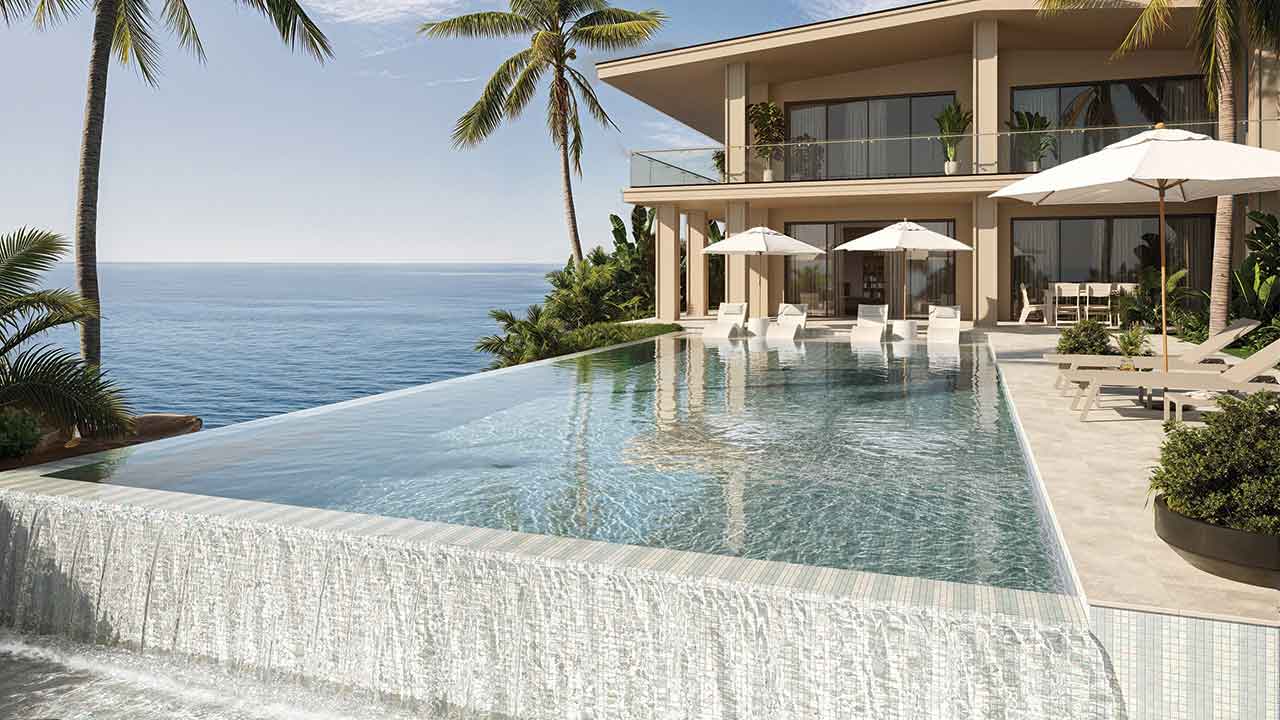
In an infinity-edge pool, the effect can help visually connect the tile with an ocean, lake or distant horizon. On raised spas, water walls, spillways and perimeter-overflow details, moving water continuously changes which portions of the pattern catch and return light.
Even a traditional waterline can become more dimensional because the pattern is not dependent on a fixed contrast between two colors.
The installation effectively changes throughout the day.
That ability gives pool builders and designers another way to create visual interest without adding more colors, decorative elements or competing materials to the project.
More Than a Waterline Tile
Although glass mosaic remains closely associated with swimming pool waterlines, Sand Pearl was developed for considerably broader use.
The collection can extend across pools and spas as well as kitchens, backsplashes and architectural feature walls, allowing designers to carry the same material language between indoor and outdoor environments.
That continuity has become increasingly relevant as homeowners treat outdoor living areas as extensions of the home.
Large sliding and folding glass doors have blurred the traditional boundary between interior and exterior spaces. Outdoor kitchens increasingly mirror their indoor counterparts. Pool houses, cabanas, fire features and covered entertaining areas are frequently designed as elements of a single architectural composition.
Sand Pearl’s coordinating patterns and field tiles make it possible to continue a color throughout those spaces while adjusting the intensity of the pattern according to the application.
A feature wall might employ the checkerboard or offset stripe as a stronger architectural statement. A surrounding surface could transition into stacked or staggered field tile. A raised spa or water feature could then reintroduce the pattern outside.
The material remains connected even as its role changes.
For pool builders and designers, glass mosaics also offer opportunities far beyond a six-inch waterline. Raised bond beams, vanishing edges, spillways, fountains, spas and other water features can become integral parts of the architecture when tile is allowed to play a larger role in the overall design.
Sand Pearl’s monochromatic approach makes that possible without requiring the tile to dominate the project.
Built for Aquatic Environments
Visual design is only part of the equation when specifying tile for a swimming pool.
Materials used in aquatic environments must tolerate constant water exposure, pool chemicals, temperature changes and, depending on the application, continuous submersion.
Sand Pearl is crafted in the United States and TCNA-tested for performance, positioning the collection for demanding aquatic installations as well as interior architectural applications.
Proper installation remains critical with any glass mosaic. Substrate preparation, setting materials, grout selection, expansion considerations and adherence to manufacturer installation requirements can ultimately matter just as much as the tile itself.
For homeowners considering glass, working with a qualified pool professional or experienced tile installer remains particularly important.

A Different Expression of Quiet Luxury
Perhaps the most interesting aspect of Sand Pearl is how naturally the collection fits within the broader movement toward quiet luxury in residential design.
Luxury does not necessarily have to announce itself.
Some of today’s most sophisticated swimming pools rely on relatively simple geometry, carefully selected materials and exceptional craftsmanship rather than an abundance of decorative features. Their visual interest comes from proportion, texture and the way materials respond to the surrounding environment.
Sand Pearl applies that philosophy directly to mosaic tile.
There is shimmer, but it is controlled.
There is pattern, but it does not depend on dramatic color contrast.
There is movement, but much of it comes from the environment itself.
A checkerboard can almost disappear before sunlight reveals it again. An iridescent stripe becomes more pronounced as the viewer changes position. Water moving across a raised spa can alter the appearance of an offset pattern from one second to the next.
What appears restrained on a sample board can become surprisingly dynamic once installed in the environment for which it was designed.
That is ultimately what distinguishes the collection.
Designed by Frank Vitori, co-founder of AquaBlu Mosaics, the AquaBlu Signature Collection reinterprets contemporary tile patterns by allowing finish, reflection, and changing light to create the contrast.
Read the Fall Issue of Pool Magazine

See more of our coverage in your search results

 Skimmer Again Ranks Among North America’s Fastest-Growing Tech Companies
 Aiper Advances the Intelligent Pool Cleaning with Evolved AI and Solar Automation at PSP Expo 2026
 Pool Magazine Announces Strategic Partnership with MyEstimator.pro to Provide Real-Time Pool Pricing
 Solenis to Unveil Revolutionary Smart Pool Technology at PSP Expo
 Pool Corporation to Acquire Team Horner, Expanding Distribution Network in Florida
 PHTA Announces 2027 Board of Directors
 Poolwerx Opens Second Northeast Florida Store on Amelia Island
 Winter is for Strategy: Build Your 2026 Business Plan Now
 New Poolsafe Removable Mesh Safety Fences available in 4 colors
 Texas Drought Puts New Focus on Pool Water Use
 Inside the 2026 Million Dollar Pool Design Challenge
 POOL CORPORATION ANNOUNCES THE RETIREMENT OF KENNETH G. ST. ROMAIN AND THE APPOINTMENT OF JOHN B. WATWOOD
 LA28 to Transform SoFi Stadium Into Record-Breaking Olympic Swim Venue
 Ownership Group Acquires Shasta Pools, Announces Expansion Plans to Offer Complete Home Services
Pool Magazine Podcast
 What’s Your Pool Company Really Worth? – Pool Magazine Podcast With Weld Valuations
 iGarden K Series Review: A Pool Pro Puts It to the Test
 Why Waiting Until Spring to Remodel Your Pool Could Cost You Time & Money
 Ready When You Are: The Changing Role of Automatic Pool Covers
 What’s Hot & Trending in Fire Pits and Fire Tables for 2026
 Sponsored Advertisement
 Pool News1 week ago
Pool Corporation to Acquire Team Horner, Expanding Distribution Network in Florida

 Pool Builder3 weeks ago
Historic Rain in Florida Takes Toll on Pool Job Sites

 Pool News2 weeks ago
Pool Filter Explosion Leaves Service Technician With Serious Facial Injuries

 Manufacturer3 weeks ago
Haviland Pool & Spa Invests $26 Million in Indiana Facility

 Equipment Supplies3 weeks ago
Pool Manager Charged Over Stolen Equipment Sold on eBay

 Manufacturer3 weeks ago
JED Pool Tools CEO Featured on ‘Growing Up B2B’

 Pool News2 weeks ago
Pool Industry Heads to New Orleans for the 2026 PSP Expo

 Manufacturer2 weeks ago
Latham Pools Unveils 2026 Photo Contest Winners
You must be logged in to post a comment Login