Features
The Critical Role of Circulation and Turnover in Residential Pool Performance

In the residential pool market, water clarity is often perceived as the greatest indicator of a well maintained pool, but this isn’t necessarily the case. Beneath the surface, proper circulation and turnover rate are the foundational drivers of water quality, chemical efficiency, energy consumption, and equipment longevity. Yet, these factors are frequently misunderstood, miscalculated, or oversimplified in both pool design and day-to-day operation.
As equipment technology continues to evolve, particularly with the rise of intelligent and adaptive pumping systems, the industry is being challenged to rethink how circulation is achieved and maintained. For pool professionals, understanding the science and application of turnover is no longer optional, it is essential.
Understanding Turnover: More Than a Number


At its core, turnover rate refers to the amount of time required for a pool’s entire water volume to pass through the filtration system once. In residential applications, this is typically expressed in hours per turnover.
Industry guidance generally suggests that residential pools achieve at least one turnover every 8–12 hours, with many professionals recommending closer to 6–8 hours for optimal water quality.
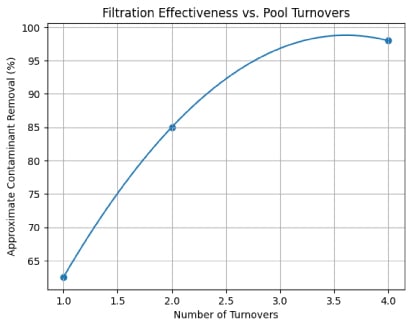
However, the concept is often oversimplified. A single turnover does not mean that 100% of the water has been filtered in a uniform or complete way. In reality, due to mixing dynamics, one turnover only removes approximately 60–65% of contaminants. Multiple turnovers are required to approach true filtration effectiveness, with two turnovers reaching roughly 85% and four approaching 98%.
This distinction is critical. Designing or operating a pool system around “one turnover per day” may meet a minimum threshold, but it rarely delivers optimal sanitation or efficiency.

Why Proper Circulation Matters


Turnover is only meaningful when paired with effective circulation. A system may technically achieve its target turnover rate while still leaving dead zones, areas of poor water movement where debris, bacteria, and algae can accumulate.
1. Water Quality and Sanitation
Proper circulation ensures that sanitizers such as chlorine are evenly distributed throughout the pool. Without it, localized imbalances can occur, leading to algae growth, cloudy water, and increased health risks.
2. Chemical Efficiency
When water is consistently moving, chemicals are used more effectively. Poor circulation often leads to overcompensation, adding more chemicals to address localized issues, ultimately increasing operating costs and creating inconsistent water conditions.
3. Energy Optimization
Circulation and energy consumption are directly linked. Running a pump longer than necessary wastes energy, but insufficient circulation leads to water quality issues that require corrective action, often at even greater cost. Achieving the correct balance is key.
4. Equipment Longevity
Hydraulic inefficiencies place unnecessary strain on pumps, filters, and heaters. Systems operating outside their optimal flow range are more prone to wear, leading to premature failure and increased maintenance requirements.
The Flow Rate Factor
Turnover rate is determined by a simple formula:
Turnover Time (hours) = Pool Volume ÷ (Flow Rate × 60)
While straightforward in theory, this calculation introduces a critical variable: flow rate. In practice, flow rate is influenced by numerous dynamic factors, including:
Filter loading (clean vs. dirty filter conditions)
Plumbing design and pipe diameter
Valve positions and system restrictions
Elevation changes and equipment layout
These variables mean that a pump operating at a fixed speed does not deliver a fixed flow rate. As system conditions change, so does the actual turnover performance.
This is where many traditional approaches fall short.
The Limitations of Traditional Pumping Strategies
Historically, residential pools have relied on single-speed or variable-speed pumps operating based on RPM (revolutions per minute). While variable-speed technology represented a significant improvement in energy efficiency, it still relies on speed as a proxy for performance.
The problem is that RPM does not equal flow.
A pump set to a specific speed may deliver vastly different flow rates depending on system conditions. For example:
A clean filter may allow high flow at a given speed
A dirty filter may significantly reduce flow at that same speed
In both cases, the pump is operating at the same RPM, but the turnover rate is not the same.
This disconnect can lead to under-circulation (compromising water quality) or overcompensation (increasing runtime and energy use).
Rethinking Circulation: A Flow-Based Approach
Modern pool operation is increasingly shifting toward flow-based system design and control. Rather than assuming that a given speed produces a consistent result, flow-based strategies focus on achieving and maintaining a specific gallons-per-minute (GPM) target.
This approach aligns directly with turnover requirements. If the flow rate is known and controlled, turnover becomes predictable, even as system conditions change.
Maintaining consistent flow ensures that:
Turnover targets are reliably achieved
Filtration operates within optimal parameters
Chemical distribution remains uniform
Energy usage is minimized without sacrificing performance


The Role of Adaptive Flow Technology: Nautis VSF
One of the most notable advancements in this area is the introduction of adaptive flow pump technology, exemplified by the Nautis VSF pump from H2flow Controls.
Unlike traditional variable-speed pumps that operate based on RPM, the Nautis VSF is designed to operate based on flow rate. This distinction is significant.
Maintaining Target Flow in Real Time
The Nautis VSF continuously monitors system conditions and automatically adjusts pump speed to maintain a desired flow rate. Whether the system experiences:
Filter loading
Partially closed valves
Minor blockages
Changes in hydraulic resistance
…the pump compensates in real time to maintain consistent circulation.
This capability directly addresses one of the most persistent challenges in residential pool operation: variability.
Ensuring Reliable Turnover
By maintaining a constant flow rate, the Nautis VSF enables predictable and reliable turnover
performance. Pool professionals can set a target flow that aligns with the desired turnover rate, confident that the system will maintain it, even as conditions change.
This eliminates the guesswork often associated with pump scheduling and system tuning.
Improving Efficiency and Reducing Costs
Because the pump only increases speed when necessary to maintain flow, it avoids the inefficiencies associated with fixed-speed operation. The result is:
Reduced energy consumption
Lower operating costs
Less strain on equipment
At the same time, consistent circulation improves chemical distribution, often reducing overall chemical usage.
Simplifying System Management
For service professionals and homeowners alike, adaptive flow technology simplifies pool management. Instead of continually adjusting pump speeds or run times to account for changing conditions, the system self-regulates.
The outcome is a more stable, predictable, and efficient pool environment.
Practical Implications for Pool Professionals
As circulation technology evolves, so too must the approach to pool design and operation. Professionals should consider the following best practices:
Design for Flow, Not Just Equipment
System design should prioritize hydraulic efficiency, including proper pipe sizing, minimized restrictions, and optimized equipment layout.
Measure and Verify
Incorporating flow measurement, either through integrated systems or external flow meters, provides valuable insight into actual system performance.
Optimize Turnover Strategically
Rather than defaulting to fixed pump schedules, turnover should be calculated based on real flow rates and adjusted for factors such as bather load, weather, and seasonal use.
Embrace Adaptive Technologies
Flow-based and adaptive systems offer a more precise and efficient way to achieve circulation goals, reducing both operational complexity and long-term costs.
Looking Ahead
The importance of proper circulation and turnover in residential pools cannot be overstated. These factors underpin every aspect of pool performance, from water clarity and sanitation to energy efficiency and equipment lifespan.
As the industry continues to move toward smarter, more connected systems, the shift from speed-based to flow-based operation represents a fundamental evolution. Technologies like the Nautis VSF pump are not just incremental improvements, they are redefining how circulation is managed.
For pool professionals, the opportunity is clear: by prioritizing proper circulation and leveraging advanced technologies, it is possible to deliver better outcomes for clients while reducing costs and complexity.
In the end, a well-circulated pool is not just cleaner, it is smarter, more efficient, and built for the future.
You must be logged in to post a comment Login