





Pool News
Step Into Swim Is Turning Industry Giving Into Life-Saving Impact
Pool industry leaders donate to Step Into Swim, expanding access to swim lessons and advancing water safety nationwide.


Drowning remains one of the leading causes of accidental death among children in the United States. It’s a sobering reality that hits hardest in underserved communities where access to swim lessons and aquatic facilities is limited. That’s where Step Into Swim, an initiative of the Pool & Hot Tub Alliance, continues to step in with purpose.
Since its launch in 2012, Step Into Swim has gifted more than 500,000 swim lessons to children across the U.S. and beyond. In 2025 alone, the program raised over $1.5 million, funding learn-to-swim programs in 43 states, American Samoa, the U.S. Virgin Islands, Grand Cayman, and Canada — providing nearly 20,000 children with access to life-saving water safety education. Every dollar donated goes directly toward programming.
Behind those numbers is a growing coalition built from manufacturers, distributors, trade organizations, and technology providers who see water safety as a shared responsibility.

At the center of the program’s outreach efforts is three-time Olympic gold medalist Rowdy Gaines, who serves as Vice President of Partnerships and Development for PHTA. Gaines has become one of Step Into Swim’s most visible advocates, helping connect industry support directly to community outcomes.
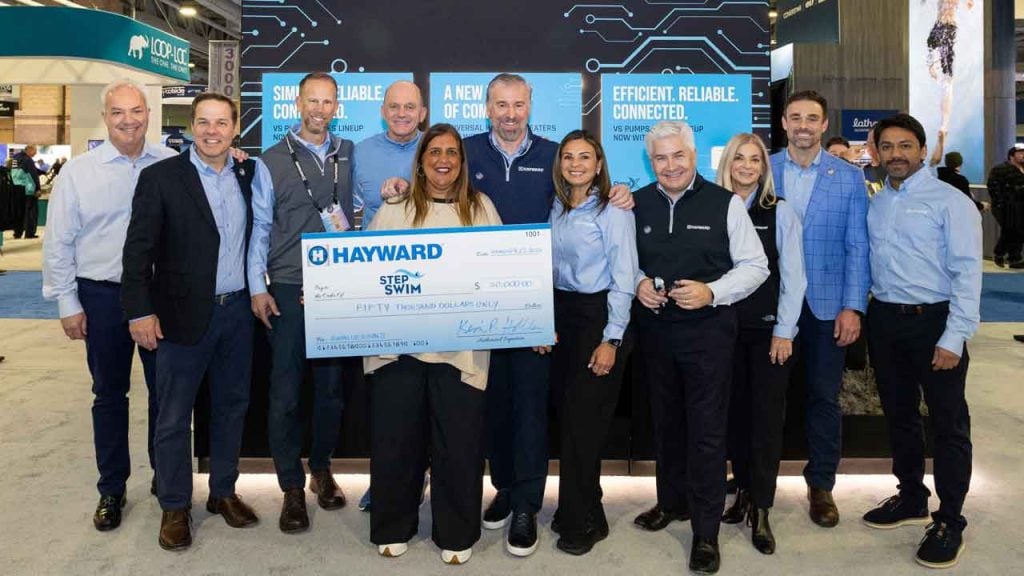
Hayward: Investing in Safer Futures
This year, Hayward expanded its multi-year partnership. They made a $50,000 donation — comprised of $25,000 in cash and $25,000 in equipment — earning Platinum-level supporter status.
Hayward President and CEO Kevin Holleran emphasized that the company’s commitment goes far beyond product innovation.
“Access to swimming pools and water safety education is essential to protecting families and strengthening communities,” Holleran said. “Hayward’s continued support of Step Into Swim helps more children access life-saving learn-to-swim programs. Investing in water safety means investing in safer futures, and this donation reflects Hayward’s values and our commitment to making a meaningful impact beyond the products we design and manufacture.”
Gaines echoed that sentiment, noting that Hayward’s involvement has helped keep community pools open while expanding access to swim lessons for underserved children.

“Hayward’s continued support has not only provided access to swim lessons to underserved children across the country — it has also helped Step Into Swim revitalize community pools that were at risk of closure,” he said.
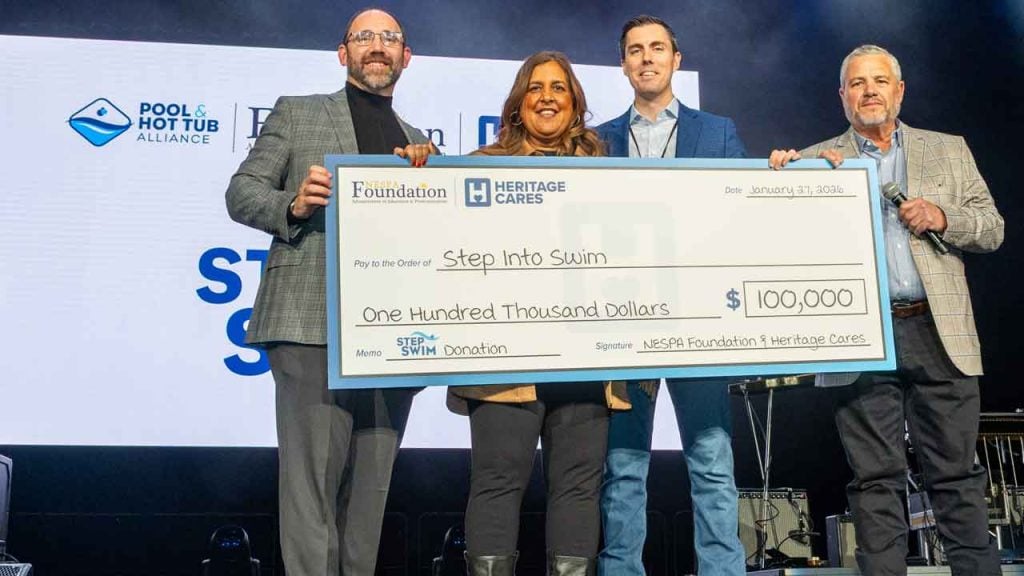
Heritage Pool Supply Group: Turning Community into Action
For Heritage Pool Supply Group, giving back is woven directly into company culture. Through its Heritage Cares Foundation, the distributor contributed $100,000 to Step Into Swim following its annual charity concert at the Pool & Spa Show in Atlantic City.
Scott Frost, President of Heritage Pool Supply Group, described the initiative as deeply personal for his organization.
“This initiative is very close to our hearts as it aims to create more swimmers and teach children in underserved communities across the country to swim,” Frost said. “By working together, we can make a significant impact and ensure that every child has the opportunity to learn this essential life skill.”
Heritage Cares has selected Step Into Swim as a beneficiary for five consecutive years, helping raise awareness throughout the pool, spa, and hot tub industry while directly funding swim access for thousands of children.
Gaines credited Heritage’s long-term commitment with tangible results.
“Since 2021, Heritage Pool Supply Group’s donations to Step Into Swim have provided nearly 20,000 children access to lifesaving learn-to-swim programs,” he said, calling Frost and the Heritage team “true champions of water safety.”

Pentair Pool: Making Safety the Starting Point
Now in its third year supporting Step Into Swim, Pentair Pool announced a $100,000 contribution as part of its broader commitment to drowning prevention and water safety education.
Greg Claffey, President of Pentair Pool, underscored the importance of introducing children to water in the right way.
“Everyone’s journey should start with a safe introduction to the water,” Claffey said. “This partnership lets us give back to our communities in a meaningful way — by supporting local families through helping future swimmers learn the skills that keep them safe in and around the water.”
Pentair’s Diamond-level support helps fund learn-to-swim programs for thousands of children nationwide. The company also sponsors National Water Safety Month each year, reinforcing its belief that education and awareness are just as critical as equipment and innovation.
Gaines praised Pentair’s consistency.
“Pentair Pool understands that enjoying aquatic environments begins with safety, and they consistently advocate for increased awareness of drowning prevention through their work with Step Into Swim, National Water Safety Month, and other water safety initiatives,” he said.

Fluidra: Five Years of Meaningful Momentum
Marking its fifth consecutive year of support, Fluidra continued its partnership with a $100,000 donation, reinforcing its commitment to underserved communities and vulnerable populations.
Gaines described Fluidra’s impact in deeply human terms.
“Their generosity has had a life-changing positive impact on literally thousands of children who now know how to be safe in and around water,” he said. “Step Into Swim is thrilled to begin our 2026 fundraising with this incredible donation from Fluidra, which will allow us to fund learn-to-swim programs across the country and fulfill our mission to save lives.”
Jon Viner, President of Fluidra North America, emphasized that water safety reaches far beyond the pool deck.
“Ensuring children have the skills to be safe and confident around water is a responsibility that extends beyond the pool,” Viner said. “Through our support of Step Into Swim, we’re helping broaden access to swim education that can truly change — and save — lives.”
Fluidra also noted that in 2025, Step Into Swim fundraising was matched by the PHTA Board of Directors, bringing total contributions to more than $3 million and supporting over 250 programs delivering roughly 180,000 swim lessons.

NESPA Foundation: Rallying the Northeast
Another major supporter helping expand Step Into Swim’s reach is the NESPA Foundation, which continued its partnership as a Diamond Level supporter with a $100,000 donation presented during the 2026 Pool & Spa Show in Atlantic City.
Jeremy Hasbrouck, President of the NESPA Foundation, said the partnership reflects what’s possible when the industry works together toward a common goal.
“Our partnership with Step Into Swim is a testament to what we can achieve when the industry unites for a common cause,” Hasbrouck said. “For the past three years, our matching program has successfully quadrupled funding, turning our members’ generosity into swim lessons. The NESPA Foundation remains steadfast in its commitment to drowning prevention, and we are thrilled to continue this journey with Step Into Swim to make water safety accessible to all.”
Beyond its financial support, the Foundation continues to create tangible community impact throughout the Northeast. Following the show, the NESPA Foundation also presented a $35,000 Step Into Swim grant to the Atlantic City Boys & Girls Club, supporting learn-to-swim programming for local youth.
Rowdy Gaines noted that NESPA’s consistent support has made the organization one of the most influential contributors to Step Into Swim’s growth in the region.
“They have shown up year after year to rally support from their members and raise awareness of the lifesaving importance of swim lessons and water safety,” Gaines said. “Step Into Swim could not reach this level of success in the Northeast without the support of NESPA, its Executive Director Dominick Mondi, and the NESPA Foundation Board.”
Industry Partners Expanding the Mission
Support for Step Into Swim also extends beyond the largest industry manufacturers. A number of companies continue to contribute through ongoing partnerships that collectively strengthen the initiative’s reach.
AquaStar Pool Products, Periodic Products, and Pool Shark H2O recently renewed their partnerships with Step Into Swim with combined donations totaling $50,000, helping fund additional learn-to-swim grants across the country.
Their support contributed to Step Into Swim’s most successful single month of fundraising ever, with donations exceeding $500,000 in January 2026 alone.
“When leaders like AquaStar Pool Products, Periodic Products, and Pool Shark H2O show their support for a cause like Step Into Swim, the rest of the pool, spa, and hot tub industry takes notice,” Gaines said. “Raising awareness of drowning prevention and understanding the lifesaving impact of swim lessons is the first step in eradicating the accidental drowning epidemic.”

For the companies involved, the mission aligns closely with their broader commitment to safety within the aquatic industry.
“At AquaStar Pool Products, safety isn’t just what we manufacture—it’s what we believe in,” said Steve Barnes, Director of Science and Compliance at AquaStar Pool Products. “Teaching children and families to swim saves lives, and we are proud to deepen our commitment.”

Periodic Products has also strengthened its long-term support by contributing to the Rowdy Gaines Water Safety Champion Endowment Fund, helping establish sustainable funding for Step Into Swim well into the future.
Meanwhile, Pool Shark H2O continues to support the initiative through its Silver Level sponsorship.
“Our continued partnership is a win for everyone involved, especially the kids who otherwise may not get access to these lifesaving swim lessons,” said Scott Trafton, President and Co-founder of Pool Shark H2O.
A Collective Mission with Measurable Impact
What makes Step Into Swim especially powerful is its collaborative model. Manufacturers, distributors, and industry partners aren’t competing for recognition — they’re pooling resources around a shared goal: reducing childhood drowning and expanding equitable access to swim education.
From revitalizing community pools to funding grassroots swim programs through YMCAs, Boys & Girls Clubs, community centers, and local organizations, Step Into Swim converts corporate generosity into real-world outcomes.
For the pool and spa industry, this initiative represents something bigger than philanthropy. It’s a unified effort to strengthen communities, improve public health, and ensure that more children grow up with confidence — not fear — around water.
As Gaines often reminds supporters, every lesson matters. Every donation counts. And every child who learns to swim is one more life potentially saved.
And with continued leadership from companies like Hayward, Heritage Pool Supply Group, Pentair Pool, and Fluidra, Step Into Swim is proving that when an industry comes together with purpose, it can make waves far beyond the water’s edge.


New ALKORPLAN ONE app lets pool professionals design, customize, and present pool projects in a client’s own backyard — in real time
RENOLIT, a leading manufacturer of reinforced PVC membranes for swimming pools and decks, announced the launch of RENOLIT ALKORPLAN ONE, a new augmented reality (AR) app that lets pool professionals design and present pool projects on-site — directly in the client’s space.
With the ONE app, professionals can sketch a pool in a client’s backyard, customize it on the spot, and show the finished result in augmented reality before a single shovel hits the ground. Proposals that once took days of back-and-forth can now happen in a single visit.

With the ONE app, pool professionals can:
- Design pools directly on-site using augmented reality
- Turn ideas into realistic, visual projects in seconds
- Customize every detail — shape, size, depth, and finishes
- Present designs in the client’s own space for a more immersive, convincing experience
- Generate technical sheets and visuals instantly
- Save, reuse, and manage projects with ease
The result is a faster path from idea to signed project. Because clients can see a customized design rendered in their own space, they gain the confidence to make decisions sooner — and professionals spend less time preparing presentations and more time closing them. “RENOLIT pool builders world-wide have already begun using the ONE app and we are thrilled to bring it to builders in North America,” says Tony Jordan, Business Development Manager for RENOLIT North America.
The ONE app is available now. Pool professionals can learn more and get started at https://renolit-alkorplan.com/professional-area/app-one.
https://renolit-alkorplan.com/
https://www.instagram.com/renolit_alkorplan_pools_usa/
LaPorte, Indiana
Email: [email protected]
Pool News
Inside the 2026 Million Dollar Pool Design Challenge
The Million Dollar Pool Design Challenge heads to New Orleans for the PSP Deck Expo in 2026 and Pool Magazine has your inside track.

Six years into the Million Dollar Pool Design Challenge, the competition has become one of the pool industry’s more interesting experiments in design education. On the surface, it is exactly what its name suggests: designers are handed an ambitious fictional project and asked to create an extraordinary pool and outdoor living environment.
But according to co-founder Mike Farley, winning the competition was never really the entire point.
Farley and fellow designer Reid Schindler created the challenge around a problem they had both seen throughout their careers. Designers often say they could produce incredible work if only they were given the right client, property, and budget. The Million Dollar Pool Design Challenge effectively removes that excuse.

“When you start your career, the most common comment everybody makes is, ‘I don’t get the opportunity to work on that project, and if I had the opportunity, I could get the job,’” Farley said. “Basically, we created an opportunity where everybody has that opportunity to try to get the job.”
Every competitor receives the same client, property, site conditions and design problem. What happens next is entirely up to them.
That concept was partially inspired by Farley and Schindler’s experiences studying landscape architecture. Students would receive the same assignment, develop completely different solutions and then learn by comparing their work with everyone else’s.
The tools have changed considerably since then.
Farley remembers his student work being drawn by hand, colored with markers and hung in hallways for classmates to study. Schindler came along later, when computers were already becoming part of the process. Yet the principle remains the same: designers improve when they can see how other designers solve the exact same problem.

That makes the competition particularly valuable for developing designers, and it also addresses one of the biggest misnomers surrounding the event.
You Don’t Have to Be an Elite Designer to Enter
There is a perception that the Million Dollar Pool Design Challenge is primarily for established designers already producing award-winning work. Farley would actually like to see more inexperienced designers use it as a training exercise.
“Really, your goal as a new or entry‑level designer in this type of situation is to learn, not to win,” he said.
A developing designer can attempt the project, attend the finalists’ presentations and compare their own decisions against five entirely different solutions. Where did they place the pool? How did they handle circulation? What did they prioritize? What did they leave out? How did the finalists present their ideas?
Even someone without enough time to prepare a polished competition entry can benefit.
“Just take the site and just do a bubble diagram,” Farley said. “Here’s where I would’ve put different things, and here’s how I would’ve solved the problem.”
Then go watch the finalists and listen to the judges critique the work.
Farley considers that educational component one area where the competition still hasn’t reached its full potential. He would like to see more entry-level designers approach the challenge as a practical design exercise rather than assuming they have no business competing against more experienced professionals.
The other common misconception is right there in the name.
“A lot of people think, ‘Oh, we’re supposed to design a pool that’s a million dollars.’ No, we want you to spend at least a million dollars,” Farley explained.
When the competition began, a million-dollar pool represented a far more unusual project. Today, Farley noted, seven-figure pools are considerably more common at the upper end of the market. The challenge has consequently continued pushing designers beyond ordinary project parameters.
There is still an important catch: the design has to be buildable.
Competitors aren’t being asked to create fantasy artwork unconstrained by engineering, safety or construction realities. Entries are judged on aesthetics and differentiation, but also functionality and buildability. Competitors must demonstrate that the design works at scale, responds to the client’s needs and could realistically be engineered and constructed.
That balance has produced something Farley wasn’t sure they would see when the competition began: radically different answers to the same problem.
“We’ve never had any two that were close to each other,” he said. “The dramatic diversity of the design solutions has been really cool to see.”

This Year’s Design Brief
For 2026, the competition moves to Louisiana in conjunction with the International Pool | Spa | Patio Expo in New Orleans. After previous scenarios set in places including Arizona, Tennessee, Chicago, California and Florida, Farley and Schindler wanted this year’s project to feel unmistakably Southern.
The fictional clients, James and Eleanor Caldwell, have purchased Siltstone Estate, a historic property in the Southern Delta. James comes from a Gulf Coast resort family and has a strong interest in craftsmanship, architecture and historic preservation. Eleanor is an interior designer. Together, they favor antiques, gardens, French wine, bourbon and traditional Southern hospitality over anything overtly trendy.
Those details aren’t window dressing. Understanding the fictional homeowners is part of solving the assignment.
“There are people that have not made the finals before, and there are people that did not win before because they did not look to what the client wanted,” Farley said. “This is not a design competition of creating what you think is best. You have to create what you think is going to be best for this client.”
The architecture adds another layer. A traditional Southern estate naturally creates strong axes and a more formal design language, but the Caldwells aren’t asking competitors to simply drop a rectangular pool behind the house. The brief specifically calls for a traditional-but-interesting recreational pool that respects the architecture without becoming predictable.
Modern amenities can still fit within that vocabulary.
“You can have modern features that don’t necessarily have to have modern architecture,” Farley said.
That distinction could prove crucial because the Caldwells’ wish list is enormous.
The program includes a covered back porch, outdoor kitchen and bar, gazebo and parterre garden, greenhouse, vegetable garden and orchard, guest cottage and pool house, driveway fountain, fishing pond and dock, courtyard wellness suite, event lawn, dual-purpose pickleball and basketball court, outdoor movie screen, fire pit, catering area and multiple secluded gathering spaces. The property must routinely accommodate around 25 guests while being capable of supporting events exceeding 100.
Then there is the water.
Competitors must incorporate either a BlueOrbit hydrotherapy system or a Riverflow lazy river, adding another design problem beyond the primary recreational pool and large family spa.
Farley sees current-driven aquatic environments as another opportunity to expose designers to possibilities they may not have considered before.
“What we’re trying to do is make people aware of things that they may not have been aware of and create another level of creativity,” he said.
With so many requested elements, the hardest part of the 2026 challenge may ultimately be deciding what not to do.
“Fitting it all in,” Farley said when asked about this year’s biggest challenge. “You’re going to be balancing, ‘Do I get it all in? If I get it all in, is there too much in this? What do I take away?’”
In other words, exactly the problem designers encounter with actual clients.
“Sometimes the right thing to say is no,” he added.
Presenting the Work Matters
A spectacular rendering alone isn’t enough to win.
Competitors must submit a scaled 2D plan, up to eight supporting graphics and a written design narrative explaining their process. Flythrough videos and physical models can supplement the submission, but judges place significant emphasis on how clearly designers communicate the thinking behind their solution.
“We want to understand your thought process in coming up with the solution, and you have to be able to document that,” Farley said. “It’s not just about the 3D image.”
That requirement becomes increasingly relevant as visualization technology advances. Yet changing technology is nothing new to the challenge.
Farley remembers when Pool Studio dominated early submissions before a student arrived using Lumion, software that relatively few pool designers had encountered at the time.
“Hardly anybody in the pool industry had ever seen Lumion,” he recalled.
The following year another winner used it. Soon competitors were learning Lumion themselves, incorporating it into their presentations and raising the overall visual standard of the competition. More recently, Pool Studio has again been behind several winning presentations.
The lesson isn’t that one program is superior. It is how quickly designers learn by watching one another.
“It has caused people to extend their horizons on what’s possible,” Farley said. “What tools am I going to use in this? Everybody’s being exposed to different things, and they learn more and more.”
Farley admits he does the same thing.
He recalled advice from one of his college professors: “The greatest designer is the greatest thief.”
The point wasn’t to copy someone else’s work, but to study good ideas, understand why they work and add those lessons to your own design vocabulary.
“There are definitely things that I’ve seen that are like, ‘Wow, I never thought about that,’” Farley said. “There’s almost every design that’s entered; there’s something to be learned from.”
Sometimes the lesson can be surprisingly simple. Farley once noticed that finalists regularly included people in their renderings while his own presentations historically did not. Seeing people using a space helped communicate scale, purpose and lifestyle. It was a small presentation technique he could immediately incorporate into his own work.
That exchange of ideas may be the Challenge’s most enduring contribution.
Farley has watched competitors return year after year without ever reaching the finals, yet their work continually improves. Others have used the exposure to create career opportunities. Past winner Brad Holley was recruited by FoxTerra after his win before later joining Claffey Pools, while other finalists and winners have gone on to work with companies that previously had their own designers represented in the competition.
“There are people in the industry that look at this for design talent, no doubt,” said Farley. “Every single year they do better and better. They come back, and their designs get better, their presentation skills get better.”
“You win by what you learn,” explained Farley. “If you learn things in this competition that help you with a client later on, which I guarantee will happen, then you win. You win by increasing your knowledge base.”
Five finalists will ultimately take their designs to New Orleans, where they’ll present their solutions live during the International Pool | Spa | Patio Expo. The judges determine who makes that final five, but the audience in the room ultimately decides who wins the $10,000 first-place prize.
For Farley, seeing those five interpretations side by side remains one of the most interesting parts of the Challenge. After six years, no two designers have ever approached the same property, client, and set of requirements quite the same way.
That may also be the best reason to follow the competition, whether you’re entering or simply sitting in the audience. The Challenge doesn’t provide a blueprint for how a million-dollar outdoor living environment should be designed. It provides five very different answers to the same question—and an opportunity for everyone in the room to walk away seeing design a little differently.
Ready to take a deeper dive?
Listen to our entire conversation with Mike Farley and learn more about this year’s Million Dollar Pool Design Challenge on the Pool Magazine Podcast.
Enter The Million Dollar Pool Design Challenge
Think you have what it takes to win this year’s competition?

Fort Wayne, IN – September 2026 – Franklin Electric Co., Inc. (NASDAQ: FELE) is supporting arts in the community by sharing its corporate collection of environmentally minded Edward Burtynsky photographs for a special exhibit titled “Water” at the University of Saint Francis. The loan coincides with the company’s sponsorship of the public exhibit, which runs from Aug. 24 through Sept. 17 in the school’s Rolland Center Weatherhead Gallery.
The Burtynsky collection, which is permanently displayed throughout the company’s Fort Wayne headquarters, features photographs of major water infrastructure resources, hydroelectric projects, aquaculture operations and agricultural irrigation systems. Burtynsky is regarded as a leader in modern environmental imagery and contemporary photography. His work is on display at the Metropolitan Museum of Art in New York, the Solomon R. Guggenheim Museum, and the Tate Modern in London, among others.
“As part of our corporate space, these photographs have served as a reminder of how the Franklin Electric team makes water possible around the world,” said Joe Ruzynski, CEO of Franklin Electric. “Now, we’re excited to share them with the Fort Wayne community. We hope they serve as a catalyst for meaningful conversations about stewardship, sustainability and responsible water use.”

Through Franklin Electric’s support, the Saint Francis exhibition and related public events are free and open to the community. For details on exhibit hours, special events and location, visit the event link here.
Supporting the arts and education has been a part of the company’s community commitment for decades. The Franklin Electric Charitable and Educational Foundation offers scholarships to college-bound high school seniors and contributes annually to non-profit organizations in communities where the company operates, including Fort Wayne.
About Franklin Electric
Franklin Electric is a global leader in the production and marketing of systems and components for the movement of water and energy. Recognized as a technical leader in its products and services, Franklin Electric serves customers worldwide in residential, commercial, agricultural, industrial, municipal, and fueling applications. Franklin Electric is proud to be recognized in Newsweek’s lists of America’s Most Responsible Companies 2025, Most Trustworthy Companies 2024, and Greenest Companies 2025; Best Places to Work in Indiana 2024; and America’s Climate Leaders 2024 by USA Today.

Read the Summer Issue of Pool Magazine

See more of our coverage in your search results
 Sponsored Advertisement
 RENOLIT Launches ONE Augmented Reality Pool Design App
 Inside the 2026 Million Dollar Pool Design Challenge
 Franklin Electric Shares Global Water Perspectives Through Art Exhibit
 SafeSplash Highlights Early Water Safety During Baby Safety Month
 5 Ways Jandy’s New AquaLink® EDGE™ Is Changing the Game for Pool Pros
 Why Pools Matter: Pool Horizons Takes Its Message Global
 Ownership Group Acquires Shasta Pools, Announces Expansion Plans to Offer Complete Home Services

 Keith Zars – One on One with Pool Magazine
 Florida Pool Professionals Honored for Excellence in Design and Craftsmanship
 Chlorine Poisoning Incident at Swimming Pool in Italy
 Remembering Pearl Harbor & The Role Swim Training Played
 Creating Fun & Excitement In The Pool With Riverflow
 Dr. R. Neil Lowry $5,000 Grant Awarded – PHTA
 Pool & Hot Tub Alliance Quarterly Pulse Report Shows Growth Across Industry

 Sponsored Advertisement
 Industry News4 weeks ago
Landmark Aquatic Names Jason Hill Kansas City General Manager

 Pool News4 weeks ago
New FCC Robotics Rules Could Affect Future Robotic Pool Cleaners

 Press Releases4 weeks ago
Veridian Service Partners Names Dave Peterson Chief Sales Officer

 Pool News3 weeks ago
Amazon Drone Drops Package Into Swimming Pool — And It’s Not the First Mishap

 Manufacturer4 weeks ago
Pentair Pool and Pool Brain Launch Technology Integration to Deliver Smarter, More Proactive Pool Service

 Manufacturer4 weeks ago
TPSC Launches East Green Teak Collection

 Awards4 weeks ago
Pentair Pool Launches 2026 Pool Pro Awards

 Press Releases4 weeks ago
Natalie Hood Swims for Every Child A Swimmer
You must be logged in to post a comment Login