





Pool News
New York’s Floating Pool Finally Set To Become a Reality


In the heart of New York City, a visionary project that has been nearly 14 years in the making is finally gaining momentum. + POOL, an open-air pool designed to float on the East River, recently received a significant boost as Governor Kathy Hochul announced state and local funding for its realization. What began as a dream in June 2010 has navigated a complex journey of fundraising, testing, partnerships, and community advocacy to bring this innovative concept to the brink of reality.
Conceived by designers Dong Ping-Wong, Oana Stenascu, Archie Lee Coates, and Jeffrey Franklin, + POOL emerged from a desire to transform part of the East River into a unique swimming pool experience. Shaped like a plus sign, the pool aimed to cater to various needs, including lap swimming, a kids’ pool, ‘hanging out,’ and water sports. The journey began with a Kickstarter campaign in June 2011, raising $250,000 within a week to design and test a primary filtration layer.

After a brief hiatus, + POOL resurfaced in October 2012 with a more ambitious fundraising goal of $1 million. The project officially became a nonprofit organization, Friends of + POOL, in October 2014, with influential founding members like Joshua David and Marc Kushner. Over the years, the designers conducted feasibility studies, tested locations, and successfully filtered East River water through the Float Lab in June 2015.

The timeline is marked by partnerships, resolutions from community boards, and the green light announcement in May 2021, signaling a step closer to turning the vision into reality. The most recent milestone, Governor Kathy Hochul’s $16 million partnership commitment in January 2024, propels + POOL towards its anticipated opening date in 2025 on the Lower East Side.
The approved funding has breathed life into a visionary idea that was initially proposed over a decade ago, only to be dismissed by some as an urban fantasy. The concept involves a self-filtering swimming pool shaped like a plus sign, strategically positioned in the East River’s murky currents. Since its initial media attention, the project, known as +Pool, has faced sporadic progress hindered by regulatory barriers, but now, with the surge in summer heat drawing more New Yorkers to water recreation, Governor Hochul has pledged to expedite the long-stalled and much-debated innovative floating pool.

Governor Hochul announced plans for a “demonstration” version to be tested this summer, with a fully operational, swim-ready pool slated to open to the public by the summer of 2025. Alongside this commitment, Hochul proposed the construction of new swimming pools and the hiring of additional lifeguards across the state. She positioned this initiative as a public health investment, emphasizing its potential to enable more children to learn how to swim. Pending approval by state lawmakers, a $60 million grant program aims to construct 10 new pools in underserved communities, while an additional $30 million would fund pop-up pools during heatwaves.
The visionary project’s advocates have previously outlined plans for an Olympic-length pool anchored to the riverbed off Manhattan’s Lower East Side, featuring a distinctive filtration system capable of purifying 1 million gallons of water daily. Despite improvements in New York’s water quality, significant amounts of sewage-contaminated water still enter the rivers during heavy rainstorms.
Kara Meyer, managing director of +Pool and a proponent of the floating pool concept, expressed the belief that it would revolutionize the way New Yorkers engage with their waterways, harkening back to a bygone era when residents regularly bathed in the rivers to beat the heat.
However, amidst the celebration of progress, there are bittersweet sentiments expressed by original + POOL designer Dong Ping-Wong. He raised concerns about potential loopholes and the risk of contributing to gentrification in Chinatown, emphasizing the importance of preserving the project’s initial inclusive vision.
As + POOL inches closer to becoming a reality, the journey encapsulates the dedication and perseverance of its designers, the nonprofit organization, and supporters. The project not only promises a unique swimming experience beneath the city’s skyline but also underscores the challenges and considerations inherent in realizing a visionary idea in the bustling urban landscape of New York City.


Some of the most memorable swimming pool designs begin with a grand architectural concept. Others start with something much smaller.
For Ray Corral, founder and creative director of Mosaicist, the inspiration for this South Florida project came from a single window.
The ultra-modern residence offered relatively few decorative cues. Its architecture was clean, geometric and intentionally restrained. The homeowner, however, had given the design team a healthy budget and a straightforward directive: create something spectacular.

“The first thing that popped out at me was this recessed trapezoid window on the corner of the house,” Corral recalled. “It was one architectural element that kept getting my attention.”
That window would ultimately provide the design language for an elaborate mosaic interior featuring a repeating pattern that appears to rise from the floor of the swimming pool.
For Corral, tying the pool back to the architecture made considerably more sense than introducing an unrelated decorative element.
“We always try to bring in a design that ties into the architecture of the home,” he explained. “It gives the project a story, and it’s something the client can relate to.”
Finding The Right Balance
In the luxury market where Corral works, where budgets are expansive and almost anything is possible, restraint can be especially important. Over more than 25 years, Mosaicist has built a reputation for highly customized architectural and aquatic mosaics. Along the way, Corral has become a familiar name on some of Florida’s most elaborate residential projects, including pools for business magnates like Larry Ellison and Arthur Blank, as well as a growing list of celebrities such as Gloria Estefan, Julio Iglesias, and most recently famed rapper Rick Ross.

Working at that level means he has become accustomed to requests that go well beyond selecting a tile color from a catalog.
Some are considerably more unusual than others.
“We’re doing a project right now for some well-known rappers, and they want their faces on the bottom of this enormous pool,” Corral said. “We’re trying to talk them out of it. I tell them, ‘You think you want this, but you’re going to get tired of looking at it, even if it’s your own faces.’”
They apparently remain committed to the idea, and Corral says Mosaicist will ultimately execute it.
The anecdote illustrates a challenge that frequently accompanies high-end pool design. When virtually anything is financially possible, clients understandably want to explore every option on the menu. Fire features, fountains, spillovers, vanishing edges, elaborate finishes and custom artwork can quickly begin competing with one another.
Earlier in his career, Corral said he was more inclined to simply deliver everything requested. These days, he is more likely to advocate for dialing things back.
“We’re always trying to figure out a way to make it tasteful,” he said. “It gets difficult when clients want to bling out the entire pool with every bell and whistle.”
Against that backdrop, developing a geometric optical illusion for a pool incorporating both a Lautner edge and negative edge could almost be considered another day at the office.

Creating Depth on a Flat Surface
The finished pattern resembles recessed cubes or a coffered ceiling, an effect that raises an obvious question: how does an architectural detail from a window become what appears to be a three-dimensional structure on the bottom of a swimming pool?
For Corral, the answer involved taking the trapezoidal language of the window and developing it into a repeating pattern capable of creating the appearance of dimensionality.
“The client wanted something spectacular that no one had ever seen,” Corral said. “This three-dimensional repetitive pattern hasn’t been done like this on the bottom of a pool. But these types of patterns go back to old-world mosaics.”
The effect has roots in much older visual language. Repeating geometric mosaics have long used proportion, orientation and tonal contrast to imply volume and shadow. Mosaicist’s contribution here was to adapt that optical vocabulary to a sharply contemporary pool and make it function within the architectural priorities of the site.
“We were working with threes and sevens,” Corral said, explaining that there were “a lot of different formulas” involved in making the geometry work.
Corral sees a connection between the pattern and sacred geometry, particularly in its use of threes and sevens. The three is readily apparent: three rhombuses, oriented in different directions and rendered in contrasting tones, combine to create each apparent three-dimensional cube. That cube, or hexahedron, is one of the five Platonic solids and was associated by Plato with the element of earth and stability. Seven also figured into the formulas Corral used to organize the larger composition, adding another layer to the mathematical relationships behind the design.

Making the Math Fit the Pool
Translating that intricate geometric design onto the pool floor would be no easy feat, particularly since the vessel had already been constructed by the time Mosaicist became involved.
“The shell was already shot, so now we had to make a design that fit perfectly,” Corral explained.
The homeowner also wanted a dedicated swim lane, creating another linear element that had to be incorporated into the composition. Fortunately, the cube pattern fit three rows across the width of the main pool floor. Getting it to resolve across the entire length required considerably more manipulation.
Toward the ends of the pattern, individual geometric elements were progressively reduced in size to maintain the visual rhythm.
“We had to make those squares a little smaller and then smaller again,” Corral said. “Your eye surprisingly doesn’t catch it. You can’t even really catch it in an aerial photograph, but we had to arrange the mosaic cubes that way to make everything fall correctly.”
That precision extended beyond the mosaic itself. Once installation began, the existing contours of the pool became part of the equation.
“There were a lot of numbers involved in this one,” Corral said. “We had to float the floor because it had too much of a concave shape. Otherwise, the pattern wasn’t going to fit right.”
With a repeating geometric design, those corrections mattered. Small variations that might disappear beneath a conventional finish could distort straight lines, alter the proportions of the cubes and undermine the optical illusion.

Designing Color Around Water and Light
Creating the optical illusion was only part of the challenge. The mosaic also had to coexist with two of the pool’s defining architectural features: its Lautner edge and negative edge. The edge treatments depended on the reflective quality of the water, while the mosaic needed enough contrast to produce its three-dimensional effect.
“We had to figure out what colors wouldn’t come through the pool reflection,” he explained. “When the sun comes down, you still want to enjoy the reflection and the effects of the negative edge and Lautner edge. That’s what the client is paying for.”
Mosaicist developed and tested custom tonal variations within its Celestial Series to provide enough contrast to create the three-dimensional effect without allowing the mosaic to overpower the water from every viewing angle.
Getting there wasn’t simply a matter of choosing colors from a sample board.
“We had to make some color tones, install them and throw them in the pool at my home to see which ones worked best,” he said. “There was a lot of trial and error.”
Water changes how those colors are perceived, so the palette ultimately had to work as a submerged composition rather than simply looking right when viewed dry.
Water was only one variable. Sunlight and viewing position were also considered.
The team studied the movement of the sun and how the pool would appear from different locations throughout the residence. One important sightline was from the second-floor primary bedroom. Corral wanted the simulated shadows within the mosaic pattern to correspond convincingly with the direction of the natural shadows surrounding the pool.
“When you look at it, you’re thinking, ‘This thing is really 3D,’” he said. “We had to put all those formulas together and get the color tones right to make it come alive.”

A New Language for Contemporary Mosaic
Designing and manufacturing a mosaic this intricate is one thing. Making it work inside an already constructed swimming pool is another. That put collaboration between Mosaicist, Environmental Design Group and Southern Pools at the center of executing the concept.
Environmental Design Group helped establish the architectural direction and brought Corral into the project. Mosaicist developed, manufactured and installed the mosaic, while Southern Pools was responsible for constructing the vessel that ultimately had to accommodate it.
“It was absolutely a complete team,” Corral said. “It’s not only how we’re going to design and manufacture it. It’s how we’re going to install it and make the whole thing work.”
For Corral, however, the significance of the finished pool extends beyond this particular residence. Mosaic is an ancient medium that many homeowners still associate with ornate, traditional designs, but this project opened his eyes to what geometric and three-dimensional mosaic could bring to contemporary pool design.
Corral described the project as something of a “glass ceiling breaker” for Mosaicist, opening the door to new ways of using geometry, dimensional effects and architectural forms in modern pools.
That may ultimately be the most interesting part of the project. In the end, the pool reads as part of the house: another surface shaped by the same lines, light and sightlines that define the interiors.
For Corral, that’s the point. Here the geometry of a window didn’t just inspire a pattern. It set a rule: nothing in the water should feel like it was brought in from somewhere else.
Everything that followed, including the math, the calculations, the formulas, and all the trial and error that came after, was just the work of keeping that promise.
Ready to take a deeper dive?
Listen to our entire conversation with Ray Corral on the Pool Magazine podcast.
Photo Credits: Max Borelli & Mosacist

When the federal government completed a massive $14.7 million makeover of the historic Lincoln Memorial Reflecting Pool ahead of the nation’s America 250 celebrations, the project quickly ran into an operational nightmare of peeling, blistering, tearing and widespread delamination.
Initial reports from administration officials pointed to potential vandalism, leading to high-profile destruction-of-property charges against several individuals, including a former Olympic athlete. Federal prosecutors later dropped the charges after court filings and project documents pointed instead to a rushed, flawed installation process.
Atlantic Industrial Coatings, the contractor tapped for the renovation, later identified problems in its own work, including insufficient primer in some areas and issues involving the materials used in the coating assembly. The disaster is a textbook case study in the unforgiving nature of large-scale concrete vessels, the importance of coating compatibility and application timing, and why an immersed-water structure cannot be approached like a standard industrial floor.

The Credentials Gap
From an engineering standpoint, the Lincoln Memorial Reflecting Pool is a roughly century-old reinforced-concrete water vessel on an enormous scale. Yet, when the National Park Service awarded the project, the choice of contractor immediately raised eyebrows among commercial aquatics veterans.
Atlantic Industrial Coatings was not a household name in the commercial aquatic world. The company’s public portfolio does not heavily advertise swimming-pool expertise, and the Reflecting Pool contract marked its first federal construction job. Public reports indicate that Atlantic had previously worked on swimming pools at a Trump golf club in Sterling, Virginia. But that is a vastly different logistical and structural challenge from restoring a high-profile national landmark.
“When the project was first made public, I naturally assumed the contract would go to an established builder or waterproofing specialist I knew in our field,” recalls Vito Mariano, president of Basecrete Technologies, who has spent decades specializing in waterproofing complex concrete structures. “As it turned out, I had never even heard of the firm selected for the installation.”
Inadequate Substrate Prep
Because an aquatic vessel behaves dynamically, any underlying weaknesses in the shell can quickly telegraph to the surface. The Reflecting Pool basin had spent years exposed to weather, water, treatment chemicals, biological growth and the normal wear that comes with operating an enormous outdoor public-water feature.
That aging concrete matrix can carry a massive hidden deficit beneath the visible surface: weak surface paste, old coating residue, microcracking, moisture-related issues, chemical exposure and years of organic buildup.

“You have a vessel that’s sitting there in a concrete shell for close to 20 years, and they’ve had an algae problem in it since the beginning,” Mariano explains. “The amount of deficiency that concrete has absorbed, I don’t know to what extent they went to remove it before they put any coating on it.”
Without rigorous remediation, a new coating can be set up to fail before it ever leaves the sprayer. Mariano sees substrate preparation as the heart of the installation’s failure.
“Really digging into it, that would’ve been the first thing that I would look at—is how to remove the absorbency of all the degraded material that’s inside it that the concrete sucked up,” he says. “I don’t think they spent enough time doing it to get it prepped, and they should have. I’m completely convinced in my mind this failure occurred because of a lack of prep work.”
While the public record has not produced a final forensic ruling that prep alone caused the breakdown, commercial builders know that on a restoration project of this scope, prep is not a side task—it is the entire job.
Missing the Window: The Mechanics of Delamination
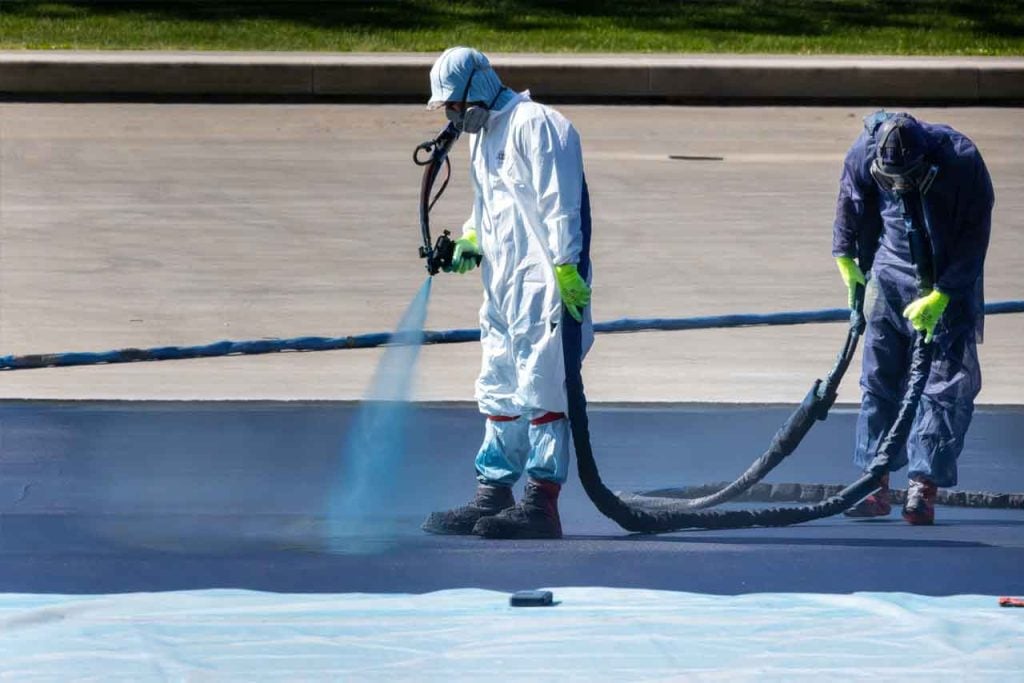
The project specifications bypassed conventional pool paint or plaster in favor of a multi-layer Rhino Linings system: Rhino 406 epoxy primer over the concrete, topped with a dark-blue Rhino Pipeliner 5000 hybrid-polyurea membrane applied at roughly 100 mils thick. The assembly was designed to perform as one integrated, monolithic waterproofing system.
For that system to succeed, every chemical interface has to work. The primer must bond to the concrete, the polyurea membrane must bond to the primer, and separately sprayed field sections must knit seamlessly together at the seams.
The system had two different clocks running, and both mattered. The Rhino 406 primer gave the crew up to 24 hours to get the Pipeliner 5000 membrane down. At one documented failure location, the coating went on outside that primer-to-membrane window.
Mariano warns that missing a manufacturer’s application window creates a serious barrier to adhesion.
“The primer underneath it had a tight window for the next coat,” he notes. “That kind of timing is everything. Once you get outside the manufacturer’s window, you have to treat it differently before you keep building the system.”
Then there was the issue with seams. Pipeliner 5000 had its own much tighter, roughly four-hour wet-on-wet window. In five documented failure areas, five hours or more passed between adjacent spray applications of the dark-blue material. At that point, the crew was no longer stitching fresh material into fresh material. They were trying to marry a new spray pass to an edge that had already started to cure.
“On a project this size, outdoors, under a hard political deadline, timing becomes a logistical knife fight,” Mariano says. “You are chasing weather, temperature, substrate conditions, equipment, crew movement, thickness, overlap and cure time while the clock is running in every direction.”

Atlantic Industrial Coatings later reported to investigators that insufficient primer application in some areas and material incompatibility contributed to widespread blistering. The contractor said the upper membrane layers heated beyond what the underlying layer could tolerate, creating a failure path between the coats.
The failure also drew congressional scrutiny. In a June 24 letter to Atlantic Industrial Coatings, Rep. Robert Garcia of California requested project specifications, coating performance standards, testing records and communications concerning deficiencies and corrective work. Garcia also asked the contractor to explain the system’s “apparent failure” and detail what was being done to address it.
“The American people deserve better management of their tax dollars,” Garcia wrote. “They also deserve to know how the contractors selected to do this work were vetted and how they plan to address their shoddy work moving forward.”
What those adhesion failures meant once the pool returned to service became increasingly visible. With little holding portions of the coating system to the substrate, isolated defects could quickly become much larger areas of delamination.
“Once it starts to delaminate, you can start peeling it back pretty easy,” Mariano explains. “The adhesion rate was minute. It was coming off in sheets, and you can pull it from one end to the other because there was very little bonding in it.”
For Mariano, the scale of the failure also points to a larger issue with approaching an immersed concrete vessel as though it were conventional industrial flatwork. Pools impose their own demands on materials, preparation and application that aren’t necessarily encountered on other concrete projects.
“Swimming pools are extremely temperamental, and our material choices are highly restricted,” Mariano emphasizes. “You can’t just take a standard industrial coating system and assume it will perform in a swimming pool.”

The Algae Debacle
The coating failure unfolded alongside a secondary public-relations nightmare: a highly visible algae problem. While the public record does not establish that delamination itself caused the biological growth, the two issues quickly became intertwined in the public eye and triggered millions in additional water-treatment spending.
To combat the murky green water ahead of the holiday events, the National Park Service awarded an emergency $1.7 million contract to Ohio-based Green Water Solutions for an ozone-nanobubble water-purification system. The system was intended to continuously inject ozone nanobubbles to destroy contaminants, while Interior officials said hydrogen peroxide was also used as part of the treatment response.
The response did not deliver a lasting operational fix. Once temporary equipment was taken offline, algae returned, and the pool remained associated with green water and the visibly failing blue coating. The government subsequently awarded another $2.7 million contract to American Ag Energy, Inc. to maintain, repair and rebuild the pool’s water-purification and sewage-treatment infrastructure.
Add the original renovation, the emergency nanobubble system and the secondary water-treatment award together, and publicly reported financial commitments reached at least roughly $19.1 million.

The Lesson Learned
The ultimate irony of the compressed schedule is how little the pool was actually utilized. The Reflecting Pool officially reopened June 6, showing off its new “American flag blue” appearance. Within days, the liner was peeling from the concrete floor in massive sheets. By mid-July—effectively a target window of only a few weeks—the pool had been drained again for repairs.
Atlantic Industrial Coatings returned to the site to address the failed lining under warranty, with Rhino Linings saying it was supporting the remediation effort. The pool was drained and closed during the reported repair period, and federal officials had not announced a firm reopening date in the reports reviewed for this story.
The rush to finish the project for the July 4 celebrations sits squarely at the center of the failure. Federal prosecutors ultimately described the installation process as rushed and flawed.
That artificial timeline compression squeezed the non-negotiable fundamentals that give an immersed coating system its chance to survive: deep substrate decontamination, uniform primer coverage, environmental controls, strict application timing and proper seam detailing. When those engineering steps get compromised, the failure waits patiently until water pressure, ambient heat and structural movement expose the weak interfaces.
“I think the push to finish by July 4 was the number one issue,” Mariano concludes. “Everybody was working against a hard deadline, and that is when problems start. When a job gets rushed, critical steps get squeezed. That never changes—and when it happens on a project this size, it gets expensive fast. That’s the lesson, if there’s anything to learn from this.”
Featured Photo Credit: Rob Atherton
Pool News
Pool Equipment Theft Is Becoming a Bigger Problem Than Most Homeowners Realize
Pool equipment theft is on the rise. Learn why thieves target pool pads and how to protect your pool equipment.

Pool equipment theft isn’t something most homeowners bother to think about until it happens to them.
That was the case recently in Bakersfield, California, where police are asking for the public’s assistance in identifying a man accused of stealing pool equipment from a residential property and causing thousands of dollars in repair damage. According to investigators, the theft took place over a two-day period, and surveillance images of the suspect have been released in hopes that someone will recognize him. Anyone with information is encouraged to contact the Bakersfield Police Department.
While the incident may seem like an isolated theft, it shines a light on a growing concern for homeowners, pool service companies, and builders alike. As the cost of pool equipment continues to rise, so does the financial impact when it ends up in the wrong hands.
Thousands of Dollars Sitting in Plain Sight
Modern pool equipment pads often contain thousands—even tens of thousands—of dollars worth of equipment.
Variable-speed pumps, gas heaters, automation systems, salt chlorinators, filters, and control panels are typically installed outdoors, often behind a side gate with little more than a fence separating them from the street.
For homeowners, that equipment represents a significant investment. For thieves, it’s an easy opportunity.
But according to Cole Daasnes, owner of Poseidon Pool Service in Loomis, California, many thieves don’t actually know what they’re stealing.
“It’s not like these thieves have pool knowledge,” Daasnes said. “They don’t know whether they’re looking at a heater, a pump, or a filter. Most of the time, they’re simply after the copper inside the equipment. They’ll destroy a piece of equipment worth several thousand dollars, hoping to recover a relatively small amount of scrap metal.”

While some electronic components and automation systems can be resold, heaters are often targeted simply because thieves assume they’re filled with valuable copper. The damage they leave behind can far exceed whatever they ultimately receive at a scrapyard.
The Real Cost Isn’t What the Thief Walks Away With
The financial consequences don’t end with the theft itself.
Without a functioning circulation system, pools can quickly begin to develop water quality issues, particularly during the summer months. Pumps stop circulating water, sanitizers can’t do their job, and algae can begin taking hold in a matter of days.
Then comes the expense of replacing the stolen equipment.
“It’s really a double whammy for the homeowner,” Daasnes explained. “First, someone destroys or steals equipment they’ve already invested thousands of dollars into. Then they have to hire someone like us to come out, remove what’s left, source replacement equipment, and install everything again. It’s an expense nobody plans for.”
Depending on what was taken, replacing equipment can cost several thousand dollars before labor is even factored into the equation.

Property Crime Carries a Heavy Price Tag
While pool equipment theft represents only a small slice of overall property crime, the financial impact of residential burglaries of this nature remains substantial across the United States.
According to national crime and insurance data, over half a million burglaries occur each year. In recent years, the average financial loss per burglary has ranged from roughly $2,700 to $2,800, with victims collectively losing $5.6 billion annually, according to recent statistics.
Those figures don’t always tell the whole story. Insurance may cover part of the loss, but homeowners are often still responsible for deductibles, depreciation, uncovered property, or upgrades required to replace older equipment with current models. Even when an insurance claim is approved, the inconvenience of replacing damaged equipment, restoring the pool, and waiting for repairs can far exceed the dollar amount on the claim.
For pool owners, the costs can escalate quickly. A thief who strips copper from a heater or damages a pump in the process may only walk away with scrap worth a few hundred dollars, while leaving behind thousands of dollars in replacement costs and labor.
Vacant Homes Are More Vulnerable
Most pool equipment theft happens when homeowners are out of town and the property is visibly unattended. An overflowing mailbox, dark backyard, empty driveway, or a side gate left unlocked can signal that no one is home.
For thieves targeting pool equipment, that window of time works to their advantage. A pool pad is usually located along the side of the home or in the backyard, away from the street and out of direct view. If a homeowner is gone for several days, a thief may have more time to access the property, remove equipment, and leave before anyone notices.
That is why cameras, alarms, motion lighting, and trusted neighbors can make a meaningful difference, especially during vacations or extended trips.
Protecting Your Equipment
No security measure can guarantee that equipment won’t be stolen, but there are practical steps homeowners can take to reduce the risk.
Installing motion-activated lighting around equipment pads can make side yards less attractive to thieves. Locking side gates and maintaining clear sightlines from the home also add layers of protection.
Daasnes believes one of the smartest investments homeowners can make today is electronic surveillance.
“If you’re seeing these kinds of thefts happening in your area, a backyard camera and an alarm system make a lot of sense,” he said. “Most people already have cameras covering their front door, but the equipment pad is usually tucked away on the side of the house where nobody’s watching. A camera back there can be a strong deterrent and may provide law enforcement with valuable evidence if something does happen.”
Recording serial numbers, photographing installed equipment, and registering eligible products with manufacturers can also simplify insurance claims and improve the chances of recovering stolen property.
A Growing Reminder for Pool Owners
This recent case in Bakersfield serves as a reminder that a pool’s equipment pad can represent one of the most valuable collections of mechanical equipment on a residential property.
While most homeowners focus on protecting what’s inside their homes, thousands of dollars’ worth of equipment often sits just outside, largely out of sight and, unfortunately, vulnerable to opportunistic thieves.
As equipment becomes more sophisticated and more expensive, protecting it is becoming an increasingly important part of responsible pool ownership. For homeowners in areas experiencing pool equipment theft, a few proactive security measures today could help prevent a much more expensive problem tomorrow.
Read the Fall Issue of Pool Magazine

See more of our coverage in your search results

 Master Pools Guild Welcomes Red Rock Design Build as Newest Member
 Luciana Amaro Joins Franklin Electric as Chief Human Resources Officer
 iGarden K Series Review: What We Learned After Months in a Customer’s Pool
 Sacred Geometry: Where Architecture, Mathematics and Mosaics Collide
 Anatomy of a Botched Remodel: What Sank the Lincoln Memorial Reflecting Pool Restoration?
 RB Retail & Service Solutions Launches RB Propel
 Pool Equipment Theft Is Becoming a Bigger Problem Than Most Homeowners Realize

 Pool Industry Accelerates Digital Transformation with POOLCORP and JobTread as Tech Stacks Become More Connected
 HASA Inc. Acquires Swimming Pool Chemicals Manufacturer Bio-Dex Laboratories, Inc.
 Landmark Aquatic Acquires CEM Aquatics
 Pool Brain Hires Eric Knight to Help Revolutionize Pool Industry Technology and Education
 CPSC Announces Spa Drain Cover Recall Over Entrapment and Drowning Hazard
 Pebble Technology International Introduces PebbleTec Glass Tile
 Swim Tests: When Schools Stop Teaching Students to Swim, Everyone Loses
 Sponsored Advertisement
 Sponsored Advertisement
 Pool News4 weeks ago
Leslie’s Files Chapter 11, Lenders Set to Take Control in Major Restructuring

 Pool Equipment4 weeks ago
AquaLink® EDGE™ and trackr iO Signal a New Direction for Pool Automation

 Features4 weeks ago
A New Era at POOLCORP: John Watwood Focuses on Customers and the Fundamentals
 Pool News5 days ago
Sacred Geometry: Where Architecture, Mathematics and Mosaics Collide

 Pool News3 weeks ago
Shasta Pools Hires 30-Year Builder to Head Residential Construction

 Retail4 weeks ago
Nasdaq to Suspend Trading in Leslie’s Stock on October 6

 Industry News3 weeks ago
Watershape University Announces Fall 2026 Session in San Diego

 Pool News4 weeks ago
Landmark Aquatic Partners With AngelEye on Drowning Detection Technology
You must be logged in to post a comment Login