





Features
The Critical Role of Circulation and Turnover in Residential Pool Performance


In the residential pool market, water clarity is often perceived as the greatest indicator of a well maintained pool, but this isn’t necessarily the case. Beneath the surface, proper circulation and turnover rate are the foundational drivers of water quality, chemical efficiency, energy consumption, and equipment longevity. Yet, these factors are frequently misunderstood, miscalculated, or oversimplified in both pool design and day-to-day operation.
As equipment technology continues to evolve, particularly with the rise of intelligent and adaptive pumping systems, the industry is being challenged to rethink how circulation is achieved and maintained. For pool professionals, understanding the science and application of turnover is no longer optional, it is essential.
Understanding Turnover: More Than a Number

At its core, turnover rate refers to the amount of time required for a pool’s entire water volume to pass through the filtration system once. In residential applications, this is typically expressed in hours per turnover.
Industry guidance generally suggests that residential pools achieve at least one turnover every 8–12 hours, with many professionals recommending closer to 6–8 hours for optimal water quality.
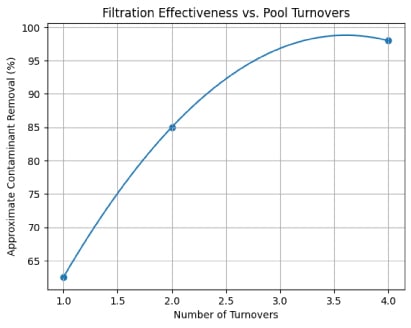
However, the concept is often oversimplified. A single turnover does not mean that 100% of the water has been filtered in a uniform or complete way. In reality, due to mixing dynamics, one turnover only removes approximately 60–65% of contaminants. Multiple turnovers are required to approach true filtration effectiveness, with two turnovers reaching roughly 85% and four approaching 98%.
This distinction is critical. Designing or operating a pool system around “one turnover per day” may meet a minimum threshold, but it rarely delivers optimal sanitation or efficiency.
Why Proper Circulation Matters

Turnover is only meaningful when paired with effective circulation. A system may technically achieve its target turnover rate while still leaving dead zones, areas of poor water movement where debris, bacteria, and algae can accumulate.
1. Water Quality and Sanitation
Proper circulation ensures that sanitizers such as chlorine are evenly distributed throughout the pool. Without it, localized imbalances can occur, leading to algae growth, cloudy water, and increased health risks.
2. Chemical Efficiency
When water is consistently moving, chemicals are used more effectively. Poor circulation often leads to overcompensation, adding more chemicals to address localized issues, ultimately increasing operating costs and creating inconsistent water conditions.
3. Energy Optimization
Circulation and energy consumption are directly linked. Running a pump longer than necessary wastes energy, but insufficient circulation leads to water quality issues that require corrective action, often at even greater cost. Achieving the correct balance is key.
4. Equipment Longevity
Hydraulic inefficiencies place unnecessary strain on pumps, filters, and heaters. Systems operating outside their optimal flow range are more prone to wear, leading to premature failure and increased maintenance requirements.
The Flow Rate Factor
Turnover rate is determined by a simple formula:
Turnover Time (hours) = Pool Volume ÷ (Flow Rate × 60)
While straightforward in theory, this calculation introduces a critical variable: flow rate. In practice, flow rate is influenced by numerous dynamic factors, including:
Filter loading (clean vs. dirty filter conditions)
Plumbing design and pipe diameter
Valve positions and system restrictions
Elevation changes and equipment layout
These variables mean that a pump operating at a fixed speed does not deliver a fixed flow rate. As system conditions change, so does the actual turnover performance.
This is where many traditional approaches fall short.
The Limitations of Traditional Pumping Strategies
Historically, residential pools have relied on single-speed or variable-speed pumps operating based on RPM (revolutions per minute). While variable-speed technology represented a significant improvement in energy efficiency, it still relies on speed as a proxy for performance.
The problem is that RPM does not equal flow.
A pump set to a specific speed may deliver vastly different flow rates depending on system conditions. For example:
A clean filter may allow high flow at a given speed
A dirty filter may significantly reduce flow at that same speed
In both cases, the pump is operating at the same RPM, but the turnover rate is not the same.
This disconnect can lead to under-circulation (compromising water quality) or overcompensation (increasing runtime and energy use).
Rethinking Circulation: A Flow-Based Approach
Modern pool operation is increasingly shifting toward flow-based system design and control. Rather than assuming that a given speed produces a consistent result, flow-based strategies focus on achieving and maintaining a specific gallons-per-minute (GPM) target.
This approach aligns directly with turnover requirements. If the flow rate is known and controlled, turnover becomes predictable, even as system conditions change.
Maintaining consistent flow ensures that:
Turnover targets are reliably achieved
Filtration operates within optimal parameters
Chemical distribution remains uniform
Energy usage is minimized without sacrificing performance

The Role of Adaptive Flow Technology: Nautis VSF
One of the most notable advancements in this area is the introduction of adaptive flow pump technology, exemplified by the Nautis VSF pump from H2flow Controls.
Unlike traditional variable-speed pumps that operate based on RPM, the Nautis VSF is designed to operate based on flow rate. This distinction is significant.
Maintaining Target Flow in Real Time
The Nautis VSF continuously monitors system conditions and automatically adjusts pump speed to maintain a desired flow rate. Whether the system experiences:
Filter loading
Partially closed valves
Minor blockages
Changes in hydraulic resistance
…the pump compensates in real time to maintain consistent circulation.
This capability directly addresses one of the most persistent challenges in residential pool operation: variability.
Ensuring Reliable Turnover
By maintaining a constant flow rate, the Nautis VSF enables predictable and reliable turnover
performance. Pool professionals can set a target flow that aligns with the desired turnover rate, confident that the system will maintain it, even as conditions change.
This eliminates the guesswork often associated with pump scheduling and system tuning.
Improving Efficiency and Reducing Costs
Because the pump only increases speed when necessary to maintain flow, it avoids the inefficiencies associated with fixed-speed operation. The result is:
Reduced energy consumption
Lower operating costs
Less strain on equipment
At the same time, consistent circulation improves chemical distribution, often reducing overall chemical usage.
Simplifying System Management
For service professionals and homeowners alike, adaptive flow technology simplifies pool management. Instead of continually adjusting pump speeds or run times to account for changing conditions, the system self-regulates.
The outcome is a more stable, predictable, and efficient pool environment.
Practical Implications for Pool Professionals
As circulation technology evolves, so too must the approach to pool design and operation. Professionals should consider the following best practices:
Design for Flow, Not Just Equipment
System design should prioritize hydraulic efficiency, including proper pipe sizing, minimized restrictions, and optimized equipment layout.
Measure and Verify
Incorporating flow measurement, either through integrated systems or external flow meters, provides valuable insight into actual system performance.
Optimize Turnover Strategically
Rather than defaulting to fixed pump schedules, turnover should be calculated based on real flow rates and adjusted for factors such as bather load, weather, and seasonal use.
Embrace Adaptive Technologies
Flow-based and adaptive systems offer a more precise and efficient way to achieve circulation goals, reducing both operational complexity and long-term costs.
Looking Ahead
The importance of proper circulation and turnover in residential pools cannot be overstated. These factors underpin every aspect of pool performance, from water clarity and sanitation to energy efficiency and equipment lifespan.
As the industry continues to move toward smarter, more connected systems, the shift from speed-based to flow-based operation represents a fundamental evolution. Technologies like the Nautis VSF pump are not just incremental improvements, they are redefining how circulation is managed.
For pool professionals, the opportunity is clear: by prioritizing proper circulation and leveraging advanced technologies, it is possible to deliver better outcomes for clients while reducing costs and complexity.
In the end, a well-circulated pool is not just cleaner, it is smarter, more efficient, and built for the future.





For John Watwood, taking the helm of POOLCORP represents something of a full-circle moment.
More than two decades before becoming President and CEO of the world’s largest distributor of swimming pool supplies, equipment and related outdoor living products, Watwood was learning the business from the ground up as a young participant in POOLCORP’s Manager in Training program.
“Right out of college, POOLCORP was my first career move,” Watwood told Pool Magazine. “I came in as an MIT. I was young. Loved the industry.”

His career would eventually take him outside the pool industry and into the bearing, power transmission and fluid power sector, but Watwood continued following both POOLCORP and the industry he had left behind.
“I always kept up with it. I always kept up with POOLCORP and what they were doing and where they were going, because I just thought it was such a unique industry, and it just kind of fit who I really was.”
One piece of advice from his first stint with the company proved particularly prophetic.
“My boss at that time, a guy named Bill Adams, who’s still with us, he told me, ‘Once you’re in the pool industry, you never get out,’” Watwood recalled. “And I guess that ended up coming true after 20-plus years, and I found my way back.”
From Management Trainee to CEO
Watwood certainly wasn’t thinking about eventually running the company during those early days. Asked whether becoming CEO had ever crossed his mind while participating in the MIT program, his answer was immediate.
“No. At that point, I think I was just trying to make sure I got to work on time,” he said.
The experience nevertheless left a lasting impression. Watwood spent roughly 90 days working in the warehouse, learning products and becoming familiar with the nuts and bolts of the distribution business.
“There are still a lot of part numbers that stuck with me from that original stint to this very day that I can easily rattle off,” he said. “Somebody comes in, they’re asking for a two-inch 90 slip. Man, I know exactly what that is and where to go.”
Decades later, Watwood returned to a dramatically larger organization and an industry facing a very different set of circumstances.
He stepped into POOLCORP’s top leadership position following several difficult years for the pool industry. Elevated interest rates, reduced housing turnover and a slowdown in new pool construction have placed pressure on builders and the broader supply chain, while the large installed base of existing pools has made service, repair and renovation increasingly important areas of the market.
Watwood doesn’t minimize those headwinds.
“We’ve got some challenges here for sure in the industry, and we’ve got some things we’ve got get better at POOLCORP for sure,” he said. “But overall it’s been great.”
Rather than arriving with a sweeping transformation plan, Watwood said his first months have largely been spent listening.
“My focus is to listen more than I talk,” he said. “I spend a lot of time in the field with our teams, at our sales centers, on calls with customers.”
Those conversations have centered on understanding what POOLCORP already does well, but perhaps more importantly, identifying where customers encounter friction.
“There’s just nothing you can do to replicate being in front of a customer and just listening to what their pain points are and what they need from us,” Watwood said.
That connectivity, he said, won’t simply be part of an introductory listening tour.
“The organization just has to be super connected to the industry, to our customers, to our employees, so we’re really listening to what they need us to be and where we need to go.”

Moving Beyond the Supplier Relationship
For a company whose scale has long been one of its defining competitive advantages, Watwood sees operational execution as a strength POOLCORP needs to preserve.
“We’re really good at the hard stuff,” he said, “when it comes to the operations, the four walls, POOLCORP’s really good at that, and has been for many years.”
But being an effective distributor is only part of what Watwood believes customers will require from POOLCORP moving forward.
“Can we be a better partner to the industry and the businesses out there? Of course we can,” he said. “Not just being a supplier, but being a business partner is just critical to the success of POOLCORP now and in the future.”
That distinction runs throughout Watwood’s strategy.
When considering what success should look like over the next 12 to 24 months, he isn’t pointing toward one massive initiative designed to reinvent the company. Instead, he describes himself as a “fundamentals guy,” with an emphasis on sales excellence, pricing and supply chain, operational execution and strategic M&A.
“I don’t think there’s any big super transformational thing POOLCORP needs to do here,” Watwood said.
From the customer’s perspective, however, he identified several straightforward benchmarks.
“We’ve got to be easier to do business with,” he said. “We need to find new ways to help them grow their business, not just supply them, and we have to continue to build trust with them.”
Reliability remains central to that equation.
“If they need something from us, they have to know it’s there. They’ve got to know we can get it to them and get it out the door quickly because time is money in this industry.”
Finding Opportunity in a Difficult Market
Exactly where those opportunities lie varies considerably across POOLCORP’s customer base.
New construction remains the most obvious trouble spot.
“That’s been the most challenged,” Watwood said. “It’s been a really tough environment for the last few years. Higher rates, less housing turnover. We all know the reasons why. It’s really slowed down new pool starts.”
The issue, from Watwood’s perspective, is larger than any single manufacturer, distributor or builder can solve independently. Getting the middle-market consumer back into the market will require cooperation throughout the industry.
“I think it’s gonna take a collective effort of all of us, supplier, distributor, dealer, builder, to really talk about what we can do and what we can impact,” Watwood said.
Those discussions are already happening. Watwood said conversations with large pool builders have focused on how POOLCORP can become a better partner and help move more pools, including addressing costs that may be keeping middle-market consumers on the sidelines.
Service and retail present a considerably different picture.
“Service and retail, that’s probably the most near-term opportunity I see,” he said. “There’s millions of pools already out there, already in the ground. The repair and remodel business has been pretty strong for us. The service business remains strong as well.”
For those businesses, Watwood sees opportunities for POOLCORP to expand its programs for chemicals and construction building materials while finding additional ways to help customers become more sustainable and profitable.
“We’ve got lead generation and joint marketing programs, really being linked up on the supply chain side,” he said. “That’s what everybody’s looking for as a partner right now, and they should be.”
Still, Watwood makes no secret of the fact that a healthier new construction market would benefit virtually every corner of the pool and outdoor living sector.
“We all wish the industry would be a little more robust, right?” he said. “It would really help us out if we could get that new pool construction 20, 30% more than what it is right now.”
New pools built today eventually become tomorrow’s service, repair and renovation customers, making construction an important feeder for the industry’s long-term installed base.
When that rebound arrives, however, remains difficult to predict.
“I honestly don’t have a crystal ball to say when the market is going to turn yet,” said Watwood.
Helping Pool Professionals Grow
Against that backdrop, Watwood believes POOLCORP’s responsibility extends beyond keeping products on the shelves.
He pointed to the company’s Retail Summit as one example of how POOLCORP can help dealers improve their businesses rather than simply sell them more inventory.
“We bring dealers in, we teach them how to run a more profitable business, how to merchandise better, how to think about their season differently,” Watwood said. “That’s us, really investing in their success, not just moving product.”
Technology represents another component of that strategy.
Watwood highlighted Pool360, which gives customers visibility into POOLCORP’s broader distribution network and the ability to check inventory beyond their local sales center.
“It’s not just an ordering tool,” he said. “It gives dealers visibility into our entire network so they can access inventory, manage their business, serve their own customers better than they could by just working off the local supply.”
Product training and marketing support also factor into the equation. Watwood said POOLCORP wants customers to have the knowledge needed to confidently sell and install new products while helping them compete more effectively in their local markets.
The objective is to identify the particular challenges confronting each type of customer rather than treating every business the same.
“It doesn’t matter if it’s retail or service or builder,” Watwood said. “They all have, as we were saying earlier, different friction points there that they’re trying to work through and we typically have a way to help them work through that.”
POOLCORP intends to continue refining the platform and reducing what Watwood described as user experience friction. At the same time, he stressed that some of the company’s most important improvements may be considerably less visible.
“How easy is it to place an order? How fast somebody gets an answer when they call in? How simple it is to check pricing or account information? How do we remain consistent in those areas?” he said.
“None of that’s flashy, but when it comes to distribution, the basics matter. The foundations matter. That’s the stuff that builds trust over time.”
Ultimately, Watwood said, customers want consistency. Technology can help create that experience, but Watwood’s view of distribution remains decidedly grounded in fundamentals.
“You got to be in the right areas. You got to have the right product in those areas. You got to have knowledgeable people working the counters, and just build upon those relationships.”
Authenticity, Transparency and Listening
Watwood’s approach to leadership follows a similar philosophy.
Among the first messages he delivered internally was the importance of authenticity.
“You’ve got to be authentic,” he said. “Who you are is who you are, and you can’t act one way towards one person and another way towards another person.”
Closely connected to that is transparency, something Watwood believes becomes increasingly important as both POOLCORP and its customers adjust to changes in the marketplace.
“The industry’s changing, we’re changing, customers are changing,” he said. “We need to be open and honest about what those changes are, where we’re going, and what we need to do to get there.”
That also means being willing to question practices simply because they’ve worked historically.
“Whatever we’ve done in the past for 20 years, maybe that’s not what we do moving forward.”
Watwood has asked the company’s executive leadership team to encourage that transparency internally, and he wants the same candor from POOLCORP’s customers.
In fact, some of the conversations he values most are with companies that don’t currently do much business with POOLCORP.
“I go and visit customers that don’t buy a lot from us because I learn a lot about the reasons why,” he said. “Probably I learn as much from those customers as I would any customer that does buy more volume from us.”
It’s an approach that requires hearing criticism as readily as praise.
“If we made some missteps in the past, I need to know those things,” Watwood said.
For an executive whose career with POOLCORP began at the warehouse level, that willingness to listen may ultimately define his tenure more than any individual initiative.
His message to builders, service professionals, retailers and dealers is that POOLCORP ultimately has to prove its value by adapting to what its customers need.
“POOLCORP is their business. It’s their company,” Watwood said. “This is a business that needs to adjust to be what they need it to be, and that’s being a true business partner.”
There are areas where POOLCORP already excels, he acknowledged, and others where the company has work ahead.
“But at the end of the day, if we don’t meet the customer’s needs, how and where they need to be met, then what’s our value proposition?”
For Watwood, the path forward comes back to the same principle that has shaped his first months in the job.
“We’re going to continue to listen. We’re going to continue to adjust and adapt,” he said. “And I think you’ll see a POOLCORP that gets even better as we move into the future.”
Ready to take a deeper dive?
Listen to our entire conversation with John Watwood, President and CEO of POOLCORP on the Pool Magazine Podcast.

Leslie’s common stock is headed for suspension from Nasdaq next week—and, under the pool retailer’s proposed Chapter 11 restructuring plan, existing shareholders are slated to receive nothing when the company emerges from bankruptcy.
Nasdaq notified Leslie’s on September 25 that its common stock was subject to delisting after the shares had closed below the exchange’s $1 minimum bid requirement for 30 consecutive business days. Trading in LESL is scheduled to be suspended at the opening of business October 6 unless the company requests a hearing by October 2. Leslie’s has said it does not intend to appeal.
Importantly, Nasdaq’s delisting determination predates Leslie’s September 30 Chapter 11 filing. The determination was based on the company’s failure to meet Nasdaq’s minimum bid requirement and its ineligibility for another compliance period following a reverse stock split.
The more consequential issue for shareholders is the restructuring itself: Leslie’s plans to eliminate roughly $685 million of funded debt and shift ownership of the reorganized company to lenders and new-money investors, with all existing common equity set to be canceled for no consideration when the restructuring becomes effective.
What Happens to LESL Stock Now?
Delisting does not necessarily mean Leslie’s shares immediately stop trading altogether.
Leslie’s said it anticipates its common stock will begin trading on a market operated by OTC Markets Group after Nasdaq suspends trading. The company cautioned, however, that there is no guarantee an OTC market will develop or remain available, that broker-dealers will continue quoting the shares, or that sufficient trading volume will exist to create an efficient market.
That creates an important distinction for investors.
LESL could continue changing hands while the Chapter 11 case works its way through bankruptcy court, but those shares would still represent Leslie’s existing equity. They would not represent ownership in the reorganized company expected to emerge from Chapter 11 if the proposed plan is confirmed and becomes effective.
Leslie’s warned investors that trading during Chapter 11 is “highly speculative” and that the market price of its securities may bear little or no relationship to whatever recovery holders ultimately receive.
That warning is particularly significant here because the proposed restructuring provides no recovery for existing common shareholders.
Once Nasdaq suspends trading, it intends to file Form 25 with the Securities and Exchange Commission to formally remove Leslie’s common stock from the exchange.
Nasdaq Rule 5450(a)(1) requires listed companies to maintain a minimum bid price of $1 per share. Because Leslie’s completed a reverse stock split within the previous year, Rule 5810(c)(3)(A)(iv) makes the company ineligible for the normal compliance period that might otherwise provide additional time to regain compliance.

Who Owns Leslie’s After Bankruptcy?
Lenders holding approximately 81.1% of Leslie’s outstanding prepetition term-loan principal have already signed onto the restructuring support agreement.
Under the proposed restructuring, a $60 million equity financing will receive 55.8% of the reorganized company’s new common equity. Existing term lenders will receive another 10% on a pro rata basis. The remaining portion of the term-loan DIP financing, including certain premiums and accrued interest, is expected to convert into 30% of the new common equity. Those allocations remain subject to dilution under the company’s management incentive plan.
The result will be a Leslie’s with substantially less debt and an entirely different ownership structure.
The distinction between the company and its stock is important. Leslie’s expects its stores and operations to continue through Chapter 11, and the company intends to emerge from bankruptcy in early 2027. Existing LESL shares, however, do not carry over into that reorganized company under the proposed plan.
Could Leslie’s Ever Trade on Nasdaq Again?
Leaving Nasdaq does not necessarily mean Leslie’s can never return to a major exchange.
A reorganized Leslie’s could seek a future Nasdaq listing if it meets the exchange’s applicable requirements. Any future listing would involve the reorganized company and its new equity—not a revival of the LESL shares currently held by investors.
For now, those shares may have another life in the over-the-counter market after October 6. How long they trade and at what price remains a matter for the market.
What the proposed restructuring makes considerably clearer is where those shares ultimately end up: canceled when Leslie’s emerges from Chapter 11.
Featured Photo Credit: JHVEPhoto


As homes get smarter, homeowners are expecting the same intelligence and control from their pool. Today, that means a fully integrated, smart backyard that gives them the same level of control they have inside the house. For today’s pool professionals, managing those expectations while dealing with labor shortages, complex wiring schematics, and the inevitable weekend service emergency can feel like a juggling act.
Jandy’s AquaLink® EDGE™ automation system puts an end to the manual juggling. Designed with pool professionals in mind, the EDGE platform delivers pool automation that connects people, equipment, and experiences seamlessly. It represents a massive leap forward in pool service
Here are five groundbreaking features within the EDGE platform that can simultaneously elevate the customer experience while making the service pro’s everyday operations significantly easier.

1. Integrated Architecture
Field labor is at an absolute premium today, so every minute saved at the equipment pad has an impact on a business’s bottom line. Traditional automation setups frequently require mounting external power supplies, sub-panels, and secondary control boxes to handle peripheral features like low-voltage lighting or saltwater chlorination.
AquaLink® EDGE™ uses preassembled kits and a highly integrated internal architecture that streamlines the entire automation setup. It features the industry’s first integrated low-voltage LED power supply built directly into the system, eliminating the need for standalone external transformers. Plus, a built-in saltwater card utilizes the exact same internal power architecture, creating a completely streamlined system.
By removing extra wiring bottlenecks and points of failure, crews can complete high-end installations with greater speed, consistency, and confidence.
“I like this unification of it where it’s more like creating an operating system that everything can plug into,” notes Ryan of Prestige Pool and Patio. “The professionals do the professional things and the customer gets to do the customer things.”

2. EDGE Insight
Historically, service companies have operated reactively. It’s a blistering-hot Saturday, and homeowners are calling left and right for emergency service.
EDGE Insight is a diagnostic system that provides real-time visibility into equipment health and system performance. Instead of waiting for a component to fail completely, EDGE Insight monitors performance metrics and sends proactive notifications regarding system anomalies directly to the professional. Technicians can spot declining flow rates, chemical variances, or heater communication glitches before the pool owner ever notices a change in their water.
It’s all easily managed through the Fluidra Pro app for 24/7 insight to customers’ systems.
Mike Donnelly of Crystal Beach Pools stresses the value of this insight: “I really like the idea of getting a heads up before a client knows… If I’m getting a message telling me this isn’t working now and I can get it dealt with before the person even notices, that makes my life measurably better.”
3. Integrated Touchscreen
It’s a horror story that’s all too common: a technician stands in the blazing sun or pouring rain at an equipment pad, struggling to sync a mobile app over a weak backyard WiFi signal just to check a relay or test an actuator.
AquaLink® EDGE™ eliminates this frustration via an integrated touchscreen right on the local control panel that’s glove-and-wet-hand-friendly. Technicians have complete, immediate access to system configuration, diagnostic logs, schedules, and manual overrides directly at the pad—no laptop, smartphone, or internet connection required.
Plus, that insight through the Fluidra Pro app will help you prepare before you even get to the jobsite. “It’s telling you before you even know it yourself, which is beautiful,” says Kelsey Wolfenbarger of Republic Pools/Pool Service Bros.
There’s no reliance on a home’s network during a standard service routine, so crews can execute diagnostics, address a problem, and move on to the next job quickly. If an accidental setting change ever does occur, the cloud-based EDGE Vault automatically backs up system configurations, allowing a technician to restore complex schedules instantly and prevent costly downtime.
4. Personalized User Profiles
User error can be a huge pain point in pool management. Homeowners hoping to avoid the cost of a service call dive into advanced settings, accidentally altering pump speeds or filtration cycles and disrupting their pool’s hydraulic balance. Innocent mistakes can have big consequences in the finely-tuned machinery of a pool.
AquaLink® EDGE™ mitigates this problem with structured User Profiles. The software establishes a clean line of demarcation between the professional installer and the consumer.
- Homeowners get a beautiful, intuitive in-home interface focused on lifestyle features like “Scenes,” temperature adjustments, and lighting controls.
- Service companies can assign individual logins to their staff members, allowing them to track system changes via an Activity Log without ever sharing client passwords.
This separation allows the homeowner to retain control over the aesthetic features that matter most to them, without wandering into the technical weeds.
“I love the fact that there’s a pro side and a customer-friendly side… you’re not bogging down the customer with all the things they really don’t need to see,” says Edwin Escobar of Regal Pools.
5. Localized Control
App control is convenient, but relying 100% on the cloud could lead to troubleshooting calls if a homeowner upgrades their router or experiences a local ISP outage.
EDGE provides a convenient, always available, always ready interface via a dedicated in-home touchscreen tablet, the Home Hub. The tablet communicates locally with the equipment pad, providing full access to personalized scenes, schedules, and equipment controls entirely independent of an internet connection. If the home’s WiFi drops, the pool is still within the customer’s (and your) control.
“Honestly, coming with the in-home controller for the customer because losing internet access, meaning they lose control of their pool, is just a nightmare for us… obviously, all that being local is going to make a huge difference,” explains a representative from Aqua Doctors/Azurion.
Future-Proofing the Backyard
The one constant in the technological age is change. Homeowner expectations change, technology innovates. The true value of any automation system is its ability to keep up. Rather than forcing pool pros into a continuous loop of hardware replacements, AquaLink EDGE enables automatic software updates that continually deliver new features, expanded equipment compatibility, and performance enhancements wirelessly through the Fluidra Evolve framework.
AquaLink® EDGE™ transforms the equipment pad from a fragmented group of components into a cohesive, continually learning operating system. This innovation is a win-win for pool owners and service pros alike. Homeowners get a worry-free luxury experience, while pros get the tools they need to diagnose and fix issues faster, and spend more time scaling their businesses.
Read the Summer Issue of Pool Magazine

See more of our coverage in your search results

 Soake Pools Bolsters National Growth With Four Key Hires
 Hayward Holdings Names New Chief Accounting Officer
 Daldorado Names Marcia Gyles Director of Sales
 Landmark Aquatic Brings Poolside Adventures Attractions Nationwide
 Shasta Pools Hires 30-Year Builder to Head Residential Construction
 Watershape University Announces Fall 2026 Session in San Diego
 NTCA Welcomes Jennifer Ibe and Rachel Smith to the Team

 Creating Multi-Purpose Areas For All Types Of Pools
 Why Do We Need Accurate Swimming Pool Chemical Logs?
 PHTA Announces Newest Strategic Partner: Watkins Wellness
 Pool Pumps: The New Rules
 Modern Pool Renovation Provides More Opportunities For Recreation
 Rolls-Royce Recreates One of Rock’s Most Infamous Poolside Legends
 Pool & Hot Tub Alliance Announces Diversity, Equity, and Inclusion Statement
 Sponsored Advertisement


 Pool News3 weeks ago
Leslie’s Reportedly Prepares for Chapter 11 Bankruptcy as Possible Nasdaq Delisting Looms

 Pool News2 weeks ago
Leslie’s Files Chapter 11, Lenders Set to Take Control in Major Restructuring

 Features2 weeks ago
A New Era at POOLCORP: John Watwood Focuses on Customers and the Fundamentals

 Pool Equipment2 weeks ago
AquaLink® EDGE™ and trackr iO Signal a New Direction for Pool Automation

 Pool Equipment4 weeks ago
Hayward Issues Recall for Universal Pool Heaters Over Carbon Monoxide Risk

 Press Releases4 weeks ago
FSPA and PHTA Reunite Through Historic Affiliation

 Press Releases4 weeks ago
Automatic Pool Covers Expands National Sales Team

 News4 weeks ago
Aquatics Veteran Natalie Hood Launches Natalie Hood & Associates, LLC
You must be logged in to post a comment Login