





Pool Builder
Why Veteran Pool Builder Marco Perrella is All-In on Ozone


For decades, Marco Perrella has been the guy other elite builders call when they’re staring down a hillside, a seismic zone, or a technical design challenge that no one else wants to touch. He carved out that reputation early, having jumped from carpentry into high-end landscape and pool design in the late ’80s and then never looking back.
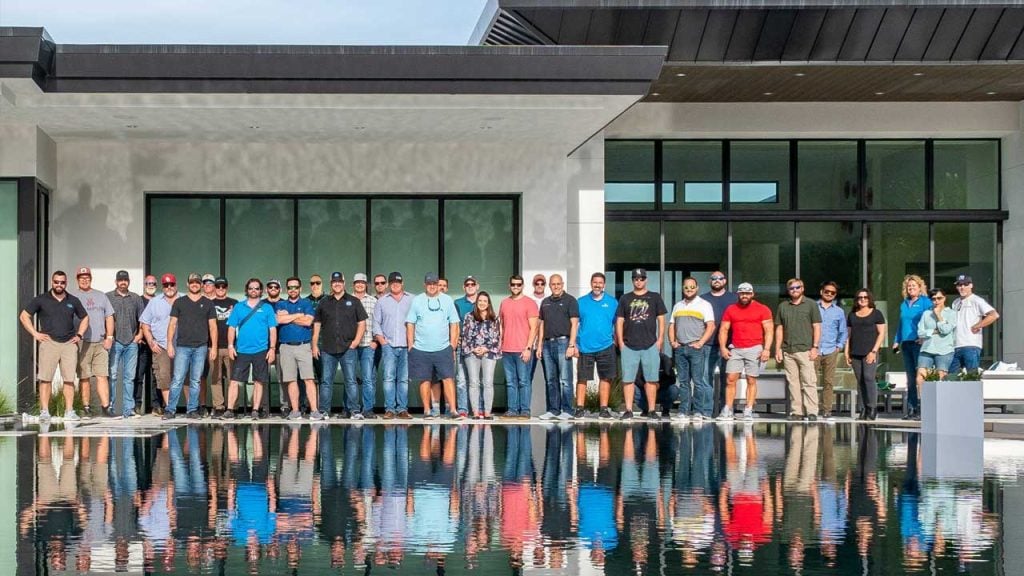
But the one constant in Perrella’s career has always been curiosity — curiosity about materials, engineering, technology, and better ways to build. That instinct is what pushed him deeper into plumbing, hydraulics, and structural problem-solving offered through Genesis. It’s aslo what drew him into the Tributary Revelation, the tight-knit circle of designers and builders who continually raise each other’s game. And it’s exactly the same instinct that eventually pulled him into ozone.
Perrella laughs, describing the Tributary group now, but it’s clear his involvement in the organization means a lot to him. “It is the most life-changing, business-changing, personal-life-changing group,” he said. “Everybody just wants to keep raising the bar. Somewhere along the line, if you’re gonna try something, somebody in this group has been there and done that.”

That collaborative energy is the same force that pushed him—slowly at first—toward a completely new way of thinking about water and how people use their swimming pools.
Going All-In on Ozone
During a Tributary event in Colorado in early 2020, water became the central theme. That’s where Perrella was first introduced in depth to ozone by consultant and educator Beth Hamil, whom he jokingly calls “the Queen of Ozone.” She agreed to speak at the event, and by the end of her presentation, Perrella made a decision: “I said, okay, I want to get one of your systems and try it out in my pool and spa.” Two weeks later, as the country locked down, the units arrived at his doorstep.
With normal business on pause, he took the opportunity to replumb his equipment pad and run ozone at home.
“I had a traditional setup and a small UV system,” he explained. “I put that ozone on and it was a complete game changer.”
“There was absolutely no chlorine smell at all. I said, ‘Oh my gosh, look at this water,’” recounted Perrella. He suddenly found himself using his spa nightly. He joked with friends that he was going out for his “COVID cleanse” in the spa, but behind the humor was a serious realization. “I would just get in and the feel of the water, the clarity… it was another level.”

He had seen enough. “That’s when I decided I was all in,” he said. He began specifying ozone on new projects and offering it as a key differentiator in his builds. It quickly became integral to what he considered a truly finished, high-end pool.

Two Steps Forward, One Step Back
Perrella’s early ozone journey almost derailed when Microplasma — the company behind his initial system — struggled during COVID. “There were a lot of hiccups,” he said. “They ended up shutting down… and that was a huge disappointment because I was so in love with ozone and committed to it.”
That’s when Beth made a timely introduction to Joe Cannavino, a commercial ozone veteran whose systems were designed for surf parks and water parks, not backyard pools. He had zero interest in the residential market, but Perrella saw something bigger.
Making The Next Big Leap, Bringing O3 Tech to Market
“ I knew I still had friends in Tributary who loved ozone, and I said to Joe, ‘What if we brought your tried-and-true machines to the residential market?’” recalled Perrella. That conversation would become the foundation of O3 Tech, a new company Perrella formed in 2023 with technical input from Beth Hamil and the engineering expertise and design skills of Joe Cannavino.
“After I put it in my pool and tried it for a while. I wanted to make sure this thing was as bulletproof as you could get,” said Perrella. So he had his friends and fellow Tributary members test units out in their own pools, and the feedback was phenomenal.
Today, O3 Tech units are on projects with firms like Red Rock and Premiere Paradise in Arizona, Design Ecology in Texas, Basin Pool Designs in Tennessee, Ozzie Kraft in Las Vegas, and Live Chlorine Free in Florida, just to name a few. “It’s catching on very fast,” he said, even as he acknowledges that some builders have “a little PTSD” from underperforming ozone experiences in the past.
“To be clear, these aren’t new machines,” he said. “They’ve been around forever.” What makes them unique is their size, output, and reliability — industrial-grade ozone re-engineered for elite residential builds.

Making the Case for Ozone to High-End Clients
Ask Perrella why ozone is worth the conversation, and he comes back to one word: reduction.
“The chemical reduction,” he said. “When you can have something that can take chlorine use down to a minimum, we’re living in a healthier world. People are more conscious about what they’re getting into, what’s on their skin.”
In his market of the North Bay area, that message resonates immediately. “I bet you nine out of ten of my pools that we design and build have our system on it,” he said. “It’s the easiest sell ever. The minute you start saying, I can reduce your chemicals to virtually nothing, that’s the end of the conversation.”
He also spends time demystifying salt systems. “The first thing you typically have to tell people is, do you realize that a salt pool is actually converting to chlorine?” he said. “That opens their eyes right out of the gate.”
Behind the sales conversation is a strong technical stance on what effective ozone actually requires. Perrella is candid about the limitations of many smaller systems on the market. “There are other systems out there that are really like toys,” he said. “You’ll see these AOP units dosing at, say, 500 milligrams. That’s barely enough for a spa, but you’ll see marketing that says that system is good for up to a 25,000-gallon pool.”
By contrast, he notes, “our smallest machines are fifteen and twenty-five grams at five percent weight. That’s a big difference.” For truly effective performance, he said, “the optimum is one gram per 10,000 gallons.”

Equally important is simplicity. As a designer-builder who does not run his own service company, Perrella knows his systems must work in the real world. “Our system is at the mercy of service outfits, so it has to be something that doesn’t overwhelm them,” he said. That criterion is a core fundamental of O3 Tech’s residential ozone units. “I didn’t want to end up being a tech and service center with the phone ringing all day,” he said. “I wanted something easy to plumb in, easy to program, and then easy to step away from and just watch it do its thing.”
For a designer who has spent decades perfecting structures, details, and environments, ozone represents something more elemental: better water, achieved through better engineering. Perrella sees it as an extension of the craft itself — a way to bring the quality of the water in line with the quality of the spaces surrounding it. And in his view, that alignment is long overdue.
Ready to take a deeper dive?
Listen to our entire conversation with Marco Perrella on the Pool Magazine Podcast.
Featured Photo Credit: Basin Pool Designs | Jimi Smith Photography




Pool Builder
Ownership Group Acquires Shasta Pools, Announces Expansion Plans to Offer Complete Home Services
Dansons Capital Group, Accrual Equity Partners, and Hydro Construction purchased Arizona’s premier pool builder with eye on developing national brand


SCOTTSDALE, Arizona (August 31, 2026) – Dansons Capital Group, in partnership with Accrual Equity Partners (AEP) and Hydro Construction (HydroCon), completed the acquisition of Shasta Pools, Phoenix Metro’s most recognized pool builder, and announced an immediate expansion into the broader home services market with plans to grow the brand into a national powerhouse. Founded in 1966 by brothers Bob and Skip Ast, the third-generation, family-owned pool business has built or renovated more than 150,000 pools across Maricopa County and is among the country’s top premier pool builders. The acquisition, finalized August 6, positions the company with a competitive edge as it enters a new phase of accelerated growth
Building on Shasta’s track record of success, the ownership group will grow the company’s core business divisions, including residential and commercial pool construction and renovation, Shasta Signature Series luxury pool designs, backyard hardscaping solutions, extended warranties, and e-commerce supplies. The deal also directs new capital into Shasta’s high-volume, recurring pool maintenance business, establishing a scalable foundation for an expanded home services portfolio.
Expanding the Home Services Model

Shasta Pools will also debut Shasta Home Services, the first step in the company’s expansion into a comprehensive home services platform. Shasta enters the space with more than 200,000 customer relationships, route density in Central Arizona, and a 60-year brand homeowners have entrusted with their homes. The company plans to aggressively expand the platform organically and through partnership across the essential services every home depends on.
In addition, work has begun on a new, state-of-the-art design center and headquarters in Scottsdale that will centralize operations and give customers a welcoming, creative atmosphere to reimagine their yards. The campus will also anchor a technology-driven contact center staffed by a world-class team that creates a single point of contact for every Shasta customer, from pool service to the company’s expanding home services platform.
A Partnership Rooted in Shared Values
Dansons Capital Group, a family business led by CEO Dan Thiessen, President Jeff Thiessen, and COO Jordan Thiessen, built and grew a portfolio of backyard-focused businesses including Pit Boss Grills, which they scaled into a worldwide brand before selling in June 2023.
Jeff Thiessen sparked a relationship with the Ast family during the construction of his own backyard pool, a personal experience that gave him firsthand insight into the industry’s potential. Recognizing the Ast family’s shared values and significant opportunity with strategic investment, he partnered with AEP and HydroCon to pursue that growth together.

“Shasta Pools has national industry brand recognition and has been an Arizona legacy for the last 60 years and we’re excited to reinvest in the company and catapult its growth into the next 60 years,” said Jeff Thiessen, President, Dansons Capital Group. “We’ve already met with more than 200 employees to learn what they love about Shasta Pools and hear their ideas of how we can grow the company and continue providing our customers with amazing customer service.”
Dan Thiessen will serve as Chairman and lead the new ownership team to identify and hire top industry talent and grow Shasta’s home services platform to develop it into a national brand.
Legacy Preserved, Future Secured
“This was the right time to bring in a new ownership team to take Shasta Pools to the next level and the next generation of growth,” said Skip Ast Jr., who served as president at Shasta Pools. “My father and my family built this company on a commitment to quality to every homeowner who trusted us with their backyard, their budget, and their own family. We’re confident that the new leadership team’s commitment to uphold that will never change. Knowing this team shares our values and will invest in our team gives Shasta Pools the foundation to grow stronger than ever.”
Ast helped build Shasta Pools to a dominant force in the industry, with multiple divisions topping $100 million in combined revenue. The company holds membership in the prestigious Master Pools Guild, one of only 110 members globally.
A Different Approach to Private Equity
“Partnering with Shasta Pools represents the future of home services. A trusted, generational brand, Shasta brings 200,000 loyal customer relationships with a genuine commitment to the people who serve them every day,” said Jacob Tilzer, Co-Founder and Managing Partner at Accrual Equity Partners. “Together with our partners at Dansons Capital Group and Hydro Construction, we all share a belief that enduring businesses are built on trust, earned one customer at a time. We’re proud to build alongside this team as Shasta grows into a nationwide home services brand.”
The new ownership group brings more than 150 years of combined expertise in building, scaling, and optimizing service industry brands. Each company shares a faith-based approach to business grounded in stewardship, integrity, and care for the communities they serve. Shasta Pools’ brand will continue its community programs, including swim lessons, support for foster care, and initiatives serving first responders.
ABOUT DANSONS CAPITAL GROUP:
Dansons Capital Group, headquartered in Scottsdale, Arizona, is a family-owned and family-managed investment firm built on shared values, integrity and long-term vision. The firm was established by the founders of Dansons, Inc., the company that launched and sold Pit Boss Grills. The company takes a hands-on approach, actively seeking opportunities across global markets and multiple asset classes. Its growing portfolio includes strategic real estate development holdings across multiple countries, oil drilling technologies, and limited partnership investments. Guided by a deep commitment to quality and the communities they serve, the Thiessen family leads with gratefulness for the blessings God has given them and in turn supports those less fortunate. Dansons Capital Group continues to identify and cultivate opportunities that reflect their family’s values and generational vision.
ABOUT ACCRUAL EQUITY PARTNERS:
Accrual Equity Partners (AEP) is a founder-led, privately funded private equity group built on the belief that every person, every percentage, and every product matters. This commitment, known as the “Power of One,” drives AEP’s mission to empower businesses and secure legacies across fragmented, service-based industries. AEP partners with founder-led and family-owned businesses to overcome barriers and unlock their full potential through strategic investment, operational performance enhancement, and advisory services. For more information, visit accrualequitypartners.com/
ABOUT SHASTA POOLS:
Shasta Pools is Arizona’s trusted name in custom pool building, proudly serving the Valley since 1966. For 60 years, Shasta has transformed backyards into beautiful, functional spaces where families relax, entertain and enjoy life. The company specializes in new pool construction, remodeling, pool service and landscape design with plans for expansion into the home services market to provide customers with complete home care solutions. Learn more at ShastaPools.com.
ABOUT HYDRO CONSTRUCTION:
Hydro Construction, LLC (HydroCon) was founded in 1986 to serve Arizona’s commercial pool construction and renovation market. Under the leadership of Curt Lonsdale, the company’s commercial pool construction division now manages some of the largest and most complex projects in the country.
Pool Builder
The Acrylic Pool Authority: How Jason Jovaag and HammerHead Aquatics Became a Go-To Name

There are luxury pools. And then there are the kinds of projects where the pool itself becomes architecture.
The kind that cantilevers off the side of a high-rise. The kind where swimmers float above a dining room through a massive transparent floor panel. The kind where acrylic walls, windows, vessels, and water features aren’t simply decorative accents — they become the centerpiece of the entire design.
That’s the world Jason Jovaag operates in every day.
As President and CEO of HammerHead Aquatics, Jovaag has quietly become one of the most sought-after specialists in the global luxury aquatic design space. When elite builders, architects, and designers need complex acrylic engineering for some of the world’s most ambitious pool projects, his name comes up repeatedly.
Ask enough people in the upper echelon of the pool industry who they trust with acrylic windows and structural aquatic features, and eventually the same answer keeps surfacing:
“Jason’s the guy.”

That reputation didn’t happen overnight. Over the years, HammerHead Aquatics has built a portfolio spanning luxury residential pools, high-rise rooftop installations, zoos, aquariums, wellness facilities, and some of the most recognizable aquatic environments in the world. What separates the company from many others operating in the acrylic space is its vertically integrated approach.
“We actually do design, engineering, fabrication, and installation,” explained Jovaag. “So it’s a one-stop shop where we can actually follow the process all the way from concept through construction.”
That turnkey approach has positioned HammerHead as a critical partner on projects where there is very little margin for error. These aren’t standard backyard pools. These are engineering exercises wrapped inside luxury architecture.

Pushing the Envelope on High-Rise Pool Design
One of the biggest trends driving HammerHead’s growth has been the explosion of vertically integrated luxury living — particularly in markets like Miami, the Bahamas, Dubai, and Beverly Hills.
Developers and ultra-high-net-worth homeowners increasingly want private aquatic experiences incorporated directly into elevated living spaces. That means plunge pools hanging off balconies. Cantilevered rooftop pools. Acrylic edge details suspended dozens of stories above the ground.
Jovaag was one of the early specialists helping bring those ideas into reality. Today, those projects are becoming increasingly extreme.
“We like to push the envelope as far as what we can design and build,” Jovaag explained. “And we’re surely still doing that to market today.”
That mentality has made HammerHead a frequent collaborator with some of the most recognizable names in luxury pool and architectural design.
Jovaag has worked alongside elite builders and designers including Ryan Hughes, Paolo Benedetti, Danny Wang, and acclaimed modern architect Paul McClean of McClean Architecture, amongst many others.
The McClean collaborations, in particular, have produced several standout residential projects in Beverly Hills and abroad.
One recently completed project incorporated a massive two-story acrylic water wall that cascades down beside floating stairs into a lower sanctuary area featuring landscaping and a reflecting pond.
“You start out at grade level as you walk up to the home over some floating stairs, and then the water cascades down two stories,” Jovaag said.
The projects are dramatic, architectural, and increasingly cinematic in nature — exactly the type of luxury installations dominating the covers of design magazines and social media feeds.

Acrylic Is Becoming More Than Just a Window
While acrylic viewing panels remain a cornerstone of HammerHead’s business, Jovaag says the material is now being integrated into luxury pools in far more creative ways than many people realize.
“We’re doing some of these swim-up bars,” he explained. “What we’re actually doing now is chemically bonding a bar top on the very top of the window.”
The result creates an interactive social experience where guests inside the pool can engage directly with people seated outside the water.
HammerHead is also seeing increased demand for acrylic fire features, acrylic spheres incorporated into landscape design, and large-format acrylic water walls that would be difficult or impossible to achieve with traditional glass.
“Glass does have its limitations when it comes to manufacturing size,” said Jovaag. “But the possibilities with acrylic are endless with the chemical bonding technology to be able to get to some of these larger format sheets.”
Another trend gaining traction in the ultra-luxury market is acrylic floor panels.
These installations allow homeowners to look upward through the bottom of a pool into living spaces below — transforming the swimming pool itself into a functional skylight.
HammerHead currently has one especially ambitious project underway involving what Jovaag described as one of the largest residential floor windows attempted to date.
“That window is massive,” he said. “It’ll be one of the largest floor windows done for a residential application at about 32,000 pounds.”
The floor window will reportedly span over an entire dining area beneath the pool.
The Deep Dive Dubai Project
Among Jovaag’s many career milestones, one project stands above the rest. Deep Dive Dubai.
Widely recognized as the deepest swimming pool in the world, the facility reaches roughly 60 meters deep and has become an internationally recognized attraction for divers and aquatic enthusiasts.
For Jovaag, the project represented one of the most technically demanding installations of his career.
“Working over in Dubai, working in the conditions that we were at, and then also just hovering scaffolding platform over a 150- or 180-foot deep hole in the ground is a little nerve-wracking by itself,” he recalled.
HammerHead worked alongside acrylic manufacturer Reynolds Polymer on the installation, handling the placement of massive acrylic viewing panels throughout the facility.
The project helped cement HammerHead’s reputation internationally and showcased the company’s ability to execute at the highest level under incredibly difficult conditions.

Educating the Industry
Despite the prestige attached to many of HammerHead’s projects, Jovaag remains heavily involved in industry education.
Because acrylic installations remain relatively specialized within the pool industry, many builders encounter a steep learning curve during their first project.
That’s where HammerHead often steps in long before installation begins.
“We want to give them the tools to make them successful,” Jovaag explained. “Giving them dos and don’ts of what not to do, what to expect from us, what we expect from them.”
That consulting mindset has made HammerHead a valuable collaborator for designers and contractors attempting increasingly sophisticated builds.
Jovaag has also become a familiar face through educational seminars and industry presentations with Watershape University, where he regularly shares knowledge on acrylic engineering, installation practices, and design limitations.
His approachable teaching style has earned him a loyal following among pool professionals eager to better understand the possibilities of acrylic integration.
Expanding Into Wellness and Hydrotherapy
Another major growth segment for HammerHead Aquatics has been wellness and hydrotherapy design. As luxury wellness spaces continue becoming more prominent in both residential and commercial development, acrylic is finding new applications beyond pure aesthetics.
“We’re seeing a big wave right now in the wellness centers,” Jovaag said.
One emerging concept involves combining hot therapy spas and cold plunges into a single body of water separated by acrylic partitions.
HammerHead is also exploring hydrotherapy applications tied to mobility rehabilitation and medical therapy, where transparent acrylic allows practitioners to study joint movement underwater in real time.
That crossover between luxury design and functional aquatic therapy reflects how broad the company’s reach has become.
While many know HammerHead primarily for high-end pools, Jovaag points out that zoo and aquarium work remains a major pillar of the business as well.
“We’re very busy with all facets of what we have going on,” he said. “The zoo and aquarium industry for us will always be one of the larger parts of our business model.”
Building the Future In-House
HammerHead Aquatics is now entering another major chapter. The company recently opened a new Las Vegas facility that will allow it to bring approximately 90 percent of manufacturing and fabrication operations in-house.
For Jovaag, the move is about greater control, better scheduling, and ensuring consistency from start to finish.
“The term I use — care, custody, and control,” he said. “We own every process from A to Z.”
That expanded capability positions HammerHead to continue growing alongside a luxury pool segment that seems increasingly willing to chase bigger ideas and more ambitious aquatic experiences.
And if current trends are any indication, those ideas are only getting bolder. Because in today’s luxury market, a pool is no longer just a vessel of water. For firms like HammerHead Aquatics, it has become structural art.
Ready to take a deeper dive?
Listen to our recent conversation with Jason Jovaag on the Pool Magazine Podcast.


Pool construction standards don’t fail all at once.
They fail the first time someone decides that the pressure of the moment is greater than the conviction behind the work. That decision is rarely dramatic. It doesn’t look like a failure. It looks like a reasonable response to a difficult situation.
In 35 years of building pools, I watched it happen more times than I can count. And it almost always started the same way.

There are two moments that begin the drift.
The first is the financial squeeze. The job is tight. The margin is thin. Something costs more than it should. And someone, maybe you, maybe someone you trusted, decides to substitute a material, compress a timeline, or skip a step that felt optional in the moment.

The Hidden Risks of Cutting Corners in Pool Construction
In the pool industry, I saw this most often in the reinforcement steel. The wrong size. The wrong spacing. Decisions made before the concrete was ever poured were invisible once the job was done. Sometimes the only way to know was to get in and look, and even then, you had to know what you were looking for.
The nature of this industry is that the most critical decisions happen before anyone can see them. The steel, the plumbing, the drainage design, the engineering behind the shell. All of it is buried, covered, or filled before the homeowner ever sets foot in the backyard.
That invisibility is exactly where the temptation lives. If no one can see it, no one will know. If it holds through the warranty period, the problem becomes someone else’s. The compromise gets made in the dark, and the person who made it is usually long gone by the time the failure shows up.
Sometimes, there was a small crack, a slight movement in the structure that only someone who knew what to look for would notice. The homeowner had no idea. The pool looked fine.
Until it didn’t.
I’ve stood in front of homeowners and explained what was failing and why. The reaction was almost always the same: shock, anger, disappointment. And then the line that never got easier to hear: “We wanted to use you guys, but you were too expensive.”
The repair was exponentially more expensive than building it right would have been. Every time.
It gets justified quickly. We’ll make it up on the next job. The customer will never know. It’s close enough.
And maybe it holds. That time.
My dad had a saying about that. Close enough is only good for horseshoes and hand grenades.
But the decision has already been made. Not just about that job. About what kind of company you are willing to be when it costs something to hold the line. The people who work for you saw it too. They filed it away. They now know where the line actually is.

Standards Are Proven Under Pressure
The second moment is customer capitulation. A client pushes back on price. A competitor comes in lower. And rather than holding the number that reflects the work, reflects the standard, you match it. You tell yourself it’s a relationship investment. A loss leader. A one-time exception.
I know that moment well.
I had a competitor, also a friend, who took a job I walked away from. After it was done, he asked me how I knew that client would be a problem. The honest answer was that I didn’t know the client would be a problem. I knew the job couldn’t be built to the standard at that price. There was no way to do it right without compromise. The client didn’t realize the compromise would result in a poor project. My competitor couldn’t collect full payment.
Nobody won. Except the standard.
It rarely stays a one-time exception. The second compromise is always easier than the first. The decision has already been made once. The precedent is set. What used to be the line is now just a starting point for negotiation.
Both moments feel like flexibility. Both moments feel like good business. But they are not flexible. They are the first compromise. And the first is never the last.
A standard is not a rule on a wall. It is not a mission statement or a values document.
A standard is only worth holding if you can explain why it exists. Not every process is a standard. Not every requirement is a conviction. The ones worth holding are the ones traceable directly to the quality of the work, the safety of the structure, and the integrity of what you promised.
A standard is a decision made under pressure.
Anyone can hold a standard when it’s easy. When the margin is healthy, when the customer is happy, when the job is going well, holding the standard costs nothing. It proves nothing.
This is where most leaders underestimate the problem.
The standard is only proven when keeping it costs something. When the squeeze is real. When the customer is unhappy. When the competitor is cheaper. That is the moment the standard either holds or it doesn’t.

Your Team Is Always Watching
And the people around you are watching. Every time. They are not judging. They are calibrating. They are figuring out where the real line is, not the one you talk about, but the one you actually defend. And they will build their own behavior around what they find.
I have seen it go both ways. A crew member at a job I wasn’t on makes the call the right way. Holds the line, pushes back on a shortcut, does it the way it should be done, even when no one is watching. You find out later. You didn’t tell them to do it. They did it because they knew why it mattered.
And I have seen the other version. A trench was not properly compacted because it was the end of the day, and everyone was ready to go home. Not dramatic. Not malicious. Just the path of least resistance when the pressure showed up, and the standard wasn’t in the room. Years later, the deck moves. The homeowner calls. You find out that way.
Both versions tell you exactly where your standard actually lives. The standard lives not in your policy manual, not in what you say at the morning meeting, but in what your people do when you are not there.
You cannot hold a standard alone. You can set it. You can model it. But you cannot be in every room, on every job, in every conversation where the pressure shows up and the easy path is right there.
My team had a saying. “That’s not how Lee does it.”
And my business partner hated it.
Not because my way was the only way. There are many ways to do a job correctly. But because I had set a standard, they had internalized it. They weren’t quoting a rule. They were carrying a conviction.
That is what it looks like when a standard has taken hold. It doesn’t need you in the room anymore.
The Builders Who Last
The reality of holding a standard is this:
You will lose jobs because of it. You will lose customers because of it.
This industry gives you plenty of opportunities to compromise. The margins are tight, the competition is real, and the homeowner standing in front of you has three other bids. The invisible nature of the work means you could cut corners, and nobody would know. The pressure to match a lower price, to substitute a material, to compress a timeline. It shows up on every job. It never stops showing up.
But the builders who last, the ones who build reputations that outlive any single project, are the ones who decided early what kind of company they were going to be when it cost something to hold the line. That decision doesn’t get made once. It gets made every time the pressure shows up. And every time it is made correctly, it gets easier for the people around you to make it the same way.
The jobs and customers you lose by holding the line are not the ones you were built to serve. And the ones who stay know what they are getting. That is the foundation worth building on.
Read the Summer Issue of Pool Magazine

See more of our coverage in your search results
 Sponsored Advertisement
 NTCA Welcomes Jennifer Ibe and Rachel Smith to the Team
 Darlly Filtration Partners With The Grit Game on Private Label Pool Filters
 A New Era at POOLCORP: John Watwood Focuses on Customers and the Fundamentals
 King Technology Opens $17M Manufacturing and Distribution Center
 Landmark Aquatic Partners With AngelEye on Drowning Detection Technology
 POOLCORP to Distribute Blue Mar Nova Light Series in North America
 Nasdaq to Suspend Trading in Leslie’s Stock on October 6

 From Line Cook to Pentair Pool Pro: How Keith Smith Transformed His Career at Heritage Pools
 Pool Troopers Acquires Premier Pool Service
 Ultraviolet Pool Systems
 Remembering Guy Wood: A Pool Builder Who Elevated the Craft
 What Really Happens After Using An Ice Bath Every Day For 30 Days
 Art In The Pool With Ania Amador
 Paragon Pools/Float Like A Duck Joined by Olympic Gold Medalist Rowdy Gaines for PHTA Step Into Swim Grant

 Sponsored Advertisement
 Products4 weeks ago
5 Ways Jandy’s New AquaLink® EDGE™ Is Changing the Game for Pool Pros

 Pool News1 week ago
Leslie’s Reportedly Prepares for Chapter 11 Bankruptcy as Possible Nasdaq Delisting Looms

 Pool News3 weeks ago
Inside the 2026 Million Dollar Pool Design Challenge

 Press Releases2 weeks ago
Soake Pools Launches Dual Pool Packages

 Industry News4 weeks ago
Why Pools Matter: Pool Horizons Takes Its Message Global
 Features24 hours ago
A New Era at POOLCORP: John Watwood Focuses on Customers and the Fundamentals

 Pool News3 weeks ago
RENOLIT Launches ONE Augmented Reality Pool Design App

 Pool Equipment2 weeks ago
Hayward Issues Recall for Universal Pool Heaters Over Carbon Monoxide Risk
You must be logged in to post a comment Login