





Pool Equipment
Beatbot AquaSense 2 Ultra Leads Automation in Pool Cleaning Robots


The rise of automation technology has fueled the widespread adoption of smart home devices, transforming household maintenance into a more hassle-free operation rather than manually demanding tasks. At the core of these developments is the increasingly recognized value of automation. As expectations for robotic pool cleaners evolve, users expect smarter, more autonomous solutions that minimize manual effort while maximizing efficiency.
A recent white paper from IDC and Beatbot highlights this shift in expectation among smart homeowners, revealing how advanced sensors, AI algorithms, and enhanced mobility are driving innovation in pool maintenance. By reducing the need for manual intervention and prioritizing convenience, time savings, and cleaning performance, automation is becoming a key driver in the growing adoption of robotic pool cleaners. To meet these growing expectations, Beatbot introduced the AquaSense 2 Ultra, the world’s first AI-powered 5-in-1 robot pool adoption of robotic pool cleaners among pool owners.

The Four Core Capabilities Defining Smart Pool Cleaning

Central to meeting customer expectations are four key capabilities that shape the future of intelligent pool cleaning:
- Perception Capability – Modern, intelligent pool-cleaning robots rely on multi-sensor systems and algorithms to scan, map, and interpret their environment for navigation. The integration of AI cameras, infrared sensors, and ultrasonic sensors equips modern cleaning products with a strong environmental perception, allowing robots to map complex layouts with precision. For example, the Beatbot AquaSense 2 Ultra leverages its HybridSense™ AI system to enhance real-time mapping, delivering critical insights for precise navigation and efficient cleaning.
- Computing and Decision-Making – Effective household automation requires efficient path planning and obstacle avoidance. AI-powered decision-making systems optimize cleaning routes, ensure quickness of completion, and require full pool coverage while avoiding obstacles. The AquaSense 2 Ultra, powered by a high-performance AI processor, maps the pool, detects obstacles, and dynamically adjusts its path for maximum efficiency.
- Execution of Cleaning – A comprehensive cleaning system is necessary for maintaining pool hygiene. Autonomous technology in cleaning technology should be able to address multiple areas to achieve thorough cleaning. This requires a new standard in mobility and suction power. The Beatbot AquaSense 2 Ultra features an industry-leading 5-in-1 system, covering water surface, waterline, floor, wall, and water clarification.
- Human-Machine Interaction – User convenience is enhanced through features that optimize cleaning efficiency, such as side brushes for improved water surface cleaning and app-based navigation controls. Additional functionalities, including automated water surface parking and one-touch retrieval, streamline operation and access. The AquaSense 2 Ultra integrates intelligent surface parking and one-touch water retrieval, allowing users to collect the robot effortlessly after cleaning without getting wet.
AI Navigating The Future of Pool Care
The white paper forecasts the continued growth of automation in smart devices, with AI further improving cleaning efficiency and user experience. As a pioneer in intelligent pool cleaning, Beatbot has consistently introduced breakthrough innovations. Following the launch of the world’s first 5-in-1 robotic pool cleaner in 2024, Beatbot is setting a new industry benchmark in 2025 by pushing AI integration. With cutting-edge automation, Beatbot is taking smart pool care to the next level, offering unparalleled convenience, efficiency, and performance.

With the rising demand for AI-powered pool robots, the industry is shifting toward smarter, high-end solutions. Consumers now prioritize advanced technology and are willing to invest more in premium products that offer superior performance and long-term benefits. This trend is not only enhancing user experience but also driving the industry to redefine the standards of modern pool maintenance.
Experience the cleaning power of Beatbot, including the industry’s most advanced pool cleaning robot, the AquaSense 2 Ultra, at Beatbot’s official website. To celebrate the spring cleaning season, enjoy up to 20% off from March 17 to 31.


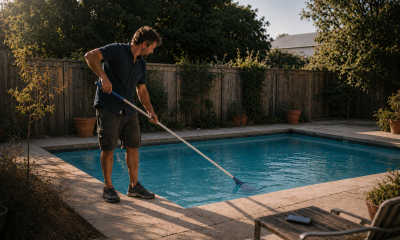


For years, swimming pool automation has largely centered on one basic proposition: giving homeowners and professionals an easier way to control equipment. Pumps could be scheduled, heaters adjusted, lights activated and features operated remotely.
Jandy’s next-generation AquaLink EDGE platform is being developed around a broader idea. Instead of treating automation simply as a control system, Fluidra is looking at a future where equipment, sensors and software are interconnected, constantly producing information about how a pool and its components are actually performing.
Alongside AquaLink EDGE, Fluidra is developing trackr iO, a software platform designed to connect that information with the operational side of a pool business.

“The biggest difference here is that current automation in the market just focuses on mainly the convenience of getting things turned on and off,” said Jeremy Young, Director of Product Marketing for Automation at Fluidra. “With this automation system, we were able to start from the ground up, and we’re building an ecosystem of automation and equipment working together, focusing on the data that the equipment produces and other sensors produce.”
For pool professionals, that evolution potentially reaches well beyond convenience. More connected equipment could mean better diagnostics, predictive maintenance, and a shorter learning curve for technicians entering the field.

Making Automation Easier to Work With
One of the first problems Fluidra set out to address was complexity.
Automation systems have become increasingly capable, but that capability can create a steeper learning curve for installers and service technicians. Young said that can be particularly noticeable in seasonal markets, where some professionals may interact with automation less frequently.
“As a professional, it can be very difficult to set a system up,” Young said. “You even see a lot of professionals that maybe avoid automation because of that.”

AquaLink EDGE attempts to streamline installation and programming by consolidating setup functions and making the interface more intuitive. Fluidra is also developing the ability to save configurations as templates that could eventually be loaded onto other pools.
The system supports legacy Jandy equipment while providing the foundation for a new generation of connected products, including SpeedSet Plus, enhancements to the Infinite Color platform and future water-care and heating products.
Hearing What Pool Pros Really Wanted
One of the most immediately noticeable changes for technicians is physical: AquaLink EDGE includes a five-inch display inside the enclosure.
That decision came directly from field feedback.
“Pool professionals want to get in and out of the backyard,” Young said. “They don’t want to mess with their phone. They don’t want to mess with the internet or anything like that, and they need access to the whole system.”
The system also isn’t dependent on a cloud connection for its primary functionality. Processing occurs locally at the hardware, allowing technicians and homeowners to continue operating the pool when internet connectivity is unavailable.
Fluidra found through its research that smartphone control alone wasn’t necessarily what consumers wanted either. Young said more than 70% of consumers surveyed wanted a dedicated interface inside the home. Consequently, every EDGE system includes a 10-inch indoor display.
For vacation rentals or homes with frequent guests, that provides another practical benefit. Temporary users don’t necessarily need to download an app or receive account access simply to operate the pool.
Connectivity has also been modernized. EDGE supports 5 GHz Wi-Fi and is optimized for mesh networks, while pairing with the app can be completed by scanning a QR code.
Those improvements address how professionals interact with automation at an individual pool. The larger implications begin when information from that pool can follow the technician back to the office.

Connecting the Equipment Pad to the Business
That is where trackr iO enters the picture.
Fluidra is developing trackr iO as a software layer capable of receiving information from connected equipment and turning it into something a pool company can act upon.
“With EDGE we can give you the status, how things are going,” explained Orlando Gadea, Vice President of Global Digital Marketing and Customer Experience for Fluidra. “With trackr iO, we let you actually take actions.”
A low-pH condition, equipment fault or other issue could eventually become more than an alert. It could initiate a workflow that allows a company to schedule a visit, assign a technician and address the problem.
One future integration Young described illustrates how closely the two platforms could eventually interact. A technician arriving for weekly service might have the EDGE enclosure display automatically optimized around the work order in trackr iO. Work performed at the equipment pad could then be synchronized back to the software rather than requiring the technician to operate one system and separately document the same tasks in another.
Empowering Proactive Rather Than Reactive Response
The more consequential use case involves what happens after the technician leaves.
A pump might stop operating Tuesday after the pool was serviced Monday. Today, the company may not discover the problem until the homeowner notices deteriorating water conditions or the technician returns the following week.
“With EDGE and trackr iO, when the pump stops working, you’ll be the first one to know it,” Gadea said. “You’ll see in your dashboard, ‘The pump in this home is down. Do you want me to schedule a repair job?’”
That begins to shift pool service from a purely scheduled model toward one increasingly informed by the actual condition of the pool and its equipment.
The amount of information available should increase as the equipment itself becomes smarter. Existing Jandy equipment can provide certain fault and diagnostic information, while next-generation products are being designed to generate considerably more operating data.
Young pointed to SpeedSet Plus as an example, saying those pumps will contribute 28 data points to Fluidra’s data bank.
That creates an opportunity to understand not only when equipment has failed, but how equipment is performing in the field before failure occurs.
Young said the information could eventually support predictive maintenance, helping forecast when service, maintenance or replacement may be necessary. Usage data could also inform recommendations around circulation schedules and chemical consumption.
“The magic happens when you turn this data into information that actually can be acted upon to drive a smarter business,” Gadea said.
For pool professionals, that’s an important distinction. Another dashboard full of raw data isn’t necessarily useful. Knowing which pools need attention, what’s wrong, and what a technician is likely to encounter when arriving is.

Taking Some of the Tribal Knowledge Out of Service
Perhaps one of the more significant implications of increasingly connected equipment is its potential to reduce the learning curve for educating new technicians.
Experienced pool techs often diagnose problems quickly because they’ve seen the same symptoms hundreds of times. Newer technicians don’t have that accumulated experience. Much of their learning curve consists of developing it.
Connected equipment can begin putting some of that knowledge directly in their hands.
“I think that we’re going to be increasingly empowering pool pros to understand what’s happening with less tribal knowledge,” Young said.
He offered electrical troubleshooting as an example.
“Instead of having to pull a voltmeter out and measure what the voltage is, these products can tell you: What’s the voltage coming in? What’s the transformer stepping it down to? Where in the safety loop is it being broken?”
The significance isn’t that every repair becomes automatic. On difficult service calls, a technician still needs to understand the equipment and interpret what is happening. The difference is that the system can provide hard data that narrows the possibilities and removes some of the guesswork.
Young described the technology as an assistant that can help technicians reach a solution faster.
Speed Loading The Training Process
That has ramifications for onboarding as well.
Talent remains a persistent challenge for pool service companies. Experienced technicians are difficult to replace, while bringing a new employee up to speed can take considerable time.
“It’s really hard to attract and retain talent,” Gadea said. “Having these kinds of platforms simplifies so much of the process that it lets you ramp up talent much faster.”
Better diagnostics don’t replace training, but they can remove some of the friction involved in getting a technician productive. Instead of relying entirely on another employee to explain what happened at a particular pool six months ago, service history and equipment data can increasingly provide that context.
The same data could eventually help extend equipment life. If operating trends reveal a developing problem before a component fails completely, maintenance can potentially happen earlier. Rather than treating equipment as healthy until the moment it produces an error code or stops working, service companies could begin recognizing deterioration as it develops.
That’s where predictive maintenance becomes particularly interesting for pool professionals. It changes the conversation from responding to failure toward understanding equipment behavior in the wild.
From Scheduled Service Toward Predictive Maintenance
The broader question is how much that information eventually changes the service model itself.
Gadea sees machine learning and increasingly detailed equipment data pushing the industry toward more predictive maintenance. Fluidra is already exploring concepts internally around what it calls the “positive pool” — understanding how a pool should operate at peak performance and comparing actual conditions against that model.
Young sees an equally significant change occurring in how service companies allocate labor.
Today, route service is largely rigid. Technicians visit pools on predetermined days because physically inspecting the pool is often the only reliable way to know its condition.
Connected equipment creates the possibility of making that schedule more dynamic.
“If the pool doesn’t need service this week, that can free a resource up to go do something else and generate business elsewhere because the pool’s being taken care of right now,” Young said.
The reverse is equally important. If conditions change Wednesday at a pool normally serviced Monday, the company can potentially respond Wednesday rather than discovering the problem five days later.
That doesn’t mean weekly pool service simply disappears. Chemistry, debris removal and physical inspection still require boots on the ground. What changes is the amount of information available to determine where those boots should go and when.
Gadea believes those efficiencies could eventually allow companies to service considerably larger portfolios with the same workforce, suggesting that a business managing approximately 400 pools could potentially expand toward 600 or 700 as connected hardware and software improve efficiency.
The Future of the AquaLink Ecosystem
AquaLink EDGE itself will coexist with AquaLink RS during the transition. Young described Edge as Fluidra’s premium automation platform, with AquaLink RS continuing in the midrange and TCX serving the entry level while EDGE expands into additional price points and applications. PDA, meanwhile, is planned to be phased out.
Fluidra is also building Edge around continued software development. Future capabilities discussed include automatic management of high and low water levels, pool-cover integration, reusable setup templates and a “Be Ready At” function that could allow homeowners to specify when they want the pool ready and let the system determine what needs to happen beforehand.
Young said customers could eventually expect two or three updates annually as new features and equipment capabilities are introduced.
What makes the direction of AquaLink EDGE and trackr iO noteworthy isn’t simply another generation of automation controls. It’s the prospect of equipment becoming a more active source of operational intelligence.
For service companies, that could mean knowing more about how equipment is actually performing across hundreds of backyards, identifying problems earlier, reducing diagnostic guesswork, and making years of accumulated technician knowledge easier to transfer to the next employee.
Young said his years visiting thousands of pools and training professionals helped shape that philosophy.
“If education’s not the solution, then the product’s probably the problem,” he said.
If connected equipment can become easier to install, easier to diagnose, and increasingly capable of explaining its own condition, the next generation of pool automation may ultimately have as much impact on the people servicing pools as it does on the homeowners using them.
Ready to take a deeper dive?
Want to hear more about where pool automation and connected equipment are headed? Listen to our full conversation with Jeremy Young and Orlando Gadea as they dig deeper into AquaLink EDGE, trackr iO, predictive maintenance, smarter diagnostics, and what these technologies could mean for the future of pool service.
Listen to the full episode of the Pool Magazine Podcast.

New compact packaging reduces shipping costs and warehouse space while maintaining the MagicVac’s pool and spa cleaning performance
Magic Plastics has introduced a newly redesigned version of its popular MagicVac pool and spa vacuum, now shipping in packaging just 38 inches long. The shorter carton means more units per pallet and shipment, reducing freight costs and saving warehouse space for dealers, distributors, and resellers without compromising performance.
Operation is simple. Users cover the ergonomic air hole with a thumb, submerge the vacuum near the debris, and release. Water and debris rush into the clear, UV-stabilized chamber, and the built-in removable filter traps virtually all of it, including sand, pebbles, and even small rocks. A quarter turn of the end cap makes emptying easy. No batteries, no cords, ready to use at all times.

The MagicVac weighs less than two pounds, making it easy for anyone to use and its telescoping aluminum pole reaches more than seven feet. Despite the smaller package, assembly is quick and easy (online assembly video is available). “We are pleased to now offer our popular Magic Vac to the industry with this new design that now makes shipping more affordable while offering consumers a simple device to keep their spas and pools cleaner,” says Mark Coito, VP of Sales and Marketing.
Learn more at www.magicplastics.com or visit the Magic Vac page.


Hayward Industries has recalled approximately 4,600 Universal-HC Series pool heaters following a potential carbon monoxide hazard, according to a recall notice issued September 17th by the U.S. Consumer Product Safety Commission.
The recall applies to Hayward HDFS400 Universal-HC Series pool heaters. The affected units are 400,000 BTU dual-fuel gas heaters sold nationwide through pool equipment distributors, builders and service professionals between March and July 2026. The heaters sold for approximately $5,600.
According to the CPSC, the affected heaters can produce elevated levels of carbon monoxide while operating, creating a risk of carbon monoxide poisoning that could result in serious injury or death. No incidents or injuries have been reported in connection with the recall.
Consumers with an affected heater are being advised to stop using it immediately. Hayward is offering a free in-home inspection and repair performed by a qualified technician.
The recalled HDFS400 heaters are brown with a black top and feature a digital control panel. The model number can be found on the heater’s name plate located below the vent.
Owners can contact Hayward Industries at 855-500-5288 between 8 a.m. and 5 p.m. ET, Monday through Friday, or email [email protected]. Additional recall information is available through Hayward’s product recall page.
The CPSC has designated the action as Recall No. 26-777.
Read the Summer Issue of Pool Magazine

See more of our coverage in your search results
 Sponsored Advertisement
 Soake Pools Bolsters National Growth With Four Key Hires
 Hayward Holdings Names New Chief Accounting Officer
 Daldorado Names Marcia Gyles Director of Sales
 Landmark Aquatic Brings Poolside Adventures Attractions Nationwide
 Shasta Pools Hires 30-Year Builder to Head Residential Construction
 Watershape University Announces Fall 2026 Session in San Diego
 NTCA Welcomes Jennifer Ibe and Rachel Smith to the Team

 Latham Dives in as an Official Sponsor of USA Artistic Swimming
 Step Into Swim Announces Partnership With Pentair Pool To Support Drowning Prevention Initiatives
 ‘The Pool is Caving In’ – Condo Collapse Victim Told Husband
 A Borates Shortage is Looming on The Horizon
 RENOLIT AKLORPLAN Receives Sustainable RecyClass Certification
 Poolside Perspectives Podcast: A Must-Listen for Pool Design and Construction Enthusiasts
 Florida Pool Owners Brace For Potential Category 3 Hurricane


 Sponsored Advertisement
 Pool News3 weeks ago
Leslie’s Reportedly Prepares for Chapter 11 Bankruptcy as Possible Nasdaq Delisting Looms

 Pool News3 weeks ago
Leslie’s Files Chapter 11, Lenders Set to Take Control in Major Restructuring

 Features2 weeks ago
A New Era at POOLCORP: John Watwood Focuses on Customers and the Fundamentals

 Pool Equipment3 weeks ago
AquaLink® EDGE™ and trackr iO Signal a New Direction for Pool Automation

 Press Releases4 weeks ago
FSPA and PHTA Reunite Through Historic Affiliation
 Pool News2 weeks ago
Shasta Pools Hires 30-Year Builder to Head Residential Construction

 News4 weeks ago
Aquatics Veteran Natalie Hood Launches Natalie Hood & Associates, LLC

 Retail3 weeks ago
Nasdaq to Suspend Trading in Leslie’s Stock on October 6
You must be logged in to post a comment Login