Pool News
Lincoln Memorial Reflecting Pool May Meet Its Deadline—But Will It Solve the Problem?

The Lincoln Memorial Reflecting Pool is one of the most recognizable bodies of water in the world. Stretching between the Lincoln Memorial and the Washington Monument, the century-old basin has served as the backdrop for presidential inaugurations, historic speeches, protests, celebrations, and countless photographs. It is as much a piece of American history as the monuments it reflects.
For decades, however, one of the most iconic pools in America has struggled with persistent algae blooms, water clarity issues, leaks, and aging infrastructure. Those problems have led multiple administrations to explore several rehabilitation projects over the years.
Now, with the nation’s 250th anniversary celebration approaching, the Trump administration has accelerated plans to renovate the pool once again, setting an ambitious timeline intended to have the project completed in time for Fourth of July festivities in Washington, D.C.


The project has generated significant discussion within both preservation and aquatic industry circles. To better understand the challenges involved, Pool Magazine spoke with Tim Auerhahn, Chairman of the Aquatic Council, who was recently interviewed by The New York Times regarding the project. Auerhahn has worked on numerous high-profile aquatic facilities, including projects at Camp David and other government installations.
His perspective offers insight into both the opportunities and concerns surrounding one of the most closely watched aquatic renovations in the country.
A Unique Aquatic Challenge
For those outside the pool industry, the Lincoln Memorial Reflecting Pool may appear to be little more than a long decorative basin. According to Auerhahn, that perception couldn’t be further from reality.
“This is an enormous project on several fronts,” Auerhahn explained. “For any pool contractor that’s working on it, it’s probably going to go down as their largest pool renovation project ever.”
The reflecting pool is approximately six million gallons and more than a third of a mile long. Unlike traditional swimming pools that gain volume through length, width, and depth, the reflecting pool derives most of its volume through its extraordinary length while remaining relatively shallow.


“You’re looking at a body of water that’s about a foot and a half to three feet deep at any given point,” said Auerhahn. “It’s a very shallow body of water, too, which really lends itself to notable algae blooms.”
The combination of shallow depth, summer heat, sunlight exposure, environmental issues, and sheer size creates conditions that make algae control extremely difficult. Those challenges have existed for more than a century.
Why Previous Renovations Didn’t Solve the Problem
The last major rehabilitation project was completed in 2012 following a roughly two-year reconstruction effort that cost approximately $34 million. That project focused heavily on structural concerns, including installing thousands of support pilings beneath the basin.
While the work addressed settlement and leakage concerns, algae problems returned almost immediately.
“Right away, when they reopened it in 2012, just a couple weeks later, the algae was back,” Auerhahn noted. “If you want it to be a really crystal clear body of water, structure, surface, and mechanical equipment all need to be considered in a restoration or a renovation.”
From his viewpoint, solving the algae issue requires a comprehensive approach that addresses circulation, filtration, chemistry, waterproofing, and structural integrity simultaneously.

The Coating That Started the Debate
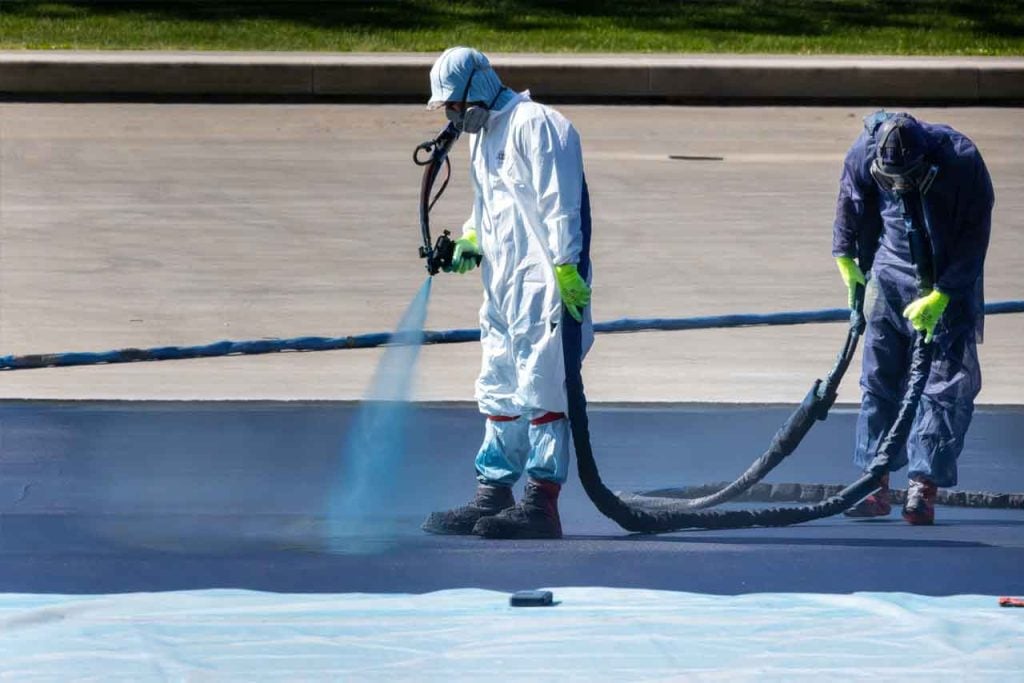
Much of the current discussion centers around the decision to coat the basin with a polyurea-based lining system.
President Trump initially described the project as a relatively straightforward effort to “paint” the reflecting pool blue, a characterization that immediately drew criticism from aquatic professionals.
Auerhahn became one of the most quoted experts on the topic after telling The New York Times that “painting is not going to solve that problem.”
His concern wasn’t that the coating would fail as a waterproofing material. Rather, he questioned whether it addressed the underlying issues that have plagued the reflecting pool for decades.
“If we’re gonna fix the algae problem and we’re going to use a sealant on this basin, that’s ultimately not going to address the real problem,” he explained.
He believes the darker blue surface may improve appearance in the short term and even make algae less noticeable, but that it won’t eliminate the biological conditions that create algae blooms in the first place.
“I think when late September rolls around, and Washington, D.C. has been baking in 90-degree heat, we’re probably gonna see a pretty significant algae bloom again in this body of water unless a whole bunch of other things are addressed.”
What About Filtration and Circulation?
One area where Auerhahn believes meaningful progress could be made is through modernization of the reflecting pool’s circulation and treatment systems.
The previous renovation in 2012 introduced new equipment that draws water from the Tidal Basin rather than relying on municipal water supplies. However, aquatic technology has advanced significantly over the past decade.
“I think what we have done in a decade and a half in filtration, chemical delivery systems, advanced oxidation, and circulation of this basin, we could probably move in a direction where this looks more like crystal clear water for longer periods of time.”
When asked what technologies might be most effective, Auerhahn pointed to ozone and ultraviolet systems.
“There does seem to be a company consulting on this from an ozone generation perspective,” he said. “Advanced oxidation through UV or ozone might be the better way to go, and with that, chemical balance supported by the right circulation system, and ultimately everything being fed through a better filtration system.”
In his opinion, upgrading the equipment might ultimately have a greater impact on water clarity than resurfacing the basin itself.
Questions About Rhino Pipeliner 5000
Another area drawing scrutiny is the specific coating selected for the project.
According to Auerhahn, the material being used, called Rhino Pipeliner 5000, is a product manufactured by the same Rhino known for their popular truck bed liners.
“That’s probably what they’re best known for,” Auerhahn said.
After researching the product and consulting industry professionals, he found little evidence of widespread use in large aquatic applications.
“I proposed it in a whole bunch of pool groups. I said, ‘Has anybody used this? Has anybody seen anybody use it?’ I kind of got crickets.”
His concerns extend beyond simple familiarity. He notes the product lacks peer-reviewed testing specific to several conditions that are highly relevant to the reflecting pool.
According to Auerhahn, there are unanswered questions regarding long-term UV exposure, chemical resistance, adhesion to granite surfaces, and how the coating could eventually be removed if future preservationists decide to restore the basin to its original appearance.
“There are a lot of question marks,” he said.
Among them are reports of bubbling, cracking, uneven appearance, and color inconsistency observed during installation.
“If we decide to remove this product at some point in the future… what have we done to that historical granite?”
Those unknowns remain one of the primary concerns among preservation-minded observers.

Another Leading Expert Weighs In
To gain additional perspective, Pool Magazine also reached out to renowned pool construction expert Paolo Benedetti.
Benedetti, a renowned pool builder, industry expert, and current Watershape University educator, offered a somewhat different assessment.
He noted that polyurea is widely regarded as a durable waterproofing material and has been successfully used in surge tanks and other demanding aquatic applications.
According to Benedetti, the material should hold up structurally and may actually be one of the few practical options available, given the immense scale of the project.
He did, however, acknowledge that UV exposure will likely cause the blue color to fade over time.
Benedetti also pointed out that alternative finishes, such as plaster, would likely deteriorate quickly under the heavy public use the reflecting pool experiences. More durable alternatives, such as large-format porcelain or stone, would dramatically increase both project cost and timeline.
Auerhahn largely agrees with that assessment.
“If you’re just focused on waterproofing this structure, this is a really reasonable solution,” he said. “I do think it’s going to slow the water loss significantly.”
His concern remains whether waterproofing was truly the primary issue being solved.
The Challenge of “Trump Speed”
Perhaps the most controversial aspect of the project has been its timeline.
The renovation was publicly announced in late April, with construction activity beginning almost immediately. Officials initially targeted May 22 for completion, a date that has already passed.
While some observers have criticized the accelerated pace, Auerhahn cautions against viewing the discussion through a political lens.
“This isn’t a political issue,” explained Auerhahn, “usually, with restoration projects of this nature, the process is going to be slow, and the solution is going to involve peer review. Because ultimately we want to make sure we get it right.”


Auerhahn noted that major restoration projects in Washington, D.C. typically involve architects, historians, preservation experts, engineers, landscape architects, the fine arts commission, and aquatic specialists working together to ensure decisions are made thoughtfully.
That level of review helps answer difficult questions surrounding materials, aesthetics, longevity, reversibility, and preservation.
The concern for some observers is that the accelerated schedule may not have allowed enough time for those conversations to ever occur.
Will It Be Ready For July 4?
Despite his reservations, Auerhahn believes the project is likely to meet its ultimate goal.
“From what I saw, they seemed to be almost done,” he said after visiting the site in person.
By his estimate, roughly 95 percent of the basin had already been coated as of his visit in early June.
“I do think at Trump speed, they got this done for the 250th.”
Barring unforeseen complications, visitors attending July Fourth celebrations will likely see a newly coated reflecting pool filled with water and ready for public viewing.
Whether the solution proves successful over the long term remains another question entirely.
A Quick Fix or a Lasting Restoration?
In the end, Auerhahn sees a distinction between achieving a short-term visual improvement and executing a true historic restoration.
“If this was a quick fix and if the messaging was, ‘We want this to look great this summer for this event,’ they did that,” he said.
Water, after all, remains remarkably forgiving. Freshly filled and newly resurfaced, the reflecting pool will almost certainly produce beautiful photographs and dramatic reflections.
But questions remain about long-term color retention, UV exposure, chemical resistance, algae control, future removability, and the impact on the original granite surfaces beneath the coating.
Those are questions that simply cannot be answered yet.
As one of America’s most visible aquatic landmarks enters its next chapter, the industry will be watching closely—not just to see how it looks this summer, but how it performs in the years to come.
Ready to take a deeper dive?
Listen to our entire conversation with Tim Auerhahn on the Pool Magazine Podcast.
You must be logged in to post a comment Login