Pool News
Top 10 Largest Swimming Pools in the World

When discussing the largest swimming pools on the planet, we’re certainly not talking about your average-sized watering hole. While there have been large man-made pools practically since civilization began, these swimming pools in particular defy the imagination in terms of their sheer scale.
You may have visited a few resorts in your time with large luxurious over-the-top pools, but trust me when we say that those pools are practically teacup-sized in comparison to these swimming pools. We’ve covered plenty of swimming pool Top 10’s in Pool Magazine, including the world’s most expensive pools. Today, however, we’re going to be looking at some of the largest pools on Earth. With that said, let’s dive right in!
The Top 10 Largest Pools In The World
| Rank | Swimming Pool | Country | City | Area | Opened | Water |
|---|---|---|---|---|---|---|
| #1 | City Stars Sharm El Sheikh | Egypt | Sharm El Sheikh | 23.9 acres | 2015 | Sea water |
| #2 | San Alfonso Del Mar | Chile | Valparaรญso | 20 acres | 2006 | Sea water |
| #3 | Mahasamutr | Thailand | Hua Hin | 17 acres | 2014 | Sea water |
| #4 | Ostrava Poruba – Vลesina | Czech Republic | Ostrava | 10 acres | 1962 | Fresh water |
| #5 | Diamante at Cabo San Lucas | Mexico | Cabo San Lucas | 10 acres | 2009 | Salt water |
| #6 | The Lagoon at Epperson | United States | Wesley Chapel, FL | 7.5 acres | 2017 | Sea water |
| #7 | Piscina Las Brisas de Santo Domingo | Chile | Santo Domingo | 5 acres | 2004 | Sea water |
| #8 | The Lagoon at Windsong Ranch | United States | Prosper, TX | 4.9 acres | 2019 | Sea water |
| #9 | Hayman Island Resort Pool | Australia | Queensland | 2.2 acres | 1950 | Sea water |
| #10 | Dreamworld Fun Lagoon | Pakistan | Karachi | 2 acres | 2008 | Well water |
Statistics are all well and good, but we’re dying to know more about these massive swimming pools and we’re sure you are too. Let’s take a closer look at each one of the swimming pools on our Top 10 Largest Swimming Pools list.
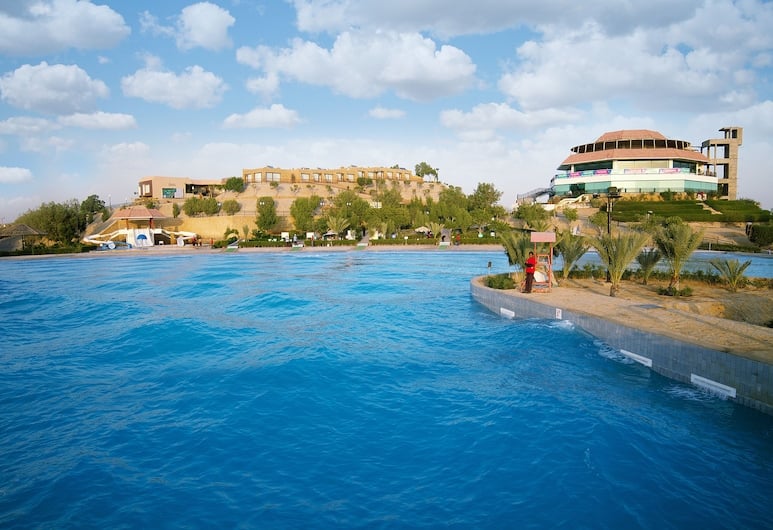
#10 – Dreamworld Fun Lagoon
The world’s largest well water swimming pool is located on the outskirts of Pakistan’s largest metropolis, Karachi. The Dreamworld Resort’s pool, which is filled with 2 million gallons of water pumped from neighboring wells, also has waterslides and an artificial sea with waves up to 4 feet high. This is a massive pool where scores of families gather together to have a good time.

Address: Gulshan-e-Maymar, Super Highway
Adjacentุ Block R Taiser Town, Karachi, Karachi City, Sindh, Pakistan
Phone: +92 21 38692000
Website: https://dreamworld.pk/
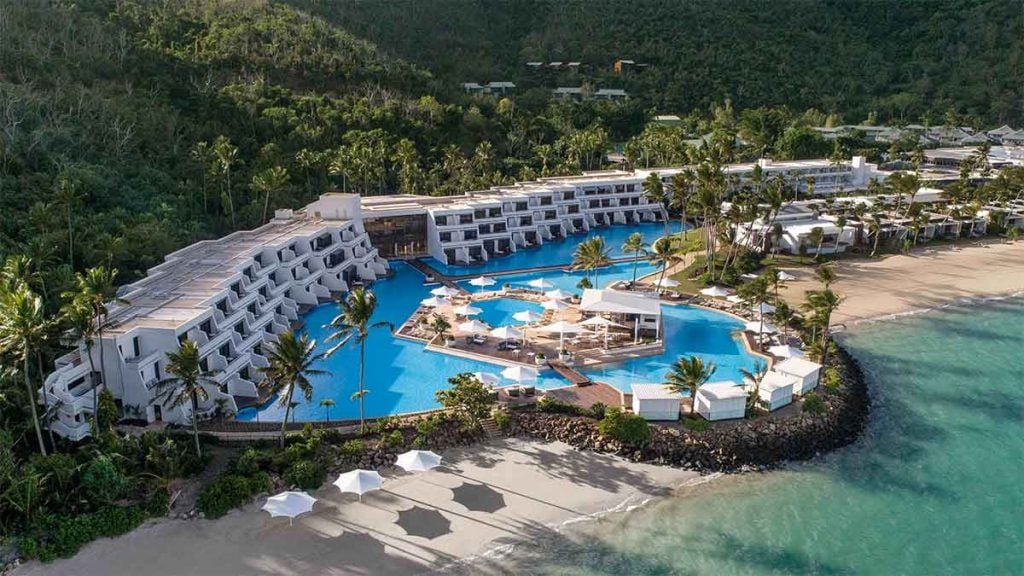
#9 – Hayman Island Resort Pool
The pool at Hayman Island Resort has the size of seven Olympic-sized pools and has a surface area of nearly 78,000 square feet. The man-made lagoon was built in 1985 as part of the exclusive Hayman Island resort in the Whitsundays, on the Great Barrier Reef’s Whitsunday Islands. The pool, which is one of the largest in the Southern Hemisphere, has a freshwater section surrounded by a bigger saltwater segment, as well as a sand bar in the center for relaxing. The largest of the four linked boardwalks, extending 165 feet, spans the water’s surface.

Address: Hayman Island Whitsunday Islands Hayman Island, QLD 4801, Australia
Phone: +61 7 4940 1234
Website: https://haymanisland.intercontinental.com/
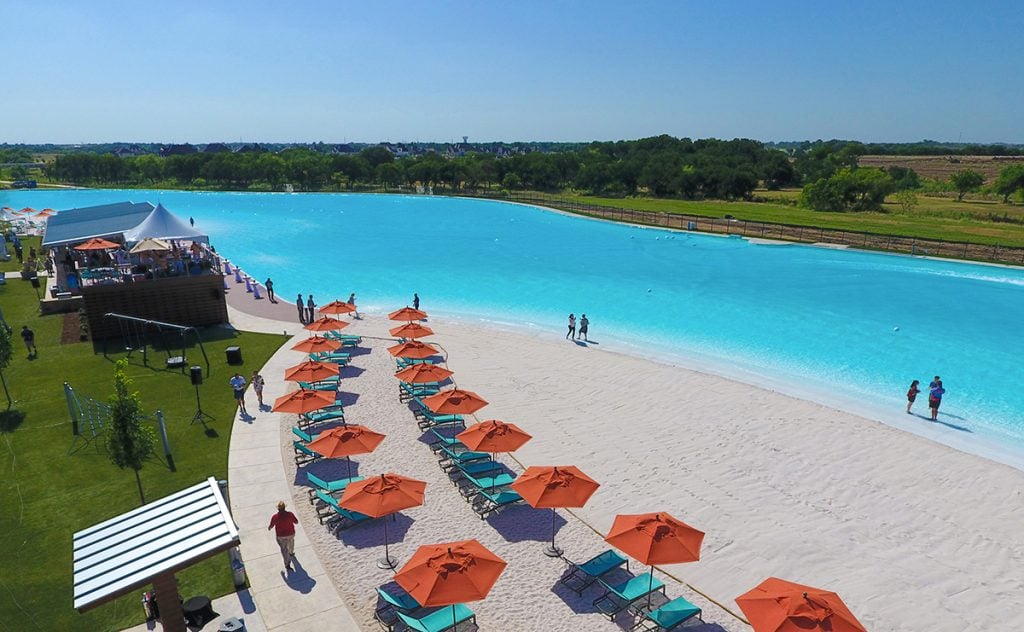
#8 – The Lagoon at Windsong Ranch
One of the largest pools on earth is actually in the United States. The Lagoon, a massive 4.9-acre seawater pool, is currently the centerpiece of Windsong Ranch. Guests of the ranch can unwind on the white sand beaches or participate in a variety of activities such as paddleboarding and kayaking in the crystal clear Caribbeanesque waters. The largest pool in the United States, this one must be seen to be believed!

Address: 1001 Windsong Pkwy, Prosper, TX 75078
Phone: (972) 347-9270
Website: https://windsongranchliving.com/
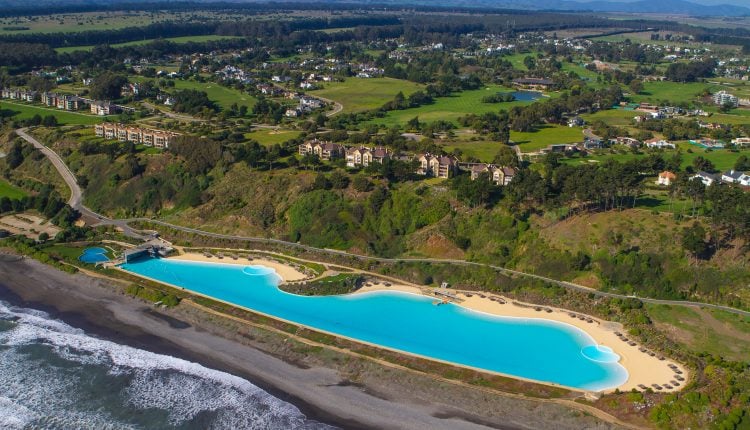
#7 – Piscina Las Brisas de Santo Domingo
Piscina Las Brisas is a five-acre saltwater pool is part of the Las Brisas upscale condominium development in Chile. To give you a sense of scale, it’s roughly the size of 16 Olympic-sized swimming pools. This architectural achievement is one of the largest swimming pools on the planet. Two of the nicest aspects are that it has a view of the Pacific Ocean and its crystal clear water.

Address: Santo Domingo, Valparaรญso, Chile
Phone: +56 2 2206 9188
Website: https://www.lasbrisasdesantodomingo.cl/
#6 – The Lagoon at Epperson
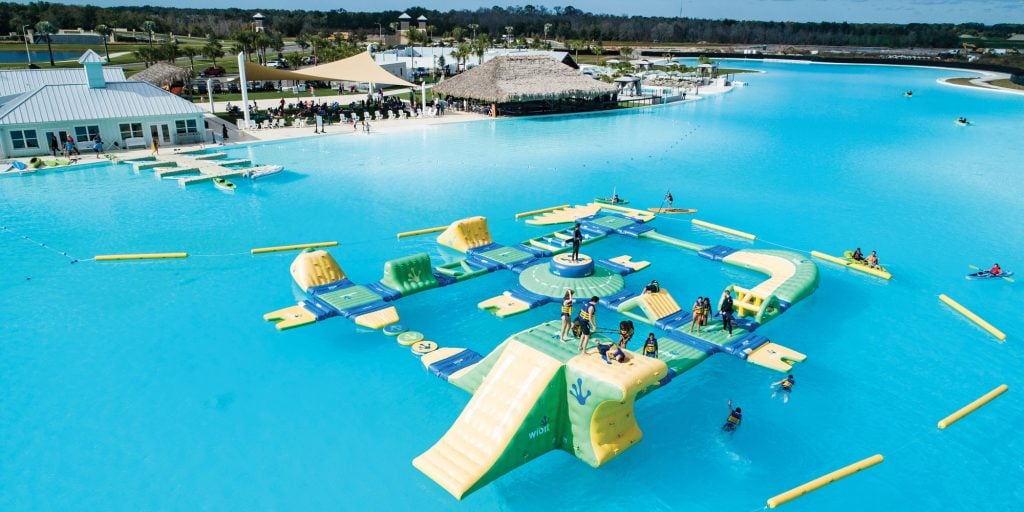
What was once a cow pasture just north of Tampa is now home to the largest swimming pool in the country. Swimming, paddle boarding, and kayaking are all possible on the man-made, sustainable body of water. It also has a swim-up bar, cabanas, a floating obstacle course, and other amenities. The lagoon spans 7.5 acres and has a perimeter of 4,200 linear square feet, with an average depth of 8 feet and some spots as deep as 12 feet.

Address: 31885 Overpass Rd, Wesley Chapel, FL 33545
Phone: (813) 444-5221
Website: https://epperson.metroplaces.com/#lagoons
#5 – Diamante in Cabo San Lucas
With views of Diamante’s signature sand dunes and the majestic Pacific Ocean, you’ll be in paradise. Sail, swim, stand-up paddleboard, and kayak, or simply relax in your own private cabana nearby. There are wide beach areas, a swim-up bar and jacuzzi, and other family-friendly amenities surrounding the lagoon, so grab your goggles and sunscreen and get ready for some serious fun. Tied with our #4 pick, the 10-acre saltwater Crystal Lagoonsยฎ at Diamante offers leisure and family-friendly activities at the heart of their resort.

Address: Diamante Blvd., 23473 Cabo San Lucas, B.C.S., Mexico
Phone: +52 624 144 2900
Website: https://diamantecabosanlucas.com/amenities/crystal-lagoons/
#4 – Ostrava Poruba – Vลesina
The Ostrava Poruba, a seasonal community pool that first opened in 1962 is the largest open-air swimming pool in the Czech Republic at 10 acres. The massive fresh water pool is designed to look like a lake. Tied with our #5 pick in terms of size, the municipal corporation Sareza (Sports and Recreational Facilities of the City of Ostrava) operates swimming pools of various sizes (indoor and outdoor) in Poruba, Ostrava-Jih, Moravskรก Ostrava a Pvoz, and Bartovice.

Address: Rekreaฤnรญ 236/74, 708 00 Ostrava-Poruba, Czechia
Phone: +420 596 977 611
Website: http://www.sareza.cz/letni-koupaliste-ostrava-poruba/
#3 – Mahasamutr
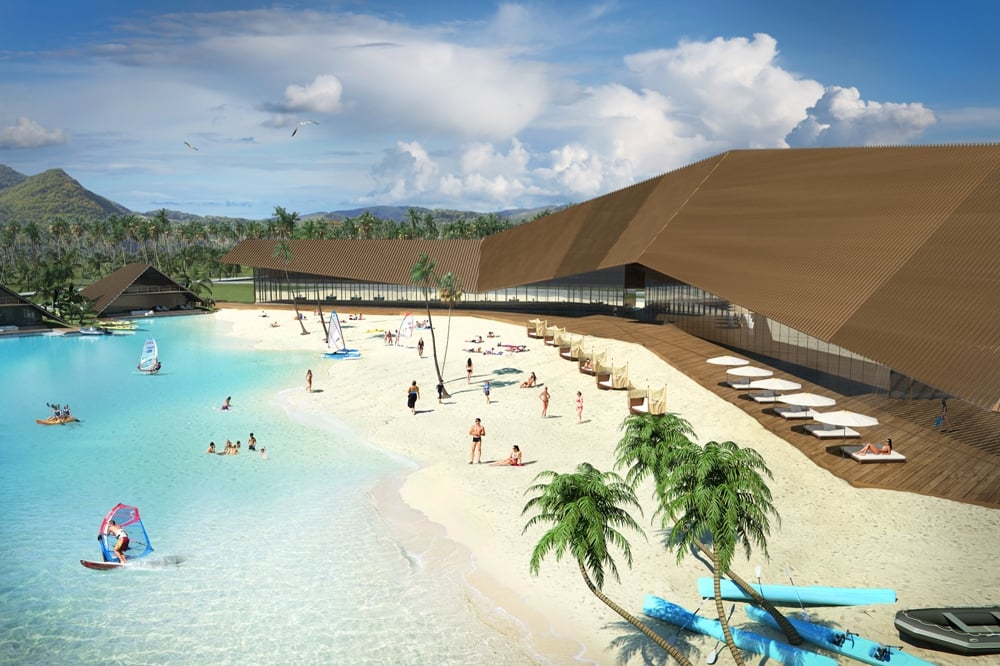
The MahaSamutr pool is home to Asia’s largest man-made lagoon. It has a surface area of 72,000 square miles and a maximum depth of 2.4 meters. The lagoon, surrounded by an artificial sand beach, is the focal point of the MahaSamutr development project, an upscale country club and residential complex in Hua Hin.

Also by Crystal Lagoons, this massive pool is the first major project in Thailand and sits proudly on our top 10 list as the #3 largest pool in the world.

Address: 70/152-153 Soi 112 Huana Tuptai Road
Prachuapkhirikhan, Hua Hin District, Prachuap Khiri Khan 77110, Thailand
Phone: +66 32 907 900
#2 – San Alfonso Del Mar
San Alfonso Del Mar Resort in Chile is currently the second largest swimming pool in the world and sits on a private resort in Algarrobo, Chile, located roughly 60 miles west of Santiago. With a length of over nine football fields, this enormous saltwater pool is filled with over 66 million gallons of water. At the time of its completion in 2006, San Alfonso Del Mar Resort captured the record for the world’s largest pool and held it for almost a decade. A builder of some of the largest pools on the planet, we can thank Crystal Lagoons for this one as well.

Featuring swimming, sailing, kayaking, and a host of world-class amenities, San Alfonso Del Mar Resort is a must-see travel destination for pool lovers and an incredible achievement in aquatic engineering.
#1- City Stars Sharm El Sheikh
The City Stars Sharm El Sheikh lagoon, which opened in 2015, is officially the world’s largest man-made body of water. Aside from its enormous size, this massive pool located in the Sinai desert is a sight to behold. The saltwater supply is drawn from aquifers and takes several weeks to replenish. The $5.5 billion project is also the most expensive pool in the world.

Address: 29HV+8HH, Qesm Sharm Ash Sheikh, South Sinai Governorate, Egypt
Website: http://www.citystars.com.eg/project.php?id=6&active=page_Sharm

At 23.9 acres City Stars Sharm El Sheikh by Crystal Lagoons; is officially the largest swimming pool project in the world.

In conclusion:
You may have asked the question “what is the largest swimming pool in the world” and gotten 100 different answers. Unfortunately, there is a lot of conflicting information out there and statistics have a tendency to be copied & pasted without much fact-checking these days. Stats also have a way of changing quicker than human beings tend to update their websites.
In fact, the Guinness Book of World Records even still lists the 8.9-acre Orthlieb Pool in Casablanca, Morocco as the largest pool on the planet. Unfortunately, that pool was demolished back in 1986 and hasn’t been around for quite some time. There are also plenty of places that still list the San Alfonso Del Mar as the world’s largest swimming pool, but it was supplanted back in 2015 by the #1 pool on our list. City Stars Sharm El Sheikh is officially the largest swimming pool on the planet – for now.
Pool News
Landmark Aquatic Earns Three 2026 PHTA Awards of Excellence

Landmark Aquatic is pleased to announce that three of its aquatic facility projects received 2026 PHTA Awards of Excellence from the Pool & Hot Tub Alliance (PHTA), one of the pool and spa industry’s premier design competitions.
- Doris Roznovak Aquatic Center, Taylor, TX โ Merit Award, Commercial Aquatic Facilities
- Danville High School Natatorium Danville, IN โ Merit Award, Commercial Aquatic Facilities
- Astra Tower Apartments, Salt Lake City, UT โ Silver Award, Elevated Pool and Spa Structures
PHTA is the trade association representing the swimming pool, hot tub, and spa industry. Its annual International Awards of Excellence is one of the industry’s largest and most respected design competitions, recognizing the most creative and innovative pools, spas, hot tubs, and water features built each year. Hundreds of entries are submitted annually by professionals across the U.S. and around the world.
“PHTA is proud to recognize our members for their craftsmanship, inspired design, and dedication to elevating the industry,” said Sabeena Hickman, CAE, President and CEO of PHTA.
โThese awards reflect what it takes to design, build, operate, and maintain a truly successful aquatic facility,โ said J. Ryan Casserly, Chief Executive Officer of Landmark Aquatic. โThat level of commitment shows up in the work of everyone on our team, and we’re proud to keep investing in serving our customers and the communities who enjoy these facilities.โ
About Landmark
Landmark Aquatic is a nationwide provider of commercial aquatic facility design, construction, and maintenance services, with more than six decades of industry experience. Landmark supports clients across most of the U.S. through construction-led solutions and its AquatiCare maintenance program โ delivering excellence โfor the life of your poolโ and building long-term partnerships through exceptional service and forward-thinking solutions. Learn more at www.landmarkaquatic.com
Pool News
Amazon Drone Drops Package Into Swimming Pool โ And Itโs Not the First Mishap

Drone delivery may be the future of getting everyday purchases to your doorstep, but apparently Amazon still has a few kinks to work out โ particularly when swimming pools are involved.
A video making the rounds on social media this week shows what should have been a routine Amazon drone delivery going very wrong. Instead of safely depositing the customer’s order on dry ground, the package winds up in the backyard swimming pool.
The incident is funny enough when viewed through the lens of an unexpected pool delivery. But it also highlights a very real challenge Amazon faces as it prepares to dramatically expand its Prime Air drone delivery program across the United States.
And remarkably, this isn’t the first time an Amazon drone has put a customer’s package in the pool.
Amazon Has Already Made This Mistake Before
In July 2025, Arizona resident Daniel Muniz decided to try Prime Air after seeing drone delivery available for his order in Avondale.
The delivery was captured on video.
Amazon’s drone successfully reached the property and released the shoebox-sized package over the designated area. There was just one problem: the downward force generated by the drone’s propellers pushed the package several feet across the yard and directly into Muniz’s swimming pool.
Fortunately, the contents weren’t particularly vulnerable to water. Muniz had ordered vitamins.
The incident was especially notable because Amazon’s delivery system is designed to identify suitable drop locations around a customer’s property. Amazon explains that its mapping technology identifies “delivery zones” free of obstacles and establishes appropriate delivery points within those areas.
The company even specifically acknowledges swimming pools as something the technology needs to recognize.
According to Amazon, a swimming pool can appear to be a flat surface in satellite imagery despite obviously being an unsuitable location for a package delivery. Once the drone reaches the designated location, the aircraft descends to approximately 13 feet above the ground, checks that the area is clear and releases the package.
In the Avondale incident, the package wasn’t intentionally dropped into the water. It initially landed on dry ground before the drone’s prop wash sent it into the pool.
Amazon apologized to the customer at the time, characterizing incidents like it as rare.
A year later, however, another swimming pool has clearly managed to intercept an Amazon delivery.
Pools Aren’t the Only Problem
Swimming pools haven’t been the only unexpected destinations for Amazon’s drones.
In another widely reported incident, an Amazon delivery drone came down in a residential garden after experiencing problems during operation. Other incidents have been considerably more serious than a wet package.
In February 2026, an Amazon Prime Air drone struck the exterior of an apartment complex in Richardson, Texas, before the damaged aircraft fell to the ground.
Amazon’s drone program has also faced scrutiny following collisions involving infrastructure. These episodes underscore the complexity of operating autonomous aircraft at scale in residential environments where drones must contend with buildings, trees, utility infrastructure, changing weather conditions and other obstacles.
Amazon says its latest MK30 drones use a sophisticated perception and “Detect-and-Avoid” system designed to identify obstacles and make navigation decisions autonomously.
That technology is going to become increasingly important because Amazon isn’t backing away from drone delivery.
It’s doing the opposite.
Amazon Plans a Massive Drone Delivery Expansion
Amazon announced this week that it intends to expand Prime Air to nearly 500 U.S. cities and towns by the end of 2026, a dramatic increase from the 11 locations where the service currently operates. New markets are expected to include areas around Chicago, Atlanta, Cleveland, Syracuse and Boise.
The company says each Prime Air location can serve communities within roughly a 7.5-mile radius. Its MK30 drones can transport eligible packages weighing up to five pounds, with Amazon targeting delivery times of roughly an hour or less.
Amazon has already completed hundreds of thousands of drone deliveries this year, according to Prime Air Vice President David Carbon.
The long-term ambitions are considerably larger.
Amazon CEO Andy Jassy has said the company believes drone delivery could eventually reach 30 million customers and handle as many as half a billion packages annually by 2030.
The appeal isn’t difficult to understand.
For small, lightweight purchases, a drone potentially eliminates much of the traditional last-mile delivery process. Instead of waiting for a delivery van to work its way through dozens or hundreds of stops, an individual aircraft can carry an order directly from a nearby fulfillment facility to a customer’s home.
Need sunscreen before heading outside? Batteries for a poolside speaker? A replacement part or bottle of test strips?
Amazon envisions those types of purchases arriving from the sky in less time than it might take someone to drive to a store and back.
The company says more than 60,000 products are already eligible for drone delivery in supported markets, ranging from household necessities to electronics.
That’s a compelling vision of where residential delivery could be headed.
The technology just needs to become consistently boring.
Right now, the occasional drone crash, unexpected landing or package taking a swim makes for an entertaining viral video. As Amazon expands Prime Air from a relatively limited program into hundreds of communities, however, the margin for these mistakes becomes increasingly important.
Delivering a bottle of vitamins into someone’s swimming pool is inconvenient and a little funny.
Doing the same thing with a smartphone probably isn’t.
Judging by the occasional package ending up at the bottom of a swimming pool, there are still a few bugs left to work out first.
Pool News
New FCC Robotics Rules Could Affect Future Robotic Pool Cleaners

A recent Federal Communications Commission action could create new compliance questions for the next generation of connected robotic pool cleaners entering the U.S. market.
On July 28, 2026, the FCC added two equipment categories to its Covered List: foreign-produced advanced robotic devices and foreign-produced power inverters. The move means certain new products in those categories may no longer receive the FCC equipment authorization required for U.S. sale unless they qualify for a Conditional Approval process.
For the pool and spa industry, the practical message is not that robotic cleaners are being banned. Existing products are not suddenly illegal, and consumers do not need to remove their current cleaner from the pool.
The more relevant question is whether some future robotic pool-cleaner modelsโparticularly connected, sensor-equipped, app-controlled products manufactured outside the United Statesโcould meet the FCCโs definition of an โadvanced robotic device.โ
That answer will likely depend on the details of each product.
What the FCC Actually Changed
The FCCโs Covered List identifies communications equipment and services that federal authorities have determined present unacceptable national-security risks.
The agencyโs July 28 action applies on a prospective basis. It affects whether newly covered equipment can receive an FCC authorization after the effective date. A product that already received the appropriate authorization before the update can generally continue to be imported, marketed, sold, and used in the United States, according to the FCCโs robotics and inverter FAQ.
That distinction matters for pool professionals, distributors, retailers, and pool owners:
- Existing authorized robotic cleaners are not automatically prohibited.
- Current owners do not need to stop using their equipment.
- Inventory of already authorized models is not automatically removed from sale.
- The principal concern is the authorization path for future covered models.
The FCC provides a Conditional Approval process for certain foreign-produced advanced robotic devices. As legal analyses from Sidley and Morgan Lewis explain, that process may require substantial disclosure regarding ownership, manufacturing, components, software, cybersecurity, supply chains, and plans to establish or expand qualifying U.S. manufacturing.

Why Pool Cleaners Are Worth Watching
Neither the FCCโs announcement nor the legal analyses reviewed specifically names robotic pool cleaners as a covered category. They do, however, describe a broad class of connected, mobile robots that can include products such as robot vacuums and robotic lawn equipment.
Some sophisticated pool-cleaning robots may share characteristics that regulators are examining:
- Self-propelled movement and autonomous navigation
- Sensors used for navigation, obstacle detection, route planning, or environmental awareness
- Bluetooth, Wi-Fi, or other network connectivity
- Mobile-app control and cloud-connected functions
- Local or remote software that controls movement, perception, data collection, or updates
- Increasing use of mapping, advanced sensing, and automated decision-making
That does not mean every robotic pool cleaner falls under the new rule. In fact, many may not.
The FCC definition is technical and depends on a combination of featuresโnot simply whether a product is marketed as a โrobot.โ A cleanerโs weight, mobility, sensor configuration, wireless capabilities, software functions, manufacturing origin, and certification status could all matter. The agencyโs own Frequently Asked Questions on the Covered List update should be the starting point for manufacturers evaluating the issue.
A basic, offline cleaner with limited sensing and no meaningful communications capability may raise a different compliance question than a connected model that maps its environment, operates through an app, receives over-the-air updates, and integrates with cloud services.
Not Every Foreign-Made Cleaner Is Automatically Blocked
The phrase โforeign-producedโ is broader and more technical than many readers may assume.
The rule is not limited to products from a particular country. It can apply to products made outside the United States, including those manufactured in China, Europe, or elsewhere, if they do not qualify as a domestic end product under the applicable federal standard. Global law firm Sidleyโs most recent analysis outlines the relationship between the FCCโs rule and the Buy American Act standard.
At the same time, a foreign-made robotic pool cleaner is not automatically barred from the U.S. market merely because it is made abroad.
For the FCC restriction to matter, the product must first fit the definition of an advanced robotic device and require a new equipment authorization. If it does, the manufacturer may need to pursue Conditional Approval or adjust its manufacturing and sourcing approach.
A qualifying domestic-end-product robot is outside this specific Covered List entry, although it may still need to meet the FCCโs ordinary equipment authorization requirements.
Why the Government Is Looking at Connected Robots
The policy reflects a broader federal concern about connected devices that can sense, collect, store, transmit, or respond to information.
Modern robotic devices can include cameras, environmental sensors, radios, processors, onboard storage, mapping functions, remote-control capability, cloud integration, and software-update systems. The governmentโs stated concern is not simply that a robot can move. It is the combination of physical mobility, connectivity, software control, and potential access to information or networks, as detailed in the FCCโs Covered List guidance and legal analyses by Morgan Lewis.
For most pool owners, a robotic cleaner remains a practical appliance designed to scrub surfaces, collect debris, and reduce manual maintenance. But as the category evolves, some units are becoming more like connected autonomous devices than traditional pool equipment.
That shift is what makes the FCC development relevant to manufacturers and importers.
What Pool Professionals Should Watch
There is no immediate reason for pool companies to change their recommendations, remove existing cleaners from pools, or tell customers that current equipment has become unlawful.
Instead, the industry should monitor how the FCCโs definition is applied to specific robotic pool-cleaner products.
Manufacturers, distributors, and importers should be asking:
- Does a new model meet each element of the FCCโs advanced-robotic-device definition?
- Does the cleaner require a new FCC authorization?
- Has the modelโor a substantially similar predecessorโalready received authorization?
- Where is the product manufactured, and does it qualify as a domestic end product?
- Does the unit have sensors, wireless connectivity, and software functions that may bring it within the rule?
- Is Conditional Approval necessary before a new model can enter the U.S. market?
The near-term impact on retail shelves may be limited because previously authorized products can generally remain available. The longer-term effects, however, could be more significant if popular manufacturers must redesign products, change supply chains, delay launches, pursue Conditional Approval, or add U.S. manufacturing capacity to preserve market access.
A Regulatory Development to Watch
The FCC action does not amount to a ban on robotic pool cleaners. It is better understood as a new regulatory hurdle that may apply to certain future, foreign-produced, connected robotic cleaners.
The pool industry has embraced cordless operation, mobile apps, automation, advanced navigation, and increasingly capable onboard software. Those same features could place some future products closer to the line drawn by the FCC.
For manufacturers and importers, the issue is now part of product planning and compliance. For pool professionals and consumers, it is a development to watchโnot a reason to panic or pull a functioning cleaner out of the water.
Industry News2 weeks agoLandmark Aquatic Names Jason Hill Kansas City General Manager
Manufacturer3 weeks agoFluidra to Acquire French Water Treatment Manufacturer Hydrapro
Press Releases4 weeks agoPinch A Penny Names John Mansfield President on 50th Anniversary
Commercial4 weeks agoLandmark Aquatic Brings Maytronics WAVE Robotic Cleaners to Commercial Pools
Pool News4 weeks agoThe Water District & ISHOF Spotlight Water Safety at USLA Championships
Pool News2 weeks agoNew FCC Robotics Rules Could Affect Future Robotic Pool Cleaners
Press Releases2 weeks agoVeridian Service Partners Names Dave Peterson Chief Sales Officer
Press Releases2 weeks agoNatalie Hood Swims for Every Child A Swimmer


You must be logged in to post a comment Login