Contractors and Builders
What’s Hiding Beneath The Surface: Artificial Rock Features

Artificial rock waterfalls, grottoes, and slides can be some of the most impressive features in a backyard swimming pool. Properly designed and constructed, they can support thousands of pounds of concrete while creating spaces meant to be climbed, walked across and enjoyed for years.
But when the structure hidden beneath that concrete is built incorrectly, the consequences can be far more serious than a few cosmetic cracks.
That became startlingly clear when Jason Lewis of Rockworks Inc. was called to inspect an artificial rock water feature at a home in Arizona. The homeowner had initially contacted Lewis after noticing deterioration in the structure. Lewis warned him that the feature appeared to be approaching failure, but other work was being done around the property and repairs were postponed.


Then the homeowner called again.
“My son fell through the top of it,” the homeowner told Lewis.
Fortunately, the child wasn’t seriously injured. The incident, and the videos Lewis subsequently shared showing what was happening inside the structure, attracted hundreds of thousands of views online.
What viewers saw was alarming. Reinforcing steel that should have been supporting thousands of pounds of concrete had deteriorated so badly that pieces of rebar could be broken apart by hand.

“That was only six years old,” Lewis said. “We opened it up, and he reached his hand in there and just started knocking number three-inch rebar into dust.”
For Lewis, who has spent more than three decades building real and artificial rock features, the failure itself wasn’t particularly unusual. Today, he estimates approximately 70% of his work involves structural repairs, demolition, or rebuilding existing features rather than new construction.
What concerned him was how quickly this particular structure had deteriorated—and how little indication homeowners may have of what’s happening underneath the surface.
How a Pool Feature Can Rot From the Inside Out
The fundamental problem Lewis encounters repeatedly is improperly protected reinforcing steel.
Artificial rock structures rely on steel reinforcement to carry and distribute the tremendous weight of their concrete shells. That steel isn’t supposed to simply sit inside an open cavity. It needs to be properly positioned and encased in concrete.
“The steel has to be encased in concrete, or there’s no long-term structural integrity,” Lewis explained. “I’m not saying anybody’s doing this on purpose, but if you don’t know, you don’t know.”
When rebar remains exposed inside a hollow artificial rock feature, moisture can reach it. Small cracks in the concrete make the situation worse.
“These things do crack. The earth moves, you get hairline cracks,” Lewis said. “You build up some moisture inside there, and you add a lot of water to that if it does crack, and that rust takes off like cancer.”
As steel corrodes, it expands and flakes apart. Eventually, the reinforcement that was intended to support the concrete can effectively disappear.
“They’re holding up thousands of pounds of concrete,” Lewis said. “So when that steel is gone, the concrete just falls in on itself.”
Continuous operation of waterfalls can also contribute to the problem when moisture finds a path into the structure. Lewis advises homeowners to operate these features when they want to enjoy them rather than automatically running them for long periods every day.
“No matter how much you seal it, it’s a big giant concrete sponge,” he said.
On one recent inspection, Lewis drilled two holes into the bottom of an artificial rock feature and estimated that roughly five gallons of trapped water drained out.
Warning Signs Homeowners Shouldn’t Ignore
The difficulty is that an artificial rock feature can still look relatively normal from across the pool while significant deterioration is occurring internally.
Lewis said slides are among the features where he most frequently sees structural problems.
Ordinary hairline cracking doesn’t necessarily mean a structure is about to collapse. Concrete moves, and minor cracking can occur. The warning becomes more serious when those cracks begin separating or when adjoining surfaces move onto different planes.
“When you see those cracks heave, like split and become on two different planes,” Lewis said, “that’s a huge indication that you have a structural problem.”

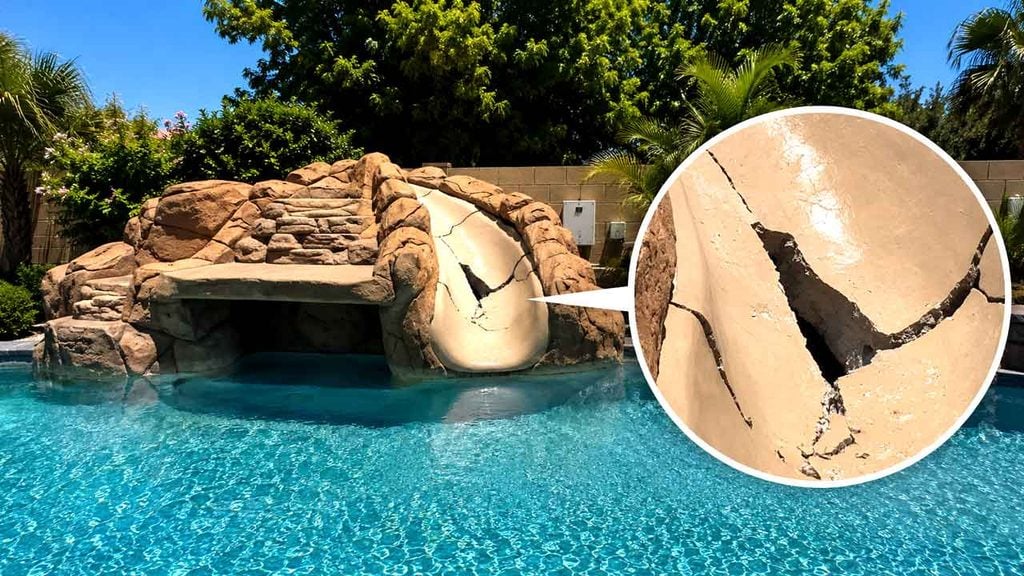
On artificial rock slides, homeowners should pay particular attention to the areas where the slide trough meets the surrounding rockwork. Lewis frequently sees consistent cracking develop along the inside and outside radiuses as the underlying reinforcement begins deteriorating.
In severe cases, gaps may become obvious, stairs may begin separating, or pieces of concrete may loosen or fall away.
His advice to homeowners is straightforward.
“Use your common sense. If it looks dangerous, it’s dangerous. It’s not perfect one day, and then it just falls apart. You can see the degradation over time.”
If cracking begins changing noticeably, sections are separating, concrete is falling away, or a step or walking surface feels compromised, the feature shouldn’t continue being used while everyone waits to see what happens next.
“Let’s stay off this. Let’s just be careful. Let’s call somebody to come and look at it,” Lewis said.
The challenge is that even an experienced contractor may not be able to determine the full condition of the reinforcement from the exterior.
“I don’t know until I open it up,” Lewis said.
On some inspections, Rockworks creates access openings specifically to examine the structure from inside. In one case, stairs had already failed, yet the adjoining slide still appeared remarkably sound. Once the structure was opened, Lewis discovered virtually none of the original reinforcing steel remained.
When a Repair Isn’t Really a Repair
Not every crack requires demolition. Rockworks routinely repairs and refinishes artificial rock features when the underlying structure remains viable.
The distinction is whether the problem is cosmetic or structural.
“When the slide is heaving, when you have chunks of concrete falling off, and you can look inside and there’s not a stitch of steel left, it needs to be torn down,” Lewis said.
That can leave homeowners facing a difficult financial decision. Some choose to remove the unsafe feature and replace it with simpler rockwork rather than reconstructing the original waterfall or slide. Others elect to demolish everything and build a new feature correctly.
What Lewis won’t do is disguise a known structural failure with a cosmetic repair.
He learned how problematic that can become through a project several years ago. Lewis inspected a slide where part of the surrounding rockwork had settled approximately three inches away from the trough. He advised that patching it wouldn’t solve the structural problem.
The homeowner nevertheless wanted it cosmetically repaired for the summer and signed a waiver acknowledging the repair wasn’t structural.
When the feature subsequently failed, the entire matter went before the Arizona Registrar of Contractors. According to Lewis, the pool company he was subcontracted to was ultimately required to correct the problem despite the homeowner’s waiver.
“You guys as contractors should know better,” Lewis recalled the ROC telling the pool builder. “You can’t be fixing things that you know are gonna fail, then ask the homeowner to take the responsibility.”
The experience changed the way Lewis approaches compromised structures.
“You couldn’t give me $100,000 to patch a job that I know it was gonna fall apart in six weeks,” he said. “It’s not ethical to do, and you’re still liable for it. I don’t want anybody getting hurt.”
What Proper Construction Looks Like
Avoiding those failures starts long before anyone applies the final texture and color that make concrete resemble natural stone.
It starts with engineering.
Rockworks spaces material behind the reinforcing steel so concrete can completely surround the structural rebar when gunite or shotcrete is applied. Lewis compares the concept to constructing a swimming pool shell, where reinforcing steel is elevated from the soil rather than lying directly against it.
“We make sure we encase all the structural rebar, so it has the strength that the engineering requires to hold up the load,” Lewis said.
On a recent San Tan Valley project, Rockworks used approximately 34 yards of shotcrete before the finish coat was applied. The grotto incorporated No. 4 rebar in a double mat, with the structure formed, poured and vibrated in an effort to ensure the reinforcement was completely encased.
The additional effort isn’t always obvious once the project is finished. In fact, that’s part of the problem when homeowners or even pool builders compare bids. Two completed artificial rock structures can look similar while being constructed very differently underneath.
Lewis said proper construction can require several additional days of labor compared with competing approaches.
“A lot of builders, again, people don’t know what they don’t know,” he said. “The price point ends up being more important than the structure itself because they don’t know if it’s being done incorrectly.”
For pool builders vetting a rockwork contractor, Lewis recommends asking specifically how the structure will be built, whether engineering requirements will be followed and how the reinforcing steel will be protected. He also photographs his projects during construction so there is a record of what’s behind the finished surface.
One project demonstrates what can happen when that attention to structure is combined with collaboration and ambitious design.
Working alongside Arizona pool builder Premier Paradise, Rockworks helped create an elaborate backyard featuring a perimeter-overflow pool, grotto, slide, jumping area and extensive artificial rockwork.

“The most important thing is we followed the engineering and built it correctly,” Lewis said.
The grotto lid was supported by engineered columns and heavily reinforced before the surrounding rockwork was constructed.
“The amount of steel and concrete they put in that lid, that thing is a helicopter landing pad on steroids,” Lewis said. “So he poured it, vibrated it, and then I came in and built my rock work around it and then did the texture coat. So it definitely was a collaboration between the two of us.”
Several years later, the feature continues to perform as intended.
“The homeowners are happy. To this day they don’t have any problems with it,” Lewis said.
That contrast—between a feature still being enjoyed years later and another only six years old with reinforcement crumbling into dust—illustrates why what’s underneath artificial rock matters as much as what homeowners see from the pool deck.
Waterfalls, grottoes and slides aren’t merely decorative sculptures. They’re engineered structures supporting substantial loads, often in environments where people climb, jump, sit and play.
For homeowners who already have one, visible deterioration shouldn’t be dismissed as simply an aging finish. Cracks that are widening or heaving, separating sections, failing stairs and loose concrete all warrant closer inspection.
For homeowners considering a new feature, the questions asked before construction ever even begins may prove even more important.
Ready to take a deeper dive?
Listen to our entire conversation with Jason Lewis of Rockworks Incorporated on the Pool Magazine Podcast.
You must be logged in to post a comment Login