Products
A Look at What’s Hot & Trending in Fire Pits and Fire Tables for 2026

Fire features are no longer a final-stage accessory in many outdoor living projects. Builders and designers are specifying them alongside pools, hardscape, furniture plans and architecture—choosing shape, height, material, fuel source and even flame presentation according to how homeowners will actually use the space.
That shift has expanded the category well beyond the traditional backyard fire pit. Today’s options can anchor conversation areas, become poolside focal points, function as dining tables or grow into large architectural features capable of accommodating a crowd.
Chuck Nitschke, National Director of Sales for The Outdoor Plus, has watched those preferences evolve through the manufacturer’s work with pool builders, landscape designers and outdoor living professionals.


“When a builder comes to us with a sleek, high-end contemporary project with more of those sharp geometric landscaping designs, we’re looking for fire features that are going to reinforce those clean lines rather than disrupt them,” Nitschke said.
That idea—selecting fire around the architecture and intended use of the space—is influencing many of the products Nitschke says are performing particularly well this year.
Matching the Fire Pit to the Space
Contemporary pool projects continue to provide a natural setting for linear fire pits. Their geometry can complement rectangular pools, porcelain decking and the strong horizontal lines found in modern architecture.
Among The Outdoor Plus’ top-selling linear models is the Del Mar, a GFRC concrete fire pit approximately 28 inches wide and 16 inches tall. Nitschke says those dimensions were selected not simply for appearance, but for how people experience the fire while seated around it.

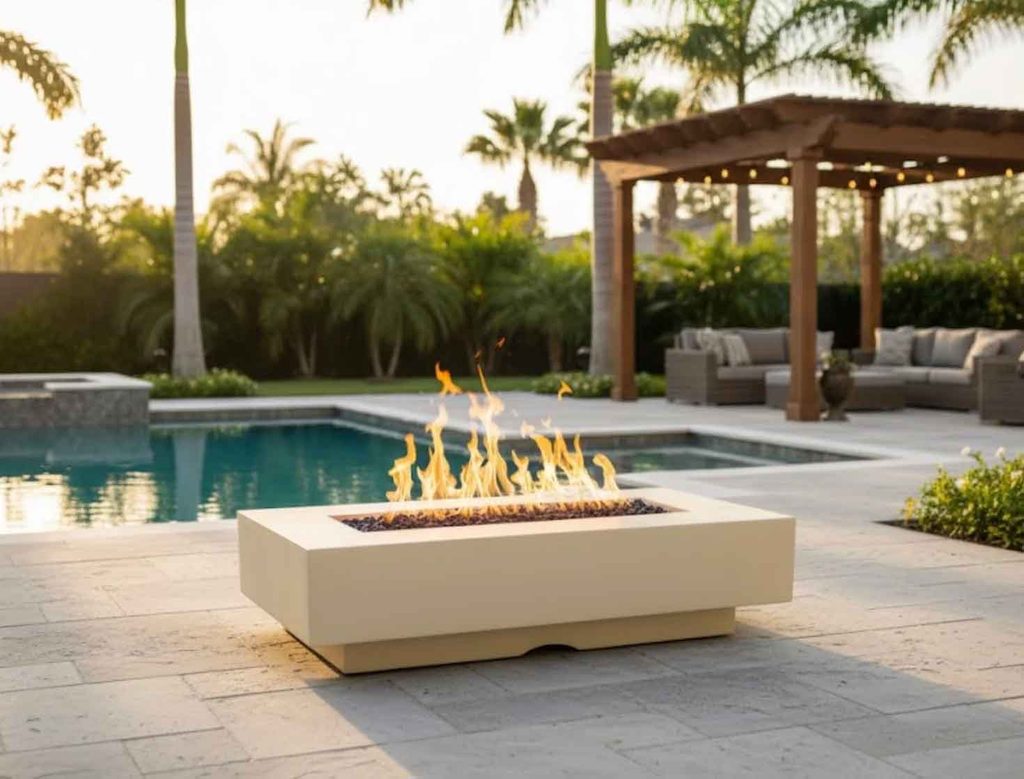
“If a fire pit is too tall, you don’t really feel the warmth around your legs. You just kind of feel it on your upper body,” Nitschke explained. “If it’s too low, it gets more on your shins, and it kind of misses that core part of your body.”


For seated conversation areas, that 15- to 16-inch range can provide a useful middle ground.
“That Del Mar hits it to a T,” Nitschke said. “That’s probably one of our top-selling linear fire pits.”

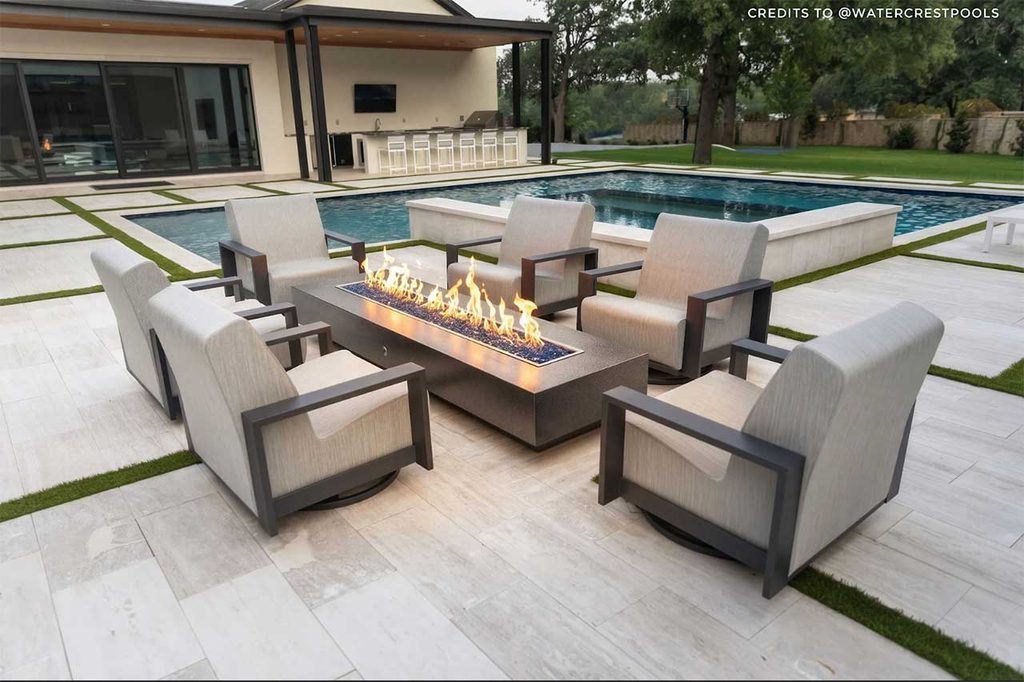
Variations on that basic linear form allow designers to solve different problems without abandoning the contemporary aesthetic. The Coronado provides similar proportions in metal, opening up finishes including powder coat, 304 or marine-grade 316 stainless steel, smooth or hammered copper and Corten steel.
The Carmen addresses projects where width is the bigger concern. At only 16 inches wide and 72 inches long, it can introduce a substantial line of fire alongside a pool or within a tighter deck area without consuming the space required by a broader pit.
Its available heights also illustrate another factor influencing product selection: fuel.
A lower version works with a hard-piped natural gas connection, while a 24-inch version provides enough internal room to conceal a propane tank. For remodels and finished patios, that can make adding fire considerably easier when running another gas line isn’t practical.
Round Designs Remain a Backyard Staple
Where linear fire pits reinforce architectural lines, round designs naturally organize seating around a central point.
The Unity is one of the manufacturer’s strongest sellers in that category.
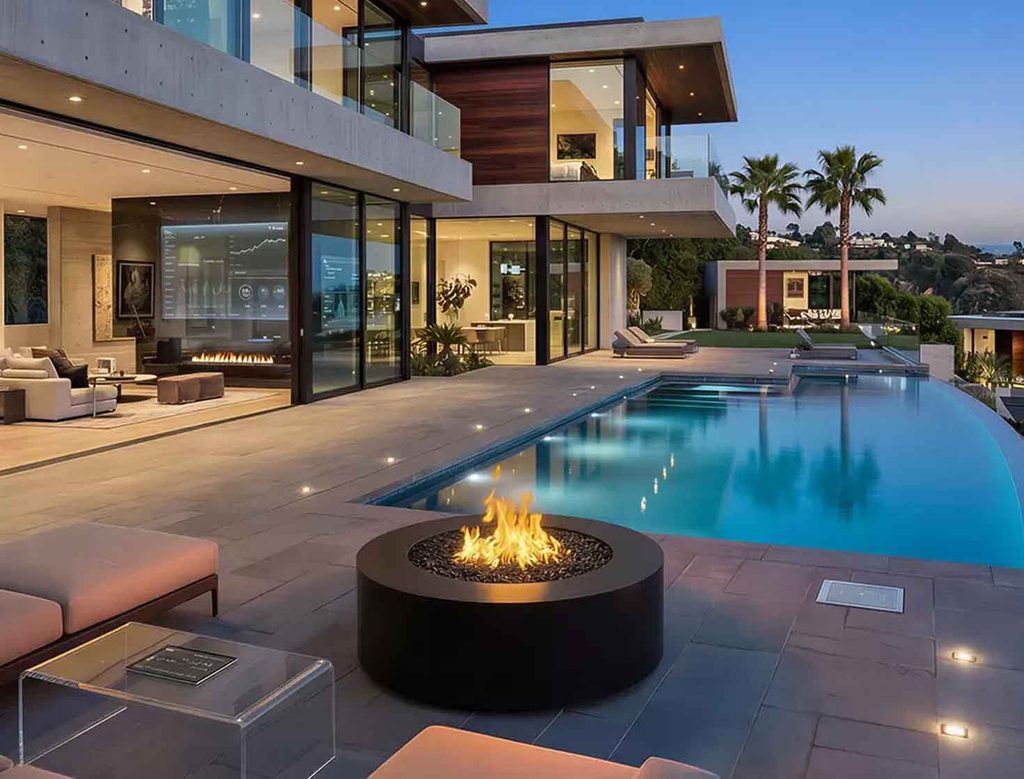
“Right now, one of the top-selling fire pits in the industry is our Unity fire pit,” Nitschke said.
Available in 48-, 60- and 72-inch diameters, the Unity can be scaled according to the size of the conversation area. Different heights and material options also allow designers to accommodate either a permanent gas connection or concealed propane.
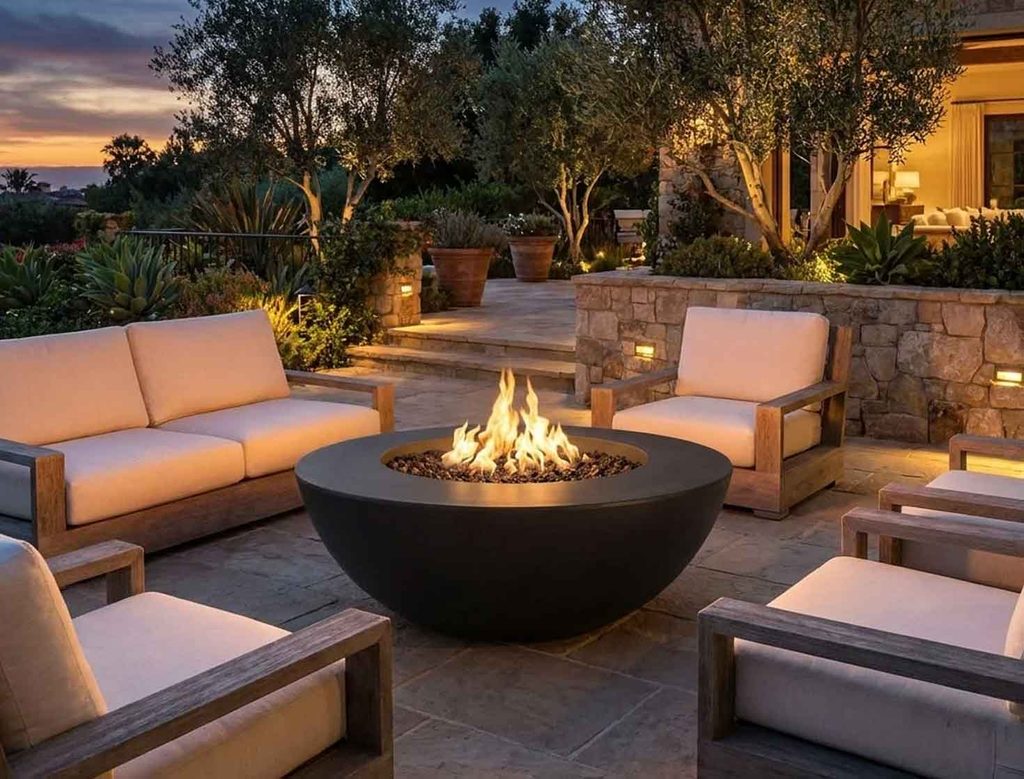
The Sedona Wide Ledge illustrates another direction within the round category. On its 48-inch model, the burner opening is approximately 28 inches, leaving significantly more usable surface around the flame.
“If you want to set a drink down on it, that Sedona Wide Ledge is another round option that is absolutely a home run,” Nitschke said.
The product illustrates demand for something between a conventional fire pit and a fire table: homeowners can retain the lower, centralized fire-pit experience while gaining enough perimeter to actually use the surface.
Rustic Materials Bring Fire Into More Natural Designs
Modern doesn’t always mean polished concrete and sharp lines.
For projects incorporating natural stone, timber and more organic landscapes, material and texture can be as important as shape. Corten steel offers one solution, developing a rusty orange appearance that continues to patina and darken as it ages.
Wood-grain concrete offers another.
The Catalina is formed and finished to resemble timber, with colors including ebony, ivory and a traditional oak tone. The effect provides the visual texture of wood while retaining the construction of a concrete fire feature.
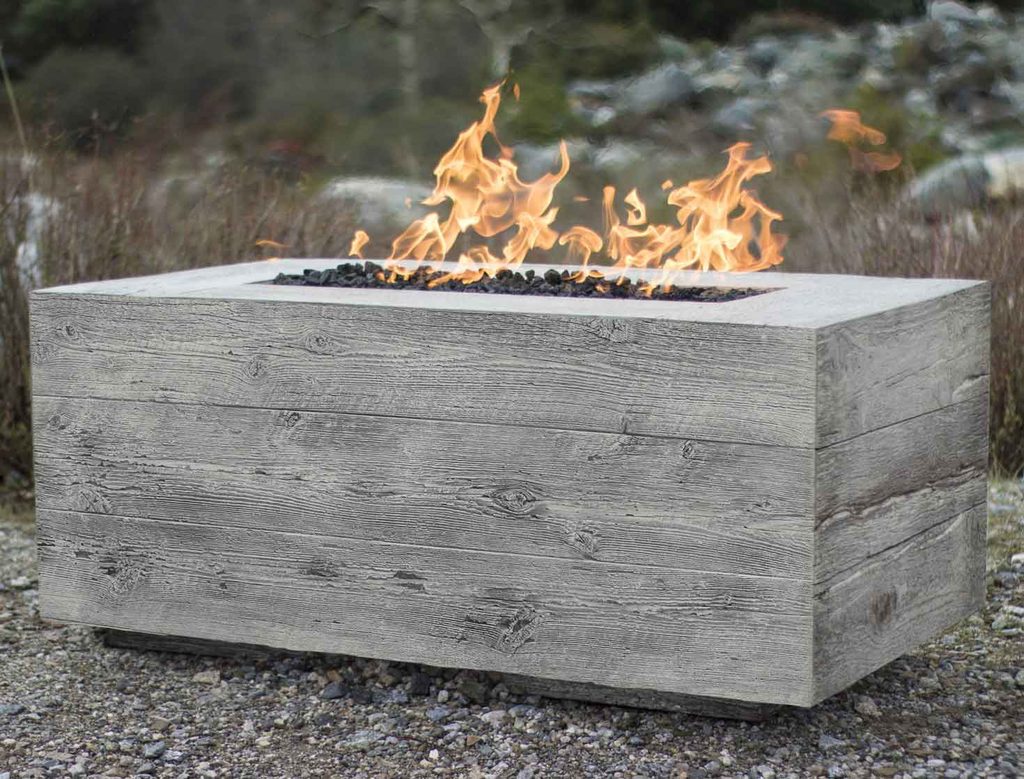
“If you’re wanting a standout feature, something that when somebody comes into your backyard they haven’t seen before, that wood grain is a beautiful little piece to add back there,” Nitschke said.
A concealed propane compartment also allows the Catalina to be incorporated where a permanent gas connection isn’t available.
The appeal goes beyond any single product. As outdoor living projects become more architecturally diverse, designers have more opportunities to specify fire features that belong within the material palette rather than simply placing another concrete element beside the pool.
Fire Tables Are Becoming Functional Furniture
At some point, product selection moves beyond the shape of the fire pit and into a more fundamental question: What is the homeowner supposed to do around it?
“It really is less about which product is better and more about the space that it’s going to be used in,” Nitschke said.
Traditional fire pits generally put the flame at the center of a dedicated seating area. Fire tables introduce usable surface space for drinks, appetizers, games and, increasingly, full dining.
“If the homeowner wants a fire feature to serve double duty as both a source of warmth and a functional gathering space, then the fire table is oftentimes going to be the better solution,” Nitschke said.
That concept is producing very different products depending on the intended application.
From Existing Patios to Statement Pieces
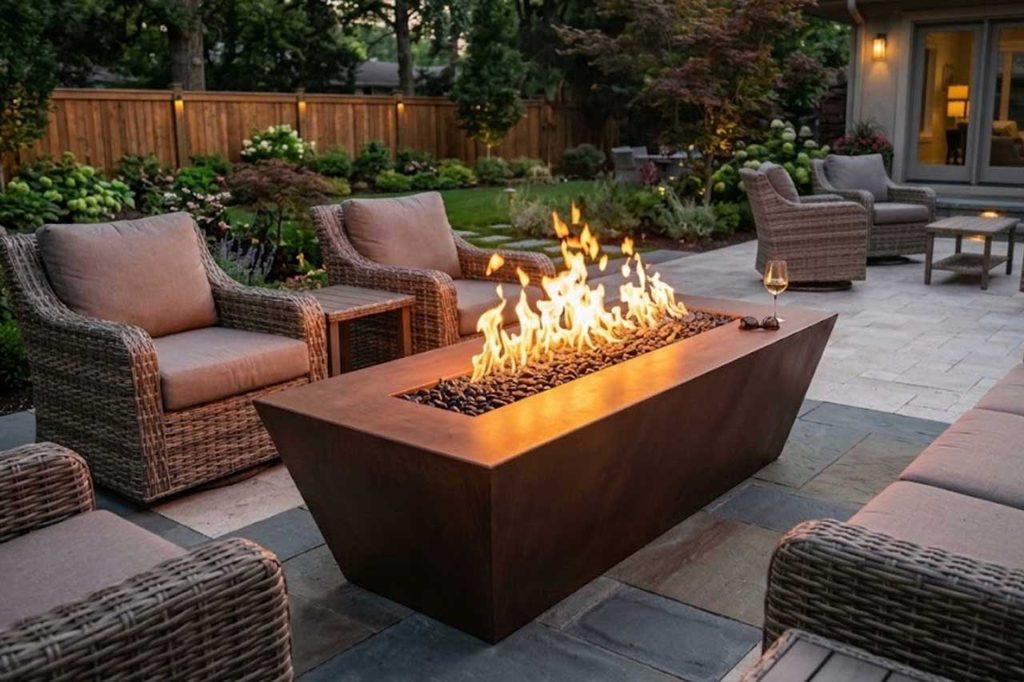
The Mesa addresses a common challenge on remodels and completed patios: adding a substantial fire feature after the infrastructure is already in place.
“The Mesa is definitely a blend of sophistication with a touch of simplicity,” Nitschke said.
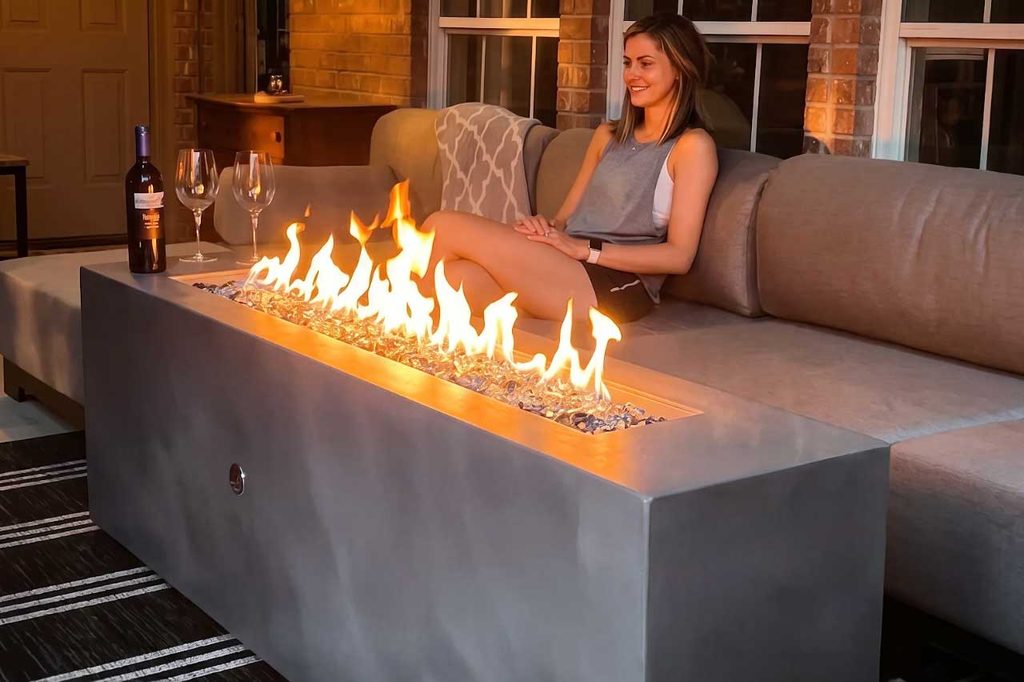
Its tapered linear profile stands approximately 24 inches tall, making it well suited for sectionals and outdoor couches while providing enough internal space to conceal a propane tank. That makes it particularly practical for finished outdoor spaces where running a new gas line may be difficult or would require disturbing existing hardscape.
On larger projects, scale itself can become part of the design.
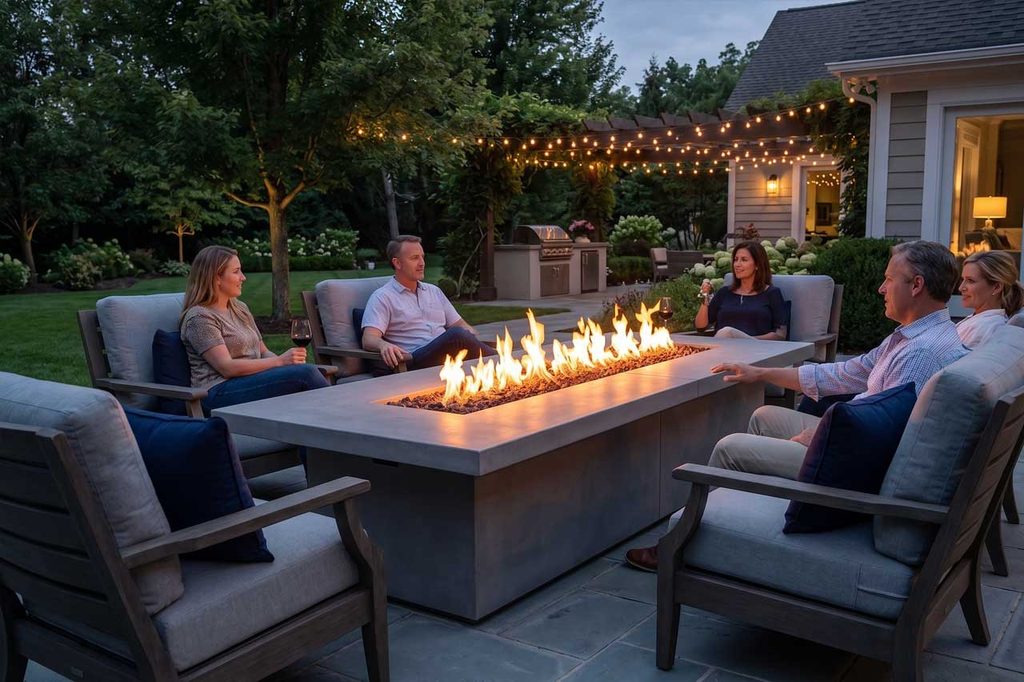
The Newport starts at 72 inches long and extends to 120 and 144 inches. At approximately four feet wide and 30 inches tall, it begins functioning less like a conventional fire feature and more like an architectural gathering place.
“The Newport is a giant,” Nitschke said. “It is a beast.”
Its size makes it particularly applicable to hospitality and commercial environments, as well as larger residential entertaining areas.
“If you’re really looking to get a lot of people to be able to gather around it, that Newport is awesome,” Nitschke said. “You can pull your chairs right up to it because it’s taller.”
The Newport shows how increasing the scale of a fire table can change its role entirely, turning it into a centerpiece designed to organize a larger gathering space.
Dining and Fire Continue to Converge
The Alameda pushes the concept of functional fire even further.
Rather than simply widening the perimeter around a burner, it is designed as a dining table with fire running through its center. Tabletops can be produced in powder coat, composite decking and GFRC, including finishes such as rustic white limestone.
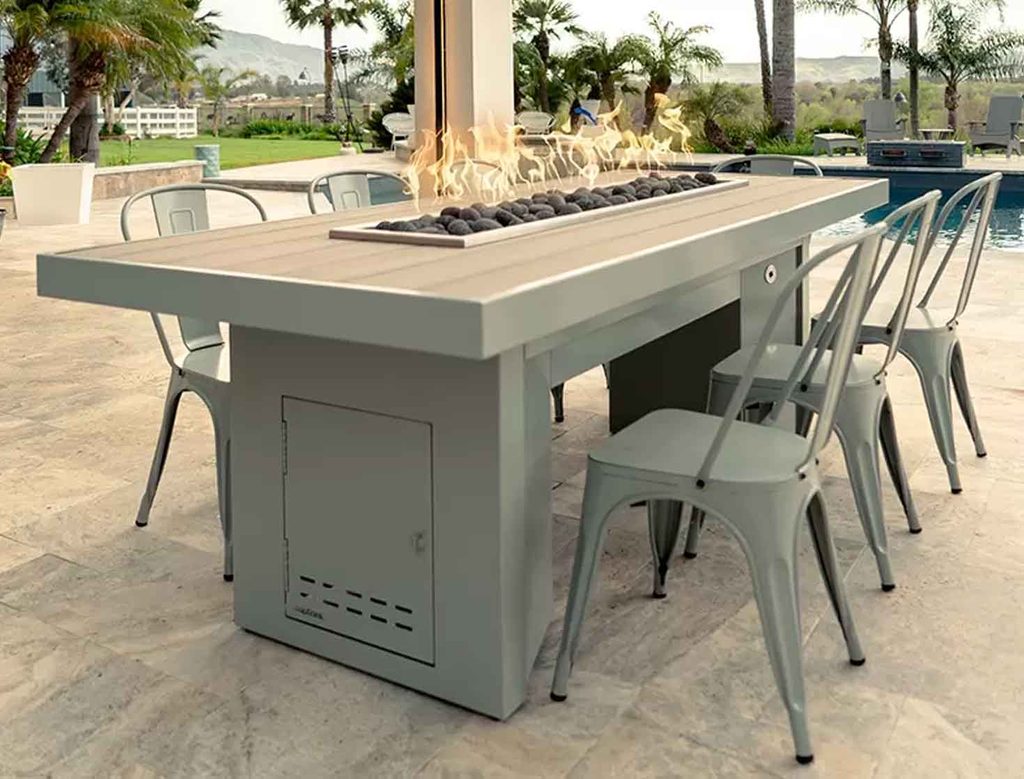
“Envision yourself having dinner outside in the summertime; you’re enjoying the evening, everyone has their plates on the table,” Nitschke said. “It’s definitely a gathering place for dining.”
The company has since extended the same basic concept into a version that replaces the fire burner with a grill, allowing people seated around the table to cook their own food.
That shift in product development shows how far the category has moved from the standalone fire pit. Manufacturers are increasingly treating fire features as part of the outdoor furniture and entertainment plan rather than equipment that simply produces a flame.
Fuel, Customization and the Flame Itself
As fire features become more integrated into the overall backyard design, manufacturers are giving designers more opportunities to customize them around the project.
Nitschke says The Outdoor Plus has been doing more with powder-coated metal, in part because fabrication isn’t constrained by the molds required for concrete products. Dimensions can be modified to better fit a particular application, whether that means making a feature taller, wider or longer.
Custom sizing allows a fire feature to better match the proportions of the project, whether it’s being positioned alongside a pool, built into a seating area or incorporated into the surrounding architecture.
The burner itself offers another opportunity for customization. The Outdoor Plus offers H burners, switchback burners, racetrack burners, rectangular burners and double-rectangle configurations, each producing a different flame pattern.
“It’s all about what you want that flame to look like,” said Nitschke.
For designers, that makes the flame itself part of the specification rather than simply the end result of selecting a fire feature.
Another area of product development Nitschke is watching is the integration of lighting into the fire feature.
“Right now there’s big movement into fire pits that also incorporate not just fire, but also LED lights,” he said.
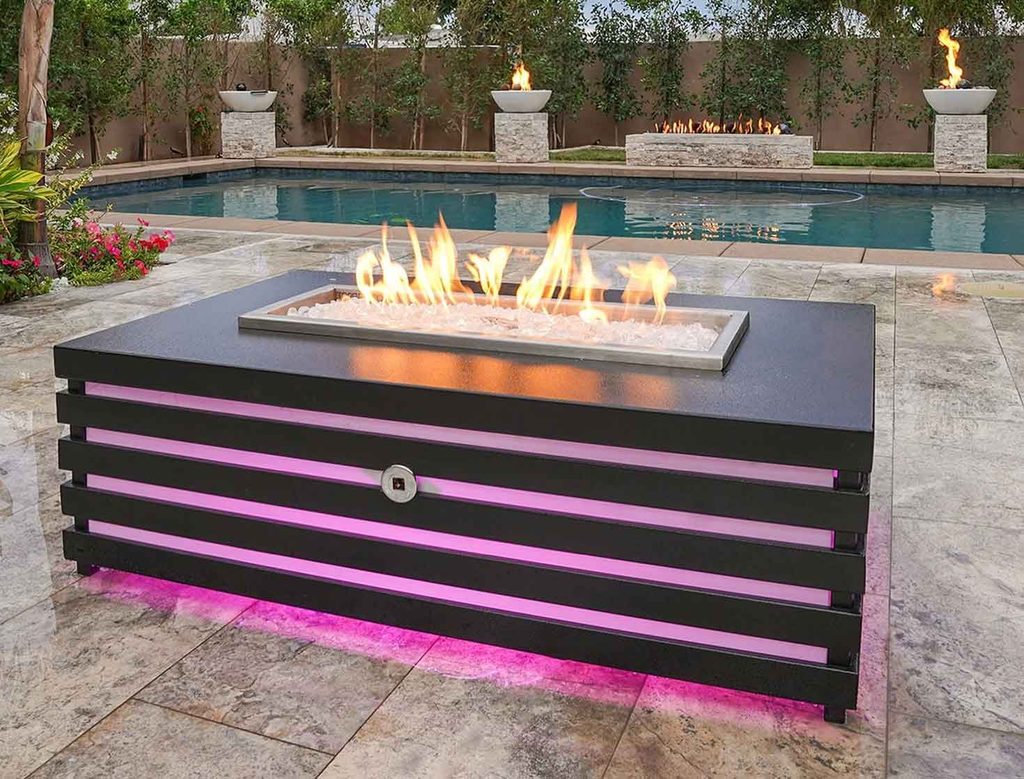
As those options expand, the question facing builders and designers is becoming less about whether a backyard should have a fire feature and more about what that feature is supposed to accomplish.
It might establish an intimate conversation area, reinforce the geometry of a modern pool, introduce texture into a natural landscape, provide a place to dine or become the centerpiece of a large hospitality space.
The products gaining traction may look very different from one another, but the underlying direction is the same: fire is increasingly being specified around the experience designers want to create.
Ready to Take a Deeper Dive?
Listen to our entire discussion with Chuck Nitschke of The Outdoor Plus on the Pool Magazine Podcast for more on the fire features, design trends, and products shaping today’s outdoor living projects.
You must be logged in to post a comment Login