Products
Ready When You Are: The Changing Role of Automatic Pool Covers
Automatic pool covers offer more than safety. Explore how they impact energy savings, water conservation, maintenance and pool design.

There is a difference between owning a swimming pool and having one that is ready to use. For many homeowners, automatic pool covers are increasingly part of what makes that possible.
Before construction begins, homeowners can spend months considering shape, finish, tile, lighting, water features, equipment and the details that will define how the finished backyard looks. Once the pool is complete, however, a different set of considerations takes over. The water must be kept clean and balanced. The pool may need to be heated. Water lost to evaporation must be replaced, and the pool remains a safety consideration whenever it is not in use.
Tom Dankel, vice president of Aquamatic Cover Systems, has worked in the automatic-cover business for more than four decades. Over that time, he has watched the role of automatic-cover systems expand beyond their traditional association with safety.


“Automatic pool covers intersect with nearly all of those realities,” Dankel said. “Long associated primarily with safety, they’re increasingly part of a broader ownership conversation involving energy use, water conservation, maintenance and how often a family actually uses their pool.”
He also sees the value in more immediate, practical terms.
“If you’ve got an uncovered pool that’s full of leaves and bugs, that’s very uninviting,” Dankel said. “A cover eliminates that. Your pool is cleaner and warmer, and consequently, you use the pool more.”
Keeping Heat, Water and Money in the Pool
The economics of pool ownership have changed substantially in recent years, particularly in California.
In June 2021, residential electricity in California averaged 23 cents per kilowatt-hour. By June 2026, the statewide average had climbed to 35 cents per kilowatt-hour—an increase of just over 50% in five years. Individual costs vary considerably, but the broader trend has made energy management a larger part of operating a pool.

“Here in San Jose, we’re over 40 cents a kilowatt hour,” Dankel said. “When you’re paying that much for energy, you start looking very closely at where you’re losing it and what you can do to reduce those operating costs.”
For an outdoor pool, evaporation is one of the primary pathways for heat loss. Heated water leaves the surface, taking energy with it, while replacement water may need to be chemically adjusted and reheated.
“With evaporative loss, you have chemical loss, and then you have to reheat and retreat that water,” Dankel said. “You’re in this cycle of loss, replenish and regenerate. With a cover, you’re interrupting that cycle.”
The financial effect varies with pool size, climate, wind exposure, utility rates, heating method, target temperature and how consistently the cover is used.
Dankel points to a roughly 30,000-gallon pool at his former California home. When uncovered, he said the circulation pump typically ran about eight hours per day. With regular cover use, he was able to reduce the schedule to approximately two hours while continuing to maintain the pool to his satisfaction.
A covered surface also keeps leaves, insects, pollen and windblown material out of the water, reducing what ultimately reaches the filtration system or has to be removed before someone swims.

Safety Is Not a Generic Claim
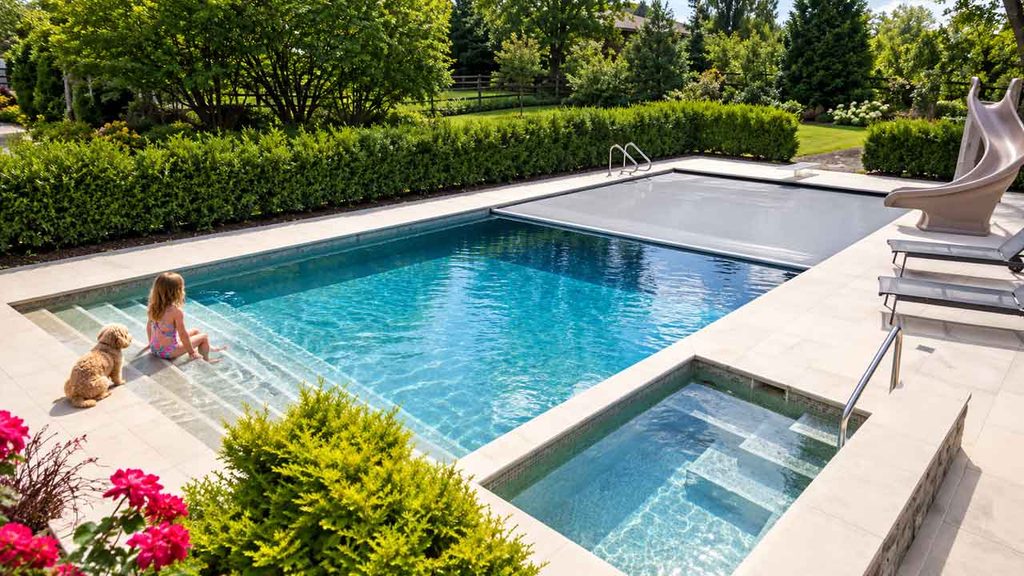
Safety remains one of the most important reasons homeowners consider automatic covers, but there is an important distinction between a product that covers a pool and one designed to perform as a safety cover.
“When people ask us about safety, they want to know, ‘Is an automatic pool cover safe? What testing is there?’” Dankel said. “ASTM set forth a standard back in 1991, and that’s what people want to know—that the cover has been tested and certified.”
In the United States, swimming-pool, spa and hot-tub safety covers are commonly evaluated against ASTM F1346, which establishes performance specifications and labeling requirements. A cover intended primarily to reduce evaporation, retain heat or limit debris may not meet the same requirements.
That distinction becomes particularly important with complex pool designs.
Homeowners increasingly request freeform curves, raised walls, integrated spas, rock features, vanishing edges and other details that do not naturally accommodate the straight, parallel tracks of a conventional automatic safety cover.
Trackless systems can accommodate some shapes that conventional tracks cannot, preserving more freedom in the pool design. That flexibility comes with an important limitation.
“We have systems that can be cut to different converging shapes because they’re trackless,” Dankel explained. “Those aren’t ASTM safety covers. They’re strictly designed with energy savings and maintenance in mind, not acting as a safety cover.”
The question, then, is not simply whether a pool can be covered, but what the homeowner expects that cover to accomplish.
Designing Beyond the Rectangle
Rectangular pools remain the most straightforward candidates for automatic pool covers. Their straight, parallel sides provide a natural operating path, and tracks and mechanisms can often be concealed beneath coping or incorporated into the surrounding structure.
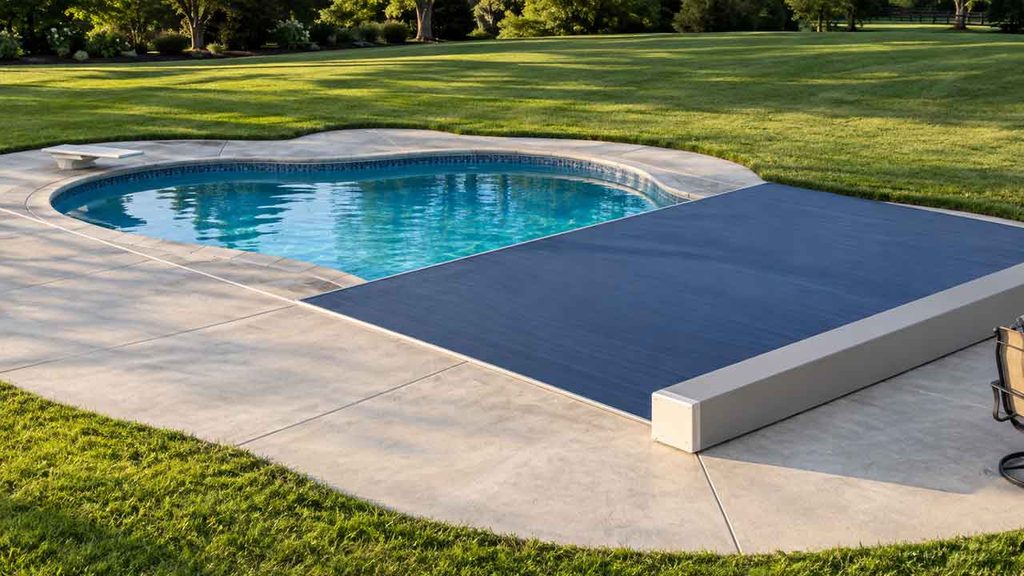
Freeform pools require more planning, but they do not necessarily rule out a cover.
One solution is sometimes described as a “pool within a pool.” Rather than requiring the entire visible water shape to conform to the cover, the builder creates a rectangular cover zone within the larger design. Curves, shelves and other aesthetic elements can remain outside it.
“If you have a freeform pool, you can create that picture frame around it using encapsulation,” Dankel said. “Whatever the pool shape is outside of that, you create the receiver for the track and then build the deck on top of it.”
Alternative mounting components and encapsulated track systems have expanded the range of pools that can accommodate automatic-cover systems. Some projects require considerably more specialized solutions.
“We did a pool that was in the shape of a letter U,” Dankel said. “We had three different covers coming out of the floor of the pool to be able to handle that.”
The Decision Belongs on the Drawing
What can be accomplished often depends on when the automatic-cover conversation begins.
Track locations, coping profiles, mechanism placement, elevations and dimensional tolerances affect the finished installation. If the system is intended to disappear into the architecture, those elements need to be coordinated before construction advances too far.
Dankel has seen how a small layout issue can become a practical problem later.
“We were at one recently and the pool was four inches out of square,” he said. “You couldn’t see it initially just by looking at it, but preparation is the key. Making sure things are square or parallel and on the same horizontal plane is what allows everything to work the way it should.”
The discussion should begin with the homeowner’s priorities. Safety may be paramount, while another owner may be focused on heat retention, debris or extending the swimming season. Curves, raised walls and water features can further narrow the available options.
Answering those questions on the drawing gives the builder considerably more flexibility than trying to solve them in finished concrete.
A Second Opportunity During Renovation
The conversation can also happen years after original construction.
Families and priorities change. Someone may purchase a home with an existing pool and later have children or grandchildren spending time in the backyard. Energy and water costs may be considerably different from when the pool was built. Renovation provides another opportunity to consider how the pool will be used and maintained going forward.
Some remodels allow concealed components to be incorporated much as they would during new construction. Others are better suited to retrofit installations with visible tracks and mechanisms.
Dankel says retrofit automatic pool covers accounts for roughly 35% of Aquamatic’s annual production. Many customers, he said, begin researching covers themselves rather than hearing about the option from the pool professional.
“People buy a house, they’ve got two kids running around, and they want safety and energy savings, so they buy a retrofit cover,” Dankel said. “I’ve heard more times than I can count, ‘Had the builder only offered this to me at the time, I would’ve taken it.’”
For pool professionals, renovation provides a natural second chance to have that conversation.
The pool was built to be used. The fewer obstacles between the decision to swim and getting into the water, the closer the backyard comes to delivering the experience the homeowner envisioned in the first place.
Ready to Take a Deeper Dive?
Listen to our full conversation with Tom Dankel on the Pool Magazine Podcast for more on automatic pool covers, energy savings, safety, design considerations and retrofit opportunities.
You must be logged in to post a comment Login