Products
The Pool Pro’s Sidekick in Algae Prevention: Robotic Pool Cleaners

When algae appears in a swimming pool, the first response is often predictable: add chlorine.
For pool professionals, however, an algae bloom should trigger a broader investigation. Is sanitizer present but less effective because pH or stabilizer levels have drifted? Are shallow areas receiving enough circulation? Is debris collecting in low-flow zones? Has biofilm developed on surfaces? And once the algae is killed, is it actually being removed from the pool?
Dr. Adva Zach-Maor, Vice President of Research and Development at Maytronics, said effective algae control requires that kind of diagnostic mindset.


“You almost have to approach it as a detective,” Zach-Maor said. “Sometimes we see surprises in those pools, but most of the time it makes sense if you look at what really causes algae blooms to occur. Those patterns keep repeating themselves all around the world.”
The larger lesson is straightforward: chemistry is essential, but it is not the entire solution. Preventing and recovering from an algae bloom requires balanced water, dependable circulation, filtration, and consistent physical cleaning of the pool’s surfaces.
Algae Will Find a Way
Algae can develop quickly when conditions are favorable. Warm water, sunlight, nutrients, poor circulation, and insufficiently effective sanitizer can create the opening organisms need to establish themselves.
“Those spores are already present in the water and just waiting for the right window to open,” Zach-Maor said. “When it does, it happens very quickly.”
A chlorine reading alone does not always provide the full picture. Poorly managed pH can reduce chlorine’s effectiveness, while excessive cyanuric acid can make it more difficult to maintain an appropriate active chlorine level. Circulation and filtration deficiencies can compound those problems, especially where water movement is limited.

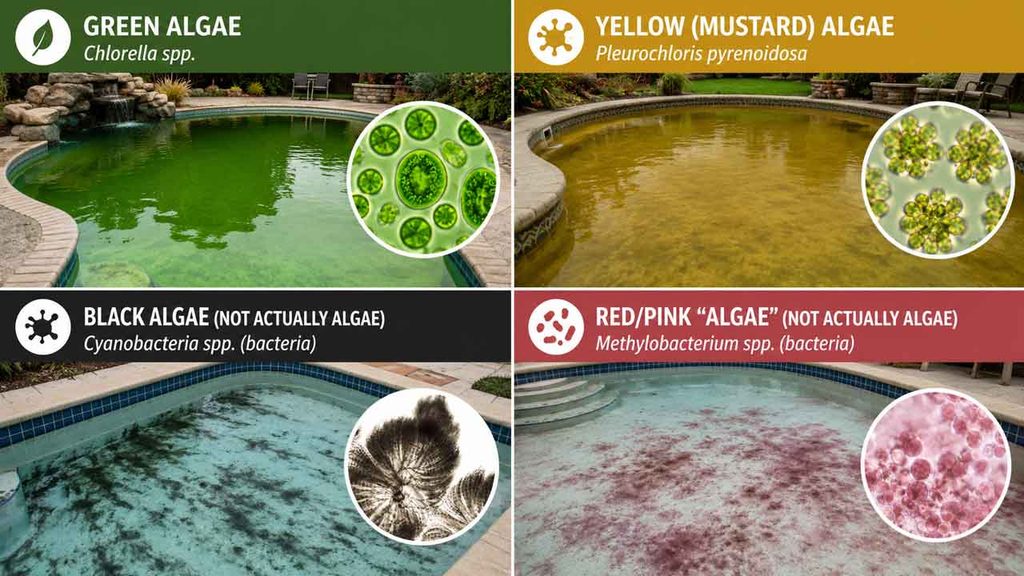
Different forms of growth can also require different responses. Green algae is generally the most familiar and often the easiest to remove. Yellow or mustard algae can be more persistent. Pink or red growth—often associated with bacterial biofilm—and black algae, a common industry term for stubborn cyanobacterial growth, can adhere tightly to surfaces and be more difficult to eliminate.
In those cases, chemical treatment alone is rarely enough.
“You need to scrub and shock, and scrub and shock again to get rid of it,” Zach-Maor said.

Killing Algae Is Not Removing It
The treatment may vary depending on what has taken hold, but one requirement remains consistent: chemical treatment alone does not physically remove the growth from the pool. Whether algae is actively growing on a surface or has already been killed by sanitizer, it still has to be dislodged and removed from the vessel. That requires physical action.
“The biggest mistake is to think that chemistry will solve everything,” Zach-Maor said.
Brushing dislodges algae and biofilm from walls, floors, steps, waterlines, and other surfaces. Once suspended, that material still has to be captured through filtration or removed through vacuuming and cleaning.
“Chemicals alone are clearly not the full solution when it comes to algae,” Zach-Maor said. “Physical scrubbing will always be essential. And of course, when you scrub, then you need proper filtration.”
Dead algae and organic material can remain in the water long after treatment. If they are not removed, they can contribute nutrients and organic loading that help create conditions favorable to another bloom.
“If we’re not filtering algae, if we’re not physically removing them from the water vessel, then they’re just creating the perfect conditions for the next algae bloom,” Zach-Maor said.
That is why recovery is not a one-step chemical correction. The water must be brought back into balance, affected surfaces must be brushed, and the released material must be removed from the system.
Why Modern Pools Need More Attention
That physical-cleaning requirement has become more significant as pool design has evolved.
Traditional rectangular pools were relatively simple vessels to circulate and clean. Today’s swimming pools often include in-pool amenities and multiple depth transitions. These features improve the experience, but they also create more surface area and more locations where debris can accumulate.
Many shallow-water features do not receive the same circulation as the main body of the pool. “You have less circulation in those areas,” Zach-Maor said. “Water temperature tends to rise, and of course it’s shallow, so there is more UV.”
“We are seeing more features in the pool such as benches, shelves, and ledges,” Zach-Maor said. “The issue with many of these styles of elements in the pool is that they create shallow areas with no flow in them, and are exactly the types of areas where debris tends to accumulate and allow algae to proliferate.”
For pool professionals, these are not simply difficult shapes for a cleaner to navigate. They are locations where warm water, limited circulation, sunlight, and accumulated debris can combine to create the perfect conditions for algae blooms.
Robotic Cleaning as a Maintenance Tool
Commercial pool operators have long understood the labor demands of physical cleaning. In a large commercial vessel, brushing thousands of square feet of submerged surface is a recurring task that must be completed consistently. A heavily used pool becomes increasingly harder to maintain between normal cleaning cycles.
That reality has helped drive the use of commercial robotic cleaners, including Maytronics’ Dolphin Wave series. Rather than replacing a facility’s circulation, filtration, or water-treatment infrastructure, robots automate a portion of the repetitive brushing and debris-removal work that would otherwise be handled manually.
“As a matter of course, we know that the combination of good maintenance both on the physical side and also on the chemical side is the true solution for prevention,” Zach-Maor said.
The same principle increasingly applies to residential pools. A backyard pool may be smaller, but its combination of steps, shelves, benches, tanning ledges, and depth changes can make it a complicated cleaning environment.
For Sacramento pool professional Kelli Clancy, robotics became a way to scale her service business without scaling labor at the same rate.
“Customers fell in love with my chem-only service,” Clancy said. “They’re brushing and skimming their own pools, and I’d drop a robotic pool cleaner in each one. For those customers, I’d only stop by every week or two to take readings and top off chemicals as needed.”
Clancy’s approach illustrates how robotic cleaners can fit into a residential maintenance program. A robot can brush surfaces and collect debris between visits, while the pool professional remains responsible for water testing, chemical adjustments, equipment inspection, and identifying problems automation cannot diagnose.
The appropriate service schedule still depends on the individual pool, its bather load, weather exposure, debris conditions, equipment, sanitation system, and the homeowner’s involvement. But that model demonstrates how robotic cleaning has become more than a convenience feature: it can be an operational tool for a service business.
Traction Is Part of Coverage
A robotic cleaner can have sophisticated navigation, powerful motors, fine filtration, and app-based controls. But those features have limited value if the machine cannot maintain contact with the surfaces it is intended to clean.
That makes traction a central part of cleaning performance.
A robot that slips on walls, falls away from a ledge, or cannot negotiate a transition onto a shelf may technically travel through the pool without delivering meaningful brushing where it is most needed. Coverage is not simply a question of where the robot goes. It is a question of where it can stay in contact long enough for its brushes to work.
“If the robot can climb it easily, that means that the pool is being taken care of,” Zach-Maor said. “If the robot is slipping on the wall, we know that the pool is not being taken care of.”
Slippage is not a standalone water-quality diagnosis. Surface finish, wall angles, pool geometry, and the cleaner’s own condition can all affect climbing ability. But it can be a useful indication that the surface, equipment, or maintenance routine deserves closer attention.
“Biofilm accumulation can make surfaces more difficult to clean and may affect a robot’s ability to grip effectively. For us, it’s typically the first visual sign for an unbalanced pool,” Zach-Maor said.
Those are the practical challenges behind Maytronics’ new Dolphin EON 100 and EON 120 residential platform. As pool designs become more elaborate, navigation, traction, brushing, debris removal, and repeatable coverage become more meaningful measures of cleaner performance.


What Robots Do—and Do Not—Replace
Robotic cleaners circulate water through onboard filtration systems and can capture fine debris. That can lead to the misconception that running a robot longer can compensate for inadequate circulation or poor primary filtration.
It cannot.
“You would not replace your peripheral equipment with a robot, meaning you wouldn’t replace your pump or your filter with a robot,” Zach-Maor said.
A pool’s primary filtration system is designed to process substantially more water and hold more debris than the compact filter inside a robotic cleaner. The robot’s purpose is more targeted: to brush surfaces, collect debris, and help remove material it dislodges during cleaning.
“The robot is helping with clarifying the pool,” Zach-Maor said. “But the target of the robot is to brush and remove everything that it’s brushing from the floor and walls—not to maintain the pool chemistry or compensate for improper filtration.”
Algae management still comes back to the same fundamentals: chemistry, circulation, filtration, and physical cleaning.
The next generation of robotic cleaners is not simply being asked to vacuum a flat pool floor. It is being asked to climb walls, navigate steps, reach shelves and ledges, maintain traction across changing surfaces, and repeatedly scrub the areas where algae and biofilm are most likely to gain a foothold.
For pool owners and service professionals, that may be the most useful way to evaluate robotic-cleaner technology in terms of algae prevention: not by the number of features printed on the box, but by how much of the pool it can actually clean.
You must be logged in to post a comment Login