





Features
Skimmer’s State of Pool Service 2025: Key Findings and Trends


Skimmer recently released its 2025 State of Pool Service report, which covers emerging trends, challenges, and opportunities in the pool service market.
According to the report, the industry is evolving rapidly. But despite economic pressures like inflation and labor shortages, pool service businesses are proving their resilience by adopting more strategic approaches to growth, pricing, and customer engagement. The 2025 State of Pool Service report is based on a survey of over 2,000 pool professionals and examines how the industry responded to challenges in 2024 and the strategies pool pros are implementing to succeed in 2025.
“The pool service industry is undergoing significant change, but the resilience and adaptability of pool professionals stand out,” said Jack Nelson, CEO of Skimmer. “This report provides actionable insights to help businesses navigate these shifts and thrive in 2025.”

Key takeaways from this year’s report:
- Economic pressures persist: Inflation, labor shortages, and rising material costs were top challenges in 2024 and will continue into 2025.
- Optimistic outlook: Pool pros remain confident about 2025, planning moderate price increases to offset costs.
- Strategic growth approaches: More businesses are leveraging technology, diversifying services, and focusing on operational efficiency.
- Private equity impact: Industry consolidation is growing, generating mixed reactions from independent service providers.
- Marketing shifts: Businesses are focusing more on customer engagement rather than traditional lead generation.
- Slow adoption of plus chems pricing: Despite fluctuating chemical prices, many businesses have yet to transition to a plus chems pricing model.
In this article, we briefly explore each key trend covered in the 2025 State of Pool Service report. For more in-depth analysis, download Skimmer’s free report here.
The economy remains the biggest challenge for pool pros
Throughout 2024, economic factors were the primary concern for pool professionals, with rising labor, chemicals, and equipment costs squeezing profit margins. Inflation has also driven up wages, while supply chain disruptions have kept material costs volatile. Looking ahead to 2025, pool businesses are focusing on cost efficiency and strategic pricing adjustments to maintain financial stability.

Industry response to economic pressure:
- Increasing service prices: Most businesses plan to raise prices moderately in 2025 to keep pace with inflation.
- Efficiency improvements: Pool pros are streamlining operations, reducing waste, and using technology to improve scheduling and billing.
- Hiring & retention strategies: With a persistent labor shortage, businesses are offering better wages and training programs to attract and retain talent.
There is optimism for 2025 thanks to strategic pricing adjustments
Despite economic uncertainty, pool pros remain optimistic about their business prospects. A key strategy for navigating financial pressures is the implementation of strategic price increases.
Pricing trends:
- Incremental price adjustments: Businesses are adjusting rates by 5-10% rather than making drastic increases.
- Value-based pricing: Many pool pros are shifting to pricing structures that highlight the quality and reliability of their service.
- Transparent communication: Customers are more likely to accept price increases when businesses clearly explain rising costs and added value.

Smarter growth strategies are taking root
In 2025, pool pros are prioritizing sustainable, long-term growth. Instead of relying solely on new customer acquisition, many are improving efficiency and expanding their service offerings.
2025 growth tactics:
- Finding internal efficiencies: Pool pros are moving away from just packing on more business at all costs. 60% of survey respondents said that in 2025, they’re planning on prioritizing internal efficiencies to support profitability.
- Diversifying services: Expanding into other lines of business gives pool pros the opportunity to upsell to their existing customer base and find new business.
- Increasing marketing budgets: 40% of survey respondents said a bigger marketing budget is on the table for 2025. This makes sense, given the relatively low barrier to entry in the pool service market. Established companies always have new competitors to contend with, and marketing beyond word of mouth will be increasingly important for pros to find new business.

Private equity is playing a growing role in the pool service industry
The pool and spa service industry has seen a surge in private equity (PE) investment, driving consolidation and expansion. PE firms are acquiring companies to create larger, more efficient entities and focus on expanding product distribution.

Several factors drive this trend, including growing consumer demand, market fragmentation, and the appeal of recurring revenue. For pool and spa service business owners, PE investment can provide access to capital, operational expertise, increased valuations, market stability, and partnership opportunities.
However, challenges exist, such as loss of autonomy, cultural misalignment, financial pressures, short-term profit focus, employee disruption, and legal risks.
Despite the prevalence of this kind of investment activity, pool pros themselves are split on what this means for the market. Some view PE investment as an opportunity for growth, higher service pricing, and easier business exits. Others worry about declining service quality, aggressive expansion strategies, and the negative impact on the industry’s reputation.

The marketing landscape has shifted in the past 12 months
Marketing strategies in the pool and spa service industry have evolved significantly over the past year, with more professionals investing in paid marketing. Only 35 of last year’s survey respondents reported doing paid marketing, with that number increasing to 41% this year.
Survey results also show an overall increase in marketing activity, particularly in paid search, SEO, referrals, direct mail, cold calling, and events. Conversely, reliance on lead suppliers has dropped by over 55%, likely due to cost concerns, competition from shared leads, and inconsistent quality. With over 42% of respondents working with a marketing budget of $5,000 or less, many are shifting to strategies that provide better control over lead quality and ROI.

Paid search has emerged as a top-performing channel, ranking second only to referrals in lead quality. Other high-ranking channels include SEO, paid social, and direct mail. The increased use of events, cold calling, and community engagement suggests a renewed focus on personal connections to drive business growth.
This year’s survey also indicates a more optimistic approach to marketing budgets. In contrast to last year’s split outlook, over 50% of respondents plan to increase their marketing budgets in 2025, with less than 10% expecting to cut spending.
The data highlights a shift toward strategic, high-ROI marketing efforts that prioritize sustainable growth, quality leads, and direct engagement over costly, low-return lead generation services.
Adoption of a plus chems pricing model is still sluggish
Despite ongoing chemical price volatility, most pool pros still favor an all-inclusive pricing model, with over 54% of survey respondents using a flat monthly rate that includes chemicals. Only 20% have adopted a “plus chems” model, where chemical costs are charged separately, and even fewer charge per stop.

There are several factors driving the preference for all-inclusive pricing. It simplifies billing for customers, improves satisfaction by providing predictable costs, and differentiates businesses from competitors. Additionally, it streamlines operations, allowing bulk chemical purchasing and reducing administrative work. Many pros also see it as a way to build customer loyalty, ensuring consistent service without disputes over added costs.
“We like to treat our clients the way we would like to be treated. No-nonsense pricing. In business, there is always a risk, and you can choose to put that risk on the client or your own business. We choose to take the risk off of our clients. It forces our entire team to become better and more mindful of their craft,” says Chancy Green of Cool Pool People in Frisco, Texas.
Thomas Walsh of Integrity Pool Service agrees, saying “It would be very hard to get most of my customers to accept anything less than all-inclusive. They like the predictability of the same amount each month, they can schedule the bill every month and not think about it”.
While including chems in pricing fosters trust and operational efficiency, it carries risks such as fluctuating chemical costs and the perception of higher base prices, which may deter budget-conscious customers.
Conclusion
The pool service industry is evolving in response to economic pressures, increased competition, and changing consumer expectations. While challenges like inflation, labor shortages, and market consolidation persist, pool pros are adopting more strategic, data-driven approaches to growth and pricing. With a focus on efficiency, service diversification, and customer engagement, the industry is set for continued success in 2025.
By leveraging smart pricing models, investing in technology like Skimmer’s all-in-one pool service software, and maintaining strong customer relationships, pool businesses can stay ahead of industry changes and drive sustainable growth in the coming year.


Robotic pool cleaners can look impressive under controlled conditions. The more meaningful test isn’t how a cleaner performs in a demonstration environment, but how it handles real-world conditions in an actual swimming pool over time.
Leaves, dirt, pet hair, changing weather, irregular pool geometry and everyday use can expose things that simply don’t show up during a short product demonstration.
That was the idea behind Pool Magazine’s recent evaluation of the iGarden K Series robotic pool cleaner.

Rather than conduct a short-term test, we placed the K Series with pool professional Kelli Clancy, owner of Legacy Pool and Spa in Sacramento, who installed the unit in one of her customer’s pools. The homeowner used the cleaner over an extended period, while Clancy monitored its performance and gathered feedback about what worked well and where the cleaner had limitations.
The result was a practical assessment of a cordless robotic cleaner that Clancy believes could make a compelling option for homeowners buying their first robot.
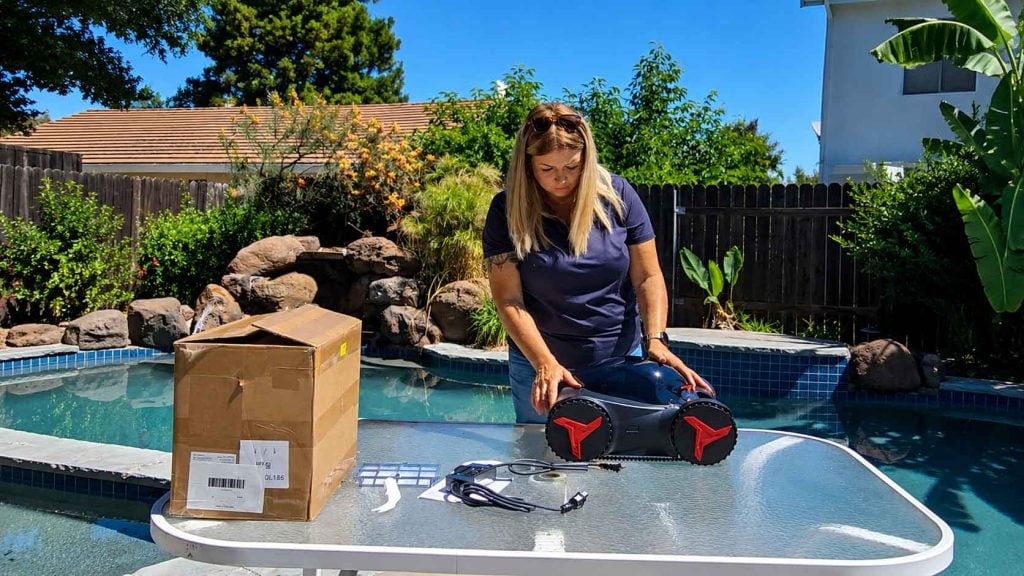
A Real Backyard Instead of a Test Tank
Clancy deliberately selected a pool that would give the K Series plenty to contend with.
“I chose this particular pool for a variety of reasons,” Clancy explained. “One, I knew the customer would give me honest feedback. I knew she would try and get everything she wanted out of the cleaner and give an honest review.”
The surrounding landscape also created a good mixture of debris.

“They had small leaves, big leaves, pine trees,” Clancy said. “So it was a variety of debris I wanted to be able to know if it could pick up.”
As luck would have it, an unrelated issue had also temporarily taken the pool’s circulation system offline, leaving the water somewhat dirtier than usual when the K Series arrived. That provided another opportunity to see how the cleaner handled real debris rather than a carefully prepared demonstration.
The pool itself presented an additional challenge. It was an older freeform gunite pool with curves, varying radiuses and features that would test the cleaner’s ability to navigate something considerably more complicated than a rectangular test pool.
For Clancy, that distinction matters when evaluating robotic cleaners.
“It’s not as authentic as putting it into somebody’s pool in an everyday yard where you have, you know, squirrels, and dogs, and wind, and rain, and all these varieties of things going on,” she said of controlled product demonstrations.
Strong First Impressions
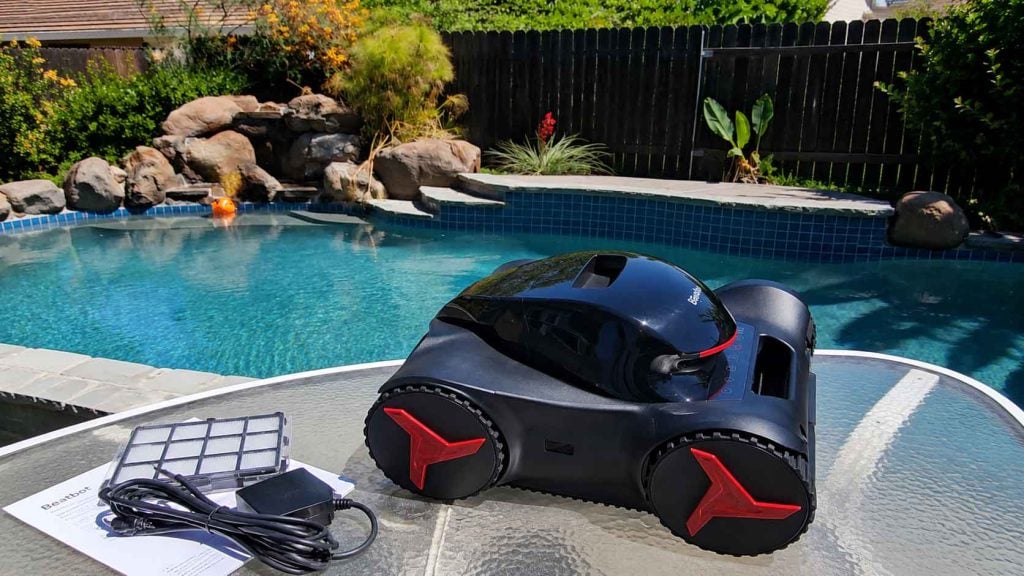
Out of the box, the K Series made a favorable impression.
“I thought it had a very sleek look,” Clancy said. “It has a great look to it, you know, very modern. It wasn’t too bulky, which I did like about it.”
More important than aesthetics was the filtration system. The cleaner includes a fine-mesh filter that fits onto the debris canister, allowing it to capture smaller material in addition to larger debris.
“I really liked that it came with that so it can catch that fine debris such as dog hair or dirt,” Clancy said.
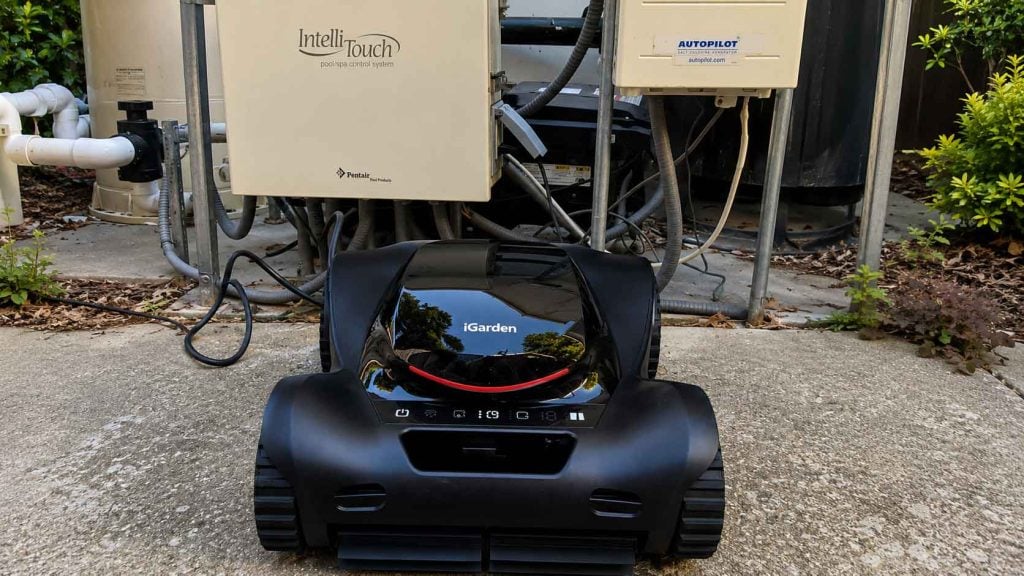
The cordless design was another immediate positive for the homeowner. She had previously owned another robotic cleaner that required placement on a charging base. The K Series offered a simpler arrangement.
“She liked on this one you could just plug it anywhere,” Clancy said. “You didn’t have to put it on a base, and it charged within three hours. She really liked that aspect of it.”
For a homeowner who wants a cleaner without adding another permanent charging station around the pool area, that simplicity can be an attractive feature.
Cleaning the Floor, Walls and Waterline
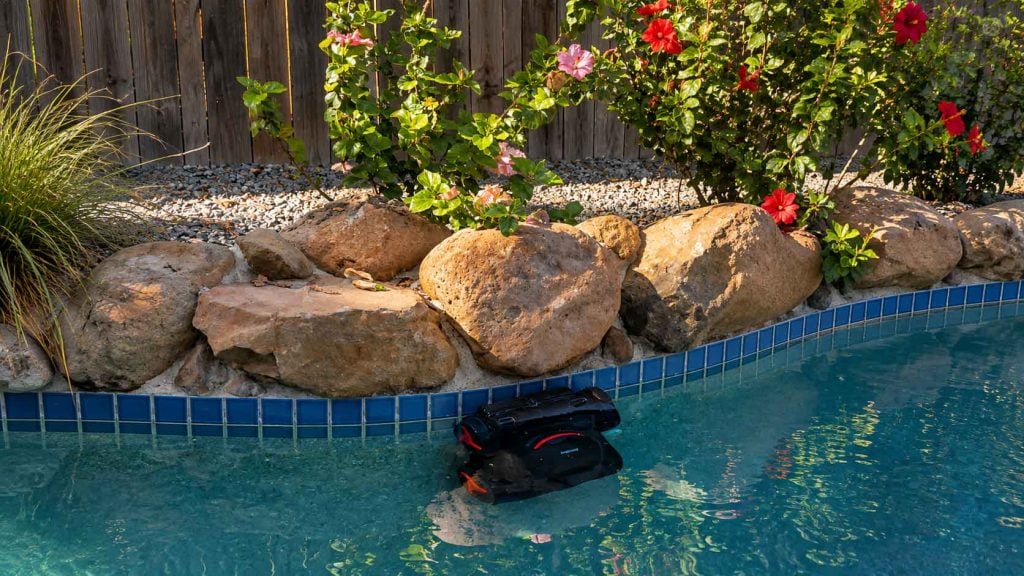
The K Series provides operating modes for floor cleaning as well as floor-and-wall cleaning. Once operating in the latter mode, Clancy found that the robot was capable of climbing the pool walls all the way to the waterline.
“It did go up the walls and did a good job at cleaning them,” she said. “So I really liked that about it.”
That capability stood out to the homeowner because previous cleaners she had owned did not provide the same wall-cleaning performance.
“That was a feature she really enjoyed,” Clancy said.
The robot also surprised Clancy by making its way onto the pool’s tanning ledge.
“It went up onto the tanning ledge. And that was surprising to me,” she said.
What impressed her most, however, was how quickly the K Series could make a noticeable difference.
“Me personally, watching it, I thought the cleaner did really well. I found that it cleaned the pool fairly quickly, which was really nice,” Clancy said. “So then if you have a party, you can just toss that in there and know within an hour that pool’s gonna be ready to go.”
Its ability to reach the waterline added another layer of cleaning.
“It climbs all the way up to clean the tile line, so that was really nice, too, if you haven’t brushed your tile in a while and have some leaves along there this will do a great job with that,” she added.
Handling Real Backyard Debris
Ultimately, a pool cleaner needs to pick things up, and Clancy came away impressed with the K Series’ ability to collect larger debris.
She specifically pointed to the tracks and intake design at the front of the cleaner.
“I think they got right with the tracks on the front where it’s collecting the debris,” Clancy said. “Those were very grippy, and when I watch it go over a pile of leaves, it was able to pull it in easily.”
Combined with the fine-mesh filtration, that gave the cleaner the ability to contend with the mixture commonly found in residential pools, including dirt, dog hair, leaves and pine needles.
Clancy sees that versatility as increasingly important as backyard landscaping becomes more elaborate and homeowners expect robotic cleaners to handle more than one specific type of debris.
Where Pool Geometry Matters
No robotic cleaner is necessarily going to perform identically in every swimming pool, and the K Series was no exception.
The test pool presented a particularly challenging combination of freeform curves and relatively narrow steps. The K Series has a fairly wide wheelbase, and Clancy observed that it could climb some steps but had difficulty stabilizing on others.
Importantly, she believed some of that behavior was specific to the dimensions of this particular pool.
“This particular issue may not be an issue in other pools, depending on the width of the steps,” Clancy explained. The steps in the test pool were approximately 10 inches wide, and she felt even slightly wider steps could have made it considerably easier for the robot to stabilize.
The irregular curves of the older freeform pool also occasionally presented navigation challenges. Based on what she observed, Clancy believes the K Series is likely to perform at its best in more geometrically shaped pools.
That doesn’t negate its performance in the test pool. The cleaner still climbed walls, reached the tile line, accessed the tanning ledge and collected a wide range of debris. It does, however, underscore something consumers should consider with any robotic cleaner: pool shape and feature dimensions can influence performance.
An Area With Room for Improvement
The primary area Clancy would like to see improved is app connectivity when the cleaner is submerged.
“The app needs a little improvement,” she said, noting that communication with the unit became less reliable once it was underwater.
For routine operation, however, Clancy found the cleaner itself straightforward to set up and use. When asked what might distinguish the K Series for someone comparing similarly priced robotic cleaners, she immediately pointed to that simplicity.
“Easy to program,” Clancy said. “It was pretty easy to program. I think that thing took maybe five minutes tops to program completely.”
The homeowner also appreciated a decidedly low-tech feature: the retrieval hook.
“That was one thing the homeowner did love was the hook that came with the cleaner actually worked,” Clancy said. Compared with another robot the homeowner had used, retrieving the K Series from the pool was considerably easier.
It may seem like a small consideration, but usability extends beyond how well a robot cleans. Charging it, programming it, removing it from the water and emptying the debris can determine whether a homeowner actually enjoys owning the product.

A Strong Entry Point Into Robotic Cleaning
With robotic cleaners now available across a wide range of prices and feature sets, one of the biggest questions is where a particular product fits.
For Clancy, the K Series occupies an appealing position for consumers who want to move into robotic cleaning without immediately jumping to the highest-priced equipment on the market.
“I would say it’s gonna be that middle ground customer, someone who’s looking for something that’s not the cheapest but not the most expensive,” she said. “Maybe more of your entry level robotic owner.”
Ease of use strengthens that argument.
“Overall, it seemed very easy to use for anybody, even somebody who doesn’t have ever used a robot,” Clancy said.
That may ultimately be one of the K Series’ strongest selling points. Robotic cleaners have become increasingly sophisticated, but sophistication isn’t necessarily what every homeowner wants. For someone purchasing their first cordless robotic cleaner, being able to charge it, program it quickly, drop it into the pool and retrieve a canister full of debris without a steep learning curve has considerable value.
Clancy’s final assessment carries additional weight because she doesn’t automatically endorse every cleaner she encounters.
“I could see this being a cleaner that I would recommend to people,” she said. “And I don’t recommend just any cleaner. I want something that actually works because, you know, it’s not a small price tag to get a robotic.”
After months in an actual customer’s backyard, the iGarden K Series showed itself to be an approachable cordless robotic cleaner with good debris pickup, wall and waterline cleaning, straightforward programming, convenient charging and thoughtful everyday usability.
There are areas where future generations could improve, particularly app connectivity and navigation around certain freeform curves or narrow features. Those considerations are worth understanding when matching any cleaner to a particular pool.
For homeowners looking to make the jump from traditional pool cleaning equipment to their first robotic cleaner, however, the K Series offers many of the capabilities that make robots attractive in the first place without making the experience unnecessarily complicated.
Should You Buy the iGarden K Series?
Yes.
The iGarden K Series makes the most sense for someone who wants to get into robotic pool cleaning without paying a premium for features they may not need. It’s a practical entry point into the category and, based on our real-world testing, capable enough to justify the investment.
That doesn’t mean it’s the perfect cleaner for every pool. More complex pool shapes and features deserve some consideration, and buyers expecting flawless app control may want to temper their expectations. But those shortcomings weren’t significant enough to change our overall opinion of the product.
What matters is whether the K Series delivers enough cleaning capability, convenience and usability to make owning one worthwhile. We think it does.
If you’ve been considering making the jump to a cordless robotic cleaner and want a capable unit without immediately moving into the upper end of the category, the iGarden K Series earns our recommendation.
And for an entry-level robotic cleaner, getting those fundamentals right matters most.
Ready to take a deeper dive?
Listen to our entire interview with Kelli Clancy about the iGarden K Series robot on the Pool Magazine podcast.


There is a point in luxury pool design where the materials stop functioning merely as finishes and begin defining the character of the space.
For Frank Vitori, co-founder of AquaBlu Mosaics and designer of the new Sand Pearl Series, the opportunity was to rethink some of the patterns currently influencing pool and architectural design without relying on the contrasting colors traditionally used to create them.
When Pool Magazine spoke with Vitori about the collection, he explained that the idea behind Sand Pearl began with a deceptively simple question: What if the pattern could be created by light instead of color?

“The concept behind Sand Pearl was to take patterns we’re seeing throughout contemporary design—checkerboards, stripes and offset stripes—and reinterpret them through finish and light,” Vitori explained. “Instead of using contrasting colors to define the pattern, we’re using the same color in matte and iridescent glass. As the light changes, the pattern reveals itself.”
That distinction is central to understanding Sand Pearl, the latest AquaBlu Signature Collection from AquaBlu Mosaics.
Rather than simply assembling existing tile into a new assortment, AquaBlu developed Sand Pearl as an original, coordinated design collection. Each colorway brings together monochromatic glass, complementary finishes, contemporary patterns, coordinating field tile and curated grout selections to create a complete material system for pools and architectural spaces.
It is a concept rooted in what Vitori describes as a quieter approach to luxury.
“Luxury doesn’t always need to announce itself,” Vitori said. “Sometimes it’s the detail you notice as you move through a space—the way a surface changes in the light or the way water completely transforms the material.”

Reinventing Pattern Through Light
Pattern is hardly new to tile.
Checkerboards, stripes and running patterns have appeared in architecture and interior design for generations. What has changed is how designers are using them.
As contemporary tile trends move toward more intentional patterns and sophisticated material combinations, Sand Pearl approaches those familiar geometries from a different direction.
The collection does not need a dark tile beside a light tile to create a checkerboard. It does not require two opposing colors to make a stripe visible.
Instead, matte and iridescent versions of the same color work together to create the pattern.
From certain angles, the distinction can appear subtle. Then sunlight moves across the installation, the viewing angle changes or water begins flowing over the surface, and individual sections of iridescent glass catch the light differently from their matte counterparts.
Suddenly, the pattern becomes more pronounced.
The effect allows a surface to remain monochromatic while still having considerable visual depth and movement. Rather than placing the emphasis on color contrast, Sand Pearl uses reflection itself as a design element.
That becomes particularly compelling in a swimming pool, where very little about the visual environment remains static.
Sunlight changes position throughout the day. Ripples continuously alter reflections. Water depth influences perceived color. Landscaping, coping, interior finishes and surrounding architecture all contribute additional tones and reflected light.
Sand Pearl was designed to interact with those variables rather than compete with them.
The collection draws its palette from sun-bleached beaches, shallow coastal water, sea glass and other subdued coastal tones, but the coastal influence provides the backdrop rather than defining the entire concept.
The real story is what happens when pattern, finish, and changing light intersect.
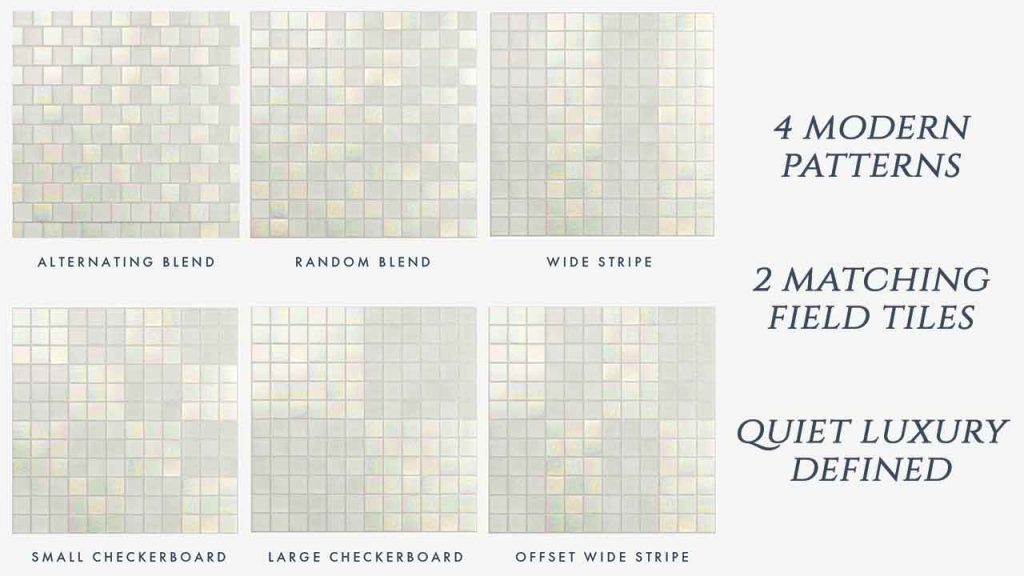
Contemporary Patterns, Reinterpreted
Sand Pearl takes several of today’s most recognizable tile patterns and reconstructs them using matte and iridescent finishes.
The checkerboard pattern provides perhaps the clearest demonstration of the concept. Instead of alternating contrasting colors, the pattern alternates finishes within the same color family. The checkerboard may appear subdued under one lighting condition and considerably more pronounced under another.
The striped pattern applies the same principle in a more linear composition, creating alternating bands of matte and reflective glass. It can introduce direction and rhythm across a waterline, raised spa, feature wall or other architectural surface without introducing another color into the palette.
The offset stripe pattern adds another level of movement by shifting that linear geometry, creating a more dynamic arrangement while retaining the collection’s monochromatic character.
These patterns are complemented by two coordinating field-tile formats: stacked and staggered.
That addition gives designers considerably more flexibility when specifying the collection across an entire project.
A checkerboard, stripe or offset stripe might be used to establish a focal point on a raised spa, water feature or architectural wall, while the coordinating stacked or staggered field tile can finish the surrounding space in the same color and material language.
Alternatively, the field tile can be carried across a larger surface where a quieter treatment is desired.
The result is not simply a selection of individual mosaics. It is a coordinated collection that allows designers to change pattern and visual intensity while maintaining continuity of color and material.

Six Coastal-Inspired Colorways
Sand Pearl is offered in six primary colorways—Marelle, Caspia, Brisa, Calista, Marea and Aurelia—ranging from luminous whites and soft sand tones to aqua, sea-glass greens and deeper coastal blues and grays.
Caspia provides one of the collection’s lightest treatments with a pearlescent white appearance suited to bright contemporary environments. Brisa moves toward tropical aqua, while Marea introduces softer sea-glass tones. Marelle and Calista bring cooler, deeper shades into the collection, while Aurelia introduces the warmth of sand and champagne.
The restrained palette is intentional.
Because the visual interest is being created through the relationship between matte and iridescent finishes, the colors themselves do not need to compete for attention. That allows designers to select a palette based on the architecture and surrounding environment while allowing changing light to bring the pattern forward.
Grout Becomes Part of the Design
AquaBlu has taken that coordination one step further by pairing Sand Pearl designs with curated Starlike PRO grout selections.
That is an important detail because grout can substantially change the appearance of a mosaic installation. With small-format glass tile in particular, grout becomes part of the visible composition rather than simply the material filling the joints.
For Sand Pearl, the grout selection is treated as another component of the design.
Each recommended grout is chosen to complement the intended color and pattern combination, helping maintain the collection’s monochromatic character rather than introducing an unintended grid or competing visual element.
The curated Starlike PRO grout options give designers and installers a defined starting point for achieving the intended finished appearance.
That level of coordination reinforces Sand Pearl’s position as an AquaBlu Signature Collection. The concept extends beyond selecting an attractive glass tile. Color, finish, pattern, field tile and grout are considered together as parts of the same visual system.
Designed for Water, Architecture and Quiet Luxury
The interaction between matte and iridescent glass becomes especially interesting when Sand Pearl enters an aquatic environment.
Water is constantly changing what we see.
Glass naturally reflects and refracts light differently than many conventional pool finishes. An iridescent surface introduces another variable because its appearance changes depending on viewing angle and illumination.
Combine those characteristics with moving water and a monochromatic pattern can behave differently from one moment to the next.
In an infinity-edge pool, the effect can help visually connect the tile with an ocean, lake or distant horizon. On raised spas, water walls, spillways and perimeter-overflow details, moving water continuously changes which portions of the pattern catch and return light.
Even a traditional waterline can become more dimensional because the pattern is not dependent on a fixed contrast between two colors.
The installation effectively changes throughout the day.
That ability gives pool builders and designers another way to create visual interest without adding more colors, decorative elements or competing materials to the project.
More Than a Waterline Tile
Although glass mosaic remains closely associated with swimming pool waterlines, Sand Pearl was developed for considerably broader use.
The collection can extend across pools and spas as well as kitchens, backsplashes and architectural feature walls, allowing designers to carry the same material language between indoor and outdoor environments.
That continuity has become increasingly relevant as homeowners treat outdoor living areas as extensions of the home.
Large sliding and folding glass doors have blurred the traditional boundary between interior and exterior spaces. Outdoor kitchens increasingly mirror their indoor counterparts. Pool houses, cabanas, fire features and covered entertaining areas are frequently designed as elements of a single architectural composition.
Sand Pearl’s coordinating patterns and field tiles make it possible to continue a color throughout those spaces while adjusting the intensity of the pattern according to the application.
A feature wall might employ the checkerboard or offset stripe as a stronger architectural statement. A surrounding surface could transition into stacked or staggered field tile. A raised spa or water feature could then reintroduce the pattern outside.
The material remains connected even as its role changes.
For pool builders and designers, glass mosaics also offer opportunities far beyond a six-inch waterline. Raised bond beams, vanishing edges, spillways, fountains, spas and other water features can become integral parts of the architecture when tile is allowed to play a larger role in the overall design.
Sand Pearl’s monochromatic approach makes that possible without requiring the tile to dominate the project.
Built for Aquatic Environments
Visual design is only part of the equation when specifying tile for a swimming pool.
Materials used in aquatic environments must tolerate constant water exposure, pool chemicals, temperature changes and, depending on the application, continuous submersion.
Sand Pearl is crafted in the United States and TCNA-tested for performance, positioning the collection for demanding aquatic installations as well as interior architectural applications.
Proper installation remains critical with any glass mosaic. Substrate preparation, setting materials, grout selection, expansion considerations and adherence to manufacturer installation requirements can ultimately matter just as much as the tile itself.
For homeowners considering glass, working with a qualified pool professional or experienced tile installer remains particularly important.

A Different Expression of Quiet Luxury
Perhaps the most interesting aspect of Sand Pearl is how naturally the collection fits within the broader movement toward quiet luxury in residential design.
Luxury does not necessarily have to announce itself.
Some of today’s most sophisticated swimming pools rely on relatively simple geometry, carefully selected materials and exceptional craftsmanship rather than an abundance of decorative features. Their visual interest comes from proportion, texture and the way materials respond to the surrounding environment.
Sand Pearl applies that philosophy directly to mosaic tile.
There is shimmer, but it is controlled.
There is pattern, but it does not depend on dramatic color contrast.
There is movement, but much of it comes from the environment itself.
A checkerboard can almost disappear before sunlight reveals it again. An iridescent stripe becomes more pronounced as the viewer changes position. Water moving across a raised spa can alter the appearance of an offset pattern from one second to the next.
What appears restrained on a sample board can become surprisingly dynamic once installed in the environment for which it was designed.
That is ultimately what distinguishes the collection.
Designed by Frank Vitori, co-founder of AquaBlu Mosaics, the AquaBlu Signature Collection reinterprets contemporary tile patterns by allowing finish, reflection, and changing light to create the contrast.


Not long ago, a hot tub was considered the ultimate backyard luxury. Today, homeowners are building complete outdoor wellness environments centered around hot tubs, swim spas, saunas, cold plunges, fitness, outdoor living, recovery, and connection.
“Wellness has replaced luxury in the sense that people increasingly view these as investments in daily health rather than status symbols,” says Jake Ricks, Vice President of Marketing and Customer Experience with Bullfrog Spas.
For pool and spa professionals, that shift is changing the sales conversation. Rather than evaluating a hot tub or swim spa strictly as a standalone purchase, homeowners are increasingly considering how water, heat, exercise, landscaping, and gathering spaces can work together to create a backyard they will use more often.
Questions This Article Answers
- Why are hot tubs becoming part of larger backyard wellness projects rather than standalone purchases?
- What makes a hot tub or spa design genuinely effective for its users?
- How can a backyard wellness space encourage family connection and more frequent outdoor use?
- When does a swim spa make more sense than a conventional swimming pool or a standard hot tub?
- How can spa technology make ownership easier without eliminating water-care responsibilities?
The Backyard Is the New Wellness Center
Today’s homeowners aren’t simply adding a hot tub or swim spa to the backyard. They’re designing outdoor environments where architecture, landscaping, wellness, and gathering spaces work together.
Whether it’s an integrated spa beside the pool, a tucked-away sauna or a dedicated recovery zone complete with a cold plunge and fire feature, the focus has shifted from individual amenities toward creating a more cohesive outdoor lifestyle.
Ricks says the hot tub frequently becomes the centerpiece of those environments.
“High-end home projects now include dedicated wellness features, and residential installations are among the fastest-growing in the category,” Ricks says. “Interestingly, the hot tub tends to anchor these designs, becoming the foundation on which everything else is built.”
The appeal of hot tubs, saunas and swim spas as places for relaxation and stress relief is nothing new. Increasingly, however, those benefits are only part of the reason homeowners continue using them.

According to Ricks, one of the biggest benefits owners discover after purchasing a spa has little to do with specifications.
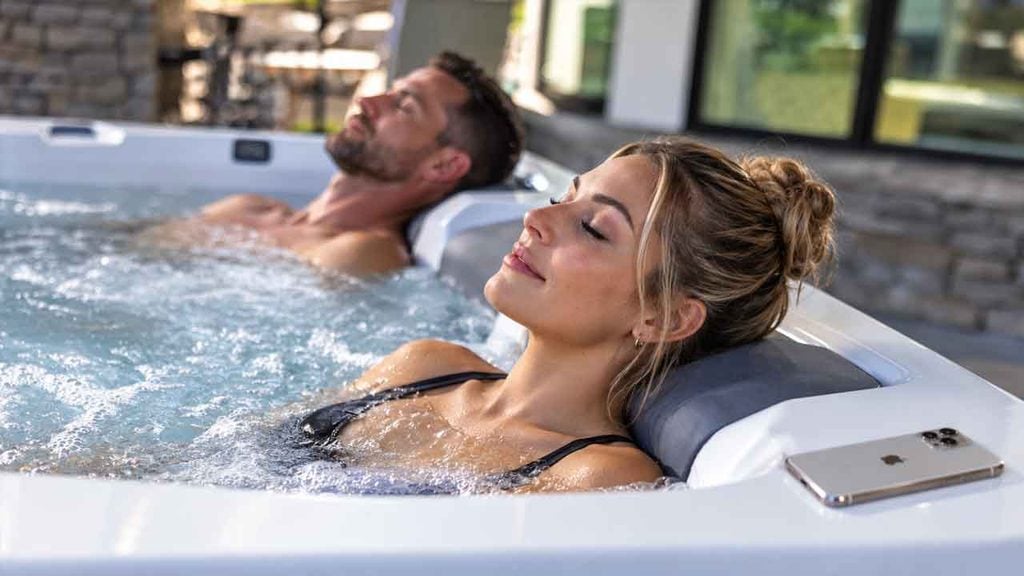
“The spa becomes a place where families put their phones down and reconnect,” he says. “Couples and families report that it becomes a distraction-free space to communicate.”
That combination of physical comfort, relaxation, and social connection helps explain why the hot tub continues to occupy such an important place in the evolving backyard wellness category.
Great Design Is About People, Not Products
When consumers shop for a hot tub, it can be easy to focus on the numbers: How many seats? How many jets? How powerful are the pumps?
But according to Vic Walker, Toro product marketing manager and former product design manager for Dimension One Spas, those specifications tell only part of the story.
Great spa design begins with a more fundamental question: How are people actually going to use it?
That philosophy extends from hydronomics — the relationship between water movement, pressure, jet placement and the human body — to the way people sit, move and interact within a spa.
It’s also why Walker cautions against assuming a higher jet count automatically means a better hydrotherapy experience. A smaller number of strategically positioned jets may ultimately accomplish more than a larger number added primarily to increase a product specification.
The same human-centered thinking applies to seating.
People move between seats, have different body types and therapeutic needs, and often want to interact with the people around them. A thoughtful layout considers those behaviors rather than simply finding room for the greatest possible number of seats and jets.
Personalization is also becoming a larger part of spa design. Bullfrog Spas, for example, uses its interchangeable JetPak Therapy System to allow owners to select and position different hydromassage experiences according to individual preferences.
Walker’s work on the Amore Bay product offers another example. Its layout incorporated captain’s chairs positioned opposite a family bench, allowing adults to enjoy dedicated hydrotherapy while remaining oriented toward children, family or friends.
The lesson is simple: features should serve the people using them, not the other way around.

The Backyard as a Place to Connect
Hot tubs may be wellness products, but they are also inherently social spaces. Increasingly, that sense of connection extends beyond the spa itself.
Ricks says homeowners are incorporating hot tubs into larger “wellness-focused backyards alongside saunas, cold plunges, fitness equipment and swim spas,” while surrounding them with shade, seating, fire pits and other features designed for gathering.
“The industry has even coined terms for it, such as the ‘backyard bathhouse’ or the ‘sparden,’” he adds.
Walker has seen the shift play out in his own backyard as well. Spaces that once saw little use are becoming places where people spend time together — gathering around water and fire pits, watching movies outdoors, talking or simply relaxing.
He also argues against viewing these installations strictly as luxury products, suggesting that immersion, exercise and outdoor gathering spaces can become meaningful parts of a family’s everyday routine.
“A well-designed product should cater to multiple needs, including solitary relaxation, social hosting, and recovery,” Walker says.
Five years after adding a swimming pool, Walker says his family’s relationship with their backyard has completely changed.
“There was grass there before. We never hung out as a family in the backyard to sit in the grass,” he says.
With additional improvements including umbrellas, furniture, multiple fire pits and an outdoor projector, their backyard has become a regular hangout spot for family and friends.
That may ultimately be the bigger story behind the backyard wellness trend. It isn’t simply about adding more amenities. It’s about creating a reason to go outside and stay there — turning the backyard into a place for both personal wellness and human connection.
Swim Spas Find Their Niche
Swim spas occupy a middle ground between traditional swimming pools and hot tubs. Their compact footprint and year-round usability appeal to homeowners looking for a convenient way to combine low-impact exercise and recreation with, in some models, the therapeutic benefits of dedicated hot tub seating.
For homeowners without the space or desire for a conventional swimming pool, they also offer another way to incorporate usable water into the backyard.
Ricks sees that same appeal carrying over to swim spas.
“People have always loved water. It’s elemental,” he says. “As humans, we intuitively understand its therapeutic power, especially when it’s hot, and increasingly when it’s cold too. Owning a little bit of therapeutic water right at home is a pretty natural draw. It’s convenient, it’s private, and it’s available whenever you need it.”
The intended use remains an important consideration. Homeowners primarily interested in exercise may place greater emphasis on the swim current and usable activity area, while families may prioritize versatility, seating, and recreation. In either case, the appeal lies in having a compact aquatic environment available at home throughout more of the year.

The Future Is Easy Ownership
As backyard wellness products become more sophisticated, the next big innovation may actually be simplicity.
Smart monitoring, automated water care and connected technology are increasingly aimed at removing one of the biggest barriers to long-term enjoyment: maintenance.
Ricks specifically points to one area where that simplicity matters.
“Water care is the other area that can detract from the hot tub experience,” he says. “If it feels confusing or goes wrong, it takes a bit of the joy out of ownership.”
Automated monitoring and dosing, supplemental oxidation technologies, mineral systems and improved filtration are increasingly designed to reduce the burden of routine water care. These technologies can simplify aspects of ownership, although they do not eliminate the need for proper sanitizer levels, balanced water, filtration and periodic testing.
Walker takes the idea even further. In his view, owners shouldn’t need to become water chemistry experts simply to enjoy their spas.
Future systems, he says, should translate complicated water-care information into simple guidance — essentially telling owners when everything is good, when something needs attention, and when it’s time to call a professional.
Ease of ownership isn’t only about what happens beneath the water.
As spas become part of increasingly sophisticated outdoor environments, homeowners also expect them to look like they belong there. Walker sees that expectation influencing future design, with more homeowners looking for ways to integrate spas naturally into the surrounding landscape.
Recessed installations, custom surrounds and other design solutions can soften the traditional boxy appearance of an above-ground spa while still preserving the access technicians need for service and maintenance.
Ultimately, the future of backyard wellness may be less about adding more features and more about removing barriers — making products easier to use and maintain, more personal and more naturally integrated into everyday life.
The most successful products won’t necessarily have the most jets or the flashiest technology. They’ll be the ones that best support how people actually live.
Read the Fall Issue of Pool Magazine

See more of our coverage in your search results
 Sponsored Advertisement
 Master Pools Guild Welcomes Red Rock Design Build as Newest Member
 Luciana Amaro Joins Franklin Electric as Chief Human Resources Officer
 iGarden K Series Review: What We Learned After Months in a Customer’s Pool
 Sacred Geometry: Where Architecture, Mathematics and Mosaics Collide
 Anatomy of a Botched Remodel: What Sank the Lincoln Memorial Reflecting Pool Restoration?
 RB Retail & Service Solutions Launches RB Propel
 Pool Equipment Theft Is Becoming a Bigger Problem Than Most Homeowners Realize

 POOL CORPORATION ANNOUNCES THE RETIREMENT OF KENNETH G. ST. ROMAIN AND THE APPOINTMENT OF JOHN B. WATWOOD
 Leslie’s Files Chapter 11, Lenders Set to Take Control in Major Restructuring
 Landmark Aquatic Taps Britton Nielsen and Tim Garner to Lead Utah Growth
 Automatic Pool Covers Expands National Sales Team
 Leadership Baton Passing on at Team Horner®
- Pool Equipment Theft Is Becoming a Bigger Problem Than Most Homeowners Realize
 Texas Pool Freeze Risk Returns as Arctic Cold Puts Major Markets to the Test
 Sponsored Advertisement


 Pool News4 weeks ago
Leslie’s Reportedly Prepares for Chapter 11 Bankruptcy as Possible Nasdaq Delisting Looms
 Pool News3 weeks ago
Leslie’s Files Chapter 11, Lenders Set to Take Control in Major Restructuring

 Pool Equipment3 weeks ago
AquaLink® EDGE™ and trackr iO Signal a New Direction for Pool Automation

 Features3 weeks ago
A New Era at POOLCORP: John Watwood Focuses on Customers and the Fundamentals
 Pool News3 days ago
Sacred Geometry: Where Architecture, Mathematics and Mosaics Collide

 Pool News3 weeks ago
Shasta Pools Hires 30-Year Builder to Head Residential Construction

 Retail3 weeks ago
Nasdaq to Suspend Trading in Leslie’s Stock on October 6

 Industry News3 weeks ago
Watershape University Announces Fall 2026 Session in San Diego
You must be logged in to post a comment Login