




Op Editorials
History Of The Pool Cleaner


Now that I am starting to reflect over my past 69 years of active duty as a pool guy. Many of my friends have told me that I have seen a lot of history in our industry and that I need to start writing them down. With this in mind, Joe & Marianne Trusty and Carol Gigliotti of Pool Magazine have asked me to put down some of my pool history that I experienced over my career.
In 1955, my father decided to move his family from Oakland, California to the rich open spaces of Contra Costa County just a few miles away. At this time, there was starting to become a migration from the inter cities to the new suburbs in the country. Much of this was driven by the Post War GI Bill that all of our returning soldiers received after fighting in WWII. The GI Bill basically gave a serviceman low interest government loans to buy a new home.
This migration and the hopes for home ownership created a huge building boom as America started to get back on her feet, post-war. My dad was one of those returning soldiers after fighting in the Pacific Theater and being discharged in Oakland, California. My dad wanted something better for his family and the attraction of moving to the fast-growing suburbs along with being part of the building boom of those suburbs, had an important attraction for my father.

He moved us to a little town that was 15 miles east of Oakland and what seemed like a whole new world. The weather was warm during the summer and a perfect place to not only raise a family in the country but also to start a new business in an almost unheard of industry, the swimming pool industry. Up to this point, only the very wealthy could afford a swimming pool. However, all this was starting to change as young families started to move to the suburbs and they realized that the weather was perfect for a fast-growing family of Baby Boomers. Now with a new home that the GI Bill allowed these young families to buy, there began the development of the front and backyard.
My father was one of the early pioneers who had the vision and the ability to do something about it. He started his pool company just prior to us moving to the little town of Lafayette, California. Little did he know that this little town of 2,500 people at the time was going to become the center of growth of our industry. Now I’m not saying that the pool business started in Lafayette, however, it was at this time in the 50’s that American families all across the country were starting to experience the same revolution of young boomer families wanting to seek a better life by moving to the suburbs and all the lifestyle that came with it. These young families had a lot in common with each other besides many returning from WWII, taking advantage of the GI bill, having several young kids or Baby Boomers along with wanting a better way of life.
As the new neighborhoods or track developments started to spring up everywhere in our area, we started to see more and more families wanting to enjoy their backyards with their growing families and friends. It was at this time the weekend BBQ with your Weber BBQ became one of the most essential tools of anyones backyard. This outdoor California Lifestyle then found itself wanting more as people could afford more.

Enter the backyard swimming pool and all the enjoyment and entertainment that it brought to our families. My dad was on the ground floor of this movement. Back in those days, his swimming pools cost $2,000 all in. Of course it’s all relative when you realize what a gallon of gas costs ($.26) or what those first track homes in the suburbs cost under $10,000 for a 3 and 2 with a garage. The beauty of those starter homes is that the lot size was big enough for a modest 15×30’ pool with a little decking.
Landscape design and construction was very modest. There weren’t too many landscape architects and most were busy designing those large estates that could afford their designs. So the early years of the industry were very modest and builders such as the Anthony Brothers in Southern California catered to those fast-growing suburb homes by selling pools based on the financing more than the ability to build a pool. As Anthony Pools was taking a commanding lead out west, other markets around the country started to boom. Arizona had the Ghiz Family with Paddock of Arizona along with the Asti Family and Shasta Pools. On the East Coast we also saw the Sullivan Pools that all of these building families started to spawn other spin-off pool builders as the demand for owning a backyard swimming pool started to grow.

Prior to the boom in the 1950’s, here in California, there were two major high-end pool builders that were building pools for the rich and famous, Paddock Pools and Landon Pools. These two builders were instrumental in the engineering and mechanical development of swimming pools. Be it the sand and gravel filters that they used or the skim filter that Landon and Paddock used to try and simplify and reduce cost in their pools.
As more and more pools were being built by new pool builders, there became this demand to help invent more and more components to help make the backyard swimming pool more accessible and user-friendly. It was about this time in the 50’s that Anthony Pools helped create the early precast skimmer with a built-in basket outside of the pool. Prior to that there was the lily pad skimmer that was a floating basket that was attached to the lily pad suction plate that bobbed up and down with the water level as water was drawn from a separate suction line. These pools also had a separate main drain suction line as well. The real custom pools that Paddock built had an 1.5” flange fitting mid way on the pool about 12” below the surface for a home owner to actually vacuums their pools using a portable vacuum hose and head. At this same time we also have the Pool Master Jet Vac pool cleaner that hooked on the end of your garden hose and blew water into a large bag that could pick up leaves and not plug up the pump basket. The bag were designed to filter the water jetting up into the bag along with some dirt.
These types of cleaning systems were designed to help keep the pool somewhat clean. The reality was that once you built a pool, you had to contend with the drudgery of cleaning your pool every weekend or be rich enough to afford a pool maintenance company. This need for keeping the pool clean has spawned an entire section of our industry and it came about more by chance then anything else.
It was the late 50’s and early 60’s that one of the Pillars of our industry, Andy Pansini was just finishing up cleaning his pool using his vacuum cleaner on his pool in San Rafael area in the SF Bay Area. Andy was cleaning his decks after cleaning his pool and was using his garden hose to hose things down. The phone rang and Andy dropped his hose in the pool and answered the phone. When he returned, the hose had been snaking back and forth on the bottom of the pool and the pool was spotless where the hose was whipping back and forth.
The History of the Pool Cleaner
It is said that “Necessity is the Mother of Invention”. Andy realized at that moment that if he could manage the whipping hose in his pool then he could chase the dirt down to the bottom of the pool and without ever vacuuming his pool again, he could always have a spotless pool. Andy solicited the help of a fellow inventor, Howard Arneson, that lived across the bay. Howard was a creator, inventor and part showman. The two of them came up with some interesting variations of these first prototypes. I was fortunate in the mid 60’s to actually work on one of the very first of these prototypes that looked nothing of what we see today of the robotic pool cleaner.
As time went on Andy and Howard both started their own manufacturing companies. Andy and his wife Jan had started Jandy and Howard started Pool Sweep. Both were here in the San Francisco Marin County area. As more and more backyard swimming pools were being built, there became more and more need to keep them clean so you could enjoy swimming in a nice clean pool. This need for a clean pool created a new part of our industry called pool service and maintenance companies. It was at this time I started my first pool company. After years of working for my Dad’s pool company, at 16 years old, I had my driver’s license and a truck to put my maintenance cleaning equipment and chemicals in.
I was one of the first pool service companies in our area and was fortunate enough to acquire some very high profile pools that I cleaned each week. Back in those days you didn’t have a self-cleaning pool like today, that you mostly test the water and add chemicals to, once a week. Back then every pool was on twice a week service with the first visit as a brush and skim the pool along with cleaning the basket and filter visit. The second cleaning was dedicated to vacuuming the pool so it was ready for the weekend entertaining.
It was at this time I learned a lot about the drudgery of cleaning and maintaining the backyard pool. Cleaning swimming pools gave me a great appreciation for what it took in the building end of a swimming pool to make it easier on our clients. Let’s face it, the reason people build a swimming pool is to relax, enjoy their leisure time in the backyard with family and friends. It is not to become a slave to the maintenance of your pool.
As the Jandy cleaner and the Arneson cleaner became more and more popular to adapt to a pool, I was seeing more and more builders first install a dedicated return line for the robotic sweep and eventually those same builders realized that upselling a client on the advantages of installing a robotic cleaner made owning a swimming more enjoyable for the homeowner. As the Jandy Porpoise and Arneson Pool Sweep was taking the industry by storm, an inventor/businessman, Jim Edmundson was creating his version of the pressure pool cleaner called the Polaris. The uniqueness of the Polaris was that it lived on the bottom of the pool and did both sweeping and vacuuming of the pool. It had a leaf bag much like the early Pool Master Jet Vac manual cleaner except that it was part of the robotic cleaner and only needed to be cleaned once a week. There was one more entrance into the robotic cleaners on the West coast and that was from Sandy Campbell, who was in the Bay Area as well but soon moved his manufacturing to Redding, California. Sandy’s cleaner was called “The Letro Jet Vac”, it had some of the similar characteristic as the Polaris but it did a better job in high leaf areas.
While all these robotic cleaner wars were going on in California, over in Arizona, in the late 60’s and early 70’s, they were creating their very own cleaning systems to help battle the high sand content and debris that was plaguing swimming pools in that market. As I stated earlier, “Necessity was the Mother of Invention”. The Ghiz Family (Paddock Pools, The Paramount System) and the Ast Family (Shasta Pools, The A&A System) both created their proprietary in-floor cleaners for their own pools in that market. They along with a friend of mine, Les Mathews (Creator of the Caretaker System). All of these three inventor families helped usher in the next generation of pool cleaning. There was one other little-known infloor cleaner called the “Turbo Clean” that I recall seeing on some of the Geremia Pools out of Sacramento, Ca. Within a few short years, these manufacturers were selling their cleaners all across the country and internationally.
For the past 40 years, I personally have designed and worked with all three cleaners. For the past 25 years, my favorite in-floor cleaner is the PCC-2000 cleaner. What is it that makes this cleaner so special to me is it’s ability to clean the entire pool as Paramount and our team design the location of the cleaner heads. PCC-2000 also has it’s patented water curtain and the MDX that is it’s debris collection system. The robotic cleaners have their advantages in that they are a low cost compared to the Paramount in-floor system. In addition, as the design of our pools have come a long way from my dad’s pioneering days of simple, functional designs with simple filtration and no cleaners, to the designs that my son, Nicco and I are creating today with baja entries, ledges and seats throughout the pool.
We are all seeing the acceptance of engineered pools hanging off slopes with vanishing edges and “O” edge designs. These pools are so artistic that a robotic cleaner with its umbilical cord running around pool will surely take away from the beauty and artistry of the pools we are designing and building today.
What the in-floor cleaner is to me and even more specifically the Paramount PCC-2000 in-floor cleaner, is the beauty of the pool is not interrupted with the visual of the robotic cleaner. The additional circulation on the bottom of the pool that takes water from the skimmer level of the water and injects it back into the floor heads. This action creates not only bottom circulation better then any other way to circulate water in your pool, but it also takes surfaced solar heated water and injects it to the bottom of the pool so the entire pool becomes a heat storage battery for the solar heat that is collected at the surface.
More and more today our pools here in the Bay Area are safety cover pools with the spa under the cover to help keep the pool safe from small children, clean from dirt falling in the pool and energy efficient because of the passive solar heat that the cover generates at the top of the water that is pumped to the bottom of the pool through the in-floor cleaning system. Not only are we delivering a very clean pool to our clients, but a very efficient pool that cleans itself and a very artistic pool that is exciting to look at.
Our industry has come a long way since I joined in with my dad and now with Nicco, my son as the 3rd generation of our family to build well-engineered, unique designed and very efficient works of art for our clients backyard enjoyment and entertainment. It has taken 3 generations for our family to build the “State of the Art” custom pools that Nicco is now building for our company. As I stood on my father’s shoulder, now Nicco stands on mine, our family tradition has continued to advance the pool industry with our knowledge and forward thinking. It has been a wonderful journey as we all get to enjoy the rich history of our industry that has taken us to where we are today. Those early pioneers helped pave the way for the next generation of pool builders.
I will continue to add to the rich history of the swimming pool industry with my personal stories that all of us will enjoy as we discover where our roots come from.


Pool construction standards don’t fail all at once.
They fail the first time someone decides that the pressure of the moment is greater than the conviction behind the work. That decision is rarely dramatic. It doesn’t look like a failure. It looks like a reasonable response to a difficult situation.
In 35 years of building pools, I watched it happen more times than I can count. And it almost always started the same way.

There are two moments that begin the drift.
The first is the financial squeeze. The job is tight. The margin is thin. Something costs more than it should. And someone, maybe you, maybe someone you trusted, decides to substitute a material, compress a timeline, or skip a step that felt optional in the moment.

The Hidden Risks of Cutting Corners in Pool Construction
In the pool industry, I saw this most often in the reinforcement steel. The wrong size. The wrong spacing. Decisions made before the concrete was ever poured were invisible once the job was done. Sometimes the only way to know was to get in and look, and even then, you had to know what you were looking for.
The nature of this industry is that the most critical decisions happen before anyone can see them. The steel, the plumbing, the drainage design, the engineering behind the shell. All of it is buried, covered, or filled before the homeowner ever sets foot in the backyard.
That invisibility is exactly where the temptation lives. If no one can see it, no one will know. If it holds through the warranty period, the problem becomes someone else’s. The compromise gets made in the dark, and the person who made it is usually long gone by the time the failure shows up.

Sometimes, there was a small crack, a slight movement in the structure that only someone who knew what to look for would notice. The homeowner had no idea. The pool looked fine.
Until it didn’t.
I’ve stood in front of homeowners and explained what was failing and why. The reaction was almost always the same: shock, anger, disappointment. And then the line that never got easier to hear: “We wanted to use you guys, but you were too expensive.”
The repair was exponentially more expensive than building it right would have been. Every time.
It gets justified quickly. We’ll make it up on the next job. The customer will never know. It’s close enough.
And maybe it holds. That time.
My dad had a saying about that. Close enough is only good for horseshoes and hand grenades.
But the decision has already been made. Not just about that job. About what kind of company you are willing to be when it costs something to hold the line. The people who work for you saw it too. They filed it away. They now know where the line actually is.

Standards Are Proven Under Pressure
The second moment is customer capitulation. A client pushes back on price. A competitor comes in lower. And rather than holding the number that reflects the work, reflects the standard, you match it. You tell yourself it’s a relationship investment. A loss leader. A one-time exception.
I know that moment well.
I had a competitor, also a friend, who took a job I walked away from. After it was done, he asked me how I knew that client would be a problem. The honest answer was that I didn’t know the client would be a problem. I knew the job couldn’t be built to the standard at that price. There was no way to do it right without compromise. The client didn’t realize the compromise would result in a poor project. My competitor couldn’t collect full payment.
Nobody won. Except the standard.
It rarely stays a one-time exception. The second compromise is always easier than the first. The decision has already been made once. The precedent is set. What used to be the line is now just a starting point for negotiation.
Both moments feel like flexibility. Both moments feel like good business. But they are not flexible. They are the first compromise. And the first is never the last.
A standard is not a rule on a wall. It is not a mission statement or a values document.
A standard is only worth holding if you can explain why it exists. Not every process is a standard. Not every requirement is a conviction. The ones worth holding are the ones traceable directly to the quality of the work, the safety of the structure, and the integrity of what you promised.
A standard is a decision made under pressure.
Anyone can hold a standard when it’s easy. When the margin is healthy, when the customer is happy, when the job is going well, holding the standard costs nothing. It proves nothing.
This is where most leaders underestimate the problem.
The standard is only proven when keeping it costs something. When the squeeze is real. When the customer is unhappy. When the competitor is cheaper. That is the moment the standard either holds or it doesn’t.

Your Team Is Always Watching
And the people around you are watching. Every time. They are not judging. They are calibrating. They are figuring out where the real line is, not the one you talk about, but the one you actually defend. And they will build their own behavior around what they find.
I have seen it go both ways. A crew member at a job I wasn’t on makes the call the right way. Holds the line, pushes back on a shortcut, does it the way it should be done, even when no one is watching. You find out later. You didn’t tell them to do it. They did it because they knew why it mattered.
And I have seen the other version. A trench was not properly compacted because it was the end of the day, and everyone was ready to go home. Not dramatic. Not malicious. Just the path of least resistance when the pressure showed up, and the standard wasn’t in the room. Years later, the deck moves. The homeowner calls. You find out that way.
Both versions tell you exactly where your standard actually lives. The standard lives not in your policy manual, not in what you say at the morning meeting, but in what your people do when you are not there.
You cannot hold a standard alone. You can set it. You can model it. But you cannot be in every room, on every job, in every conversation where the pressure shows up and the easy path is right there.
My team had a saying. “That’s not how Lee does it.”
And my business partner hated it.
Not because my way was the only way. There are many ways to do a job correctly. But because I had set a standard, they had internalized it. They weren’t quoting a rule. They were carrying a conviction.
That is what it looks like when a standard has taken hold. It doesn’t need you in the room anymore.
The Builders Who Last
The reality of holding a standard is this:
You will lose jobs because of it. You will lose customers because of it.
This industry gives you plenty of opportunities to compromise. The margins are tight, the competition is real, and the homeowner standing in front of you has three other bids. The invisible nature of the work means you could cut corners, and nobody would know. The pressure to match a lower price, to substitute a material, to compress a timeline. It shows up on every job. It never stops showing up.
But the builders who last, the ones who build reputations that outlive any single project, are the ones who decided early what kind of company they were going to be when it cost something to hold the line. That decision doesn’t get made once. It gets made every time the pressure shows up. And every time it is made correctly, it gets easier for the people around you to make it the same way.
The jobs and customers you lose by holding the line are not the ones you were built to serve. And the ones who stay know what they are getting. That is the foundation worth building on.


Every successful pool company develops habits—whether intentional or not. The difference between companies that consistently grow and companies that constantly struggle often comes down to the behaviors, routines, and standards they practice every single day.
Good habits create consistency. They improve communication, strengthen culture, sharpen operations, and build trust with customers. Bad habits do the opposite. They create confusion, missed opportunities, unnecessary stress, unhappy customers, and frustrated employees. Over time, those habits compound and become part of the company’s identity.
The truth is, it’s just as easy to develop bad habits as it is to develop good ones. A company can slowly become reactive instead of proactive. Communication can slip. Accountability can disappear. Standards can decline. Before long, leadership is spending more time putting out fires than building the business.

That’s why highly effective pool companies focus heavily on discipline, consistency, and accountability. Many owners describe it as “training the muscle.” The more often strong habits are reinforced, the stronger the company becomes. Winning businesses understand that success isn’t built through occasional bursts of effort—it’s built through repetition.
The same principle applies to the people companies hire and surround themselves with. Skills can be taught. Habits are much harder to change. The best pool companies look for employees who naturally demonstrate professionalism, communication skills, organization, accountability, attention to detail, and a willingness to improve. Those qualities tend to elevate the entire team.
In an increasingly competitive industry, the companies that separate themselves are usually the ones willing to put in the work behind the scenes. Successful companies build and refine systems. They communicate clearly and hold themselves accountable. Most importantly, they commit to habits that position them for long-term success instead of short-term survival.
10 Habits Highly Successful Pool Companies Share
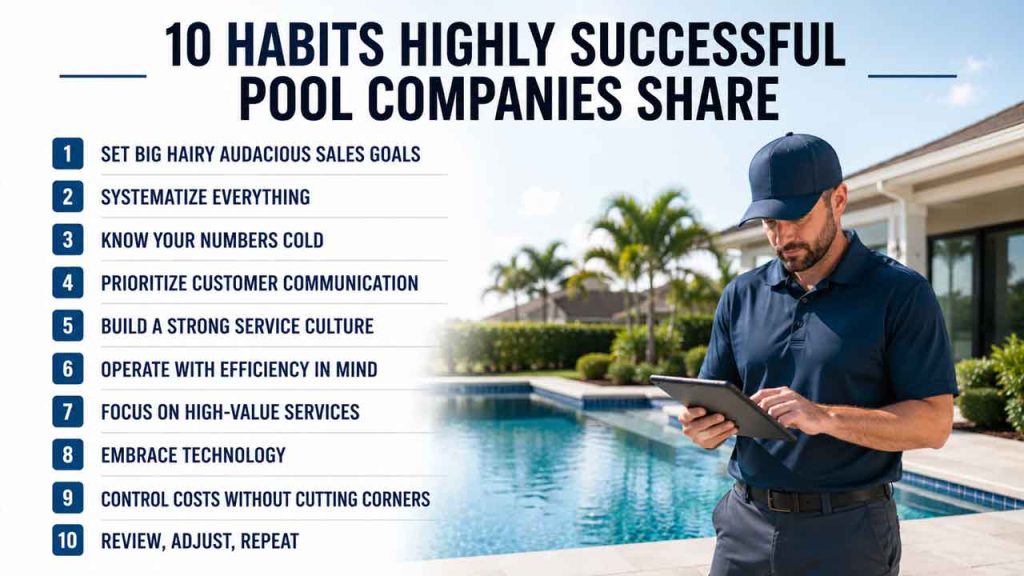
1. Set Big Hairy Audacious Sales Goals
Successful pool companies don’t stumble into growth—they pursue it with intention. The most effective organizations establish aggressive but measurable goals that push the company beyond its comfort zone and provide a clear roadmap for success. Whether the objective is increasing revenue, expanding into new markets, improving close rates, or growing average project size, ambitious goals help create alignment and accountability throughout the organization. Just as important as setting those goals is regularly measuring progress against them.
Companies that consistently review performance, track key metrics, and adjust course when necessary are often better positioned to achieve sustainable growth. Kelly Peel of Lakeside Custom Pools believes that goal setting and regular accountability meetings are critical components of building a high-performing team.

“We’ve never been interested in setting goals that we know we’ll hit. The goals that create real growth are the ones that challenge the organization to think bigger, operate differently, and raise its standards. Some years we hit every target, and some years we fall short, but that’s not really the point. The value comes from creating a vision that’s ambitious enough to inspire the team and then measuring our progress throughout the year. When everyone is working toward something significant, it changes the way decisions are made and helps drive the entire company forward.”
2. Systematize Everything
Most pool companies aren’t disorganized. They’re un-systematized. There’s a difference. Disorganized people forget; un-systematized businesses repeat avoidable mistakes at scale.
Take Adam Beech, who wanted to scale his growing service company systematically. The tech he needed didn’t exist- so he built it. We know his system today as Pool Brain.
“Managing technician training, service quality, and turnover was extremely chaotic and difficult. Once we solved this with the first version of Pool Brain, tech training reduced by almost 70%, green pools reduced by over 80%, customer churn due to complaints was virtually eliminated, turnover no longer impacted our business, employee morale improved, and we could do way more with way less.”
Systematization turns a “practice” into a “science.” By creating repeatable processes, a business moves from relying on luck to relying on logic.
3. Know Your Numbers Cold
Highly effective pool companies understand their financials at a granular level. They know their profit margins, labor costs, close rates, equipment costs, customer acquisition costs, and overhead. Owners who operate on instinct alone often discover problems too late.
The most successful operators review their numbers regularly and use data to guide decisions. Knowing your metrics doesn’t just help you weather challenging markets—it helps you spot opportunities, identify inefficiencies, and make smarter decisions faster than competitors who are flying blind. Scott Reynolds, owner of Purpose Pools, says investing in systems that provide real-time visibility into business performance has been a game-changer for his company.
“For years, we made decisions based on gut instinct instead of real-time data. Once we instituted better technology and systems and started tracking our key metrics in one place, we could see revenue, receivables, upcoming work, technician productivity, and cash flow at a glance. That visibility helped us make faster decisions, improve accountability, forecast growth more accurately, and run a much more efficient service operation.”
4. Prioritize Customer Communication
If Rudy Stankowitz had to create a one-sentence business plan for a pool company, it’d be: “Answer the phone, dummy.”
This isn’t just about quick communication to secure a lead. It’s being fast and clear throughout the entire life of the account. The way Bruno Brum at XBrum Piscinas in Rio sees it, “Most problems don’t stem from the water itself, but from misaligned expectations”.
It may be for this reason that the top pros consistently name the post-visit recap as one of their highest-leverage communication habits. The format is intentionally simple: Tell the customer what you found, what you did, and what’s next. Same format every time.
Scott Rhodes at Rhodes Custom Pools puts simply: never leave them guessing or in the dark.
5. Build a Strong Service Culture
The strongest pool companies understand they’re not simply selling a service—they’re delivering experiences. A strong service culture starts internally with leadership and extends outward into every customer interaction. Companies that emphasize professionalism, accountability, and pride in workmanship tend to generate stronger reputations and more referrals. Customers remember how they were treated long after they forget what they paid. For Gordie Robinson of Cox Pools, exceptional customer service isn’t just a philosophy—it’s a long-term growth strategy that has helped the company build lasting relationships and establish itself as a leader in its market.
“When you consistently deliver a great customer experience, the benefits compound over time. Customers stay with you longer, they’re more likely to trust your recommendations, and they become your biggest advocates in the community. Some of our best customers have referred multiple friends, neighbors, and family members over the years because they know the level of service they’re going to receive. That creates a cycle where great service leads to stronger retention, stronger retention leads to more referrals, and those referrals bring in customers who already trust your company. That’s been a big part of how we’ve continued to grow and strengthen our position in the market.”
6. Operate With Efficiency In Mind
Efficiency isn’t never breaking, it’s what your team does when something does break. This goes back to finding your biggest drain, not just on margin but on time.
Adam Beech watched his own service company bleed both on guesswork. “When we implemented automatic chemical dosing, it drastically reduced technician training, chemical spend (40% reduction), algae growth, and customer complaints. That single feature gave us a TON of time and money back with way less effort and changed our business for the better.”
Brian Menzies at Pinch A Penny shared: “I’ve seen businesses [without route optimization] waste hours of payroll on road trips across cities to clean pools to lose money weekly.”
Efficiency is not about perfection. It is about fewer wasted steps, fewer repeated problems, and fewer decisions made from scratch. The strongest companies find the leaks in their operation before those leaks become big losses.
7. Focus on High-Value Services
Not all revenue is created equal. The most effective pool companies understand which services generate the strongest margins and position themselves accordingly. High-end remodels, automation upgrades, equipment modernization, outdoor living enhancements, and recurring maintenance agreements often produce more stable and profitable revenue streams than competing solely on low-margin construction bids. Successful companies learn to sell value rather than price. They also recognize when market conditions are shifting and adapt their service offerings to meet changing consumer demand. Pool builder Emile Stinchcombe of Aqua Guard Pools, says that flexibility has been a key factor in helping his company navigate a softer market for new pool construction while continuing to grow through renovations and upgrades.
“Like many builders, we’ve seen demand for new pool construction cool compared to the peak years, but we’ve also seen a significant increase in remodeling projects, equipment upgrades, and backyard improvements. Homeowners may not be ready to build a brand-new pool, but many are still willing to invest in improving the one they already have. We’ve made a conscious effort to expand our renovation and upgrade services because that’s where we’re seeing strong demand. That shift has allowed us to maintain healthy revenue streams, keep our crews busy, and continue growing while some companies that relied too heavily on new construction have faced greater challenges.”
Companies that diversify their revenue streams are often better equipped to weather market fluctuations and changing consumer spending patterns. By offering remodeling, modernization, service, and upgrade opportunities alongside new construction, pool professionals can create a more resilient business model that generates revenue across multiple customer segments and stages of pool ownership.
8. Embrace Technology
Hesitant to adopt new tech? Brian Menzies has three words for you: “Your competitors already are.”
The mistake most pros make isn’t refusing tech; it’s trying to overhaul everything at once and bouncing off the implementation. Adam Beech’s advice to operators is the same advice he followed building his platform one feature at a time: “Don’t try to eat the whole elephant in one bite.” Focus on routes first, then on chemistry, on billing, and then on the next thing. Pick what’s hurting most next.
Rudy Stankowitz put it plainly, “Technology is inevitable, and the tech-averse are putting themselves on a path to extinction.” The goal is not to become a tech company. The goal is to stop losing time to tasks, mistakes, and gaps that better systems can prevent.
9. Control Costs Without Cutting Corners
Highly effective pool companies pay close attention to expenses, but they also understand the difference between reducing waste and sacrificing quality. Cutting corners on materials, training, or labor may improve short-term numbers, but it often damages reputation and profitability over time. Smart operators negotiate better purchasing agreements, optimize labor efficiency, and monitor overhead carefully while still delivering exceptional work. Long-term success depends on maintaining both quality and profitability simultaneously. For Cole Daasnes of Poseidon Pool Service, improving margins has never been about finding cheaper products or lowering service standards. Instead, it’s about identifying efficiencies that strengthen the business without compromising the customer experience.
“One thing we’ve been focused on is finding ways to improve profitability that don’t impact the quality of service our customers expect. Purchasing lower-quality materials or cutting corners was never on my bingo card for 2026. Our reputation is too important, and it takes years to build trust in a market. Instead, we’ve worked closely with vendors to negotiate better terms and discounts by paying invoices faster. In some cases, simply moving from net 30 to net 15 payment terms has created opportunities for savings that improve our margins without affecting the customer at all. That’s the kind of win-win every pool company should be looking for. Managing expenses and improving efficiency is a continuous process, but the goal should always be to become more profitable while maintaining the same level of quality and service that earned your customers’ trust in the first place.”
The strongest operators understand that profitability and quality are not mutually exclusive. In fact, the most successful companies often improve margins by becoming more efficient, strengthening vendor relationships, and eliminating unnecessary costs rather than reducing the value they deliver.
10. Review, Adjust, Repeat
“One mistake is human,” Rudy Stankowitz says. “The same mistake twice is a process failure.” Or to paraphrase Brum, the best opportunities for business evolution lie in recurring problems.
However, if you’re not reviewing your business on a regular basis you may not even know how many times something really is a problem. But reviewing without adjustment is journaling. And adjustment without first reviewing is just guessing. The highly successful are doing both, on a predictable repeatable rhythm.
Or as Drew Coppolino at Pools Etc puts it, “Continuous improvement has to be built into the culture of the business, not treated as a one-time initiative.”

Good or Bad, The Habits You Tolerate Become Your Company Culture
One of the biggest mistakes pool companies make is underestimating how quickly habits spread throughout an organization. When poor communication, disorganization, chronic lateness, lack of accountability, or cutting corners are tolerated, they eventually become normalized. Over time, those habits affect multiple parts of the business—from customer satisfaction and employee morale to profitability and reputation.
That’s why highly effective pool companies pay close attention to the habits of the people they hire and surround themselves with. Skills can be taught. Habits are far more difficult to change. The best operators look for people who naturally demonstrate consistency, professionalism, accountability, strong communication skills, attention to detail, and a willingness to improve. Employees who take pride in their work, show initiative, stay organized, and follow through on commitments tend to elevate everyone around them.
At the same time, successful companies learn to recognize warning signs early. Employees who constantly make excuses, resist feedback, create negativity, communicate poorly, or lack urgency can quietly undermine a strong team culture. One person with bad habits can impact an entire organization faster than many owners realize.
In a service-driven industry like pool construction and maintenance, bad habits tend to show up quickly—in missed callbacks, poor communication, sloppy workmanship, declining reviews, and employee turnover. Research from Gallup continues to show that disengaged teams produce lower profitability, lower productivity, and significantly higher turnover rates than highly engaged ones. Winning companies understand that culture and habits aren’t “soft skills”—they directly impact the bottom line.
Ultimately, culture is built through repetition. The habits leadership rewards, reinforces, and tolerates eventually become the habits the company is known for. Winning pool companies understand that building a successful business starts with building the right habits first.


There’s a moment in many careers that doesn’t feel like a breakthrough at the time. It feels uncertain, uncomfortable, maybe even like you’ve been set up to fail. For me, that moment came early on, in what I now think of as my first experience with a “negative edge.”
I was just getting my start in the industry at Southernwind Pools, a place that gave me lots of opportunity and where I was learning quickly and eager to prove myself. Around that time, a project surfaced that the company had reservations about taking on. It lived just outside the organization’s comfort zone, with an unclear scope, unclear ownership, and no guaranteed outcome. Instead of fully committing resources or leadership, the company took a cautious stance. Eventually, the responsibility landed on me, but without a clear roadmap, strong backing, or much direction.
In other words, I was on my own.

Standing at the Edge
What made the situation even more defining was the addition of a newly assigned project manager, Eli Brannon. He was stepping into his role just as I was stepping into this challenge. We had a strong start. There was energy, momentum, and a shared sense that this could be something meaningful.
But early on, I realized that clarity mattered more than comfort.
I remember looking Eli straight in the eyes and asking him point-blank, “Are you up for doing this with me? Because if not, I’m okay running this build on my own.”
It wasn’t confrontational. It was honest. The stakes were high, and I needed to know where we stood.
That moment set the tone for everything that followed.

Building Without a Blueprint
With no predefined process to lean on, we had to create our own. Together, we navigated the unknowns, figuring things out in real time, solving problems as they came, and learning through action rather than instruction.
I started asking better questions, not just “What should I do?” but “What needs to happen for this to succeed?”
First, we broke the project down into manageable pieces. We sought input where we could find it, even if it wasn’t formally assigned. Then we made decisions, sometimes imperfect ones, and learned quickly from the outcomes. Most importantly, we didn’t wait for permission to move forward.
That shift, from dependency to ownership, was the real turning point.

How the Opportunity Found Me
This project didn’t happen by chance. It came through a relationship that had been built over time. About a year earlier, I had worked alongside interior decorator Karyn Dismore, who had been brought in on a new home build where I was responsible for the backyard scope.
That experience created trust. We learned how each other thought, how we approached design, and how to communicate a shared vision to clients. So when this new opportunity came up, she thought of me.
She brought me in to help elevate the backyard to match the level of the home her client was building. From the start, it was clear this wasn’t going to be a typical project. It needed intention, creativity, and a willingness to push beyond standard solutions.
In our first review, Karyn and I agreed that the elevation of the yard was greater than most in the area. To me, that wasn’t a challenge. It was an opportunity. I explained how we could use that elevation to highlight the views the homeowner loved and create something that felt intentional and fitting for the client’s desire to have a “statement” backyard.
That conversation was a turning point. It gave her the confidence to go back to her client and stand behind me as the right fit for the project.
Looking back, the biggest lesson I was learning in those moments wasn’t just about design. It was about collaboration.
Early on, I thought collaboration meant working side by side on every idea. But what I’ve come to understand is that real collaboration is about listening first. It’s about understanding the vision others are bringing to the table and then contributing in a way that strengthens it.
That same lesson showed up again in my partnership with Eli Brannon. Just like with Karyn, it wasn’t about overlapping roles. It was about alignment. I had to clearly communicate vision and direction while giving Eli the space to take ownership, execute, and make decisions that supported not just me, but the homeowner and the overall design.
Collaboration, when done right, doesn’t dilute a project. It elevates it. It creates clarity, builds trust, and ultimately leads to a better result than any one person could achieve alone.

A Lesson in Hydraulics: Designing for Control, Not Convention
One of the most technical and ultimately rewarding lessons from that project came through hydraulics.
From the beginning, I was aiming to create a clear separation between the pool and spa, not just visually, but functionally. I wanted control over how the water moved, how each body performed, and how the overall experience would feel. It wasn’t the most conventional approach, and that became clear pretty quickly.
As we got deeper into the design, I remember being told that a more familiar and safer route would have been to let the spa spill into the pool, and then the pool spill into the basin. It was a tried and true method. Predictable. Easier to manage.
But that wasn’t the direction we had chosen.
Instead, we leaned into the challenge. We made a deliberate decision to design the suctions and returns in a way that would give us control over each spillway independently. It required more thought on the front end, anticipating flow rates, balancing elevations, and understanding how small adjustments would impact the system as a whole.
At the time, there was no guarantee it would work exactly how we envisioned. It was another moment at the edge, where theory meets reality and you don’t fully know the outcome until water is moving.
When we reached startup, everything came into focus.
With only minimal adjustments to pump speeds, we were able to dial in the exact effect we had been aiming for. The spillways behaved the way we intended. The separation held. And more importantly, we had control, real, functional control over the system.
It wasn’t just a design win. It was a confidence builder.
That experience taught me that hydraulics isn’t just about making water move. It’s about shaping behavior. And when you’re willing to think beyond standard approaches and truly understand the system, you can create outcomes that are both precise and intentional.
It also reinforced something that’s stayed with me ever since. The best results don’t always come from doing what’s most familiar. They come from understanding why things work and having the confidence to apply that knowledge in new ways.

Redefining the Experience
For a long time, I viewed that project as something I had to “get through.” It felt like an exception, an outlier in an otherwise structured career path. But over time, my perspective shifted.
That “negative edge” wasn’t a setback. It was a catalyst.
One that pushed me to become more resourceful, more decisive, and more comfortable with uncertainty. It also forged a professional relationship that has stood the test of time.
Today, Eli is a construction manager on the team I joined this year. That shared experience, one that could have easily gone the other way, is something we still talk about. We think fondly of that build, not because it was easy, but because of what it demanded from us and what it gave in return.

The Edge as an Advantage
Now, I see those kinds of situations differently. What once felt like a lack of support, I recognize as an opportunity to grow, space to step up, take ownership, and define success on my own terms.
The edge hasn’t disappeared from my career. If anything, I seek it out more intentionally now. Because I know that’s where the most meaningful growth happens, not in the well-lit center, but at the boundaries where things are still being figured out.
That first negative edge didn’t just change how I approached one project.
It changed how I approach everything.
And for that, I wouldn’t change the experience in any way.
Read the Summer Issue of Pool Magazine

See more of our coverage in your search results
 Sponsored Advertisement
 RENOLIT Launches ONE Augmented Reality Pool Design App
 Inside the 2026 Million Dollar Pool Design Challenge
 Franklin Electric Shares Global Water Perspectives Through Art Exhibit
 SafeSplash Highlights Early Water Safety During Baby Safety Month
 5 Ways Jandy’s New AquaLink® EDGE™ Is Changing the Game for Pool Pros
 Why Pools Matter: Pool Horizons Takes Its Message Global
 Ownership Group Acquires Shasta Pools, Announces Expansion Plans to Offer Complete Home Services

 PSP/Deck Expo Opens Its Million Dollar Pool Design Challenge
 Pool Waterproofing Products
- PHTA Announces Newest Strategic Partner: Raypak
 Fluidra Joins IBEX 35
 Installing Automatic Pool Covers On Fiberglass Pools
 Wednesday Kicks Off Series With Scary Pool Piranhas
 California Aiming For Energy Efficient Pools by 2025
 Sponsored Advertisement
 Sponsored Advertisement
 Industry News4 weeks ago
Landmark Aquatic Names Jason Hill Kansas City General Manager

 Pool News4 weeks ago
New FCC Robotics Rules Could Affect Future Robotic Pool Cleaners

 Press Releases4 weeks ago
Veridian Service Partners Names Dave Peterson Chief Sales Officer

 Pool News3 weeks ago
Amazon Drone Drops Package Into Swimming Pool — And It’s Not the First Mishap

 Manufacturer4 weeks ago
TPSC Launches East Green Teak Collection

 Press Releases4 weeks ago
Natalie Hood Swims for Every Child A Swimmer

 Awards4 weeks ago
Pentair Pool Launches 2026 Pool Pro Awards

 Manufacturer3 weeks ago
Pentair Pool and Pool Brain Launch Technology Integration to Deliver Smarter, More Proactive Pool Service
You must be logged in to post a comment Login