




Equipment Supplies
Polaris Celebrates 50th Anniversary
Polaris celebrates 50 years of pool cleaner innovation.


Polaris is celebrating its 50th anniversary this year. The brand has been a pioneer in the pool cleaner industry since its inception. Over its 50 years of existence, Polaris has established itself as a household name, providing reliable and efficient cleaning solutions to pool owners worldwide.
To mark this milestone, we spoke with Greg Howard, the former CEO and President of Polaris Pool Systems (1986-2004), and Skye Svenningsen Director of Product Marketing for Fluidra North America. Both shared some insights about the brand’s history and discussed the key factors that have contributed to its success. During our discussion, we delved into the history behind Polaris and talked about some of the key milestones that have helped make Polaris a trusted name in pool cleaners.
Today, Greg Howard is the President of Carecraft, a leading buying group for the pool industry. He still has fond memories of his Polaris days and shared the origin of how the brand first got its start.

“There were two people who invented the original Polaris, Mel Henkin and Jordan Laby. One was a dentist and one was an anesthesiologist. For the initial prototype, the two of them took Coke cans and rubber bands and fashioned them into a little car that would walk around on the bottom of a pool and it had a bag on the top that kind of looked like a chef’s hat,” explained Howard.
Polaris made its first initial debut at the 1973 National Swimming Pool Convention in Anaheim, California. The product immediately captured the interest of the pool industry and would quickly find itself in competition with the Arneson Pool Sweep which had a predominant share of that nascent market at the time.
“The initial idea was that it was the first pool cleaner that could vacuum and sweep. The Arneson product was just hoses in a pool. It stirred up the water, and you still had to lift a basket out to empty the debris. Ours was the first product that actually vacuumed and swept, hence the name Polaris Vac-Sweep. It took a team of engineers two years to take those Coke cans and turn it into a working pool cleaner,” said Howard.
Howard said he still remembers the days going head to head with the Arneson Pool Sweep who at the time had golf legend Arnold Palmer as their spokesman. Not to be undone, Polaris would recruit bathing beauty Suzanne Somers, star of the hit sitcom Three’s Company, as their spokesperson.

“She was on all of our packaging, and she was in our ads,” said Howard, “she also came on our incentive trips with us. She would sit by the pool and sign autographs and talk to the customers. Suzanne Somers was a big part of our marketing,” explained Howard.

Back in the 80’s, the Polaris 180 would become the defining product the brand would eventually become known for. “For the first ten or 15 years of the company’s life, it was the only product that we had,” explained Howard, “We literally built an entire company around a single product until there were additional ones brought on later.”
Polaris, was acquired by Zodiac Pool Systems in 2005 which would later merge with Fluidra. “Currently the Polaris brand has dozens of pool cleaners in every category. They have suction cleaners, pressure cleaners, electric cleaners, and now cordless cleaners. They’ve really expanded the line. But yeah, we started with one product, and it took us quite a while to add a second, a third, and a fourth.”
Today, folks like Skye Svenningsen look at the Polaris brand with a mix of nostalgia and optimism for the future that lies ahead. “There’s a whole lot behind us that has really led to Polaris as a brand being known in our industry the way that it is today,” said Svenningsen, “after 50 years, the spirit of our company, the innovation, passion, and drive to make something new and great for our users is still at the core of what we do every day.”
“It all started with the 180, which of course was the main product and then the Polaris 280 Vac-Sweep, which remains as a product that people still rely on today. Technology and things may have changed, but we created a product that truly has stood the test of time. I’m really proud that some of the innovations that we made way back then still are relevant today.”

“In 2017, we introduced the Polaris QUATTRO™ Sport into the industry, which was a new way to look at pressure cleaning with dual filtration canisters. We’re not sitting on our laurels around here waiting. We know that consumers are looking for the next big thing and we’re going to bring it,” said Svenningsen.
“Consumers today expect most of their new products to have an app and give them some information about their cleaner or their product,” explained Svenningsen, “with the iAquaLink® control in some of our robotic products, you’re able to set a cleaning cycle, start it from work or while you’re on the road, and ensure that your pool is clean by the time that you get home. We’re able to do a lot of things that we weren’t able to do historically.”
Today the Polaris brand is synonymous with the latest technological innovations in pool cleaners. “We’ve absolutely evolved and brought new products to the market, “said Svenningsen, “the ALPHA™ iQ platform and our EPIC™ platforms have been very successful for us. We have put a lot of engineering and marketing support behind these products. I hope that we’re here 50 years from now talking about how these products were the start of some truly exciting innovations.”
Listen to our interviews with Greg Howard and Skye Svenningsen on the Pool Magazine podcast.


The evolution of automatic pool cleaners over the last forty years has been remarkable. Many professionals who have been in the industry long enough remember the Arneson Pool Sweep — the “jellyfish cleaner,” as I called it when I was a child — pulsing its way across the pool floor. Others recall the Ray-Vac, which, to my young imagination, looked exactly like a stingray gliding along the bottom. These early hydraulic cleaners were simple, mechanical, and surprisingly effective for their time, even if most of us didn’t fully understand how they worked.
Today’s Pool Cleaning Landscape
Today, modern pools may rely on in-floor cleaning systems, robotic cleaners, suction-side units, or pressure-side cleaners. Each of these technologies has a legitimate place in the industry, but none of them is universally appropriate. Cleaner selection must be based on hydraulics, debris load, regional environment, and overall system design. It cannot be reduced to brand familiarity or homeowner preference alone.
When a client contacts me about replacing a pool sweep, the evaluation begins long before I recommend a product. I start by examining the filtration system, pump type, plumbing layout, and overall equipment condition. I walk the property and assess the surrounding landscape — not just the client’s trees, but the neighbors’ as well. My mother, who serviced pools long before I did, taught me that anything within a five-mile radius can eventually end up in a pool. She wasn’t exaggerating. That principle still guides my assessments today. Cleaner selection is not a one-size-fits-all decision. It is a hydraulic engineering decision.


Pressure-Side Cleaners Have Their Place
Pressure-side cleaners rely on return-side pressure to move throughout the pool and collect debris. They excel in high-foliage environments because they capture medium-to-large debris in an onboard bag, keeping it out of the pool’s suction plumbing. Booster pump models provide consistent performance and maintain cleaning efficiency regardless of filter condition, though they require dedicated plumbing and increase energy consumption. Non-booster models depend heavily on system hydraulics and can quickly lose effectiveness when filters are dirty, cartridges are failing, or plumbing is undersized. Tires, belts, bearings, and debris bags are the most common wear items. Pressure-side cleaners are particularly effective in heavily landscaped yards, where their wide intake and debris bag help prevent clogging and maintain reliable performance.

Suction-Side Cleaners and System Load
Suction-side cleaners operate using the pool’s existing filtration system and are well-suited for fine debris, dust, and small leaves. They perform especially well in desert environments or pools with minimal foliage, provided the filter is properly sized and well-maintained. Because suction cleaners increase filter load, they require more frequent filter cleanings to maintain performance. Their effectiveness is directly tied to filter condition and pump speed, and they benefit significantly from the addition of an inline leaf canister to help prevent plumbing blockages.
One of the most important lessons I learned early in my career came from trying to help a budget-conscious homeowner. Her older pool lacked a dedicated cleaner line, so I installed a suction cleaner through the skimmer. The cartridges were failing, the hydraulics were weak, and a massive oak tree overshadowed the pool. The cleaner simply could not keep up. It underperformed, I refunded her money, and ultimately lost the client. That experience reinforced a critical truth: cleaner selection must be based on system capability, not just cost.

In-Floor Cleaning Systems
In-floor cleaning systems are engineered directly into the pool structure and rely on pop-up heads to push debris toward the main drain. When properly designed, they provide excellent circulation and a clean aesthetic with no visible cleaner in the pool. However, they require strong pump performance and regular head maintenance, and they can be expensive to repair or retrofit. When the hydraulics are correct, they are highly effective. When they are not, they can become a long-term liability.

Robotic Pool Cleaners
Robotic cleaners operate independently from the pool’s circulation system and offer some of the highest filtration capabilities available today. Many models filter down to 2–5 microns, significantly reducing the workload placed on the pool’s primary filtration system. They excel at wall climbing, tile-line scrubbing, and energy efficiency. Because they operate on low voltage, they must be plugged into a GFCI-protected outlet, and the transformer must be positioned at least ten feet away from the water. Robots should never be operated while swimmers are in the pool.

Despite their advantages, robotic cleaners do have limitations. Motor blocks typically last three to five years, and some units struggle with complex baja shelves, irregular steps, or pools with heavy dog use. Still, for many modern pools, they provide the best overall cleaning performance available today.

Variable-Speed Pumps Changed Everything
Cleaner performance is inseparable from hydraulic conditions. A mismatch between cleaner type and system capability can lead to cavitation, low-flow alarms, heater shutdowns, poor debris removal, excessive filter pressure, and premature equipment wear.
Variable-speed pumps add another layer of complexity. If a pump is programmed too low, suction cleaners stall, pressure cleaners lose drive pressure, in-floor systems fail to pop properly, and heaters or flow switches may shut down.
The best practice is to program a dedicated cleaner speed directly into the automation or pump schedule. For suction cleaners, installing an actuator to isolate the cleaner line during non-cleaning cycles can help preserve skimmer efficiency and extend the cleaner’s lifespan.
Why Geography Matters
Cleaner selection must also account for regional differences. Fine dust in desert climates requires different filtration capabilities than large leaves in wooded environments. Coastal regions introduce sand and silt. High-pollen areas demand stronger micron filtration.
Surface type, pool geometry, and local energy regulations — especially Title 20 and Title 24 requirements in California — all influence cleaner performance and overall system compatibility. A cleaner that performs flawlessly in Northern California may struggle in North Carolina or Southern California simply because of environmental differences.
The Real Lesson Behind the “Jellyfish Cleaner”
The Arneson “jellyfish cleaner” may now be a nostalgic memory, but it still represents an enduring truth: a cleaner only works when it matches the pool’s hydraulics, environment, and system design. Modern cleaners are more advanced, more specialized, and more capable than ever before, but they are also more dependent on proper selection and configuration.
As professionals, our responsibility is to evaluate every pool as a unique hydraulic system and recommend the cleaner that will perform reliably within that environment. Cleaner selection is not a sales decision. It is a technical decision. When done correctly, it leads to cleaner pools, happier clients, and fewer callbacks — a win for both the homeowner and the professional.

Observations From The Field
JR Ramos, Popas’ Pools — Placerville, CA

“We service more than 500 pools each week using a wide variety of cleaners, including pressure-side, return-side, suction-side, and robotic units.
In my experience, the Polaris 280 pressure-side cleaner stands out as one of the sleekest and most durable cleaners on the market, with one of the largest debris bags available.
While replacement parts are affordable, it does require a booster pump, so it may not be the most energy-efficient option. That said, it remains incredibly reliable.”
Dan Lenz — Manhattan, IL

“Before robotics, I was a pressure-side guy. I think it stemmed from the days of the Arneson Pool Sweep and later expanded into Polaris pressure-side cleaners. I was never a fan of suction-side cleaners. In the Midwest, they would clog skimmer or pump baskets too quickly with debris and put major strain on the pump. Cavitation and shaft seal failures were common.
My own pool, which I built in 2006 in the shape of a famous rodent, proved to be a challenge for pressure-side cleaners because, at the time, most had a maximum hose length of only 30 feet. The pool was 48 feet wide and 36 feet tall, and the head alone was a 30-foot-diameter circle. The pressure-side cleaner could barely cover it.
To compensate, I installed in-floor cleaning in the ears. What I didn’t anticipate was that every time the pressure-side cleaner headed toward an ear, the hose would pull tight, causing the cleaner to do a wheelie and fall onto its side, wasting valuable cycle time before righting itself. The ears were always spotless thanks to the in-floor system, and I eventually wished I had installed it throughout the entire pool.
Years later, my pressure cleaner finally died. While waiting for parts, I brought home a demo robotic cleaner from Maytronics. The thing had a 60-foot cord. It rolled over my in-floor heads like roadkill, scooping up debris before the heads even had a chance to rotate. For the first time, I was no longer limited by hose length.
In the twenty years since building that pool, it has basically become a crash-test dummy for everything in the swimming pool industry — pumps, salt systems, ORP and pH metering systems, automation systems from just about every manufacturer you can think of. I’ve probably tested nearly every pool cleaner on the market, and none of them compare to robotics.”
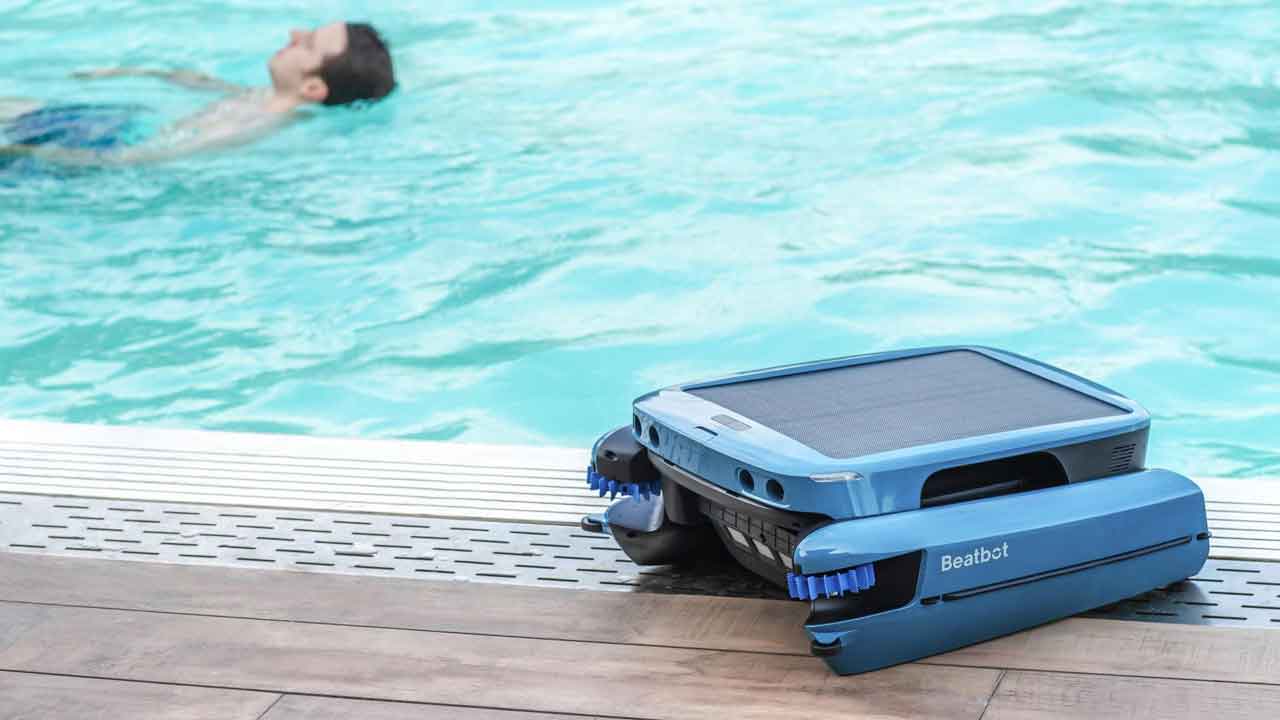
Beatbot has been gaining serious traction in the robotic pool cleaner space with its AquaSense and Sora lines, establishing itself as a legitimate contender in a category long dominated by legacy brands. Now, the company is making a calculated move into robotic pool skimmers with the launch of the iSkim and iSkim Ultra, bringing a layered approach to the category and offering two distinct tiers that target very different types of pool owners.
Why Robotic Skimmers Are Gaining Momentum
Surface debris has always been one of the most persistent pain points in pool maintenance. Leaves, pollen, bugs, grass clippings, and fine dust collect on the surface long before they ever make it to the floor. Once they sink, they’re harder to remove, placing more strain on filtration systems and robotic cleaners.
Robotic skimmers aim to solve that problem at the source—continuously patrolling the waterline and removing debris before it becomes a bigger issue. Solar-powered designs have made this category even more appealing, allowing for extended runtimes with minimal user intervention.

That’s the opportunity Beatbot is leaning into.
Beatbot iSkim: Built for Continuous Surface Cleaning
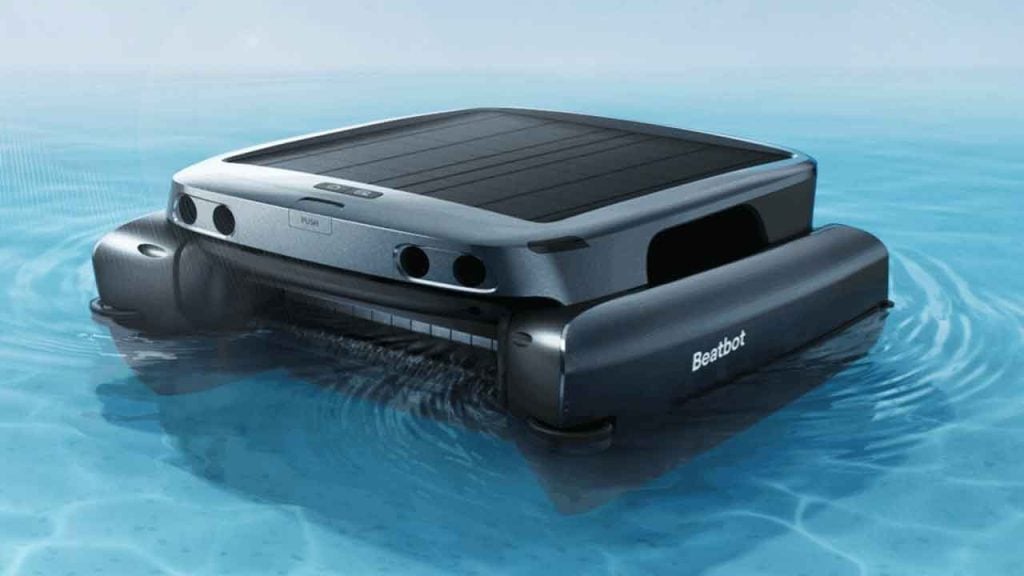
The iSkim is positioned as the more accessible entry point into Beatbot’s skimmer lineup, but it still brings a solid feature set designed for real-world pool conditions.
At its core is a large 9-liter debris basket, giving it the capacity to handle significant surface load without constant emptying. That matters in environments where leaves and organic debris are a daily occurrence. The unit is designed for continuous operation, powered by a solar panel and backed by a 10,000mAh battery, with manufacturer claims of up to 28 hours of runtime without sunlight.
From a mechanical standpoint, the iSkim uses a three-motor system, including dual motor propulsion. That means it’s actively driving itself across the pool surface using two independent propulsion motors, allowing it to steer and reposition rather than simply drifting. Navigation is handled through a combination of basic sensors and random movement with smart rerouting.
It also includes features that are quickly becoming standard in the category: app integration, scheduled cleaning, smart automatic parking, one-click app parking, and an anti-spill basket design with one-click debris release.

Where the iSkim keeps things simple is in its cleaning approach. It focuses on broad surface coverage rather than precision navigation, making it a strong fit for homeowners who want a set-it-and-forget-it solution that runs long and handles the bulk of surface debris without complication.
No products found.
Beatbot iSkim Ultra: A Step Into Smart Surface Care
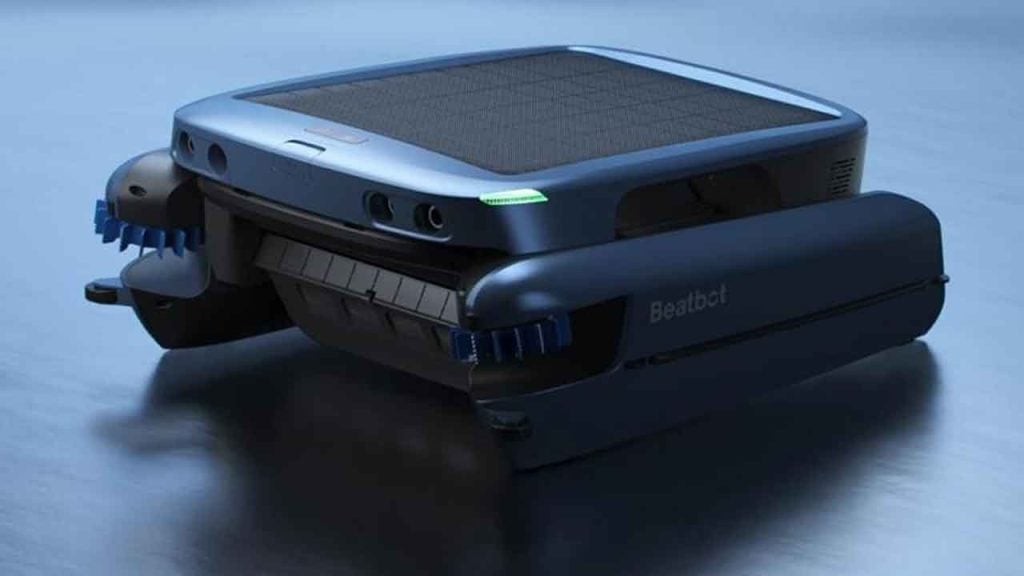
The iSkim Ultra takes a very different approach. While it shares the same 9-liter basket and 10,000mAh battery platform, everything else about the unit pushes it into a higher tier.
This model is built around a seven-motor system and a 20-sensor array, dramatically increasing its ability to navigate, detect obstacles, and clean with intention rather than randomness. Instead of relying on passive coverage, the iSkim Ultra uses an S-path cleaning pattern, allowing it to systematically cover the pool surface.
One of the biggest hardware upgrades is the addition of dual-side brushes and an expanded wheel system, which improve its ability to reach edges and corners—areas where surface debris tends to accumulate but where many skimmers struggle.
The Ultra also introduces environmental awareness features, including water temperature detection, along with voice broadcast capabilities for system status updates. These additions reinforce its positioning as a connected, smart device rather than just a cleaning tool.
But the standout feature—and the one that truly separates it from the base model—is the integrated water clarification system. The iSkim Ultra can actively contribute to water quality by dispensing clarifying agents, helping improve water appearance while it performs surface cleaning. That moves it beyond simple debris removal and into a more holistic surface-care role.
Charging is also upgraded, with the Ultra supporting magnetic wireless charging in addition to solar and adapter-based charging.
No products found.
Where Beatbot Fits in the Market
The robotic skimmer category is no longer niche. Brands like Aiper, WYBOT, Dolphin, and Betta have already proven there’s demand for automated surface cleaning, especially in markets where debris load is high and homeowners want to reduce manual maintenance.
Beatbot’s entry stands out because it doesn’t just compete on price or basic functionality. Instead, it introduces a clearer segmentation within its own lineup.
The iSkim targets homeowners who want reliable, continuous surface cleaning with long runtime and minimal complexity. The iSkim Ultra targets a different buyer—someone looking for smarter navigation, better edge performance, and additional water care features.
That distinction matters, because one of the biggest challenges in this category has been bridging the gap between simple floating skimmers and truly intelligent systems.
The Bigger Picture for Pool Automation
What Beatbot is doing here mirrors a broader trend across the pool industry: moving toward specialized, connected devices that each handle a specific part of pool care.
Instead of relying on a single piece of equipment to do everything, homeowners are increasingly building out systems—one robot for floors and walls, another for surface cleaning, and potentially additional tools for water monitoring and treatment.
With the addition of iSkim and iSkim Ultra, Beatbot is positioning itself to be part of that ecosystem conversation, not just as a cleaner manufacturer but as a broader automation player.
Final Thoughts
The launch of iSkim and iSkim Ultra signals that Beatbot is serious about expanding beyond traditional robotic cleaners and into a more complete pool-care lineup.
The iSkim delivers what many pool owners are looking for: long runtime, large capacity, and consistent surface cleaning without added complexity. The iSkim Ultra, on the other hand, pushes the category forward with smarter navigation, improved edge performance, and integrated water clarification.
Together, they give Beatbot a foothold in one of the most active segments in pool automation—and set the stage for even more competition in the robotic skimmer space moving forward.
Equipment Supplies
Under The Hood: A Close Look at Aiper Scuba V3, The World’s #1 Pool Cleaner
Thinking about the Aiper Scuba V3? Get full specs, features, pros & cons, and see how it compares to top robotic pool cleaners.


If you’ve been digging around for Scuba V3, Scuba V3 reviews, or trying to make sense of the Aiper Scuba V3 specs and features, you’re not alone. This thing has quickly become one of the most talked-about robotic pool cleaners in the game—and not just because of marketing hype.
The Scuba V3 is part of a new wave of cleaners that are trying to move beyond random navigation and brute-force cleaning. This one’s built around AI vision, adaptive routing, and cordless operation, putting it firmly in the premium cordless category.
Let’s break it down properly—what it does, how it performs, and how it stacks up against other cleaners in its class.


What Is the Scuba V3?
The Scuba V3 by Aiper is a cordless robotic pool cleaner designed for in-ground pools, capable of cleaning the floor, walls, and waterline while using onboard AI to improve efficiency.
Aiper calls it the “World’s No. 1” smart robotic pool cleaner, a claim tied to global sales volume—but what makes the Scuba V3 relevant isn’t just how many units they’ve moved. It’s that the product actually delivers in the areas that matter.
Instead of blindly covering the pool, it uses an AI camera-based system to detect debris and adjust its cleaning path in real time, actively routing toward problem areas rather than relying on random movement. In other words, it makes smarter decisions about how to best clean your swimming pool as it runs.
Scuba V3 Specs & Features That Matter
This is where the V3 separates itself from most of the competition.

Cognitive AI Navigation (Navium™ + VisionPath™)
At the core of the Scuba V3 is its AI-driven navigation system.
• Detects debris in real time
• Avoids obstacles and adjusts routes dynamically
• Reduces overlap and missed areas
It’s not just mapping—it’s reacting mid-clean.

AI Patrol Cleaning & Smart Optimization
The system continuously adapts to pool conditions.
• Learns pool layout over time
• Adjusts to debris levels
• Optimizes cleaning patterns
It’s not fully autonomous yet—but it’s clearly heading that direction.

Dual LED Vision System
A subtle but important upgrade.
• Improves visibility for onboard AI
• Enables better low-light performance
• Supports nighttime cleaning cycles
Most cleaners in this class don’t offer this.

JetAssist™ Waterline Cleaning
Waterline cleaning is where a lot of robots fall apart. This one holds its position.
• Maintains consistent contact at the tile line
• Reduces slipping during scrubbing
• Improves perimeter cleaning

Dual Brushes + High Suction Power
This is where performance comes together.
• Dual active brushes loosen debris
• Strong suction pulls it in
• Handles both large debris and fine particles

MicroMesh™ Multi-Layer Filtration
Built to capture everything from leaves to silt.
• Outer basket handles larger debris
• Inner mesh captures fine particles
• Delivers excellent water clarity
Trade-off: takes a little more effort to clean.

Featherlight Design & Easy Retrieval
• Around 18 lbs
• Easier to lift than most competitors
• Waterline parking simplifies removal

Wireless Charging Dock
• No cables to manage
• Clean, simple charging setup
• Faster turnaround between cycles
Scuba V3 Specs
• Runtime: Up to 180 minutes
• Charging Time: ~4–5 hours
• Coverage: Up to ~1,600 sq ft
• Weight: ~18 lbs
• Cleaning: Floor, walls, waterline
• Suction: ~4800 GPH
• Filtration: Dual-layer MicroMesh™
• Connectivity: Wi-Fi + Bluetooth
Within the sub-$1,000 cordless cleaner category, that runtime is one of its stronger advantages—especially for a unit handling full pool coverage.

Scuba V3 Reviews: Our Analysis
Cleaning Power
• Handles leaves, dirt, and fine debris effectively
• Strong suction paired with smart routing
• Delivers consistent results in a single cycle
Navigation & Coverage
• Targets debris zones
• Revisits missed areas
• Reduces unnecessary movement
It cleans with intent, not randomness.
Battery Life
At around 170–190 minutes per cycle, the Scuba V3 delivers strong runtime for a full-coverage cordless cleaner.
Compared to other units in the sub-$1,000 range, that’s a meaningful advantage—especially when factoring in wall and waterline cleaning.
Ease of Use
• Lightweight
• Cordless
• Simple drop-in operation
One of the easiest cleaners to use day-to-day.
Maintenance
• Excellent filtration performance
• Fine mesh requires a bit more effort to rinse out

How the Scuba V3 Stacks Up Against the Competition
Here’s how it compares against similar cordless cleaners.
| Model | Navigation | Runtime | Cleaning Coverage | Filtration | Weight | Smart Features | Standout Feature |
|---|---|---|---|---|---|---|---|
| Aiper Scuba V3 | AI Vision + Adaptive Routing | ~180 min | Floor, Walls, Waterline | Dual-layer fine + coarse | ~18 lbs | App control | AI-powered debris detection |
| WYBOT C2 | Smart Path (Gyro-based) | ~150–180 min | Floor, Walls | Dual-layer | ~20+ lbs | App control | Strong wall climbing |
| Beatbot Sora 70 | AI Path Planning + Smart Sensors | ~150–180 min | Floor, Walls, Waterline | Large-capacity multi-stage | ~20 lbs | App + automation | High debris capacity + strong all-surface cleaning |
| iGarden K Pro | Smart Navigation | ~120–150 min | Floor, Walls | Standard filtration | ~20+ lbs | Touch/app features | Budget-friendly smart cleaner |
Where the Scuba V3 Wins
• Advanced AI-driven navigation
• Lightweight and easy to handle
• Strong all-around cleaning performance
• One of the better runtime profiles in its class
• True cordless convenience
Where the Scuba V3 Falls Short
There’s a lot to appreciate about this cleaner, though if we were to identify a few areas for improvement, the following stand out:
• No surface skimming — floating debris like pollen, leaves, and bugs still need to be handled separately or by a different product
• Debris basket release button on the nose can be triggered on hard impacts with walls or corners
• Larger or complex pools may require multiple cleaning cycles
• Navigation can struggle around benches, tanning ledges, and irregular pool shapes
• Price sits at the higher end of the category, which raises expectations for some buyers
Who the Scuba V3 Is Really For
Best fit for:
• Medium-sized in-ground pools
• Buyers who want cordless simplicity
• Users who value smarter navigation
• Service pros looking for a lighter, more efficient unit
Not ideal for:
• Very large or highly complex pools
• Buyers focused strictly on budget
• Anyone expecting surface cleaning
Final Verdict: Is the Aiper Scuba V3 Worth It?
The Scuba V3 is one of the most forward-thinking robotic pool cleaners available today.
It’s not perfect—but it’s pushing the category forward in a meaningful way.
You’re getting:
• Smarter navigation
• Strong cleaning performance
• A runtime profile that holds up well against similarly priced cordless competitors
Plain and simple—it’s one of the most complete cordless cleaners you can buy right now.
No products found.
Photo Credits: Aiper
Read the Summer Issue of Pool Magazine

See more of our coverage in your search results

 Soake Pools Bolsters National Growth With Four Key Hires
 Hayward Holdings Names New Chief Accounting Officer
 Daldorado Names Marcia Gyles Director of Sales
 Landmark Aquatic Brings Poolside Adventures Attractions Nationwide
 Shasta Pools Hires 30-Year Builder to Head Residential Construction
 Watershape University Announces Fall 2026 Session in San Diego
 NTCA Welcomes Jennifer Ibe and Rachel Smith to the Team

 Aqua-Leisure Recreation Acquires INYO Pool Products
 POOL & HOT TUB ALLIANCE ANNOUNCES RECIPIENTS OF 2022 CHAIRMAN’S AWARDS
 Can You Catch Monkeypox From Swimming Pools?
 Florida Pool Pros Tackle the Challenges of an Unusual Cold Snap
 Aiper Debuts Smart Solar Robotic Pool Surface Skimmer
 Fluidra To Acquire German Pool Equipment Distributor
 Water Tech Corp Voted Best Place to Work 2022 by NJ Business Journal


 Pool News3 weeks ago
Leslie’s Reportedly Prepares for Chapter 11 Bankruptcy as Possible Nasdaq Delisting Looms

 Pool News2 weeks ago
Leslie’s Files Chapter 11, Lenders Set to Take Control in Major Restructuring

 Features2 weeks ago
A New Era at POOLCORP: John Watwood Focuses on Customers and the Fundamentals

 Pool Equipment2 weeks ago
AquaLink® EDGE™ and trackr iO Signal a New Direction for Pool Automation

 Press Releases4 weeks ago
Soake Pools Launches Dual Pool Packages

 Pool Equipment4 weeks ago
Hayward Issues Recall for Universal Pool Heaters Over Carbon Monoxide Risk

 Press Releases3 weeks ago
FSPA and PHTA Reunite Through Historic Affiliation

 Press Releases4 weeks ago
Automatic Pool Covers Expands National Sales Team
You must be logged in to post a comment Login