Pool Maintenance
The Lifetime Cost of Pool Ownership Is Often Lower With Professional Maintenance

For many pool owners, the decision to maintain a swimming pool themselves feels logical. After all, how hard can it be to skim leaves, test water, and add chemicals? On the surface, DIY maintenance appears cheaper, especially when compared to a monthly service bill. But the cost of pool ownership isn’t a month-to-month expense. It’s a long-term financial commitment that plays out over years, sometimes decades. When evaluated over the full lifespan of a pool and its equipment, the lowest apparent short-term cost is rarely the lowest total cost.
Professional pool maintenance doesn’t eliminate expenses. What it does is reduce the frequency, severity, and cost of preventable failures. And over time, that difference compounds.
Lifetime ownership cost is driven by failures, not weekly chores
Most pool owners underestimate how much of their total ownership cost comes from rare but expensive events rather than routine upkeep. These include:


• Premature equipment failure
• Severe water quality incidents
• Surface damage caused by chemistry imbalance
• Emergency repairs and after-hours service calls
• Extended downtime where the pool is unusable
Weekly service fees are predictable. Failures are not. And unpredictable expenses are almost always more expensive.
Professional maintenance reduces the probability of these events, which is why the lifetime cost curve often favors professional service even when the monthly line item looks higher.
Chemical overdosing: the most common and most expensive DIY mistake
One of the most overlooked cost drivers in DIY pool care is chemical overdosing. It happens quietly and frequently.
When homeowners don’t test consistently, misunderstand test results, or attempt to “fix everything at once,” they often add far more chemicals than the pool actually needs. This creates a cascade of secondary problems that are far more expensive than the chemicals themselves.
Overdosing commonly leads to:
• Accelerated corrosion of metal components
• Scaling inside heaters and salt cells
• Etching or roughening of plaster surfaces
• Bleaching or discoloration of finishes
• Increased chemical demand that never stabilizes
In many cases, the owner believes the pool is “hard to maintain” when in reality the water has been chemically abused into instability.
Professional service technicians are trained to dose incrementally, watch trends, and allow chemistry to settle before adding more product. That restraint alone can save thousands of dollars in surface and equipment life over time.
Small problems become expensive when they are not seen early
Pools rarely fail catastrophically without warning. Most expensive repairs start as small, inexpensive problems that go unnoticed or are dismissed.
Examples include:
• A slow drip at a pump seal
• Slightly elevated filter pressure
• Air bubbles forming in the pump basket
• Gradual loss of chlorine demand control
• Minor staining beginning on steps or benches
Homeowners often don’t see these issues until the pool stops working. A professional technician, by contrast, sees dozens or hundreds of pools and recognizes abnormal conditions early.
Catching a failing pump seal early may mean a modest repair. Ignoring it may mean water intrusion into the motor and full pump replacement. The difference is not theoretical — it’s a common outcome.
Equipment damage from improper operation and maintenance
Pool equipment is designed to operate within specific parameters. When those parameters are ignored, lifespan shortens dramatically.
DIY maintenance often unintentionally creates damaging conditions, including:
• Running pumps with restricted flow due to dirty filters or clogged baskets
• Allowing heaters to fire under low-flow or scaled conditions
• Running salt systems in improperly balanced water
• Operating variable-speed pumps at inefficient or harmful RPM ranges
Each of these shortens equipment life without creating an obvious immediate failure. The owner only sees the cost years later when equipment fails prematurely.
Professional maintenance keeps systems operating in their intended range, which directly impacts how long expensive components last.
Repairs, warranties, and the hidden cost of doing it yourself
This deserves its own discussion because it is one of the most financially misunderstood areas of pool ownership.
Many pool equipment manufacturers include language in their warranties that limits coverage when:
• Repairs are performed by unqualified individuals
• Equipment is installed or modified incorrectly
• Damage results from improper water chemistry
• Required maintenance is not documented
When homeowners attempt their own repairs, even well-intentioned ones, they risk voiding remaining warranty coverage. That risk is invisible until the day a major component fails and the claim is denied.
Professional service companies not only understand warranty requirements, they often provide documentation that supports claims if a failure occurs. That documentation has real financial value when dealing with high-ticket items like heaters, automation systems, and variable-speed pumps.
Additionally, DIY repairs often lead to secondary damage. A poorly sealed union or misaligned gasket may work temporarily, only to fail later and cause water damage to motors or electrical components.
Downtime has a real cost, even if it isn’t on a receipt
One of the least discussed costs of DIY maintenance is lost pool availability.
When something goes wrong under DIY care, pools tend to stay down longer. Homeowners troubleshoot, research, order parts, wait for delivery, and schedule time to attempt repairs. During that period, the pool is often unusable.
Professional service reduces downtime by:
• Identifying issues before failure
• Carrying common replacement parts
• Having supplier relationships for rapid sourcing
• Knowing when a problem requires escalation versus adjustment
If a pool is unusable for weeks during peak season, the owner has effectively paid for an asset they couldn’t use. While this cost doesn’t show up as a line item, it matters — especially for families who installed a pool specifically for lifestyle value.
Water waste and chemical waste add up over time
Improper maintenance leads to unnecessary draining, dilution, and excessive backwashing. Each of these carries both water and chemical costs.
DIY pools are more likely to be drained or heavily diluted to “reset” chemistry after problems spiral. Professional maintenance aims to keep water stable indefinitely, avoiding those resets whenever possible.
Over years of ownership, the cumulative cost of wasted water, salt, stabilizer, and chemicals can be substantial, particularly in regions with high water costs or usage restrictions.
Professional maintenance creates cost predictability
Perhaps the most overlooked benefit of professional pool service is predictability.
With professional maintenance, owners trade volatile, surprise expenses for a known monthly cost. Over time, that predictability often results in lower total spend because catastrophic failures and emergency fixes are less frequent.
Predictability also prevents panic spending — the tendency to throw money at products, gadgets, or drastic actions when frustration sets in.
The long view favors prevention
DIY pool maintenance can work, especially for technically inclined owners who are consistent, disciplined, and available year-round. But most pool owners are not operating at that level indefinitely.
Over the lifetime of a pool, professional maintenance reduces:
• Equipment replacement frequency
• Surface damage risk
• Chemical overuse
• Emergency repair costs
• Warranty disputes
• Extended downtime
Those reductions compound year after year.
When evaluated honestly over 10, 15, or 20 years, professional pool maintenance is often not an added expense at all — it is a cost-control strategy that protects one of the most expensive features of a home.
Modeled Cost Comparison: DIY Pool Care vs Professional Pool Maintenance
10-Year Residential Inground Pool Ownership (Industry-Based Estimates)
| Category | DIY Pool Owner | Professional Pool Service |
|---|---|---|
| Average annual chemical spend | $900–$1,400 | $500–$800 |
| 10-year chemical spend | $9,000–$14,000 | $5,000–$8,000 |
| Chemical overdosing / reset events | Common | Rare |
| Estimated water replacement (10 yrs) | 120,000–250,000 gallons | 40,000–80,000 gallons |
| Water & dilution cost (10 yrs) | $1,200–$3,000 | $400–$1,000 |
| Pump & motor replacements (10 yrs) | 1.3–1.6 events | 0.6–0.9 events |
| Pump/motor spend (10 yrs) | $3,500–$6,000 | $1,800–$3,500 |
| Heater repairs or early replacement | 1 major event likely | Often avoided or delayed |
| Heater-related spend (10 yrs) | $2,000–$4,500 | $500–$1,500 |
| Filter damage / premature media replacement | Common | Rare |
| Filter-related spend (10 yrs) | $1,200–$2,500 | $600–$1,200 |
| Surface damage risk (plaster/pebble) | Moderate to high | Low |
| Surface remediation allowance (10 yrs) | $2,000–$5,000 | $0–$1,000 |
| Average major repair events | 2–4 | 0–1 |
| Warranty claim denials | Common | Rare |
| Days pool non-operational per swim season | 10–25 days | 1–5 days |
| Emergency service calls | Frequent | Rare |
| Professional service fees (10 yrs) | $0 | $12,000–$18,000 |
10-Year Ownership Cost Summary (Modeled)
| DIY Pool Owner | Professional Pool Service | |
|---|---|---|
| Total estimated 10-year spend | $22,900–$41,000 | $20,800–$35,200 |
| Cost volatility | High (unpredictable spikes) | Low (predictable monthly spend) |
| Risk of catastrophic expense | High | Low |
At first glance, the DIY column appears cheaper because it excludes a monthly service fee, but the cost summary at the bottom tells a different story when viewed over a 10-year ownership period. DIY pool owners typically spend more on chemicals due to overdosing, corrective treatments, and occasional drain-and-refill events, while also facing higher water costs and more frequent equipment failures. Those failures — pumps, heaters, filters, and seals — account for the largest cost swings in the table and are far more common when small issues go unnoticed or water chemistry drifts out of range.
By contrast, professionally maintained pools show lower equipment replacement rates, fewer major repair events, reduced downtime during swim season, and significantly less cost volatility. When all categories are combined, professional maintenance shifts pool ownership from an unpredictable, failure-driven expense model to a more controlled and predictable one — often resulting in a lower or comparable total cost over time, with far less risk and disruption.

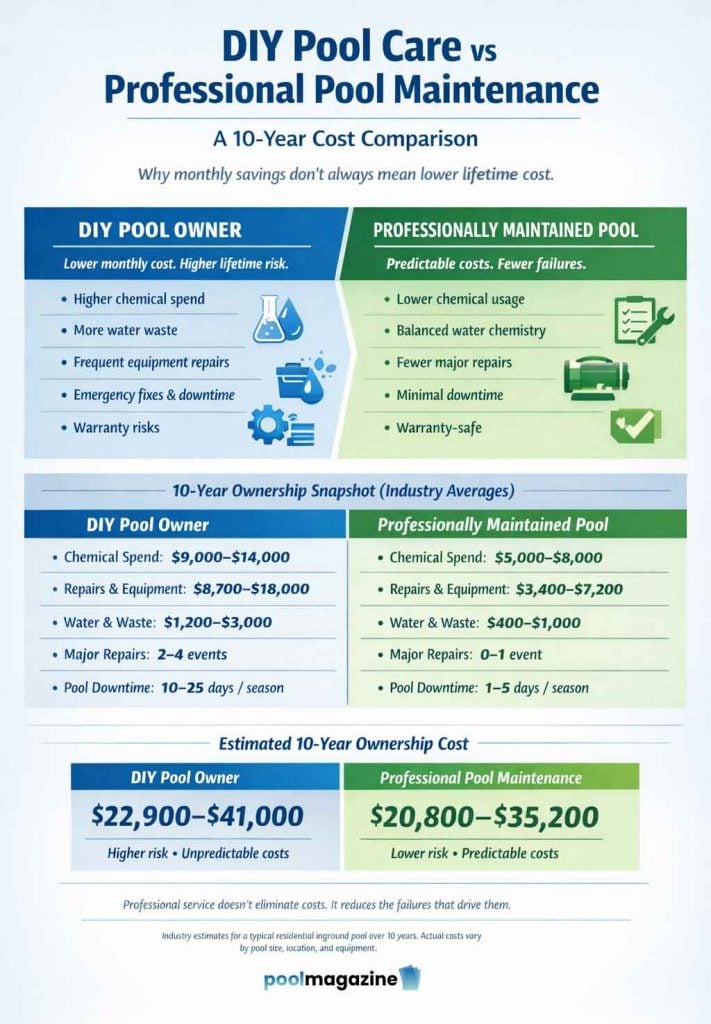
These figures represent conservative, industry-based estimates for a typical residential inground pool over a 10-year ownership period. Actual costs vary based on pool size, climate, equipment selection, water rates, and usage patterns. The comparison reflects cumulative ownership trends rather than short-term monthly expenses.
Lifetime Ownership Cost Summary (Modeled)
| Category | DIY Pool Owner | Professional Pool Service |
|---|---|---|
| Estimated Over 10-Years | $22,900 – $41,000 | $20,800 – $35,200 |
| Estimated Over 15-Years | $34,500 – $61,500 | $30,500 – $52,500 |
| Estimated Over 20-Years | $46,000 – $82,000 | $40,000 – $70,000 |
| Cost Volatility | High (unpredictable spikes) | Low (predictable monthly spend) |
| Risk of Catastrophic Expense | High | Low |
Most pool ownership cost comparisons that pertain to maintenance focus on a single year or a monthly service bill. But pools are long-life assets, and their true cost only becomes clear over time. Pumps, heaters, filters, surfaces, and plumbing do not fail on a monthly schedule — they fail based on accumulated wear, chemistry drift, and delayed intervention. Looking at pool ownership through a 10-, 15-, and 20-year lens reveals how small maintenance differences compound into very different long-term cost outcomes.
Independent Cost Studies and Industry Benchmarks
Most consumer-facing pool cost studies focus narrowly on routine annual maintenance — chemicals, basic cleaning, and scheduled service visits. These studies are useful for establishing baseline expectations, but they frequently avoid modeling long-term ownership risk. It’s important to know that these figures generally reflect idealized, short-term conditions and assume consistent chemistry management, timely intervention, and minimal corrective events.
What these sources do not attempt to quantify is how often real-world pool ownership deviates from those assumptions — particularly under DIY care. Chemical overdosing, delayed repairs, unnoticed equipment stress, water replacement events, and warranty exclusions are typically treated as outliers rather than modeled realities.
The analysis presented here does not dispute other popular baseline maintenance figures. Instead, it builds on them by examining how small deviations from ideal maintenance compound into higher total ownership costs over time, which is where the largest financial differences between DIY and professional care emerge.
Readers interested in reviewing those baseline maintenance statistics can reference popular national cost guides, which provide a useful snapshot of routine annual maintenance costs, but may not discuss the full lifetime cost of ownership as it pertains to maintenance and repairs.
Reference:
• Homeguide – How Much Does It Cost To Own & Maintain a Swimming Pool
• Angi – How Much Does Pool Maintenance Cost
• HomeAdvisor – How Much Does Pool Maintenance Cost in 2025?
You must be logged in to post a comment Login