Pool News
9/11 Memorial Pools – An In Depth Look at The Two Reflecting Pools
On the 20th anniversary of the September 11th attacks, we look at the two pools and Delta Fountains, the pool builders behind the 9/11 Memorial.

As the 20th anniversary of the attacks on September 11th approach, we take a moment to look at the 9/11 Memorial and the two reflecting pools that mark the footprint of where the Twin Towers once stood.
We are now looking back at a point in history that occurred before approximately 28.5% of Americans were ever even born. There are many memorials for the victims of 9/11, but none clearly encapsulate the raw emotions of absence the way the 9/11 Memorial does.
A look at the two reflecting pools at the 9/11 Memorial
Two reflecting pools mark the exact place of the World Trade Center and stand as a permanent place of remembrance. Both pools commemorate the names of nearly 3,000 killed in the attacks on September 11, 2001 and the World Trade Center bombing of February 26, 1993. Each of the victims names are inscribed on bronze parapets surrounding both of the memorial pools.




It’s hard to believe that two decades have gone by since the day happened that would forever change the course of our modern history. 9/11 is a moment in time that will live in as much infamy as December 7th (the attack on Pearl Habor), perhaps even more so in our generation. September 11th is important to people, and the memorial embodies what it means not only to New Yorkers who were first-hand witnesses, but to Americans who watched the events of September 11th unfold live on television.
The mourning and sorrow the nation still feels even twenty years later is evident in the amount of visitors the 9/11 Memorial draws each year. The memorial site was built to remember the victims as well as those involved in the rescue and recovery efforts.

Why did they choose reflecting pools for the memorial site?
Tracing their roots back to the ancient Persian gardens, reflecting pools have been a time honored traditional memorial structure and a water feature typically found in gardens and parks. One of the most iconic reflecting pools is at the Lincoln Memorial in Washington D.C. Most reflecting pools are shallow vessels and can range in size from as small as a bird bath to as large as a major civic center water feature like the one found at the 9/11 memorial site.
The 9/11 Memorial Design Competition
An open competition for designing the memorial site drew 5,201 entries from 63 countries. The thirteen-member jury chose eight finalists on November 19, 2003.
At a press conference held at Federal Hall National Memorial on January 14, 2004, the final design for the 9/11 memorial was revealed to the public. Israeli-American architect Michael Arad of Handel Architects and landscape architecture firm Peter Walker and Partners concept ‘Reflecting Absence‘ was chosen as the winning design. Their design consisted of a forest with two large, recessed pools that represent the Twin Towers’ footprints.


The deciduous trees (swamp white oaks) form informal clusters, clearings, and groves when arranged in rows. The park is located above the Memorial Museum, at street level. The names of the victims of the attacks (including those from the Pentagon, American Airlines Flight 77, United Airlines Flight 93, and the 1993 World Trade Center bombing) are inscribed on the parapets surrounding the waterfalls.
‘Reflecting Absence’ stands in the footprints of the Twin Towers
‘Reflecting Absence’ consists of two 1-acre pools. The structures are the largest man-made waterfalls in the United States. Both pools symbolize the loss of life and the physical void left by the attacks. The dual waterfalls are meant to drown out the sounds of the city, and create a peaceful haven of remembrance for what was lost.


Remembering those who were lost
On 152 bronze parapets on the memorial pools, the names of 2,983 victims are inscribed: 2,977 killed in the September 11 attacks and six killed in the 1993 World Trade Center bombing.


The two reflecting pools at the 9/11 Memorial
The North and South Fountains at the 9/11 Memorial have combined recirculating systems that pump up to 26,000 gallons of water per minute non-stop every day of the year. The water flows over the memorial’s two deep reflecting pools’ walls before being recirculated into catch basins.
The September 11 Memorial utilizes a method of keeping water constantly flowing from a 30-foot drop regardless of the weather New York City gets. The pool is engineered in such a way so that it’s reflective qualities and the sound of falling water remain consistent through the changing seasons.

The Builders of The 9/11 Memorial
You may not know this, but Delta Fountains are the pool builders responsible for building the 9/11 Memorial pools. Joe Petry, President of Delta Fountains said the company has done architectural and floating fountain designs for universities, police memorials, parks and more. They are also the firm behind the Oklahoma City memorial reflecting pool, built in honor of the lives lost on April 19, 1995 and the memorial at the Pentagon. Delta collaborated on the project with Siemens for the automation, pump and flow controls. Dan Euser of Waterarchitecture also worked on the project as well


Challenges in Engineering
There were more than a few challenging engineering feats Delta had to achieve in order to build the pools for the 9/11 memorial site. The weir structure they devised had specific requirements, one was the ability to easily adjust and level water flow to within 1/16th inch over 1400 linear feet.


Another challenge for Delta was avoiding dry spots. Engineers accomplished this thanks to integral-design adjustability which allows for constant expansion and contraction of adhesive materials while still maintaining structural integrity. They devised a method of adding ribs which helped to prevent buckling and allowed field welding.

How the reflecting pools are controlled and maintained
By far one of the most impressive aspects to these two reflective pools is the sophisticated smart chemical filtration system they use. The system is able to anticipate and react to New York’s inclimate weather conditions on the fly.
Chief Engineer – Anthony LoCasto, says it takes a crew of three men to clean the pools 5 nights a week and roughly 8 hours to clean, vaccuum and brush each of the memorial pools.

Both of the pools utilize a total of 16 pumps to circulate 26,000 gallons of water each minute. The system is responsible for circulating over 480,000 gallons of recycled water.
There is also a cutting-edge networked control management system which effectively monitors over a thousand different data points about the pools to maintenance personnel, making it one of the smartest pools on the planet.

The maintenance crews perform goes far beyond simply maintaining the pools; displaying a reverence for the victims with gestures of remembrance. One of their duties is placing a white rose on top of each victim’s name who has a birthday each day before the memorial opens to the general public.
The project, which also includes an underground museum that utilizes parts of the fallen towers, had a budget of $610 million and offically opened to the public on September 12, 2011; ten years and one day after the September 11th attacks.
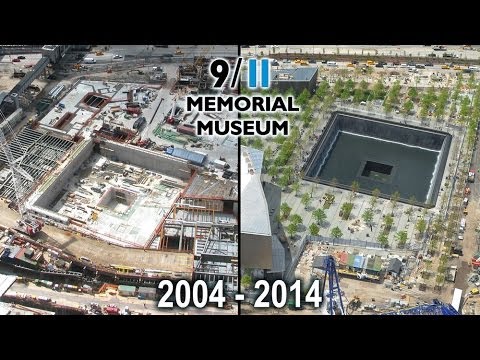
Watch a time lapse of “How the 9/11 Memorial Was Built“. We hope you’ve enjoyed this article on learning what role folks in the pool industry had in creating the September 11 memorial. If you think it’s important to share the story, please do so. Feel free to make a donation to the 9/11 Memorial & Museum who are preserving the history of the events of September 11th for future generations to come.


You must be logged in to post a comment Login