





Pool News
Chatting with Pool Design Innovator – Noah Nehlich
Discussing his start in the pool industry and release of Vip3D 3.0. Product feedback from designer Kyle Franco.


For the past decade Pool Studio has been a favorite design software for professionals in the pool industry. With the release of Vip3D 3.0 the software has evolved to move the future of Pool Design into an artform all it’s own. The new capabilities of the software make 3D renderings more realistic than ever before. Today we’re chatting with Noah Nehlich, the innovative genius and driving engine of Structure Studios – developers of Pool Studio, VizTerra, Vip3D, and YARD.
We wanted to give our readers the complete backstory about Nehlich and Structure Studios. In the course of our discussion we found out how he first got his start in the pool industry and talked about some of the amazing new features in Vip3D’s latest release. We also talked with one of the beta testers and top pool designers – Kyle Franco, to get his assessment about the new features in version 3.0.

The Story Behind Noah Nehlich & Structure Studios
Noah Nehlich has certainly come a long way in his career. Twenty years ago he had aspirations of being a video game designer. He spent the majority of his time designing game levels and mods for popular computer games. The trajectory looked set for a career in Gaming. That was, until the day he happened to incorporate one of his brother-in-laws pool designs into a game level he had modifying. Nehlich had been inspired by the design (a geometric pool with fire bowls) and replicated it into a 3D model.

The rendering which would be considered rough by todays standards was pretty cutting edge at the time and utilized the Unreal Engine found in some of the most popular computer games of the day. When his brother-in-law saw the end result he was floored. Word began to quickly get around. Joe Vassallo (an industry veteran) who was with Paddock Pools at the time, had seen a demonstration and introduced Nehlich to Buzz Ghiz of Paramount.
Ghiz, (a legend in his own right in the pool industry) was impressed with the young man and the technology. Ghiz asked Nehlich to give a presentation of his 3D pool designs.
“I’m 19 years old and there I am… in a corporate boardroom, giving a presentation for the very first time in my life. But it’s going well, I mean, there were audible gasps in the room.”
Noah Nehlich – Structure Studios
From that point Nehlich’s path transitioned from Gaming Designer to Pool Designer. Nehlich had begun providing design services for a variety of diffent pool companies. He had put together some 3D Pool Packages and began functioning as a design consultant for pool builders across the country.
At first Nehlich offered 6 different pools with 3 variations each for $5,000. The design packages he offered sold quickly. Pool companies noticed that 3D renderings helped them dramatically shorten the sales cycle. Nehlich observed that while his product was very successful, his business model still wasn’t. He noticed that he still wasn’t making much profit as a Pool Designer. “The process simply took too long.” said Nehlich.


Pivoting to Software Development
Nehlich knew that converting his design process into a software was the correct path towards establishing a much more profitable business model. It was at this point that he began working with a team of developers in order to help bring his vision for the product to life. Nehlich found a group of initial investors and began the arduous process of developing a software and bringing it to market.
Innovation comes with struggle
“The journey wasn’t without it’s struggles.” says Nehlich “It took four years and we went 10 times over our original projected budget for developing the software.”
Early investors threatened to walk numerous times, Nehlich explained. The stress of potential failure was something that he coped with daily during development. Still, he continued to throw everything he had at his idea. When down to his last $1.18 in his pocket, Nehlich found that he had exactly enough money left for a poor man’s feast at Taco Bell. He paused for a second and seemed to reflect on this for a moment during the course of our conversation.
With the software still left unfinished, Nehlich was some how able to convince investors to continue with the project. Investors agreed not to pull the plug, provided he was able to complete a sale. At the 11th hour, Nehlich had managed to sell Viking Pools a 3D Rendering package for $20,000. The cash infusion brought investor confidence back in Nehlich, enough to see the software project through to it’s fruition.
Fast foward to 2004 – Structure Studios was staring at 400 pre-orders valued at $2,000 each. First year revenue of $800,000 from a grass roots effort of showing off the product one builder at a time. “There were no crowd funding platforms like Kickstarter back in ’04, they simply didn’t exist yet.” said Nehlich.
Nehlich and his team had successfully managed to build enough confidence with early adopters to grow his software Pool Studio into a viable product and Structure Studios into a thriving company.

The software and company which Nehlich had founded, suddenly began receiving tremendous attention. During conventions and tradeshows, throngs of spectators were huddling 20 deep just to grab a glimpse of the incredible new 3D technology in action.
The product however, was still very new for the industry. Builders were in awe of the capabilities, but Structure Studios was still finding difficulty achieving mass adoption with their new product.
“In 2008, the economy was riding high and many builders felt they still didn’t need 3D in order to close sales.” said Nehlich. This was in spite of the fact that more and more companies began incorporating 3D in their sales presentations.
By 2009, The Great Recession had hit the pool industry hard and perceptions slowly began shifting. “Builders found increasing competition in the market.” said Nehlich. “The economic downturn had suddenly made it much more difficult for them to close sales.” he continued.
Builders vying for those same discretionary dollars suddenly found that they needed a differentiator to help give them an edge. Structure Studios answered by providing them the means to compete at a whole new level. Nehlich had helped usher in a new era, providing the pool industry with the software necessary to “Design for Story“. Homeowners could now completely visualize what their outdoor project would look like from start to finish as a realistic 3D representation.
Demand for Nehlich’s 3D design software began to skyrocket. Structure Studios would ultimately wind up releasing a variety of different software products that catered to pool designers as well as landscape and hardscape designers.
- VizTerra is the Professional Designer’s Choice. Customized for landscape, hardscape, and outdoor living and garden designers as well as builders and architects.
- Pool Studio is an intuitive interface with 3D design tools that enables designers to create immersive 3D presentations. The software makes generating expertly designed swimming pools a breeze.
In 2009, Structure Studios combined the two softwares together into a unified platform and released Vip3D which is actually an acronym for Vizterra in Pool Studio. The new software combined the best aspects of both and was an immediate success. With tremendous confidence in the future of his product, Nehlich leveraged every penny he had during the height of the recession in 2010 to purchase 100% ownership of Structure Studios.
Over the years, Nehlich and his team have continuously worked on their platform to refine and improve the experience for both the end user and the consumer. Recently they released their newest version of the award winning platform. A new and improved rendering engine supports many of the innovative features now found in Vip3D.
New Enhancements in Vip3D 3.0
- Next-level realistic real-time 3D rendering
- Edit shapes instantly in 3D
- More automatic terrain data
- All new material library
One of the aspects that Nehlich and his team worked hard on improving in 3.0 is the realism in 3D graphics. “The consumers tolerance for 3D changes with the technology.” said Nehlich. “The bar for realism in 3D environments goes up each year.”
Pool Designer Kyle Franco Beta Tested Vip3D 3.0
To get a pulse of how the new features in Vip3D are perceived in the industry, we decided to contact Kyle Franco, a top pool designer and one of the beta testers of Version 3.0.
We asked Franco, co-owner of Premier Pools & Spas in Fort Worth, what he thought of the new version. Franco, who has been using the software for years, makes great use of the platform. A top performer for the Premier Pools organization; his 3D pool designs are helping him develop his social media following.

“The new version really allows me as a custom designer to take things to the next level with more details.” said Franco, whose designs can also been seen on DIY Channel’s TV Show – Pool Kings. “As a builder it helps provide a better visual for the homeowner so that they have the right expectations when the pool is completed.” he continued.
“I nearly perfected the old version and was excited to see this come out and begin working on it!” said Franco, “The new functions in version 3 allow me to design even faster than before, which is a huge bonus for someone like me.”
We asked him to elaborate on what other improvements he liked. “One of my favorite things about the new version is the detail in color, and presentation mode. All the options to really spice up the images and videos, are incredible! All in all, just an amazing update… I have all 5 of my designers using it!”
The Future of Pool Design
Nehlich says the future for 3D Pool Designs is even brighter as we move into 2022 and beyond. “As mobile processors and hardware catches up, we continue to innovate and improve upon our products.” said Nehlich.

Emerging technologies like Augmented Reality, Aerial 3D Mapping and Virtual Reality have found a home in the product. Structure Studios release of YARD (Your Augmented Reality Designer) a new add-on available for Vip3D customers is a testament to their investment in continuously improving the design platform.
Companies like Cody Pools, Anthony Sylvan, and Presidential Pools are already early adopters of this new technology. Wearable tech like the Oculus is also dramatically gaining traction with builders as a means to immerse potential buyers in the design and shorten the sales process.
Feature Photo Credit: Kyle Franco – Premier Pools & Spas










Pool News
The Current State of the Backyard Pool Industry: Short Film Holds Up a Mirror
The film that asks the question… is family togetherness worth the price of summer’s most expensive luxury?
At first glance, The Current State of the Backyard Pool Industry sounds less like a short film and more like something you’d see on the agenda at an industry summit. It reads like a white paper. A market report. An economic forecast delivered in a ballroom with bad coffee and PowerPoint slides.
That’s intentional.
Because the film isn’t just about a backyard pool. It’s about everything surrounding it right now — inflation, supply chain issues, pricing anxiety, dwindling usage, and the uneasy dance between homeowners and contractors trying to justify what something costs these days.

Film Title Anything But a Misnomer
The short film from Derek Frey, David Amadio, Gil Damon, and Steve Kuzmick opens in territory that ought to immediately feel familiar to anyone working in the pool industry: a dated backyard pool. The liner is aging. The water looks neglected. The chemistry is questionable. And the homeowner is staring at a renovation estimate he isn’t sure he can justify — financially or emotionally.
From that setup, the film does something clever. It takes the headlines we’ve been writing about here at Pool Magazine — rising costs, logistical breakdowns, economic pressures — and drops them into an everyday backyard conversation. Then it asks a harder question:
When the cost of maintaining the pool goes up… what happens to the meaning of it?

Film Shows The Realities of Rising Costs
In the opening scene, a homeowner, Henry (played by Gil Damon), asks his pool guy, Rick (played by Steve Kuzmick), why his pool liner replacement now carries a five-figure price tag.
The character Rick cites inflation. Supply chain instability. A late winter freeze in Texas. Petrochemical plant shutdowns. Limited liner availability.

If you’ve read Pool Magazine over the past few years, you’d already know that at least a few of those stories have already been validated in print. They’re real. They happened. They created issues that affected contractors nationwide.
That’s what makes the scene land.
Because Rick isn’t inventing stories. He’s pulling from real-life industry issues. But the way he delivers his points — confidently, rapidly, with the cadence of someone who has well rehearsed his rebuttal — creates more than a sliver of doubt.
Is he educating the homeowner? Or is he stacking headlines into a persuasive narrative that smacks with the slick gold chain energy of a used car salesman?
“The whole Texas freeze thing came from research,” David Amadio explains. “We were trying to connect the plight of this one contractor to a larger industry issue. The audience doesn’t know if it’s real. They don’t know if it’s legit. It could just be a ruse.”
That ambiguity is the point. The film doesn’t accuse the industry of exaggeration. It simply shows how real economic forces can easily blur into sales language.
The inflation and Texas freeze references aren’t throwaway lines. They were well researched.
Art Sometimes Imitates Life
“When you first reached out to us for an interview, I went on the Pool Magazine website, and one of the top headlines was about another Texas freeze,” director Derek Frey says. “I was like, wow. I don’t know if that’s art imitating life or not, but that was particularly intentional in our crafting of this story.”

That realness doesn’t just live in the headlines, pool guy Rick cites — it lives in how he carries himself.
Kuzmick’s performance isn’t built only on what he says but on the physicality of how he delivers his lines. After making his case for why Henry’s liner replacement will be more expensive, he wraps the conversation with a firm slap on his customer’s back and a casual, “Talk it over with the family and let me know.”
Then he walks.
He doesn’t linger, and he sure doesn’t soften the number. The message is subtle but unmistakable: I’ve got other jobs. I’m busy, and you need me more than I need you.
A View From The Other Side of the Mirror
Henry, the homeowner, is just as recognizable as Rick — only from the other side of the estimate.
He’s the Everyman. The middle-aged dad staring at a liner replacement bill that costs far more than he expected and wondering how he’s going to explain it at the dinner table. There’s a touch of Clark Griswold in him — earnest, well-intentioned, slightly overwhelmed. You get the sense that if something can go wrong with his pool, it probably will. When his skimmer pole snaps in half on the first attempt to clean, it’s funny — but it’s also revealing. This is a man losing control of something he once felt confident about.
The real pressure, though, is about the conversation waiting for him inside the house.
Henry knows the liner replacement isn’t just a repair. It’s a negotiation. One where he has to justify the expense to his wife — and he already senses she won’t be on board. In today’s economy, a five-figure liner replacement isn’t a casual conversation. It’s sure to be a debate and a potential source of tension.
That’s where the film pivots from industry commentary to something more personal, and a conversation happening in many homes across the nation.

The hesitation isn’t just about money. It’s about relevance.
Fighting a Losing Battle Against Devices & Indifference
Henry tries to make his case by appealing to what the pool used to represent — long summers, family time, shared memories. But when he looks to his kids for reinforcement to help him make the case, he’s met with indifference. Phones in hand, half-hearted answers, distracted nods. The pool that once anchored family life now competes against their screen time.
“It’s like a fantasy of middle-class American fatherhood,” David Amadio says. “All of us are watching our kids grow older by the day. All these pastimes we loved are falling by the wayside. This movie was our attempt to try to hold onto those things for a little bit longer.”
Gil Damon, who plays Henry — and who actually owns the pool used in the movie — brings an authenticity to that quiet frustration.
The Film Introduces a Thought Provoking Question
“Whether the kids swim in it or not, you still have to maintain it,” Damon says. “If you don’t maintain it, something goes terribly wrong. And there’s still something kind of joyous in maintaining it. Even just skimming the leaves. But at some point you’re like, wait, what am I doing all this for?”
That question lingers in the film.
What are we maintaining?
The pool becomes a metaphor for something bigger — for rituals that once felt permanent but now feel optional. For investments that once made obvious sense but now require defense. For a version of family life that doesn’t compete well with Wi-Fi.
Competing Against Technology
“Technology is king,” Amadio says. “There are so many casualties in the culture of technology. The pool’s like a little antidote to that. It’s an analog getaway from the digital maelstrom in which we all live.”
In that context, the liner replacement isn’t just a repair. It’s a referendum. Not just on budget, but on whether the pool still holds meaning inside the household. Henry’s wife finally says she would just as soon as like to fill in the pool and be done with it altogether.
And it’s right when Henry seems ready to give up — when he shuts off the timer and retreats inside — that the film introduces its wild card.
Reigniting That First Spark
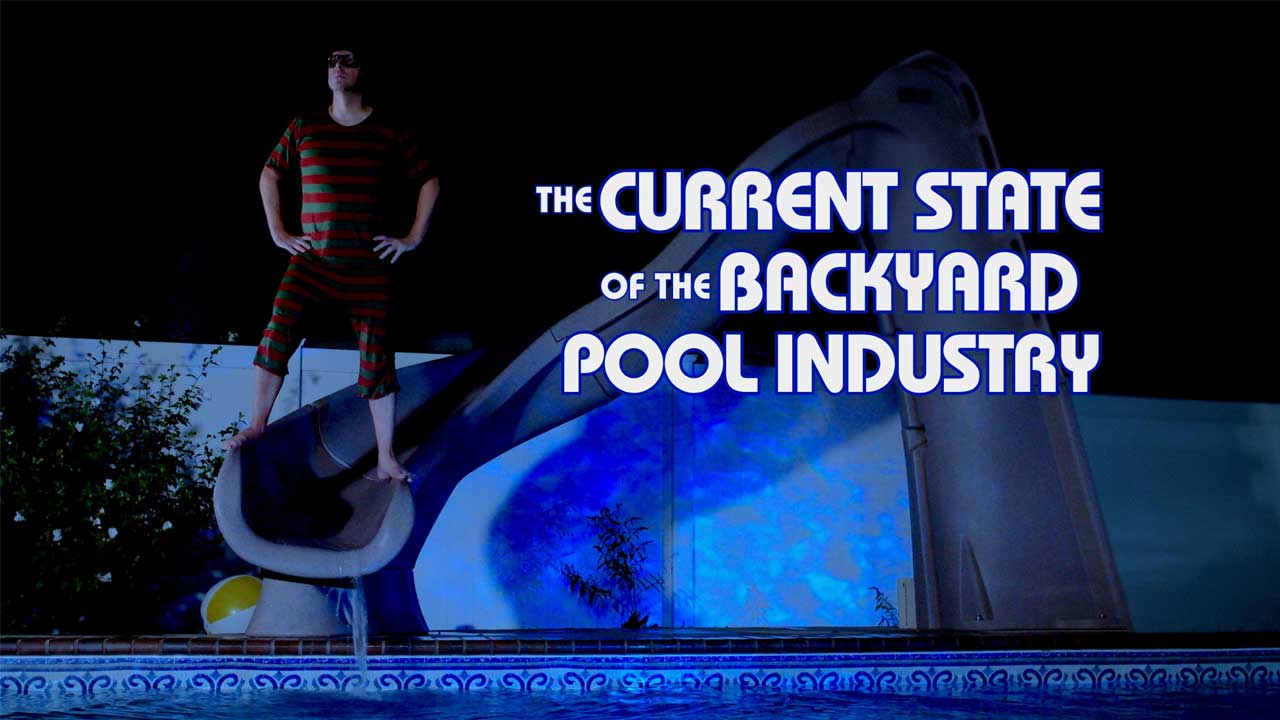
Henry awakens to the sound of splashing. The pool lights are on. The water, which hours earlier looked neglected and uninspiring, now appears clean, inviting, almost cinematic. Floating across the surface is a stranger in goggles, a swim cap, and striped bathing suit, casually doing the backstroke.
He introduces himself as Willy Chamieux — played by writer David Amadio — and calmly explains that he is “the manifestation of why pools are cool.”

Henry, understandably alarmed, tells him the pool is in no condition to swim in (even though it’s clearly been transformed) and orders him out, a command which Willy ignores.
Instead, he dives beneath the surface to “inspect” the torn liner Henry was complaining about. When he resurfaces, it’s face down in a dead man’s float. Henry panics and jumps in to save him — only to discover he’s been played.
Getting Memory to Break Down The Barriers
And that’s the turning point. The moment Henry slips into the water, all of the tension drains from him. The defensiveness, the budgeting, the quiet resentment we saw earlier — it all fades. There’s something about being back in his pool — not as a project, not as an expense, but as he always imagined it — that softens him. You can see it on his face. He’s not calculating anymore. He’s remembering.

Willy challenges him to a game. They dive for quarters. They laugh — the kind of unguarded laughter that hasn’t been heard in that backyard in a while.
Soon, the rest of the family drifts outside. They’re tackled into the pool by Willy and quickly fall under the same spell as Henry, experiencing the renovated condition and joy of once more being in their own pool. The tone of the film shifts again. Visually, the sequence leans into classic aquatic spectacle.
“That was the main reference,” Derek Frey says. “Those 1930s films choreographed by Busby Berkeley — Footlight Parade — and Olympic synchronized swimming. We storyboarded the movement based on many of those references.”

The overhead shots evoke old Hollywood water ballets. The pool center stage again once more in the lives of Henry and his family.

Analysis of Willy Chamieux
The character of Willy carries an apparition-like quality throughout that the film never explains outright.
“We don’t know if he’s a water sprite or an actual person,” David Amadio adds playfully. “He kind of straddles the line.”
That ambiguity is deliberate.
Willy clearly isn’t there to fix the pool; the illusion disappears the moment he does. Rick will still need to be called if that dream is ever to become a reality. No, Willy is merely there to remind.
To remind Henry what the pool once felt like, reconnecting the emotion to the investment.
To remind the family of what enjoying the pool together once meant.
There’s something unmistakably Dickensian about the structure. Willy feels like a warm-weather variation of A Christmas Carol — less chains and underdone potato, more chlorine and cannonballs. If Scrooge needed the Ghost of Christmas Past to remember who he once was, Henry needs something similar.
Willy may very well be the Ghost of Summers Past.
The film never spells it out, but the parallels are there, and we pointed some of them out to the filmmakers. The character Henry represents a man on the brink of abandoning something meaningful. A supernatural visitation. A night that changes perspective before it’s too late.
“We hadn’t thought about Dickens specifically,” David Amadio admits, “but it’s definitely there.”
Whether spirit, trickster, or simply shared DNA, Willy’s function is clear: he forces Henry to re-experience joy before he walks away from it.
And then comes the final turn.
Coming Full Circle
Henry wakes the following morning, not on the couch where he had resigned himself to defeat, but in bed — surrounded by his family. The energy is different. The tension is gone. His wife looks at him and gives a quiet, approving nod. No speech is necessary. No debate. They both know what comes next.
His first order of business will be to call Rick and approve the liner replacement.
The film doesn’t frame that moment as one of defeat or capitulation, but one of clarity.
Only then does the final reveal land.
As day breaks, Rick pulls up in a truck and Willy climbs in. They head off toward another address — another backyard, another hesitant homeowner, another family on the fence. The magic wasn’t random but part of the process.
There’s a faint echo here of The Swimmer — one almost immediately draws the comparison of Burt Lancaster moving from pool to pool. Only this time, the journey is one of restoration. Willy isn’t drifting through suburbia trying to outrun a sad reality. He’s moving through it, reminding families what once made their backyards matter. It’s a subtle but meaningful reframing.
Rather than positioning Rick as a manipulator, the filmmakers present something more layered and nuanced. Rick understands that homeowners don’t just need pricing estimates. They need perspective.
“I think they’re ultimately doing good for people,” Derek Frey says. “Rick is pure business. He’s about the sale. Willy is doing it for the reasons he outlined. Everybody kind of comes out a winner.”
Together, they’re not just repairing pools — they’re restoring connection.
And that’s where the film’s theme settles.
The current state of the backyard pool industry isn’t simply about tariffs, inflation, or any of the other litany of issues impacting the industry. It’s about relevance and reminding consumers why they opted to build a pool in the first place.
Screening The Current State of the Backyard Pool Industry
For pool professionals, the takeaway isn’t that they need a gimmick.
It’s remembering what it is that they’re really selling.
The film doesn’t pretend that the economics aren’t real. The cost increases are real. The supply chain strain was real. The sticker shock homeowners feel is real. Those conversations happen every day in the backyard.
But so does the other part — the part that’s harder to quantify.
The first cannonball of the season.
The late-night sessions of Marco Polo.
The laughter that carries from backyard to backyard all summer long.
Rick understands the business of that, but Willy understands the magic.
And that’s why the film resonates.
Screening this film could be a useful exercise for pool professionals across the industry — not as satire, not as critique, but as perspective. It invites a simple question: Are we leading with cost, or are we leading with value?
We may not all have a magical spirit like Willy to bring along on every job to convince the customer.
Which means the magic has to come through us. Because if we don’t remind them why it matters, no one else will.
Ready to take a deeper dive?
Listen to our entire interview with the filmmakers of The Current State of the Backyard Pool Industry on the Pool Magazine Podcast.
Photo Credits: Derek Frey Films


Rising fuel costs are quickly becoming one of the biggest pressures facing pool professionals this season. For an industry that depends on being out in the field every day, the impact is immediate.
No matter the role—service, construction, remodeling, or sales—pool companies rely heavily on their vehicles to get the job done. Crews are constantly moving between stops, job sites, and customer appointments, often covering a lot of ground in a single day. Trucks aren’t just a convenience—they’re a core part of how pool companies operate.
That’s why fuel costs hit harder here than in most industries. When prices climb, it doesn’t take long for that increase to show up across the board. What used to be a manageable expense is now becoming a real strain on day-to-day operations, forcing companies to pay closer attention to routing, efficiency, and overall fleet costs.
What’s Driving Fuel Prices Higher
The current spike in fuel prices isn’t happening in a vacuum. It’s being driven by geopolitical tension centered around Iran and the Strait of Hormuz, one of the most critical oil chokepoints in the world.
Roughly a fifth of the global oil supply moves through that narrow passage. When conflict escalates or shipping lanes are threatened, even the perception of disruption sends shockwaves through energy markets. Tankers reroute, insurance costs climb, and traders begin pricing in risk before actual shortages even materialize.
That’s exactly what we’re seeing play out right now. Oil prices have surged as markets react to instability in the region, and those increases are working their way down the chain—from crude oil to refined gasoline and diesel—until they land squarely at the pump.
Diesel, in particular, has been hit harder than gasoline due to tighter global supply and its reliance on international shipping. That matters for the pool industry because diesel fuels everything from heavy-duty trucks to construction equipment and material transport.
The bottom line is simple: when global oil flows get disrupted or even threatened, domestic fuel prices respond quickly—and often aggressively.
A Look at Prices Then vs. Now
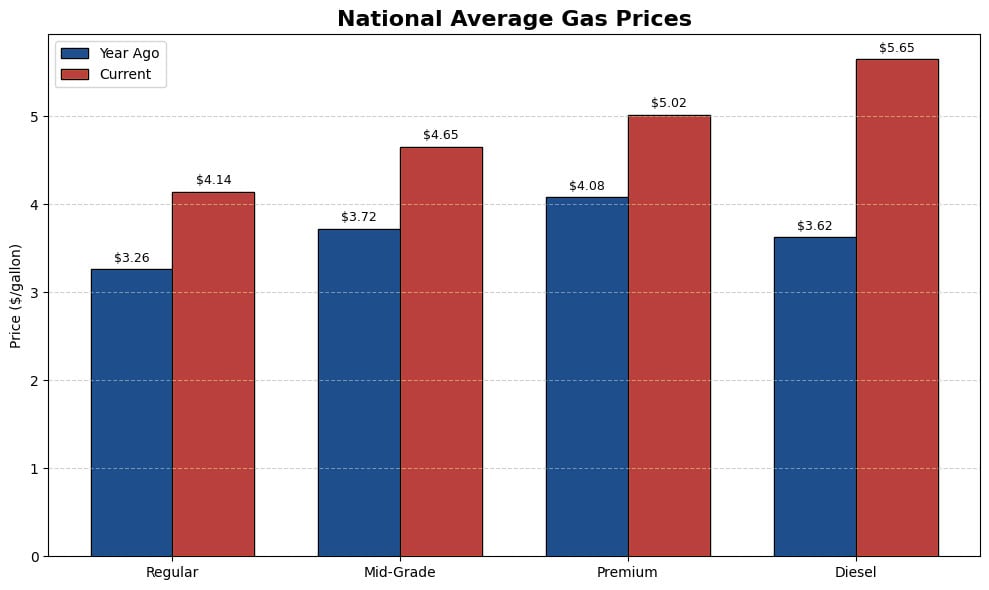
Compared to this time last year, fuel costs have taken a noticeable jump.
Nationally, gasoline prices have climbed from the low-$3 range into the $4-plus range in many markets, representing roughly a 25–30% increase year-over-year. Diesel has surged even more dramatically, with increases approaching 40–50% in some cases.
And while those numbers are significant on their own, they don’t tell the full story.

Western States Hit Hardest
The western states, already home to some of the highest fuel prices in the country—have been hit especially hard. It’s not uncommon to see prices well above the national average, pushing deeper into the $5+ range for gasoline and even higher for diesel.
That’s particularly relevant for the pool industry. California isn’t just another state—it’s one of the largest and most active pool markets in the country. From new construction to ongoing service and maintenance, the concentration of pool ownership means a significant portion of the industry is operating in one of the most expensive fuel environments in the U.S.
Fuel prices tend to run higher across the western half of the U.S. in general. Refining capacity is more limited, particularly in California, where the state relies on a smaller number of in-state refineries that produce a specialized gasoline blend required by stricter environmental regulations. That limits supply flexibility—when one refinery goes down for maintenance or an outage, prices can spike quickly. Add in higher state taxes, regulatory costs, and a geographic disconnect from major Gulf Coast refining hubs, and it becomes more expensive to produce and distribute fuel. The result is a market that’s more sensitive to disruptions and consistently priced above the national average.
The Daily Impact of Rising Fuel Costs on Pool Operations
For pool professionals, rising fuel costs aren’t theoretical—they show up every single day.
A service technician running a route might drive 80 to 120 miles in a day. Multiply that across a week, then across an entire team, and you’re talking about hundreds or thousands of gallons consumed every month.
Now layer in a 25–50% increase in fuel costs. At some point, those rising costs have to be absorbed—or passed along.
We’re already seeing pool service professionals begin to address this head-on. Price increase letters are going out to customers, explaining the reality of higher operating costs and the need to adjust monthly service rates accordingly.
For builders, the impact is more layered. Increased fuel costs affect:
• Material delivery pricing
• Equipment transport
• Labor costs tied to travel time
• Subcontractor pricing
All of that ultimately feeds into the total cost of a project.
While no company wants to raise prices, the reality is that sustained increases in fuel costs make it unavoidable. Margins in the pool industry are already under pressure from labor, materials, and regulatory costs. Fuel is now another major lever pulling those margins tighter.

How Companies Are Responding
Pool companies aren’t just sitting back and absorbing the hit—they’re adapting.
One of the most notable shifts in the industry has been how companies are rethinking their fleets altogether—but for many, there’s no easy solution.
Tightening Routes
David Goldenberg, owner of Las Vegas Pool Bros, says rising fuel costs have forced operators like him to take a hard look at how much they’re spending to reach their customers.
“Fuel has become one of the biggest variables in our operation. When you’re running multiple trucks every day, even a small increase at the pump turns into a significant expense by the end of the month. That’s really what pushed us to start tightening our route. For us it’s about controlling costs and protecting the business from the kind of volatility we’re seeing right now.”
Moving to EV / Hybrid Vehicles
For others, the conversation has shifted beyond tightening routes and into rethinking the long-term makeup of their fleet.
Paul Presley, owner of Blue Wave Pools, has been methodically working at transitioning his vehicles as a way to reduce exposure to rising fuel costs, though he says the process is far from straightforward.
“Fuel costs have definitely been a wake-up call for us. We knew we couldn’t just keep absorbing increases every year and expect it not to impact the business. We’ve started transitioning the fleet and we’re about halfway there now, but it’s not as simple as flipping a switch. The goal is to get to a place where all of our vehicles are either electric or hybrid, but getting there takes time and money.”
Presley says that path has become more challenging as incentives that once helped offset the cost of electric vehicles have been scaled back or removed.
“For a while, the numbers made a lot more sense with the incentives in place. Losing things like the $7,500 tax credit definitely changes the equation. You’re still dealing with higher upfront costs, and you have to be more strategic about how and when you make those upgrades.”
Better Fleet Management
Fleet management tools have quickly becoming one of the biggest eye-openers for pool companies trying to get a handle on rising fuel costs. What many operators are discovering is that the problem isn’t just what they’re paying at the pump—it’s how fuel is being used throughout the day.
Elizabeth Donald of Superior Pools notes that the opportunity for savings is often hiding in plain sight.
“Fuel is an enormous cost—especially now—and even small changes in driver behavior can produce dramatic savings. Idling, for instance, burns a half-gallon of fuel per hour. When diesel costs $6 per gallon, that can be several hundred dollars a day in wasted fuel for a 10-truck fleet.”
For Superior Pools, it’s about seeing exactly how long trucks are idling, how aggressively they’re being driven, and how efficient each route actually is. What fleet management tools have done for them is help turn those assumptions into hard data.
In many cases, that visibility alone is enough to drive immediate change. Companies are tightening routes, reducing idle time, and coaching drivers on more efficient habits—all without adding new vehicles or making major capital investments.
And while these strategies are helping companies regain some control, they don’t eliminate the bigger question looming over the industry: where do fuel prices go from here?
What the Industry Is Watching for the Rest of 2026
Looking ahead, there are a few key factors pool professionals are keeping an eye on:
• Stability (or escalation) in the Middle East
• Oil production levels from major global suppliers
• Domestic refining capacity and output
• Seasonal demand shifts during peak summer months
At the same time, many companies are taking a more proactive approach to cost management. That includes reevaluating service areas, tightening route density, investing in more efficient vehicles, and communicating transparently with customers about pricing increases.
The reality is that fuel costs are now a strategic consideration, not just an operational expense.
Is There Any Relief on the Horizon?
That’s the question everyone is asking.
The honest answer is that it depends heavily on what happens geopolitically. If tensions around the Strait of Hormuz ease and oil flows stabilize, we could see some softening in fuel prices. But even in that scenario, prices don’t typically snap back overnight.
Markets tend to hold onto a risk premium until there’s sustained stability. That means even if conditions improve, it could take months for prices to normalize.
If tensions persist or escalate, the opposite is true. Prices could remain elevated—or climb even higher—especially for diesel.
For pool professionals, that means planning for continued volatility rather than banking on a quick return to lower prices.
The Bottom Line
Fuel has always been a part of doing business in the pool industry—but rarely has it taken center stage like it is right now.
From service routes to construction sites, rising costs are reshaping how companies operate, price their services, and plan for the future. The impact is immediate, tangible, and widespread.
Whether relief comes later this year or the industry settles into a new normal of elevated prices, one thing is clear: pool professionals will continue to adapt, just as they always have.
But for now, it’s a season where every gallon matters—and every dollar counts.
Pool News
Texas Drought Puts New Focus on Pool Water Use
Texas drought conditions have put a new focus on pool water use in light of increasing water restrictions in the lone star state.

Drought is shaping up to be one of the defining issues for the pool industry this season in Texas.
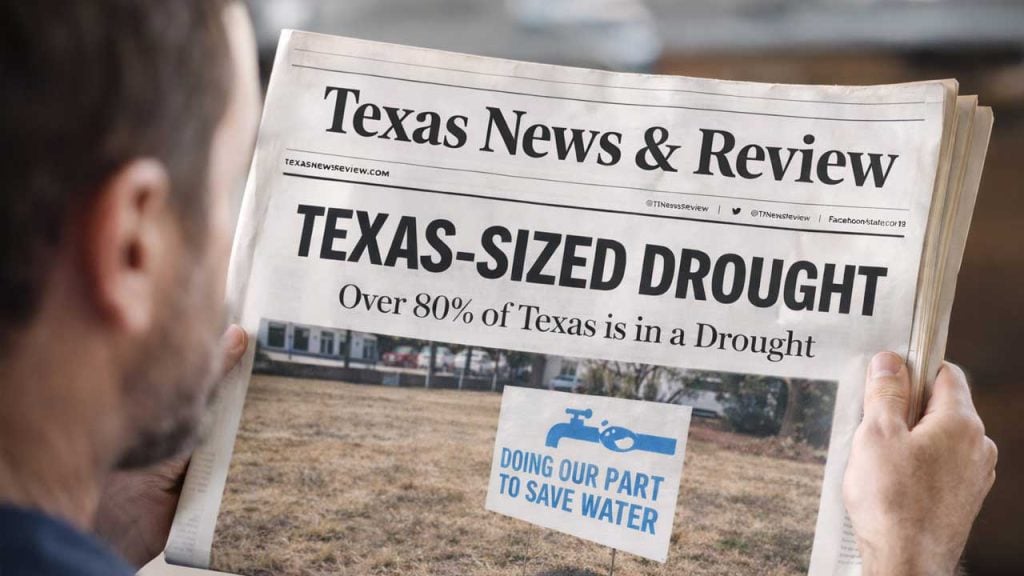
According to the latest drought monitoring data, over 80% of the state is currently experiencing at least some level of drought conditions. Large portions of South and Central Texas are facing severe, extreme, or exceptional drought classifications — the highest levels on the scale.
As temperatures begin to climb and pool season approaches, the conversation around water use is starting to intensify. For the pool industry, that discussion always brings a mix of concern, confusion, and opportunity.
Texas consistently ranks among the top states in the country for residential pool ownership. Warm weather, long swimming seasons, and rapid suburban growth have made backyard pools a staple in many communities across the state.
But when water becomes scarce, swimming pools often get pulled into the broader public debate about conservation.
Drought Puts Swimming Pools In The Crosshairs
When drought conditions worsen, municipalities typically introduce staged conservation measures designed to reduce water consumption.
These restrictions usually start with things like limiting lawn irrigation schedules or restricting car washing. As conditions tighten, additional measures can follow. In some areas, that can eventually include limits on filling decorative water features, restrictions on new pool fills, or guidelines about maintaining proper water levels without waste.
Even when pools are not specifically targeted by regulation, they often become part of the public conversation simply because they are visible.

A full backyard pool can stand in stark contrast to brown lawns and dry landscapes. As a result, pools sometimes become symbolic in drought discussions, even though their actual water usage patterns are often misunderstood.
The Reality of Pool Water Use
One of the most persistent misconceptions about pools is that they constantly consume large volumes of water.
In reality, once a pool is filled, it functions largely as a contained system. While the initial fill of a typical residential pool can require roughly 15,000 to 30,000 gallons of water, ongoing water use is primarily driven by evaporation and minor maintenance top-offs rather than continuous consumption.
Annual replacement water for many residential pools often falls somewhere in the range of 10,000 to 20,000 gallons depending on climate, wind, and whether a pool cover is used.
By comparison, landscape irrigation—particularly traditional turf lawns—can consume far more water over the same period. Studies comparing water use have found that lawns of similar square footage may require tens of thousands of gallons annually, and in some cases over 160,000 gallons per year depending on climate and irrigation practices.
Fiction vs Reality
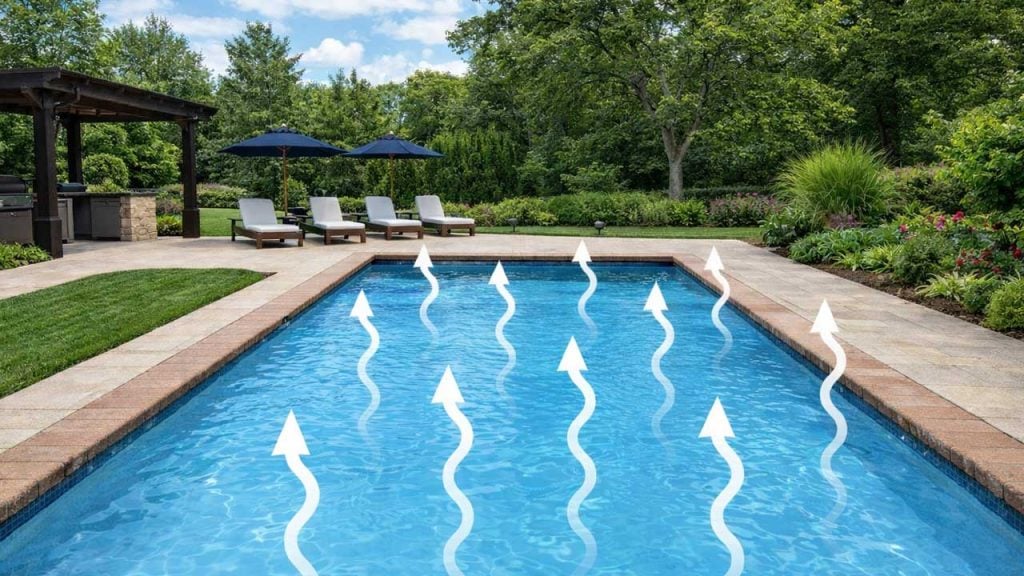
In reality, once a pool is filled, it operates as a contained system. Water loss typically occurs through evaporation, splash-out, or minor backwashing depending on the filtration system being used.
For most residential pools, evaporation is the primary factor driving water replacement.
While initial fills can require a substantial amount of water, ongoing annual replacement volumes are generally far lower than many people assume. Compared to irrigation systems that run daily throughout the summer, a properly maintained pool can represent a relatively stable water footprint.
Still, during periods of drought, perception often matters as much as the numbers. When water shortages intensify, swimming pools frequently become part of the broader conservation conversation.
The Impact on New Pool Construction
For pool builders across Texas, the concern is equally measured. It’s undeniable that drought headlines can affect customer psychology. Even before restrictions are implemented, potential buyers may begin asking questions.
Will they be allowed to fill the pool once construction is complete?
Could new restrictions limit how the pool is used?
And in the middle of a drought, how will neighbors perceive it?
These concerns can slow down decision-making for homeowners who are already evaluating the cost of a pool project.
Texas heat still makes backyard pools extremely attractive, but uncertainty around water policy can stretch sales timelines or delay projects in certain regions. Builders may also see an increase in questions about water-efficient designs, filtration systems, and evaporation control.
Service Companies May See a Different Effect
While drought can create trepidation for new construction, service companies often experience a different dynamic.
When water becomes scarce, pool owners tend to become more cautious about losing it. Small leaks that might have been ignored during wetter years suddenly become urgent issues. Equipment that wastes water through inefficient operation draws greater scrutiny.
Industry veteran Harold Tapley says the industry has seen that pattern play out before. After decades working on the West Coast—where drought conditions and water policy have long shaped how pools are built and maintained—Tapley has watched how quickly regulators begin examining water use across all sectors, including backyard pools.
How The Industry Is Responding
“As drought conditions intensify in Central Texas and across the Colorado River Basin, water policies could be impacted,” Tapley explained. “I can tell you that when Nevada experienced drought conditions, places like Las Vegas began limiting new pool construction to a maximum of 600 square feet. When California experienced drought conditions, certain counties paused pool construction permits for a while. Water conservation concerns are real and always an important topic within the pool industry.”
Tapley advised that one of the areas most likely to draw attention during drought conditions is the routine maintenance of the pool itself. Practices such as backwashing filters or cleaning cartridges can discharge large amounts of treated water that must then be replaced with a potable supply. As water agencies increasingly look for ways to reduce waste, those processes are becoming a greater part of the conservation conversation.
Tapley, a member of the PHTA-13 commission on Water Conservation Efficiency, says newer water recovery technologies are beginning to offer a way to dramatically reduce those losses.
“Backwashing in particular, discharges treated water that must then be replaced, and cartridge filter cleaning can waste significant amounts of water,” Tapley said. “Certified reuse systems can now recover 80–99% of that water—transforming what was once waste into measurable conservation.”
Tapley indicated that in challenging times, when drought restrictions come into play, service professionals may see increased demand for:
• Leak detection
• Equipment optimization
• Water level management
• Water reuse systems
• Filtration efficiency improvements
Homeowners want reassurance that their pools are operating responsibly and not wasting water unnecessarily. For service companies, positioning themselves as water management experts can become an important differentiator during drought conditions.
Texas and the Backyard Pool Market
Texas has one of the largest residential pool markets in the country. Major metropolitan areas such as Houston, Dallas–Fort Worth, Austin, and San Antonio continue to see strong demand for backyard pools due to population growth, climate conditions, and lifestyle preferences. But the scale of that market means that drought conditions can have wide-ranging effects across the industry.
Builders, service companies, retailers, and equipment manufacturers all operate within a broader ecosystem that depends on consumer confidence and stable infrastructure. When water supply concerns begin to dominate local headlines, that confidence can shift.

Potential Regulatory Responses
If drought conditions persist or intensify, expect municipalities to begin introducing additional conservation measures.
Possible actions might include:
• Limits on pool refilling during certain hours or days
• Temporary delays for filling newly constructed pools
• Stricter enforcement of visible water waste
• Increased public messaging about responsible water use
Historically, most municipalities attempt to strike a balance between conservation goals and practical realities. Swimming pools are rarely among the largest drivers of municipal water use compared to agricultural irrigation or landscape watering. However, because pools are highly visible, they often become part of the public conversation when drought conditions intensify.
How the Industry Can Respond
For the pool industry, drought conditions highlight the importance of education. Pool professionals can emphasize design choices that help reduce water loss, including:
• Pool covers that reduce evaporation
• Efficient filtration systems that minimize backwash waste
• Automatic water level controls
• Smart monitoring technologies that detect leaks early
Service companies can also play a role by helping homeowners maintain pools responsibly. Regular equipment inspections, proper water chemistry management, and leak detection services all contribute to minimizing unnecessary water loss.
Communicating these practices clearly to customers helps reinforce the idea that pools can be managed responsibly even during periods of water stress.
Innovation and Adaptation
Water scarcity often accelerates innovation. Manufacturers are continuing to develop technologies that improve efficiency across the pool ecosystem. Variable-speed pumps, smarter automation systems, and improved filtration technology all contribute to more responsible water and energy use.
As drought conditions become more common across parts of the country, with many experts linking the trend to climate change, these technologies are likely to become standard expectations rather than optional upgrades. Builders and service companies that stay ahead of these trends will be better positioned to navigate future drought cycles.
Looking Ahead
Drought conditions in Texas may fluctuate throughout the year depending on rainfall patterns and seasonal weather shifts. But the current situation serves as a reminder of how closely the pool industry is tied to broader environmental conditions.
Water is the foundation of the entire business. When water becomes scarce, it affects not only regulations but also consumer perceptions, purchasing behavior, and long-term planning.
Overall, the Texas pool market remains strong, fueled by the state’s climate and outdoor lifestyle. New pool construction has cooled slightly over the past three years following the pandemic surge — a trend we recently explored in our analysis of Texas pool permit data. Even so, demand remains healthy. What may change this season is the conversation around water management as drought conditions intensify across the state.
For industry professionals, those conversations represent both a challenge and an opportunity. The companies that succeed will be the ones that help homeowners understand how to enjoy their pools while also managing water responsibly.


Download the NEW Pool Magazine App
 Under The Hood: A Close Look at Aiper Scuba V3, The World’s #1 Pool Cleaner
 Soake Pools Partners with Slipstream to Elevate At-Home Wellness
 Landmark Aquatic Taps Waterpark Industry Veteran Craig Nielsen
 RENOLIT Offers Natural Pool reinforced PVC membrane
 Taking On the Hard Jobs Others Won’t Touch – Melo’s Pools & Outdoors
 Latham Rings Nasdaq Opening Bell Commemorating 70th Anniversary & 5 Year IPO
 The Current State of the Backyard Pool Industry: Short Film Holds Up a Mirror

 How Paul Porter Built The World’s Largest Pool Company
 Chlorine Prices Continue To Go Up This Summer
 WYBOTICS Announces Release of WYBOT C1 PRO Pool Cleaner
 Wednesday Kicks Off Series With Scary Pool Piranhas
 Water Tech Celebrates 20th Anniversary
 Hayward Moving it’s Corporate Headquarters to North Carolina
 AquaStar Hires Michael Krause As Brand Manager
 Sponsored Advertisement

 Sponsored Advertisement
-
 Pool News2 weeks ago
The Current State of the Backyard Pool Industry: Short Film Holds Up a Mirror
-

 Pool News3 weeks ago
Rising Fuel Costs Are Hitting Pool Pros Where It Hurts Most
-

 Pool News3 weeks ago
POOLCORP Strengthens Retail Strategy With New Chemical Systems and Pool360 Unlocked
-

 Pool News3 weeks ago
This Summer, A Pool Floats in NYC: Update on + POOL Project
-

 Pool News3 weeks ago
Rolls-Royce Recreates One of Rock’s Most Infamous Poolside Legends
-

 Equipment Supplies3 weeks ago
Spring Fling: New Robotic Pool Cleaners Making a Splash in 2026
-

 Cleaning and Service Equipment and Supplies3 weeks ago
Building Trust With Water Quality
-

 Safety3 weeks ago
Electrical Safety for Pool Pros: OSHA Guidelines Every Technician Should Know