




Pool Service News
The State of Pool Service in 2026: The Industry Isn’t Slowing Down—It’s Tightening Up


For years, pool service has had a reputation for being a simple business. Show up, clean the pool, balance the water, and move on to the next stop. And in many ways, that’s still true: the work is hands-on, local, and built on trust.
But in 2026, the data makes one thing obvious: the businesses winning in pool service aren’t winning because they’re grinding harder. They’re winning because they’re operating with more discipline.
That’s the defining story in Skimmer’s 2026 State of Pool Service report, built from survey insights from more than 1,600 pool pros, plus platform data from over 35,000 Skimmer users servicing more than 1,000,000 pools each month.

Demand is still strong. The market is still durable. But the industry is entering a phase where professionalism is no longer a nice-to-have. It’s the dividing line between companies that grow with control and companies that grow into chaos.
Here are the biggest takeaways shaping what pool service looks like in 2026—and what the smartest operators are doing about it.
1) The market is stable, durable, and still growing
Pool service continues to benefit from a rare advantage in home services: maintenance isn’t optional. Once a homeowner owns a pool, recurring care becomes necessary, creating a dependable base of ongoing demand.
The report clearly frames the opportunity: there are roughly 10.7 million pools in the U.S., including 10.4 million residential pools, and residential pool owners spend an average of about $1,700 per year on maintenance.

And interest is rising, not fading. Total annual search volume across major pool categories is up 22% from 2022 to 2025 (29.7M to 36.3M), signaling that pool care demand is holding strong well beyond the post-pandemic surge.
What it means: The market isn’t disappearing. The winners will be the operators who build businesses capable of delivering consistent service at scale.
2) The biggest risks are the same ones owners feel every day
If you want a reality check on what’s shaping the industry, the report delivers it: pool pros still see macroeconomic conditions as the biggest swing factor heading into 2026.
Nearly 40% rank economic conditions—such as inflation, interest rates, and consumer spending—as the #1 factor affecting their business.
Costs are also a looming variable. Most operators expect tariffs to raise prices over the next year: 47% anticipate slight cost increases, and 18% expect significant increases.
What it means: 2026 rewards operators who know their numbers and price with intention, rather than reacting late after margins have already eroded.
3) Customer expectations are rising, and digital proof is part of service now
Pool service has always been built on trust, but in 2026, homeowners want trust backed by visibility.
Pool pros believe customers will increasingly expect:
- Digital communication and photo/video reporting
- Consistent technician assignments
- Eco-friendly or low-chemical options
This is a major shift in what defines “great service.” The quality of the water still matters, but it’s no longer the full story. Consistency, transparency, and communication are becoming part of the product.
What it means: Operators who systematize reporting and customer communication will retain customers more easily and build pricing power faster.
4) Optimism is rising in a measured, disciplined way
Pool pros aren’t blindly bullish. They’re confident because they’re building stronger operations.
This year, 64% expect to bring in more revenue than last year, while only 8% expect a decrease.
The report also points to a mindset shift: owners are moving away from growth that depends on piling on more stops, and toward “better revenue per stop.”
What it means: The industry is maturing. Growth in 2026 is about execution quality, not only customer volume.
5) Efficiency is the #1 growth strategy—and some owners are cutting accounts on purpose
When asked how they plan to hit their 2026 goals, operators aren’t betting on a single lever. They’re using a more balanced playbook.
The top strategies for 2026 include:
- 61% will find internal efficiencies and streamline services
- 47% will increase marketing spend
- 42% will expand into other service lines (repairs, renovations, builds, etc.)
- 24% will reduce customer count and increase profitability per pool
That last number is one of the most telling signals in the entire report. A quarter of operators are willing to trim accounts to protect route health and profitability.
What it means: In 2026, smart growth often looks like doing fewer things better—and charging appropriately for it.
6) Pricing is stabilizing, but chemical billing is evolving fast
Pricing in 2026 is becoming more consistent and more structured across the industry. Monthly billing is now the clear standard, with 76% of companies billing monthly and only 19% billing per stop.
But the biggest shift is how operators handle chemicals. In 2026:
- 45% include chemicals in the monthly price
- 30% bill chemicals separately
- 25% use a hybrid model
This reflects a market that’s tired of absorbing chemical volatility inside a flat rate. It’s also a sign that customers are becoming more accustomed to transparent billing.
What it means: “Chems included” is no longer the default strategy for protecting margin. More operators are moving toward clarity and cost control.
7) Software is no longer a differentiator—it’s becoming the baseline
The report makes it clear that modern pool service businesses are building cleaner, more connected operations stacks: fewer disconnected tools, tighter workflows, and systems that support the full job cycle from scheduling to billing.
Among companies planning to purchase software in 2026, 68% plan to buy an all-in-one solution.
AI is entering the conversation too, but in a measured way:
- 16% actively using AI tools
- 31% testing or exploring
- 45% interested but not using yet
And owners have clear guardrails. 40% say they would never trust AI to fully handle invoicing and payments.
What it means: Technology is becoming operational infrastructure. The competitive edge comes from how well systems are implemented—not whether they exist at all.
2026 is the year that organized operators pull away
The State of Pool Service in 2026 isn’t defined by chaos or collapse. It’s defined by a widening gap.
On one side: businesses running on memory, habit, and heroic effort.
On the other: businesses running on systems—clear pricing, consistent service standards, documented work, and modern communication.
The report’s message is simple: demand is steady, but expectations are rising. The operators who win in 2026 will be the ones who treat pool service like the professional operation it has become—disciplined, digital, and built to scale.Download the full 2026 State of Pool Service report from Skimmer now, for more insights, benchmarks and helpful tools to successfully tackle everything 2026 has in store.


A pool service technician in Charlotte County, Florida, suffered multiple facial fractures when a pressurized pool filter lid blew off and struck him in the face. Weslee Blakeslee spent two nights in the hospital after the Nov. 4 incident.
Blakeslee told the station he was working on a pool filter when pressure built rapidly. A lid came off, cutting his cheek and knocking him to the ground. Nearly a week later, the swelling had gone down, but he said the left side of his face was still numb, making it difficult to brush his teeth. Even wearing glasses put pressure on his injured nose.
“This was just a regular Wednesday, and it could have been so much worse,” Blakeslee told Gulf Coast News, which originally broke the story.

A GoFundMe co-organized by his wife, Ana Blakeslee, says he was transferred to a hospital in Fort Myers for specialist evaluation. The family’s account describes nine fractures in his face, including his jaw, cheek, nose, and bones surrounding his eye.
Pool filter failures have caused deaths and serious injuries in the past
Blakeslee acknowledged how fortunate he was that his injuries weren’t far worse, and is currently recovering at home. Other pool workers have died in similar incidents. In June 2023, a worker opening a residential pool in Sandy, Utah, was killed when a filter lid blew off and struck him in the face. The investigation summary says it remains unclear what he was doing when the lid separated.
In December 2012, a filter housing lid struck a worker in the head at a residential pool, causing facial fractures and putting him in the hospital for two weeks. OSHA’s accident summary noted deformation on the ring clamp that secured the lid. Investigators reported that the bolt holding the clamp together appeared to have pulled free under excessive pressure.
A similar injury happened to a Florida homeowner. In a 2020 investigation, Tampa Bay’s WFTS reported that David Shimkus had just finished cleaning his pool filter in Belleair Bluffs when the metal top blew off and struck him in the forehead. He told the station he was still dealing with daily pain from the injury about a year later.
For service crews, the clamp on a split-tank filter is a pressure-retaining component. The ANSI/APSP/ICC standard for above-ground and on-ground residential pools addresses that hazard directly. It calls for perimeter-clamped filter tanks to release air pressure gradually before the clamp disengages the tank halves. The Florida incident leaves an open question about which component failed. The earlier cases show how serious the consequences can be when a lid separates.



Pool service companies rarely grow all at once.
A manageable weekly route becomes a larger customer base. Then comes another technician, another truck, repair work, equipment installations, office staff, sales and marketing. Eventually, the owner is no longer just managing pools—they are managing a growing organization.
That was the progression for Scott Reynolds, owner of Purpose Pools in Las Vegas.

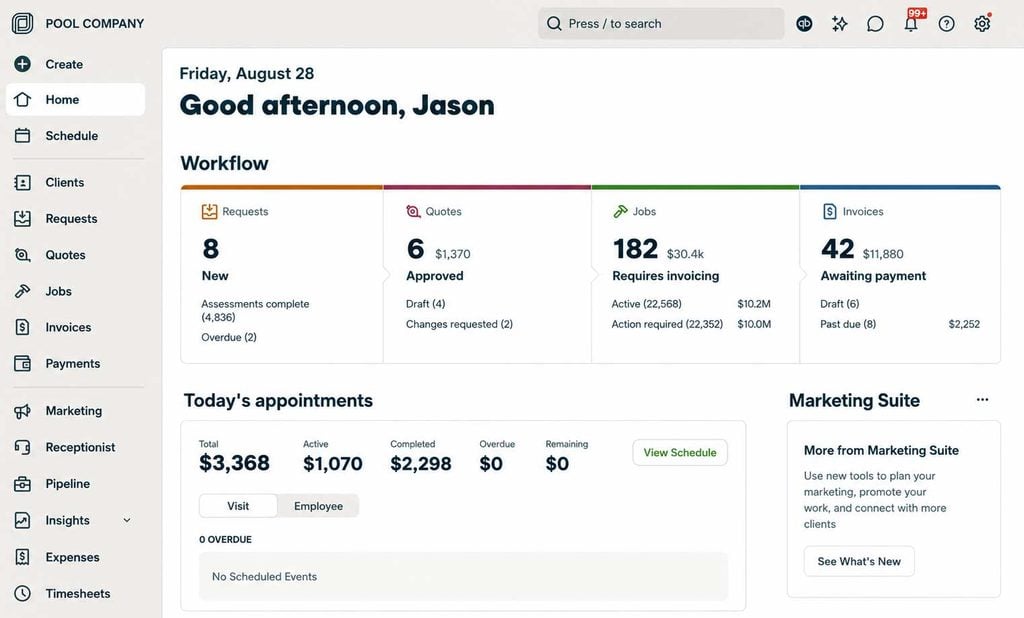
Jobber, a field-service management platform for scheduling, customer communication, estimates, invoicing and related operations, has become part of the company’s operating infrastructure as Purpose Pools has expanded. More recently, Reynolds has focused on a different challenge: using the company’s data to make smarter decisions about marketing, profitability and growth.
His experience reflects a broader shift among service contractors.
Software Is Becoming a Business Essential
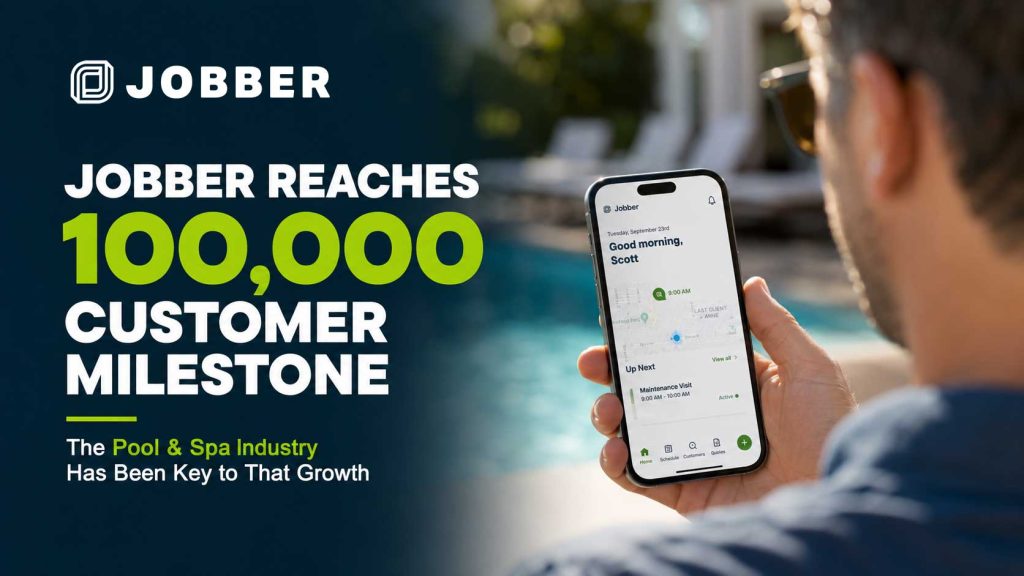
Jobber recently surpassed 100,000 paid customers. Moly Milosovic, Jobber’s Head of Community, says service professionals in the pool and spa industry have been a key part of their growth story.
“I’ve been going to trade shows for years, including a lot of pool industry shows, and back then the rebuttal I always heard was, ‘I want to learn more, but I don’t think I need it yet,’” Milosovic said. “I don’t hear that anymore.”
Milosovic said contractors increasingly recognize that operational software is not something to postpone until the company reaches a certain number of employees, trucks or accounts.

“There’s so much more awareness that software doing work and tracking work for you is a smart investment as soon as you can afford it,” Milosovic said. “It’s become more like table stakes.”
For Purpose Pools, that investment has supported a transition from a relatively simple cleaning route to a more complex service and repair operation.
Choosing a System That Can Scale
Reynolds began his search for field management software in 2022. He had prior experience with enterprise software and knew that a platform with extensive functionality was not necessarily the easiest system to operate.
“I came from a corporate background where we relied heavily on Salesforce, so I’m used to all the bells, whistles and features, but it’s extremely complex,” Reynolds said.
Before adopting a new system, Purpose Pools had worked through other solutions and developed a clearer understanding of its needs.
“I was looking for a really robust platform, and we finally landed on Jobber,” Reynolds said. “It was super straightforward and easy to use.”
For a service business, usability matters because the platform needs to work for office staff, salespeople, technicians and management—not just the person responsible for implementing it.
Support Beyond Onboarding
Reynolds said the company’s rapid adoption of Jobber has also been shaped by the personal attention he receives from his account specialist.
“Probably what has impressed me most has been the support,” he said.
He initially expected a typical onboarding period, followed by a more self-directed relationship with the platform. Instead, Jobber continued to provide assistance as Purpose Pools added people, services and workflows.
“I thought it might just be that first 90 days of, ‘Let’s get you started and make sure you’re successful,’ but since we signed up in 2022, that support has continued all the way through today,” Reynolds said.
Growth Creates More Moving Parts
“When we first started out, we were just doing weekly cleanings,” Reynolds said. “Now we push about 100 customers a week through the platform between service calls, cleanings and repairs.”
The team has grown alongside the customer base, with employees now working across sales, administration and operations.
“As we’ve grown our customer base, we’ve also grown the team and added people to sales, administration and operations,” Reynolds said. “Jobber makes it easy to get them up to speed and onboarded because the tool set continues to be straightforward and simple.”
Avoiding Costly Operational Gaps
The need for an integrated system usually becomes apparent when information starts falling through the cracks.
A technician may forget a follow-up. An estimate may not receive a response. A repair could be completed without an invoice being sent. A customer note may exist only in a text message or handwritten file.
“Think about when you lost track of something you wrote down, or when you literally forgot to invoice someone for a job worth thousands of dollars,” Milosovic said.
Those breakdowns become more expensive as a company handles greater volume.
“One of the biggest things Jobber helps us with is avoiding that memory lapse,” Reynolds said.
Faster Repair Follow-Up
At Purpose Pools, Jobber helps centralize customer communication and task management across recurring service and repair work.
That structure has helped the company reduce its repair sales cycle.
“Our entire sales cycle is less than 40 hours,” Reynolds said. “From the time someone submits a request or makes a phone call, we can be completing the repair.”
The system allows customers to respond when it is convenient for them instead of forcing every interaction into a phone call or office-hours conversation.
“They can answer the text when they want, or log into the Client Hub when they’d like to,” Reynolds said. “Jobber is always working for us, but it’s also working on the customer’s timetable.”
Empowering Pool Pros To Answer Bigger Questions
Once Purpose Pools established stronger systems for managing jobs and customer communication, Reynolds turned his attention to marketing efficiency.
“For us, the shift probably happened about a year ago,” Reynolds said. “We went from, ‘Let’s just spend. The top line looks really good,’ to asking how we could become more efficient.”
For many pool companies, advertising platforms provide useful—but incomplete—data. They can show impressions, clicks, calls and submitted forms, but they do not always reveal whether those leads became paying customers or generated meaningful revenue.
“We wanted to know where the lead was coming from, what channel produced it and what that lead cost us,” Reynolds said. “Ultimately, we wanted to know what revenue it generated.”
Connecting Ad Spend to Revenue
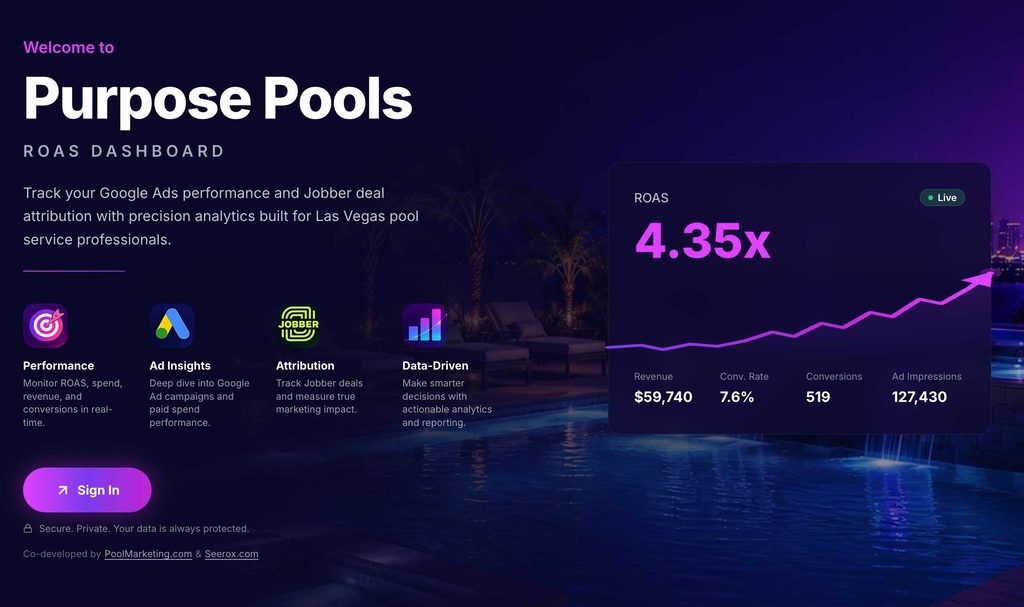
Working with digital agency PoolMarketing.com, Purpose Pools developed a custom return-on-ad-spend dashboard that connects advertising performance with customer, sales and revenue data flowing through Jobber’s API.
The dashboard is a custom integration built by PoolMarketing.com, rather than a native Jobber reporting feature. It allows Reynolds to track a lead after it enters the business, including the source, current sales stage and outcome.
“Now I’m able to tell when a lead hit the system, what stage it’s in and what the response was,” Reynolds said. “That allows us to make more efficient decisions.”
Better Data Creates Better Decisions
At scale, modest improvements in advertising efficiency can have a significant impact.
“As you grow, even being able to save a couple of percentage points on ad spend and reallocate that money somewhere else is a really big deal,” Reynolds said.
A channel that produces low-cost leads is not necessarily the best channel if those leads do not become profitable jobs. On the other hand, a higher-cost source may warrant greater investment if it consistently produces valuable repair work, installations or recurring service accounts.
The objective is not simply to identify wasted spend. It is also to invest more heavily in the channels that consistently generate worthwhile customers.
“I think that’s what a lot of owner-operators miss out on—really working through the efficiency of their costs and expenses and knowing where the money goes and why it goes there,” Reynolds said. “In our case, we can double down and spend more on the channels that are working because we have the data in front of us.”
Turning Operational Data Into Insight
Jobber occupies an important place as the source of truth in the attribution process because the ultimate value of a marketing lead is determined by what happens after the initial inquiry.
Customer records, estimates, jobs, invoices and revenue data provide the operational information needed to evaluate whether an advertising source actually produces profitable work.
For Jobber, that represents an evolution in the role of field-service software. The platform is not only a scheduling and communication tool; it can also become a source of business intelligence.
“It takes that kind of discipline—knowing your numbers and making those percentage-type decisions,” Milosovic said. “You need that visibility.”
Demand for Better Reporting
Milosovic said the Purpose Pools dashboard illustrates the type of analysis that a growing number of contractors want.
“That dashboard looks amazing,” she said. “I would love to see a dashboard like that in Jobber. We’re investing in helping customers understand their numbers better so they can make those kinds of high-growth decisions.”
Jobber has seen similar demand since introducing its own marketing tools.
“When we launched our marketing suite, the response was immediate: ‘How do you give me more information to make smarter decisions?’” Milosovic said. “We’ve continued investing in those marketing tools to give people that kind of visibility because there absolutely is demand for it.”
Revenue Alone Does Not Equal Success
For Reynolds, marketing attribution is part of a broader shift in how he measures the health of Purpose Pools.
“I think when most pool companies start out, we generally chase that vanity top line of, ‘Hey, I’m doing X amount of revenue,’ but we’re not really understanding the profit margins,” Reynolds said.
He said he often hears similar stories from other contractors who have built significant revenue but still struggle financially.
“I’ll hear, ‘We’re doing X amount a year or X amount a month, and that’s really good—but I’m also kind of going broke,’” Reynolds said.
A company can look successful on paper while dealing with poor pricing, escalating labor costs, weak material markups, excessive overhead or unprofitable marketing spend.
Knowing the Cost of the Work
Purpose Pools has responded by becoming more intentional about job costs and pricing.
“We need to understand our costs,” Reynolds said. “We’ve created a tiered cost ladder so we know what a job costs and what markup needs to go with it. That helps make sure we’re hitting our bottom-line numbers at the end of the week, quarter or year.”
That level of discipline becomes increasingly important as a business grows. More jobs do not automatically create more profit. In some cases, growth can magnify inefficiencies that were less noticeable when the company was smaller.
Jobber’s reports and operational data can support that analysis by giving contractors a clearer view of the work being performed, the revenue being generated, and the processes behind it.
Pool Service: A Key Piece of the Puzzle
Across Jobber’s customer base, the volume of operational information has grown substantially. The company says its 100,000 customers have completed nearly 90 million jobs representing more than $100 billion in services.
Pool service and repair represent an important piece of that growing field-service economy. Unlike businesses built primarily around one-time projects, pool companies often combine recurring maintenance with repair and installation work, sending technicians into the field day after day while managing an ongoing relationship with the customer. It’s a model Milosovic sees as particularly well aligned with the platform Jobber has built.
“Pool service is huge. It’s growing. It’s year-round outdoor work, and it’s exactly who Jobber was built for — people who are going to homes and commercial properties,” Milosovic said.
As those companies grow, the information generated through their day-to-day operations can become increasingly valuable. For Milosovic, the opportunity is to turn that data into actionable business guidance.
“We have this exciting opportunity because you’re already doing your work in Jobber and all of those numbers are in there,” she said. “The question becomes: How do we surface that information so you can get advice that helps you make more money?”
For Jobber, that is the larger opportunity: becoming more than a platform for scheduling and job management.
“We want to be your most trusted partner, your most trusted employee and your most trusted advisor,” Milosovic said. “We want to help surface those opportunities.”
Ready to take a deeper dive?
Listen to the full conversation with Moly Milosovic and Scott Reynolds for a practical look at how Purpose Pools uses Jobber and custom reporting to manage service work, track marketing results, improve operational follow-through and make more informed decisions about growth and profitability.
Pool Service News
SPS PoolCare Celebrates Five Years, 50,000 Recurring Customers
Nation’s largest pool services company enters the Atlanta market with Good Boy Pool Services acquisition


SPS PoolCare, the largest swimming pool services company in the United States, celebrated its fifth anniversary by completing its acquisition of Good Boy Pool Services and reaching the milestone of 50,000 recurring maintenance customers. The acquisition expands SPS PoolCare’s service area to the Atlanta market and marks more than 220 acquisitions since its founding.
Backed by Storr Group, SPS PoolCare operates across Texas, Florida, Arizona, Nevada, and Georgia, serving more than 50,000 weekly recurring residential and commercial customers and performing over 2.5 million pool services annually. SPS PoolCare leverages technology to streamline operations, enhance service delivery, and elevate the customer experience across every market it serves.
“This anniversary marks five years of building something the pool industry has never seen before, and our Atlanta market expansion with Good Boy Pool Services is proof that we are not slowing down,” said Lance Martin, CEO of SPS PoolCare. “Our exceptional team and technology-forward approach gives us the tools to grow quickly while never losing sight of what matters most: delivering exceptional service to every customer, every time.”

SPS PoolCare’s growth trajectory includes recent landmark acquisitions of Pool Troopers and the majority of the pool service operations of Amenity Pool Services, two of the largest pool service companies in the United States. Those acquisitions significantly expanded SPS PoolCare’s geographic presence across the Sunbelt, added thousands of new customers, and established the foundation for the company’s continued expansion into new markets, including Atlanta.
“Five years ago, we set out with a simple goal: build the most trusted pool services company in the country,” said Fraser Ramseyer, Founder of SPS PoolCare and Founder and CEO of Storr Group. “More than 220 acquisitions later, that mission remains unchanged. Every business that joins SPS strengthens our ability to invest in our people, technology, and local operations while preserving the customer relationships that made those businesses successful.”
SPS PoolCare continues to pursue acquisitions in existing and new markets as it works toward becoming the most comprehensive pool services platform in the nation.
About SPS PoolCare:
As the #1 swimming-pool services company in the United States, SPS PoolCare is on track to perform over 2,500,000 weekly recurring pool services in 2026 and employs more than 1,300 staff across five states. Backed by Storr Group, the company is focused on growing its family of brands across the Sun Belt as it continues to make owning a pool a joy. SPS PoolCare is committed to creating a world-class service experience for its customers and being an employer-of-choice for its team members. Read more at spspoolcare.com

About Storr Group:
Storr Group is an operationally focused lower-middle-market private equity firm that backs, builds, and scales industry-leading platforms. With a rich background in business building, Storr combines world-class operators with strategic M&A, deep integration, and sophisticated technology to drive sustainable growth and long-term value. Storr Group has offices in West Palm Beach, New York City, and Austin. To partner today, visit storrgroup.com
Read the Fall Issue of Pool Magazine

See more of our coverage in your search results

 Aiper Advances the Intelligent Pool Cleaning with Evolved AI and Solar Automation at PSP Expo 2026
 Pool Magazine Announces Strategic Partnership with MyEstimator.pro to Provide Real-Time Pool Pricing
 Solenis to Unveil Revolutionary Smart Pool Technology at PSP Expo
 Pool Corporation to Acquire Team Horner, Expanding Distribution Network in Florida
 PHTA Announces 2027 Board of Directors
 Poolwerx Opens Second Northeast Florida Store on Amelia Island
 Pool Industry Heads to New Orleans for the 2026 PSP Expo
 Pool Brain Hires Eric Knight to Help Revolutionize Pool Industry Technology and Education
 Florida Pool Professionals Honored for Excellence in Design and Craftsmanship
 Pool & Hot Tub Alliance Announces 2026 Greg Garrett Scholarship Award Winners
 Skimmer and Heritage Pool Supply Launch Direct Ordering, Expanding Their Strategic Partnership
 SafeSplash Highlights Early Water Safety During Baby Safety Month
 Pentair Pool Earns Top Safety Honors in North Carolina
 Low-Chlo™ Launches Revolutionary Low-Chlorine Pool Sanitation System for Homeowners Nationwide
 Sponsored Advertisement
Pool Magazine Podcast
 What’s Your Pool Company Really Worth? – Pool Magazine Podcast With Weld Valuations
 iGarden K Series Review: A Pool Pro Puts It to the Test
 Why Waiting Until Spring to Remodel Your Pool Could Cost You Time & Money
 Ready When You Are: The Changing Role of Automatic Pool Covers
 What’s Hot & Trending in Fire Pits and Fire Tables for 2026
 Sponsored Advertisement
 Pool News1 day ago
Pool Corporation to Acquire Team Horner, Expanding Distribution Network in Florida

 Pool News4 weeks ago
Sacred Geometry: Where Architecture, Mathematics and Mosaics Collide

 Pool News4 weeks ago
Anatomy of a Botched Remodel: What Sank the Lincoln Memorial Reflecting Pool Restoration?

 Pool Builder2 weeks ago
Historic Rain in Florida Takes Toll on Pool Job Sites

 Equipment Supplies4 weeks ago
iGarden K Series Review: What We Learned After Months in a Customer’s Pool

 Press Releases3 weeks ago
Watson’s Acquires Tampa Bay Spas, Enters Tampa Bay Market

 Pool News4 weeks ago
Landmark Aquatic Taps Britton Nielsen and Tim Garner to Lead Utah Growth

 Contractors and Builders4 weeks ago
What’s Hiding Beneath The Surface: Artificial Rock Features
You must be logged in to post a comment Login