




Talking Pools
10 Habits of Highly Effective Pool Companies


Every successful pool company develops habits—whether intentional or not. The difference between companies that consistently grow and companies that constantly struggle often comes down to the behaviors, routines, and standards they practice every single day.
Good habits create consistency. They improve communication, strengthen culture, sharpen operations, and build trust with customers. Bad habits do the opposite. They create confusion, missed opportunities, unnecessary stress, unhappy customers, and frustrated employees. Over time, those habits compound and become part of the company’s identity.
The truth is, it’s just as easy to develop bad habits as it is to develop good ones. A company can slowly become reactive instead of proactive. Communication can slip. Accountability can disappear. Standards can decline. Before long, leadership is spending more time putting out fires than building the business.

That’s why highly effective pool companies focus heavily on discipline, consistency, and accountability. Many owners describe it as “training the muscle.” The more often strong habits are reinforced, the stronger the company becomes. Winning businesses understand that success isn’t built through occasional bursts of effort—it’s built through repetition.
The same principle applies to the people companies hire and surround themselves with. Skills can be taught. Habits are much harder to change. The best pool companies look for employees who naturally demonstrate professionalism, communication skills, organization, accountability, attention to detail, and a willingness to improve. Those qualities tend to elevate the entire team.
In an increasingly competitive industry, the companies that separate themselves are usually the ones willing to put in the work behind the scenes. Successful companies build and refine systems. They communicate clearly and hold themselves accountable. Most importantly, they commit to habits that position them for long-term success instead of short-term survival.
10 Habits Highly Successful Pool Companies Share
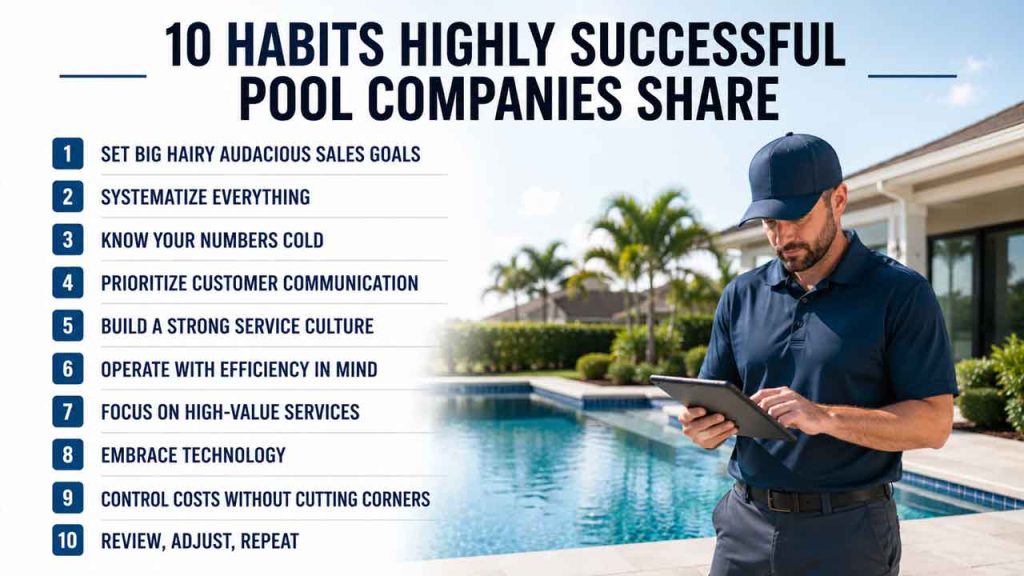
1. Set Big Hairy Audacious Sales Goals
Successful pool companies don’t stumble into growth—they pursue it with intention. The most effective organizations establish aggressive but measurable goals that push the company beyond its comfort zone and provide a clear roadmap for success. Whether the objective is increasing revenue, expanding into new markets, improving close rates, or growing average project size, ambitious goals help create alignment and accountability throughout the organization. Just as important as setting those goals is regularly measuring progress against them.
Companies that consistently review performance, track key metrics, and adjust course when necessary are often better positioned to achieve sustainable growth. Kelly Peel of Lakeside Custom Pools believes that goal setting and regular accountability meetings are critical components of building a high-performing team.

“We’ve never been interested in setting goals that we know we’ll hit. The goals that create real growth are the ones that challenge the organization to think bigger, operate differently, and raise its standards. Some years we hit every target, and some years we fall short, but that’s not really the point. The value comes from creating a vision that’s ambitious enough to inspire the team and then measuring our progress throughout the year. When everyone is working toward something significant, it changes the way decisions are made and helps drive the entire company forward.”
2. Systematize Everything
Most pool companies aren’t disorganized. They’re un-systematized. There’s a difference. Disorganized people forget; un-systematized businesses repeat avoidable mistakes at scale.
Take Adam Beech, who wanted to scale his growing service company systematically. The tech he needed didn’t exist- so he built it. We know his system today as Pool Brain.
“Managing technician training, service quality, and turnover was extremely chaotic and difficult. Once we solved this with the first version of Pool Brain, tech training reduced by almost 70%, green pools reduced by over 80%, customer churn due to complaints was virtually eliminated, turnover no longer impacted our business, employee morale improved, and we could do way more with way less.”
Systematization turns a “practice” into a “science.” By creating repeatable processes, a business moves from relying on luck to relying on logic.
3. Know Your Numbers Cold
Highly effective pool companies understand their financials at a granular level. They know their profit margins, labor costs, close rates, equipment costs, customer acquisition costs, and overhead. Owners who operate on instinct alone often discover problems too late.
The most successful operators review their numbers regularly and use data to guide decisions. Knowing your metrics doesn’t just help you weather challenging markets—it helps you spot opportunities, identify inefficiencies, and make smarter decisions faster than competitors who are flying blind. Scott Reynolds, owner of Purpose Pools, says investing in systems that provide real-time visibility into business performance has been a game-changer for his company.
“For years, we made decisions based on gut instinct instead of real-time data. Once we instituted better technology and systems and started tracking our key metrics in one place, we could see revenue, receivables, upcoming work, technician productivity, and cash flow at a glance. That visibility helped us make faster decisions, improve accountability, forecast growth more accurately, and run a much more efficient service operation.”
4. Prioritize Customer Communication
If Rudy Stankowitz had to create a one-sentence business plan for a pool company, it’d be: “Answer the phone, dummy.”
This isn’t just about quick communication to secure a lead. It’s being fast and clear throughout the entire life of the account. The way Bruno Brum at XBrum Piscinas in Rio sees it, “Most problems don’t stem from the water itself, but from misaligned expectations”.
It may be for this reason that the top pros consistently name the post-visit recap as one of their highest-leverage communication habits. The format is intentionally simple: Tell the customer what you found, what you did, and what’s next. Same format every time.
Scott Rhodes at Rhodes Custom Pools puts simply: never leave them guessing or in the dark.
5. Build a Strong Service Culture
The strongest pool companies understand they’re not simply selling a service—they’re delivering experiences. A strong service culture starts internally with leadership and extends outward into every customer interaction. Companies that emphasize professionalism, accountability, and pride in workmanship tend to generate stronger reputations and more referrals. Customers remember how they were treated long after they forget what they paid. For Gordie Robinson of Cox Pools, exceptional customer service isn’t just a philosophy—it’s a long-term growth strategy that has helped the company build lasting relationships and establish itself as a leader in its market.
“When you consistently deliver a great customer experience, the benefits compound over time. Customers stay with you longer, they’re more likely to trust your recommendations, and they become your biggest advocates in the community. Some of our best customers have referred multiple friends, neighbors, and family members over the years because they know the level of service they’re going to receive. That creates a cycle where great service leads to stronger retention, stronger retention leads to more referrals, and those referrals bring in customers who already trust your company. That’s been a big part of how we’ve continued to grow and strengthen our position in the market.”
6. Operate With Efficiency In Mind
Efficiency isn’t never breaking, it’s what your team does when something does break. This goes back to finding your biggest drain, not just on margin but on time.
Adam Beech watched his own service company bleed both on guesswork. “When we implemented automatic chemical dosing, it drastically reduced technician training, chemical spend (40% reduction), algae growth, and customer complaints. That single feature gave us a TON of time and money back with way less effort and changed our business for the better.”
Brian Menzies at Pinch A Penny shared: “I’ve seen businesses [without route optimization] waste hours of payroll on road trips across cities to clean pools to lose money weekly.”
Efficiency is not about perfection. It is about fewer wasted steps, fewer repeated problems, and fewer decisions made from scratch. The strongest companies find the leaks in their operation before those leaks become big losses.
7. Focus on High-Value Services
Not all revenue is created equal. The most effective pool companies understand which services generate the strongest margins and position themselves accordingly. High-end remodels, automation upgrades, equipment modernization, outdoor living enhancements, and recurring maintenance agreements often produce more stable and profitable revenue streams than competing solely on low-margin construction bids. Successful companies learn to sell value rather than price. They also recognize when market conditions are shifting and adapt their service offerings to meet changing consumer demand. Pool builder Emile Stinchcombe of Aqua Guard Pools, says that flexibility has been a key factor in helping his company navigate a softer market for new pool construction while continuing to grow through renovations and upgrades.
“Like many builders, we’ve seen demand for new pool construction cool compared to the peak years, but we’ve also seen a significant increase in remodeling projects, equipment upgrades, and backyard improvements. Homeowners may not be ready to build a brand-new pool, but many are still willing to invest in improving the one they already have. We’ve made a conscious effort to expand our renovation and upgrade services because that’s where we’re seeing strong demand. That shift has allowed us to maintain healthy revenue streams, keep our crews busy, and continue growing while some companies that relied too heavily on new construction have faced greater challenges.”
Companies that diversify their revenue streams are often better equipped to weather market fluctuations and changing consumer spending patterns. By offering remodeling, modernization, service, and upgrade opportunities alongside new construction, pool professionals can create a more resilient business model that generates revenue across multiple customer segments and stages of pool ownership.
8. Embrace Technology
Hesitant to adopt new tech? Brian Menzies has three words for you: “Your competitors already are.”
The mistake most pros make isn’t refusing tech; it’s trying to overhaul everything at once and bouncing off the implementation. Adam Beech’s advice to operators is the same advice he followed building his platform one feature at a time: “Don’t try to eat the whole elephant in one bite.” Focus on routes first, then on chemistry, on billing, and then on the next thing. Pick what’s hurting most next.
Rudy Stankowitz put it plainly, “Technology is inevitable, and the tech-averse are putting themselves on a path to extinction.” The goal is not to become a tech company. The goal is to stop losing time to tasks, mistakes, and gaps that better systems can prevent.
9. Control Costs Without Cutting Corners
Highly effective pool companies pay close attention to expenses, but they also understand the difference between reducing waste and sacrificing quality. Cutting corners on materials, training, or labor may improve short-term numbers, but it often damages reputation and profitability over time. Smart operators negotiate better purchasing agreements, optimize labor efficiency, and monitor overhead carefully while still delivering exceptional work. Long-term success depends on maintaining both quality and profitability simultaneously. For Cole Daasnes of Poseidon Pool Service, improving margins has never been about finding cheaper products or lowering service standards. Instead, it’s about identifying efficiencies that strengthen the business without compromising the customer experience.
“One thing we’ve been focused on is finding ways to improve profitability that don’t impact the quality of service our customers expect. Purchasing lower-quality materials or cutting corners was never on my bingo card for 2026. Our reputation is too important, and it takes years to build trust in a market. Instead, we’ve worked closely with vendors to negotiate better terms and discounts by paying invoices faster. In some cases, simply moving from net 30 to net 15 payment terms has created opportunities for savings that improve our margins without affecting the customer at all. That’s the kind of win-win every pool company should be looking for. Managing expenses and improving efficiency is a continuous process, but the goal should always be to become more profitable while maintaining the same level of quality and service that earned your customers’ trust in the first place.”
The strongest operators understand that profitability and quality are not mutually exclusive. In fact, the most successful companies often improve margins by becoming more efficient, strengthening vendor relationships, and eliminating unnecessary costs rather than reducing the value they deliver.
10. Review, Adjust, Repeat
“One mistake is human,” Rudy Stankowitz says. “The same mistake twice is a process failure.” Or to paraphrase Brum, the best opportunities for business evolution lie in recurring problems.
However, if you’re not reviewing your business on a regular basis you may not even know how many times something really is a problem. But reviewing without adjustment is journaling. And adjustment without first reviewing is just guessing. The highly successful are doing both, on a predictable repeatable rhythm.
Or as Drew Coppolino at Pools Etc puts it, “Continuous improvement has to be built into the culture of the business, not treated as a one-time initiative.”

Good or Bad, The Habits You Tolerate Become Your Company Culture
One of the biggest mistakes pool companies make is underestimating how quickly habits spread throughout an organization. When poor communication, disorganization, chronic lateness, lack of accountability, or cutting corners are tolerated, they eventually become normalized. Over time, those habits affect multiple parts of the business—from customer satisfaction and employee morale to profitability and reputation.
That’s why highly effective pool companies pay close attention to the habits of the people they hire and surround themselves with. Skills can be taught. Habits are far more difficult to change. The best operators look for people who naturally demonstrate consistency, professionalism, accountability, strong communication skills, attention to detail, and a willingness to improve. Employees who take pride in their work, show initiative, stay organized, and follow through on commitments tend to elevate everyone around them.
At the same time, successful companies learn to recognize warning signs early. Employees who constantly make excuses, resist feedback, create negativity, communicate poorly, or lack urgency can quietly undermine a strong team culture. One person with bad habits can impact an entire organization faster than many owners realize.
In a service-driven industry like pool construction and maintenance, bad habits tend to show up quickly—in missed callbacks, poor communication, sloppy workmanship, declining reviews, and employee turnover. Research from Gallup continues to show that disengaged teams produce lower profitability, lower productivity, and significantly higher turnover rates than highly engaged ones. Winning companies understand that culture and habits aren’t “soft skills”—they directly impact the bottom line.
Ultimately, culture is built through repetition. The habits leadership rewards, reinforces, and tolerates eventually become the habits the company is known for. Winning pool companies understand that building a successful business starts with building the right habits first.








Skimmer, a leading-edge pool service software provider, recently unveiled its “2024 State of Pool Service Report,” a comprehensive analysis based on the invaluable feedback from over 1,700 pool service professionals who responded. This report delves deep into key facets of the industry, such as market challenges, business structures, pricing strategies, technology adoption, and growth plans. Notably, the report culminates from survey responses from Skimmer’s platform of over 25,000 users as well as insights gleaned from broader market research.
Rising Tides of Costs and Strategic Business Responses
One of the more eye-opening aspects to the report, 73% of surveyed pool service professionals reported a commendable upswing in revenue in 2023 compared to the previous year. However, the buoyancy in revenue was tempered by a prevailing concern – rising costs. The majority identified escalating costs as the most formidable challenge faced in 2023, with an anticipatory nod to this trend persisting into the unfolding year of 2024.
A significant number of companies are gearing up to address these rising costs by contemplating price adjustments, with nearly 74% of pool professionals signaling their intention to implement price increases in the current year to sustain revenue streams.

In an exclusive interview with Talking Pools Podcast, Jack Nelson, CEO of Skimmer, underscored this critical issue, stating, “Everyone in the industry feels like costs are going to keep rising. It’s unfortunately an inevitability with sort of inflation. The question is, what are we going to do about it? It’s really interesting to see that most respondents said they were planning on raising prices in order to maintain profit margins.”

Workforce Dynamics and Marketing Strategies
Beyond the realms of financial strategies, the report casts its gaze on the dynamic workforce within the pool service industry. A noteworthy revelation is that 52% of respondents expressed an intent to expand their teams in 2024. This metric supports a positive indicator that most respondents believe the industry will continue to grow rather than contract.
One statistic you may find surprising, the report indicated that the majority of service technicians still rely heavily on the age-old method of word-of-mouth referrals, with only a modest 35% reporting that they’re investing in marketing. Nelson, who has experienced this sentiment first hand expressed that this way of thinking might be outdated.
“So many folks in the industry think they don’t need to pay for marketing because they get a lot of referrals,” said Nelson, “that’s true. You can grow your business that way, but you can grow it so much more quickly if you are spending a little bit of marketing. Because most of the industry is still not doing it, there’s a real chance to kind of take advantage of that. It’s a huge opportunity for ambitious pool service companies.”
Technology Integration: The Digital Oasis
In counterpoint to that, one area where the pool industry is embracing technology is business operations. One pivotal aspect of the report indicated an escalating integration of technology within the pool service industry. Approximately 75% of respondents revealed that they are leveraging software to streamline various aspects of their business operations. This underscores a growing acknowledgment of the pivotal role technology plays in enhancing efficiency, streamlining operations, and staying ahead in a competitive landscape.
“I think knowing your numbers is absolutely critical,” said Nelson, “so is embracing technology to operate your business more efficiently. That’s true whether it’s Skimmer or any other type of technology. I think there’s a tendency to underestimate the cost associated with doing business. Time is money. If you’re accepting a check from a customer because that customer refuses to get on ACH or credit card, there’s time associated with that cost. I think really understanding where you can automate different aspects of your business to save time and money is critical as costs continue to rise.”
Strategic Navigations for Future Growth
One noteworthy observation gleaned from the report is the success of companies that choose to bill separately for chemicals. Businesses charging customers separately for chemicals were on average more profitable than those who opted to include chemicals in the total price of service.
Including the price of chemicals has traditionally been a more straightforward, fixed-rate structure that is perhaps more easily grasped by pool owners and simplifies billing for pool professionals. However, the drawback lies in the susceptibility to frequent price adjustments due to significant fluctuations in chemical costs.
According to Skimmer’s data analysis, the model that charges extra for chemicals, known as the “plus chems” model, emerges as the most effective strategy in mitigating the impact of both fluctuating chemical costs and variations in weather patterns that might affect chemical usage, providing a robust buffer against such uncertainties.
Beyond immediate challenges, the report reveals a spectrum of strategic approaches pool service professionals are exploring for future growth. Notably, 33% of respondents expressed a nuanced interest in reducing their customer count while concurrently focusing on upselling more services and augmenting the overall value provided per pool serviced. Additionally, 43% are pinning their hopes on introducing operational efficiencies to curtail costs and bolster profitability.

Want to take a deeper dive? Read Skimmer’s 2024 State of Pool Service Report or listen to the interview on the Talking Pools Podcast.

Water, the essence of life, can harbor imperceptible perils in the form of waterborne diseases. Within the United States, a multitude of cases of waterborne infections are contracted annually, imposing a substantial toll on public health. Pseudomonas and the RWIs (recreational water illnesses) derived from them are one concern in particular that swimmers need to be aware of.
What is Pseudomonas?
Pseudomonas is a type of bacteria, specifically the genus Pseudomonas, which includes various species. One of the species within this genus that is relevant to RWIs is Pseudomonas aeruginosa. Pseudomonas aeruginosa is a common environmental bacterium that can cause infections in humans under certain circumstances. It is known to be an opportunistic pathogen, meaning it primarily affects people with weakened immune systems or those who are already ill.
When it comes to swimming pools, Pseudomonas aeruginosa can be of concern because it has the potential to cause a condition known as “hot tub rash” or “hot tub folliculitis.” This condition is characterized by itchy and sometimes painful red bumps or rash that develop on the skin after exposure to contaminated water, such as in hot tubs, pools, and water playgrounds.

The reasons why Pseudomonas aeruginosa can become a problem in swimming pool settings include:
- Warm Water: Pseudomonas bacteria thrive in warm water environments, which are often found in heated swimming pools and hot tubs.
- Moist Environment: The bacteria can survive and multiply in the moist environment of swimming pools and hot tubs, especially if proper water disinfection and maintenance practices are not followed.
- Insufficient Chlorination: Inadequate disinfection, usually due to low chlorine levels or poor maintenance of chlorine levels, can allow Pseudomonas bacteria to proliferate.
- Lack of Circulation: Stagnant water areas or poor water circulation can create pockets where bacteria can grow.
- Contaminated Water Sources: If the water supply to the pool or hot tub is contaminated with Pseudomonas bacteria, it can lead to infections among swimmers.
- Lack of Hygiene: Swimmers who don’t shower before entering the pool can introduce bacteria and other contaminants into the water.
A revolutionary study titled “Assessing the Burden of Waterborne Infectious Diseases by Exposure Pathway in the United States, 2014” has illuminated the magnitude of this concern, particularly concerning diseases emanating from swimming pools. This piece delves into the pivotal discoveries of the research and spotlights the profound insights shared by microbial physiologist Roy Vore and chemist Jenn Huang in an exclusive two-part episode of the Talking Pools Podcast on July 28, 2023.

The Startling Statistics of Pool-Linked Diseases
The study’s staggering figures reveal that in 2014 alone, the United States witnessed an excess of 7.15 million instances of domestically acquired waterborne infections. Tragically, these infections culminated in 120,000 hospitalizations and 6,600 fatalities. Such data underscores the exigent necessity to effectively address waterborne diseases.
A key facet of the study was the meticulous breakdown of disease incidence according to diverse exposure pathways: recreational water, potable water, and non-recreational non-potable (NRNP) water. Recreational water, encompassing pools, hot tubs, and natural water bodies, constituted the source for approximately 5.61 million illnesses, securing its place as the predominant exposure route.
Potable water, drawn from public systems, private wells, or commercial containers, accounted for around 1.13 million illnesses. NRNP water, employed for non-leisure activities like agriculture or medical applications, contributed to roughly 407,000 instances of waterborne ailments. Acquiring a comprehensive understanding of these exposure routes is pivotal in directing preventive actions and optimizing resource allocation.

The Role of Biofilms
The study also underscored the prominence of biofilms in waterborne infections. Biofilms form as thin layers of microorganisms on diverse surfaces within water systems, such as pipes and filters. Pathogens ensconced within biofilms present formidable challenges for eradication, serving as a substantial source of infections.
Insights from the Experts
In the episode of the Talking Pools Podcast, microbial physiologist Roy Vore and chemist Jenn Huang shared invaluable insights. They emphasized the necessity for water management initiatives to combat the proliferation of pathogens within biofilms, particularly within recreational water venues. Additionally, public health campaigns are pivotal in averting biofilm-related diseases and safeguarding community well-being.
Learn more at CPOClass.com:
https://cpoclass.com/swimming-pool-diseases/

We hate to be the one to say it, but the time has come to make some changes and recession-proof your pool business. We’ve been riding a wave that’s been an incredible boom for the industry. People have stayed home during the quarantine, and the money they would have spent on vacations has become disposable income that they’ve used to reinvest into the home. Home improvements are up in general during the pandemic and the end result has been nothing short of unprecedented in terms of growth for the pool industry.
Over 94,000 pools were installed during 2020, up 21% from the previous year in 2019. The numbers aren’t in just yet for last year but as the dust still settles from 2021, the entire pool industry has boomed.
This year, the complexion and outlook does not appear to be a repeat of the previous two years in terms of demand. Right now we’re looking at high inflation. Increases in fuel costs are soaring through the roof. We’re on the brink of a recession. Hopefully, I’m wrong but I’m not the only one that thinks this way. Supply chain shortages are just ongoing and something we’ve been plagued with since the very start of the pandemic. At some point in time, the momentum is going to stop.

Some folks had disposable income and used that towards home improvement. Others took out loans and mortgages. Many feel the inevitable crash is coming, and for those who are unprepared the change in the economy will hurt, perhaps irreparably.

There are a few things that pool professionals need to consider in order to recession-proof their business. I think one may be coming within the next year. Hopefully, that doesn’t happen. Hopefully, you never need to use any of this advice in this article. However, there is absolutely nothing wrong with putting yourself in a good position to handle a recession, and it looks like one may be on the horizon.
Ways to Recession-Proof Your Pool Business
There are different things you can do to arrange things so that you’re in a better position financially if a recession happens in our country. This may mean raising prices with customers, but you need to make certain you’re in the best position possible to survive tough times should they occur.
Split Chemicals as an Itemized Bill From Services
One great idea to recession-proof your pool business is to start billing separately for chemicals. With more price increases on chemicals looming in the near future, it simply makes sense to begin to start passing these costs on to the consumer. It’s an unsustainable business practice to continue to absorb rising costs. Pool companies cannot continue to take it on the chin the way we have.
Now is the time to explain the prevailing market conditions to the consumer and perhaps change your business practice for billing customers. In our roundtable discussion last year, we discussed rising prices. Not much has changed in the last 6 months except perhaps consumer confidence. Instead of continuing to raise prices for service, what makes more sense in this climate is to separate chemical usage as an itemized bill.


Change Your Billing Practices
Another aspect of billing that should change during this climate is charging for service after it’s been rendered. Many pool companies have their act together in this regard and are doing the right thing by billing for services ahead of time, however, there are still many professionals who do not. Billing ahead ensures that you are cash solvent enough to pay employees, for inventory, equipment, and materials. Failing to do so leaves you at the mercy of the customer.
Billing after the fact is tantamount to supplying customers with a credit line on every job you do. This is a surefire way to fall behind during a recession. As customers begin to become cash strapped during this economy, one of the first bills they’re liable to ignore is yours! Pool service professionals run the distinct possibility of becoming low priority when it comes time to pay bills, especially when the service has already been rendered.
How Do You Switch Your Billing to Recession-Proof Your Business?
One question pool professionals who bill at the end of the month is, how do they switch? How do you switch to billing at the beginning of the month without double billing? People by nature are resistant to change, they also don’t like paying in advance. So the question remains, how do you switch the way you’ve been billing without upsetting all of your customers?
The answer is – incrementally. Make the change slowly and begin retraining your customers to expect a bill earlier than they have. There’s not a recession today, there probably won’t be one this summer; but if what industry experts are predicting is true, one is coming soon and the time to adapt is now!
Get Ahead of the Game
This month coming up, instead of billing on the 30th for the service you’ve performed all month, start billing on the 3rd week. Then the next month, bill your customers on the second week. By the end of the summer, you should be caught up and now be billing all of your customers for the month of service ahead.
It’s important to be transparent to customers. Explain what you’re doing and why. Using this method of billing allows the customer to become slowly acclimatized to paying their bill earlier. In just a few months’ time, you will have effectively changed your entire billing practice and insulated yourself much better financially in the process.
Build Your Credit
Heather Linton also spoke on another episode of “Talking Pools” about building credit for your pool company. While pool professionals may be cash-rich right now, the time to start building your credit is now. Simply put, people need money when a recession hits. If you have not been building your business credit, do not wait until a recession hits. During a down economy is when consumers make the biggest run on banks. It’s also when credit is hardest to come by.
At the end of the day, when considering ways to recession-proof your business, it’s important to put together a game plan that allows you the flexibility to maneuver in tough environments. Some of these suggestions may seem hard to implement, but are entirely necessary in order to ensure you remain solvent in a down economy. In the last two years we’ve seen unprecedented growth, but now is the time to make sure that we stay in a good place financially during the tough times to come.
Listen to the entire episode on the Talking Pools podcast:
Read the Summer Issue of Pool Magazine

See more of our coverage in your search results
 Sponsored Advertisement
 NTCA Welcomes Jennifer Ibe and Rachel Smith to the Team
 Darlly Filtration Partners With The Grit Game on Private Label Pool Filters
 A New Era at POOLCORP: John Watwood Focuses on Customers and the Fundamentals
 King Technology Opens $17M Manufacturing and Distribution Center
 Landmark Aquatic Partners With AngelEye on Drowning Detection Technology
 POOLCORP to Distribute Blue Mar Nova Light Series in North America
 Nasdaq to Suspend Trading in Leslie’s Stock on October 6

 On Underwater Pool Lighting
 RENOLIT Offers Natural Pool reinforced PVC membrane
 Keep Commercial Pools Clean With Polaris®
 Pentair Names David Kraft as Group Sales Leader for Pool Business Unit
 Pool Spa Patio Expo: Innovative Product Showcase Winners Steal The Show
 Stellar Sales Alliance Partners with Chlorine Genie
 PSP/Deck Expo Returns to Las Vegas, November 15-17 as the Premier Trade Event for the Pool, Spa, Patio, and Decking Industries
 Sponsored Advertisement


 Products4 weeks ago
5 Ways Jandy’s New AquaLink® EDGE™ Is Changing the Game for Pool Pros

 Pool News7 days ago
Leslie’s Reportedly Prepares for Chapter 11 Bankruptcy as Possible Nasdaq Delisting Looms

 Pool News3 weeks ago
Inside the 2026 Million Dollar Pool Design Challenge

 Press Releases2 weeks ago
Soake Pools Launches Dual Pool Packages

 Industry News4 weeks ago
Why Pools Matter: Pool Horizons Takes Its Message Global

 Pool News3 weeks ago
RENOLIT Launches ONE Augmented Reality Pool Design App
 Features10 hours ago
A New Era at POOLCORP: John Watwood Focuses on Customers and the Fundamentals

 Pool Equipment2 weeks ago
Hayward Issues Recall for Universal Pool Heaters Over Carbon Monoxide Risk
You must be logged in to post a comment Login