Equipment Supplies
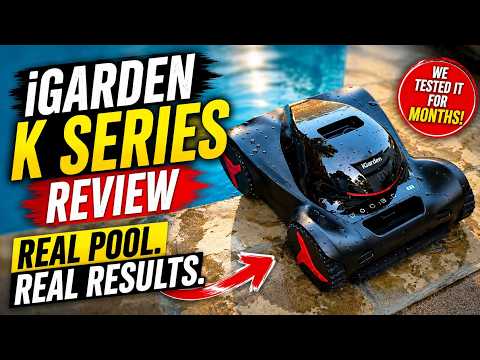
iGarden K Series Review: What We Learned After Months in a Customer’s Pool

Robotic pool cleaners can look impressive under controlled conditions. The more meaningful test isn’t how a cleaner performs in a demonstration environment, but how it handles real-world conditions in an actual swimming pool over time.
Leaves, dirt, pet hair, changing weather, irregular pool geometry and everyday use can expose things that simply don’t show up during a short product demonstration.
That was the idea behind Pool Magazine’s recent evaluation of the iGarden K Series robotic pool cleaner.


Rather than conduct a short-term test, we placed the K Series with pool professional Kelli Clancy, owner of Legacy Pool and Spa in Sacramento, who installed the unit in one of her customer’s pools. The homeowner used the cleaner over an extended period, while Clancy monitored its performance and gathered feedback about what worked well and where the cleaner had limitations.
The result was a practical assessment of a cordless robotic cleaner that Clancy believes could make a compelling option for homeowners buying their first robot.

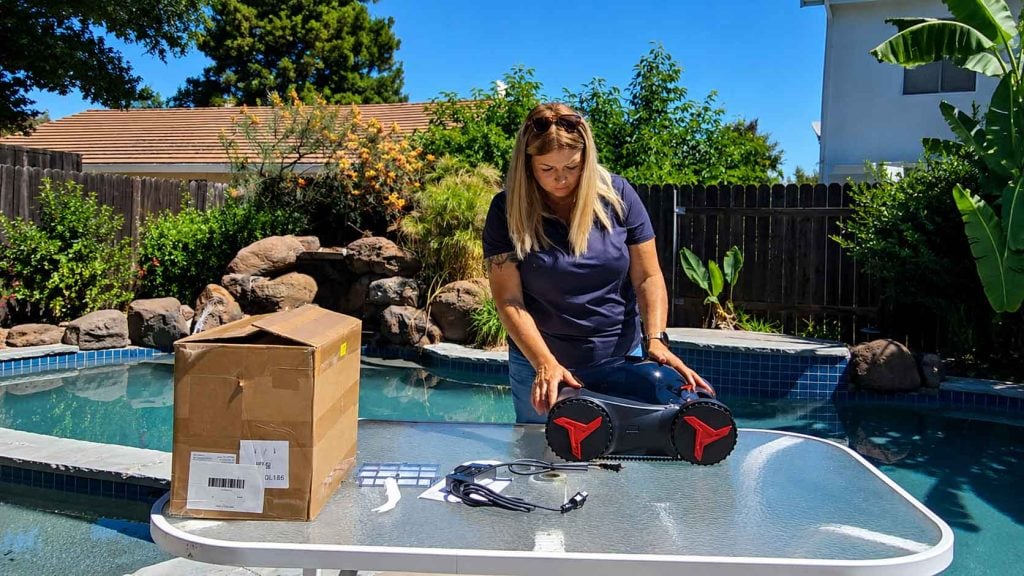
A Real Backyard Instead of a Test Tank
Clancy deliberately selected a pool that would give the K Series plenty to contend with.
“I chose this particular pool for a variety of reasons,” Clancy explained. “One, I knew the customer would give me honest feedback. I knew she would try and get everything she wanted out of the cleaner and give an honest review.”
The surrounding landscape also created a good mixture of debris.


“They had small leaves, big leaves, pine trees,” Clancy said. “So it was a variety of debris I wanted to be able to know if it could pick up.”
As luck would have it, an unrelated issue had also temporarily taken the pool’s circulation system offline, leaving the water somewhat dirtier than usual when the K Series arrived. That provided another opportunity to see how the cleaner handled real debris rather than a carefully prepared demonstration.
The pool itself presented an additional challenge. It was an older freeform gunite pool with curves, varying radiuses and features that would test the cleaner’s ability to navigate something considerably more complicated than a rectangular test pool.
For Clancy, that distinction matters when evaluating robotic cleaners.
“It’s not as authentic as putting it into somebody’s pool in an everyday yard where you have, you know, squirrels, and dogs, and wind, and rain, and all these varieties of things going on,” she said of controlled product demonstrations.
Strong First Impressions
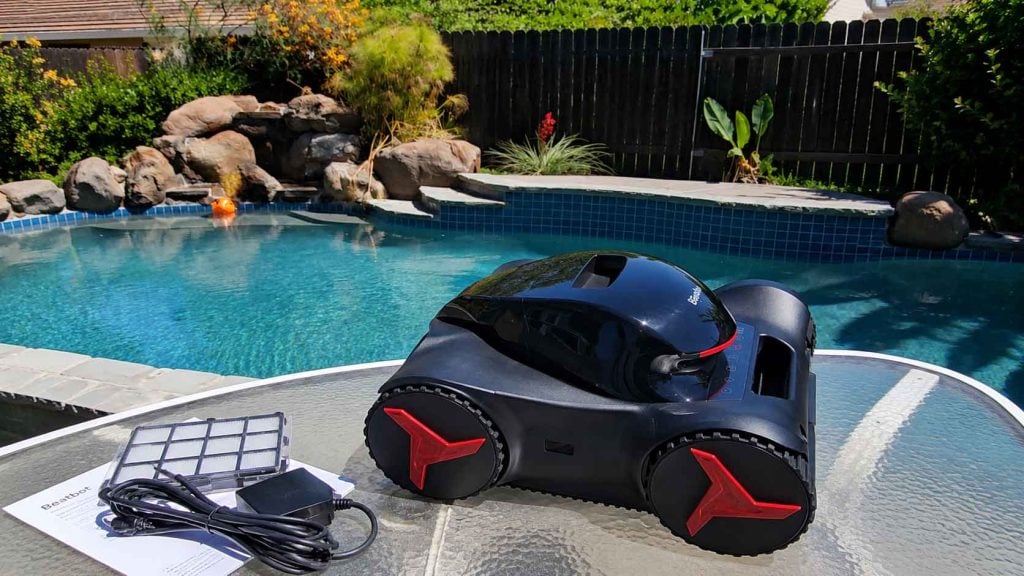
Out of the box, the K Series made a favorable impression.
“I thought it had a very sleek look,” Clancy said. “It has a great look to it, you know, very modern. It wasn’t too bulky, which I did like about it.”
More important than aesthetics was the filtration system. The cleaner includes a fine-mesh filter that fits onto the debris canister, allowing it to capture smaller material in addition to larger debris.
“I really liked that it came with that so it can catch that fine debris such as dog hair or dirt,” Clancy said.
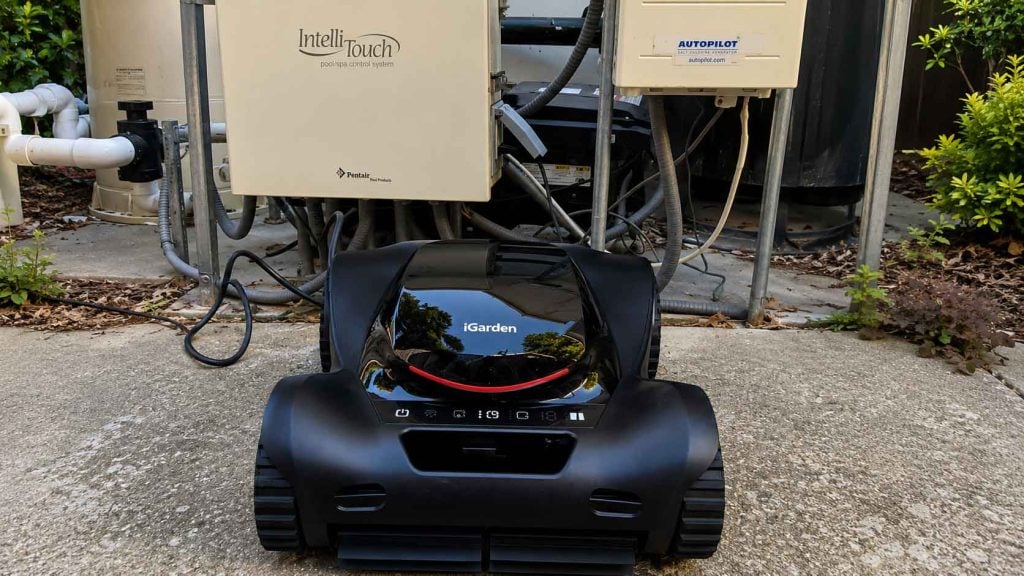
The cordless design was another immediate positive for the homeowner. She had previously owned another robotic cleaner that required placement on a charging base. The K Series offered a simpler arrangement.
“She liked on this one you could just plug it anywhere,” Clancy said. “You didn’t have to put it on a base, and it charged within three hours. She really liked that aspect of it.”
For a homeowner who wants a cleaner without adding another permanent charging station around the pool area, that simplicity can be an attractive feature.
Cleaning the Floor, Walls and Waterline
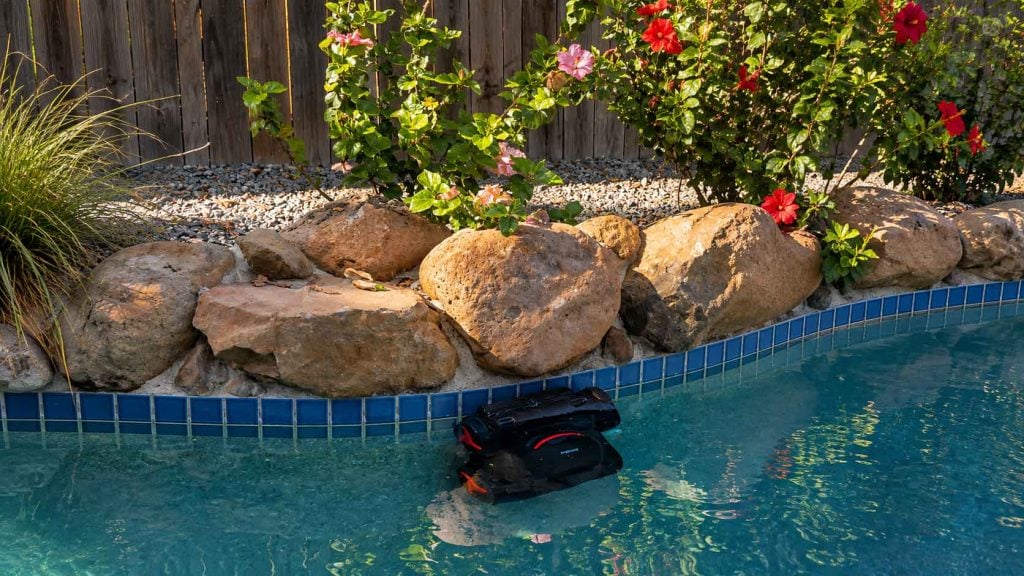
The K Series provides operating modes for floor cleaning as well as floor-and-wall cleaning. Once operating in the latter mode, Clancy found that the robot was capable of climbing the pool walls all the way to the waterline.
“It did go up the walls and did a good job at cleaning them,” she said. “So I really liked that about it.”
That capability stood out to the homeowner because previous cleaners she had owned did not provide the same wall-cleaning performance.
“That was a feature she really enjoyed,” Clancy said.
The robot also surprised Clancy by making its way onto the pool’s tanning ledge.
“It went up onto the tanning ledge. And that was surprising to me,” she said.
What impressed her most, however, was how quickly the K Series could make a noticeable difference.
“Me personally, watching it, I thought the cleaner did really well. I found that it cleaned the pool fairly quickly, which was really nice,” Clancy said. “So then if you have a party, you can just toss that in there and know within an hour that pool’s gonna be ready to go.”
Its ability to reach the waterline added another layer of cleaning.
“It climbs all the way up to clean the tile line, so that was really nice, too, if you haven’t brushed your tile in a while and have some leaves along there this will do a great job with that,” she added.
Handling Real Backyard Debris
Ultimately, a pool cleaner needs to pick things up, and Clancy came away impressed with the K Series’ ability to collect larger debris.
She specifically pointed to the tracks and intake design at the front of the cleaner.
“I think they got right with the tracks on the front where it’s collecting the debris,” Clancy said. “Those were very grippy, and when I watch it go over a pile of leaves, it was able to pull it in easily.”
Combined with the fine-mesh filtration, that gave the cleaner the ability to contend with the mixture commonly found in residential pools, including dirt, dog hair, leaves and pine needles.
Clancy sees that versatility as increasingly important as backyard landscaping becomes more elaborate and homeowners expect robotic cleaners to handle more than one specific type of debris.
Where Pool Geometry Matters
No robotic cleaner is necessarily going to perform identically in every swimming pool, and the K Series was no exception.
The test pool presented a particularly challenging combination of freeform curves and relatively narrow steps. The K Series has a fairly wide wheelbase, and Clancy observed that it could climb some steps but had difficulty stabilizing on others.
Importantly, she believed some of that behavior was specific to the dimensions of this particular pool.
“This particular issue may not be an issue in other pools, depending on the width of the steps,” Clancy explained. The steps in the test pool were approximately 10 inches wide, and she felt even slightly wider steps could have made it considerably easier for the robot to stabilize.
The irregular curves of the older freeform pool also occasionally presented navigation challenges. Based on what she observed, Clancy believes the K Series is likely to perform at its best in more geometrically shaped pools.
That doesn’t negate its performance in the test pool. The cleaner still climbed walls, reached the tile line, accessed the tanning ledge and collected a wide range of debris. It does, however, underscore something consumers should consider with any robotic cleaner: pool shape and feature dimensions can influence performance.
An Area With Room for Improvement
The primary area Clancy would like to see improved is app connectivity when the cleaner is submerged.
“The app needs a little improvement,” she said, noting that communication with the unit became less reliable once it was underwater.
For routine operation, however, Clancy found the cleaner itself straightforward to set up and use. When asked what might distinguish the K Series for someone comparing similarly priced robotic cleaners, she immediately pointed to that simplicity.
“Easy to program,” Clancy said. “It was pretty easy to program. I think that thing took maybe five minutes tops to program completely.”
The homeowner also appreciated a decidedly low-tech feature: the retrieval hook.
“That was one thing the homeowner did love was the hook that came with the cleaner actually worked,” Clancy said. Compared with another robot the homeowner had used, retrieving the K Series from the pool was considerably easier.
It may seem like a small consideration, but usability extends beyond how well a robot cleans. Charging it, programming it, removing it from the water and emptying the debris can determine whether a homeowner actually enjoys owning the product.

A Strong Entry Point Into Robotic Cleaning
With robotic cleaners now available across a wide range of prices and feature sets, one of the biggest questions is where a particular product fits.
For Clancy, the K Series occupies an appealing position for consumers who want to move into robotic cleaning without immediately jumping to the highest-priced equipment on the market.
“I would say it’s gonna be that middle ground customer, someone who’s looking for something that’s not the cheapest but not the most expensive,” she said. “Maybe more of your entry level robotic owner.”
Ease of use strengthens that argument.
“Overall, it seemed very easy to use for anybody, even somebody who doesn’t have ever used a robot,” Clancy said.
That may ultimately be one of the K Series’ strongest selling points. Robotic cleaners have become increasingly sophisticated, but sophistication isn’t necessarily what every homeowner wants. For someone purchasing their first cordless robotic cleaner, being able to charge it, program it quickly, drop it into the pool and retrieve a canister full of debris without a steep learning curve has considerable value.
Clancy’s final assessment carries additional weight because she doesn’t automatically endorse every cleaner she encounters.
“I could see this being a cleaner that I would recommend to people,” she said. “And I don’t recommend just any cleaner. I want something that actually works because, you know, it’s not a small price tag to get a robotic.”
After months in an actual customer’s backyard, the iGarden K Series showed itself to be an approachable cordless robotic cleaner with good debris pickup, wall and waterline cleaning, straightforward programming, convenient charging and thoughtful everyday usability.
There are areas where future generations could improve, particularly app connectivity and navigation around certain freeform curves or narrow features. Those considerations are worth understanding when matching any cleaner to a particular pool.
For homeowners looking to make the jump from traditional pool cleaning equipment to their first robotic cleaner, however, the K Series offers many of the capabilities that make robots attractive in the first place without making the experience unnecessarily complicated.
Should You Buy the iGarden K Series?
Yes.
The iGarden K Series makes the most sense for someone who wants to get into robotic pool cleaning without paying a premium for features they may not need. It’s a practical entry point into the category and, based on our real-world testing, capable enough to justify the investment.
That doesn’t mean it’s the perfect cleaner for every pool. More complex pool shapes and features deserve some consideration, and buyers expecting flawless app control may want to temper their expectations. But those shortcomings weren’t significant enough to change our overall opinion of the product.
What matters is whether the K Series delivers enough cleaning capability, convenience and usability to make owning one worthwhile. We think it does.
If you’ve been considering making the jump to a cordless robotic cleaner and want a capable unit without immediately moving into the upper end of the category, the iGarden K Series earns our recommendation.
And for an entry-level robotic cleaner, getting those fundamentals right matters most.
Ready to take a deeper dive?
Listen to our entire interview with Kelli Clancy about the iGarden K Series robot on the Pool Magazine podcast.
You must be logged in to post a comment Login