




Equipment Supplies
iGarden Unveils New AI-Powered Pool and Lawn Innovations at CES 2026


Las Vegas, NV (January 7, 2026) – iGarden, the global pioneer in artful living technology and
smart garden robotics solutions from Fairland Group, today unveiled its trust-centered AI
Ecosystem and three new flagship products at the Consumer Electronics Show (CES) 2026
(Booth #51248): the iGarden Pool Cleaner M1 Pro Max, iGarden Swim Jet X series, and
iGarden Lawn Mower L/ L AWD Series. As outdoor living becomes the next strategic frontier in whole-home smart technology, iGarden’s global debut of its AI Ecosystem introduces next-
generation interconnectivity in smart garden robotics, positioning the brand at the forefront of this rapidly evolving space.
Innovation Utopia: iGarden’s AI Ecosystem for Artful Living
iGarden establishes an innovative foundation for artful living with its cost-effective, trust-
centered AI Ecosystem to deliver worry-free maintenance and robust security. The iGarden AI ecosystem seamlessly integrates advanced hardware with intelligent software solutions,
including the iGarden app and AI-driven features to address the demands of modern smart
garden scenarios.
At its core is the iGarden Central Control, which provides zero-lag stability and comprehensive
device management to automate complex multi-device interactions with professional-grade
precision. The iGarden App serves as a single platform to manage the entire backyard
experience, while the iGarden Portal supports service partners with remote diagnostics,
predictive maintenance, and streamlined inventory management, ensuring proactive and
reliable support.


iGarden Expands Globally, from Performance to Trust
Reinforcing its commitment to superior quality and certified innovation, iGarden received the
prestigious TÜV Rheinland certification live at CES, highlighting the brand’s reliability and
leadership in the industry. This milestone makes the iGarden Pool Cleaner M series the world’s
first pool cleaning system to earn a TÜV Rheinland certification as recognition for its advanced
deep-cleaning capabilities. iGarden continues to integrate smart technology with artful living,
delivering solutions that address real-life challenges and enhance the way people enjoy their
outdoor spaces.
Beyond Limit: Innovation with Purpose, Enhancing Life with Technology
iGarden Pool Cleaner M1 Pro Max – Redefining Autonomous Pool Care
iGarden Pool Cleaner M1 Pro Max is an AI-powered flagship pool cleaning robot. Recognized as a CES Innovation Awards® 2026 Honoree, it combines dual-camera 3D vision with intelligent algorithms to precisely perceive the environment, plan paths, and avoid obstacles. With adaptive AI suction, dual-pump power, and extended runtime, it delivers a truly smarter, deeper, and effortless cleaning experience.

● 20-Hour Ultra-Long Runtime: An extended runtime that is nearly 5x the industry
average, allowing for continuous, high-frequency operation to ensure even the largest
pools receive a thorough, deep cleaning without interruption.
● Dual-System Architecture for Deep Cleaning: Integrating dual-pump power with
adaptive AI suction, the M1 Pro Max intelligently detects debris and boosts negative
pressure to lift the most stubborn grime for a deeper clean.
● Industry-First Dual-Camera 3D Vision: Equipped with twin UHD cameras to precisely
perceive the environment in 3D, ensuring complete coverage and precise obstacle
avoidance through smarter path planning.
● Dual-Layered Anti-Clog Filtration: A specialized two-tier system that maintains
consistent suction by capturing both large and microscopic particles, making the entire
process more effortless and effective.
iGarden Swim Jet X Series – Intuitive Aquatic Fitness & Fun, Anywhere
The Swim Jet X Series, a CES Innovation Awards® 2026 Honoree, brings high-performance swim training and recreation to any pool with an ultra-portable cordless design and intuitive one-touch control for instant operation.

● Powerful, customizable currents up to 250m3/h, delivering a smooth and consistent
swimming experience.

● AI-Inverter technology that provides up to 3.5 m/s flow speed and 250 m3/h maximum
water volume, delivering a strong and stable current for an enhanced swimming
experience.
● Up to 10 hours of battery life, enabling uninterrupted use of family pool fun and swim
training.
● Easy suitcase-style portability with wheels and handles ensures smooth one-hand
mobility and accessible use anywhere.
● Smart app control through the iGarden app to adjust flow intensity, monitor
performance, and access data-driven, customizable workouts.
iGarden Lawn Mower L Series / L AWD Series — Boundless, Powerful, Long-Lasting
The iGarden Lawn Mower L Series and L AWD Series introduce hands-free innovation to
robotic lawn care, combining advanced AI with robust engineering for effortless, all-terrain
mowing.

● True Plug-and-Play: 5-minute setup with no perimeter wires or RTK antenna installation
required.
● 8-Hour Ultra-Long Runtime: Up to 8 hours of runtime on a single charge—finish the
entire lawn in one go without mid-job charging breaks.
● Smart LiDAR and AI Vision, paired with a 1080p HD camera and ultra-wide 110° field
of view, for precise lawn mapping and real-time adaptation.
● Advanced navigation capabilities that handle complex landscapes, slopes up to 70%
(35°), and obstacle avoidance with ease.
● Uniform, precise cutting across every inch of the lawn through intelligent route
planning.
● Durable, easy-to-maintain design with intuitive controls and seamless integration into
the iGarden AI ecosystem.
“We’re proud to be leading the evolution of the smart backyard, where technology acts in the
background, converting complexity into simple, elegant experiences,” said Charlene Feng, Global Brand Manager at iGarden. “With our trust-centered AI Ecosystem and next-generation products, we’re delivering a new wave of intelligent autonomous devices that bring professional-grade results with real convenience. Together, we’re empowering families to reclaim their time, connect, and experience the art of living every day.”
About iGarden
As the innovative sub–brand of Fairland Group, iGarden is leading the global AI Garden
revolution. By fusing advanced AI with eco–smart design, we create outdoor spaces that think,
adapt, and self–manage. Our curated portfolio, from AI–enhanced pool cleaners and swim jets
to smart lawn mowers, AI–driven pumps, and AIoT systems, delivers a seamless lifestyle that is quiet, sustainable, and beautifully intelligent.
With iGarden, outdoor living becomes a feeling of ease, of connection, of art in everyday
motion.
Always Intelligent. Always Inspiring. Always Sustainable.






A former New Jersey pool company manager has been charged with theft after allegedly selling company equipment through an unauthorized eBay account and keeping more than $14,000 in proceeds, according to police allegations reported by Newport Dispatch.
Jessica Szurick, 42, of Clifton, was charged Oct. 27 with theft by unlawful taking following an investigation involving Preferred Pool Management Inc. in Fairfield. The company’s owner contacted police Aug. 27 to report the alleged unauthorized sales.
Investigators said industrial machinery and pool equipment had been sold through the account. Financial records obtained through court-authorized subpoenas allegedly showed approximately $14,253 from three transactions deposited into a bank account registered to Szurick rather than the business. The owner also reported unauthorized company credit card purchases, which were reviewed during the investigation.

According to Daily Voice, Szurick’s LinkedIn profile listed employment with Preferred Pool Management from May 2018 through July 2026, most recently as a senior regional manager. The profile described responsibility for 161 commercial aquatic facilities and approximately 315 seasonal employees.
Szurick was issued a complaint-summons and is scheduled to appear in Essex County Superior Court on Dec. 9. The charge remains an allegation, and she is presumed innocent unless proven guilty.
Tracking Equipment and Sales Proceeds
The available reporting does not explain the alleged motive or establish which safeguards Preferred Pool Management had in place. But the alleged transactions illustrate a vulnerability other pool companies can examine: equipment leaving the business without the corresponding revenue reaching its bank account.
Pool Magazine recently explored pool equipment theft and its costly consequences for homeowners. Inside a pool business, protecting those assets requires more than locks and cameras. Employees need access to equipment to do their jobs, and owners need records that account for what happens afterward.
The Cost of Earning That Money Back
For a pool company, an equipment loss can create expenses beyond the item itself. Depending on what disappears, the business may face an urgent replacement purchase, a delayed installation, another truck roll, or hours spent reconstructing records. The reporting does not establish whether those disruptions occurred in this case.

Even the direct loss can take considerable work to recover. At a hypothetical 10% profit margin, a company would need $100,000 in additional sales to generate $10,000 in profit—the amount needed to offset a $10,000 unrecovered loss. That follows OSHA’s cost-divided-by-profit-margin calculation.
The reported eBay proceeds do not establish Preferred Pool Management’s total financial loss. They put a dollar figure on the transactions investigators say they traced.

Building Accountability Into the Business
For pool companies, the challenge is giving employees the access they need while maintaining oversight of valuable assets. Managers must be able to purchase equipment, move it between locations, and keep jobs moving. Those responsibilities should come with records another person can review.
The Insurance Information Institute recommends businesses “implement tight accounting controls that include frequent audits and take steps to ensure employees are aware of these practices.” Its employee theft prevention guidance also encourages businesses to provide a way for employees to report concerns without fear of reprisal.
For a pool business, that oversight can start with equipment sales. Document the item, require authorization for its release, and have someone other than the person arranging the transaction verify that payment reached the company’s account. Equipment marked discarded or damaged should also have a documented explanation.
Broader occupational-fraud research supports the value of internal oversight. “Organizations with effective anti-fraud controls in place consistently experienced lower losses and faster fraud detection,” the Association of Certified Fraud Examiners states in its 2026 occupational fraud findings.
As a pool company adds crews, vehicles, and service locations, an owner’s ability to personally track every asset becomes harder to sustain. Equipment may move among a warehouse, several trucks, and multiple job sites before anyone considers selling or disposing of it. The records and review process need to grow with that operation.
The Fairfield allegations remain for the courts to resolve. For other owners, they present a reason to examine their own process now. Delegating responsibility keeps the business moving; independent review gives the owner confidence that equipment releases are authorized and sale proceeds reach the company. Establishing those checks during everyday operations is far easier than reconstructing the trail after something goes missing


Robotic pool cleaners can look impressive under controlled conditions. The more meaningful test isn’t how a cleaner performs in a demonstration environment, but how it handles real-world conditions in an actual swimming pool over time.
Leaves, dirt, pet hair, changing weather, irregular pool geometry and everyday use can expose things that simply don’t show up during a short product demonstration.
That was the idea behind Pool Magazine’s recent evaluation of the iGarden K Series robotic pool cleaner.
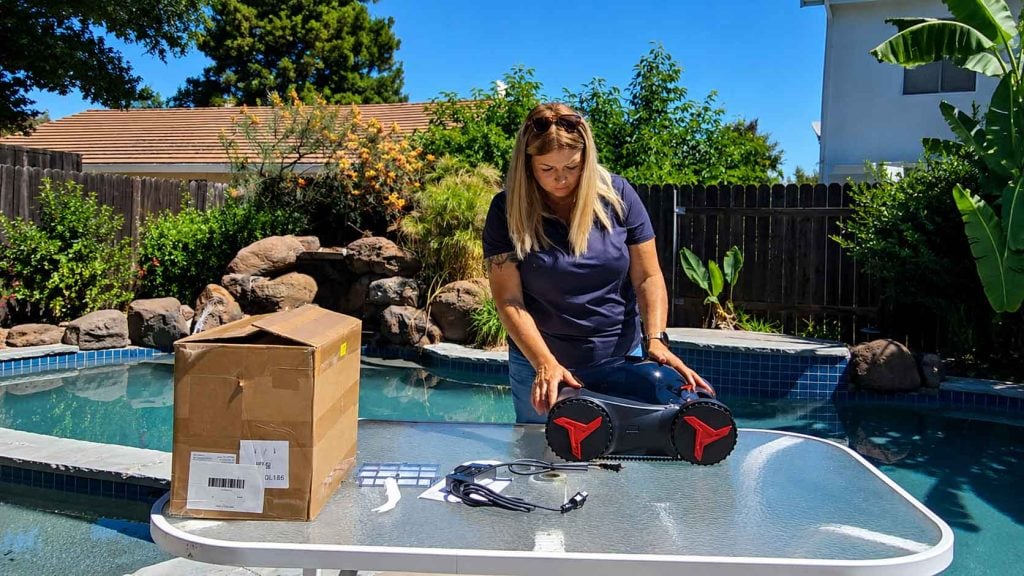
Rather than conduct a short-term test, we placed the K Series with pool professional Kelli Clancy, owner of Legacy Pool and Spa in Sacramento, who installed the unit in one of her customer’s pools. The homeowner used the cleaner over an extended period, while Clancy monitored its performance and gathered feedback about what worked well and where the cleaner had limitations.
The result was a practical assessment of a cordless robotic cleaner that Clancy believes could make a compelling option for homeowners buying their first robot.
A Real Backyard Instead of a Test Tank
Clancy deliberately selected a pool that would give the K Series plenty to contend with.
“I chose this particular pool for a variety of reasons,” Clancy explained. “One, I knew the customer would give me honest feedback. I knew she would try and get everything she wanted out of the cleaner and give an honest review.”
The surrounding landscape also created a good mixture of debris.

“They had small leaves, big leaves, pine trees,” Clancy said. “So it was a variety of debris I wanted to be able to know if it could pick up.”
As luck would have it, an unrelated issue had also temporarily taken the pool’s circulation system offline, leaving the water somewhat dirtier than usual when the K Series arrived. That provided another opportunity to see how the cleaner handled real debris rather than a carefully prepared demonstration.
The pool itself presented an additional challenge. It was an older freeform gunite pool with curves, varying radiuses and features that would test the cleaner’s ability to navigate something considerably more complicated than a rectangular test pool.
For Clancy, that distinction matters when evaluating robotic cleaners.
“It’s not as authentic as putting it into somebody’s pool in an everyday yard where you have, you know, squirrels, and dogs, and wind, and rain, and all these varieties of things going on,” she said of controlled product demonstrations.
Strong First Impressions
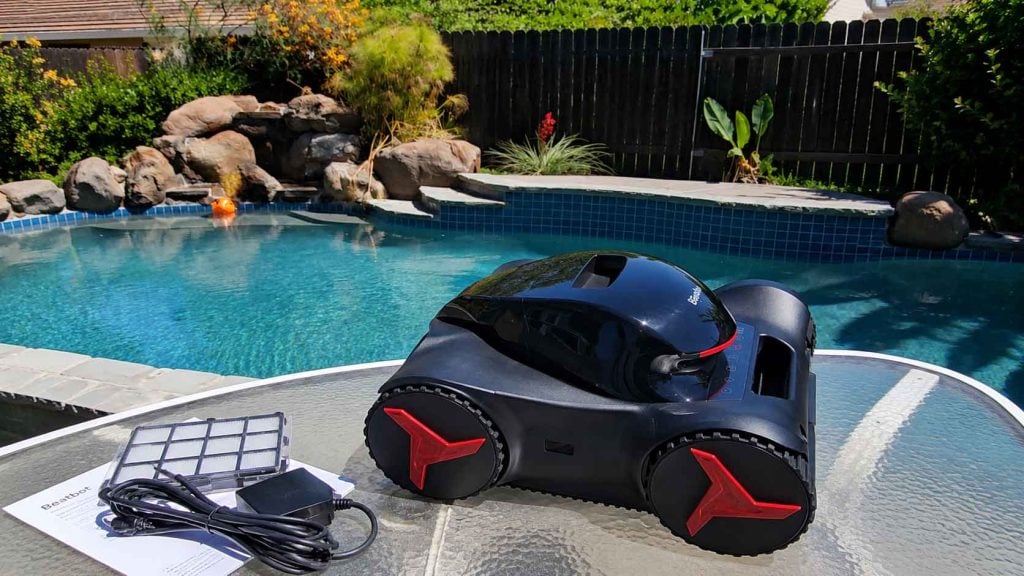
Out of the box, the K Series made a favorable impression.
“I thought it had a very sleek look,” Clancy said. “It has a great look to it, you know, very modern. It wasn’t too bulky, which I did like about it.”
More important than aesthetics was the filtration system. The cleaner includes a fine-mesh filter that fits onto the debris canister, allowing it to capture smaller material in addition to larger debris.
“I really liked that it came with that so it can catch that fine debris such as dog hair or dirt,” Clancy said.
The cordless design was another immediate positive for the homeowner. She had previously owned another robotic cleaner that required placement on a charging base. The K Series offered a simpler arrangement.
“She liked on this one you could just plug it anywhere,” Clancy said. “You didn’t have to put it on a base, and it charged within three hours. She really liked that aspect of it.”
For a homeowner who wants a cleaner without adding another permanent charging station around the pool area, that simplicity can be an attractive feature.
Cleaning the Floor, Walls and Waterline
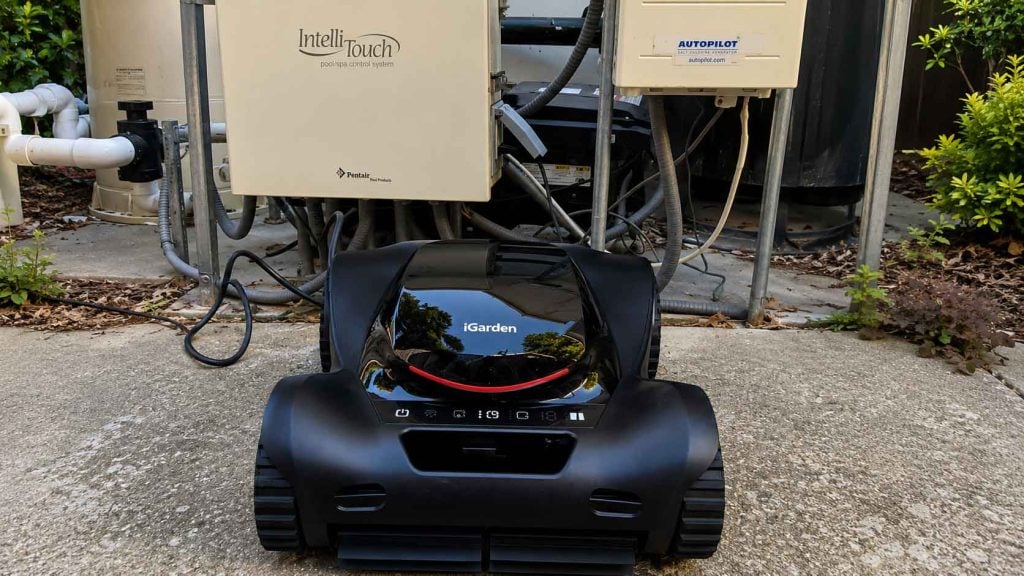
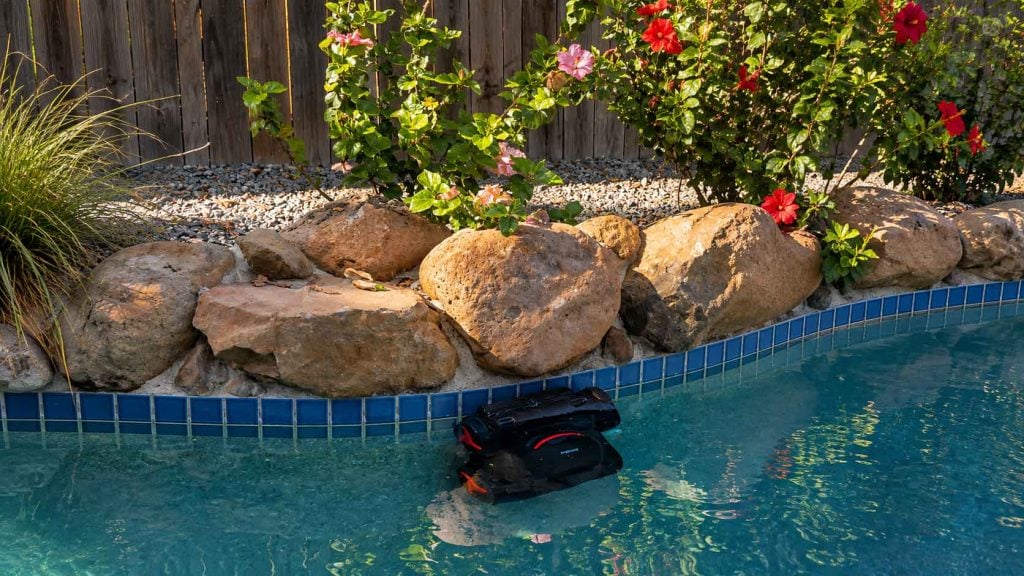
The K Series provides operating modes for floor cleaning as well as floor-and-wall cleaning. Once operating in the latter mode, Clancy found that the robot was capable of climbing the pool walls all the way to the waterline.
“It did go up the walls and did a good job at cleaning them,” she said. “So I really liked that about it.”
That capability stood out to the homeowner because previous cleaners she had owned did not provide the same wall-cleaning performance.
“That was a feature she really enjoyed,” Clancy said.
The robot also surprised Clancy by making its way onto the pool’s tanning ledge.
“It went up onto the tanning ledge. And that was surprising to me,” she said.
What impressed her most, however, was how quickly the K Series could make a noticeable difference.
“Me personally, watching it, I thought the cleaner did really well. I found that it cleaned the pool fairly quickly, which was really nice,” Clancy said. “So then if you have a party, you can just toss that in there and know within an hour that pool’s gonna be ready to go.”
Its ability to reach the waterline added another layer of cleaning.
“It climbs all the way up to clean the tile line, so that was really nice, too, if you haven’t brushed your tile in a while and have some leaves along there this will do a great job with that,” she added.
Handling Real Backyard Debris
Ultimately, a pool cleaner needs to pick things up, and Clancy came away impressed with the K Series’ ability to collect larger debris.
She specifically pointed to the tracks and intake design at the front of the cleaner.
“I think they got right with the tracks on the front where it’s collecting the debris,” Clancy said. “Those were very grippy, and when I watch it go over a pile of leaves, it was able to pull it in easily.”
Combined with the fine-mesh filtration, that gave the cleaner the ability to contend with the mixture commonly found in residential pools, including dirt, dog hair, leaves and pine needles.
Clancy sees that versatility as increasingly important as backyard landscaping becomes more elaborate and homeowners expect robotic cleaners to handle more than one specific type of debris.
Where Pool Geometry Matters
No robotic cleaner is necessarily going to perform identically in every swimming pool, and the K Series was no exception.
The test pool presented a particularly challenging combination of freeform curves and relatively narrow steps. The K Series has a fairly wide wheelbase, and Clancy observed that it could climb some steps but had difficulty stabilizing on others.
Importantly, she believed some of that behavior was specific to the dimensions of this particular pool.
“This particular issue may not be an issue in other pools, depending on the width of the steps,” Clancy explained. The steps in the test pool were approximately 10 inches wide, and she felt even slightly wider steps could have made it considerably easier for the robot to stabilize.
The irregular curves of the older freeform pool also occasionally presented navigation challenges. Based on what she observed, Clancy believes the K Series is likely to perform at its best in more geometrically shaped pools.
That doesn’t negate its performance in the test pool. The cleaner still climbed walls, reached the tile line, accessed the tanning ledge and collected a wide range of debris. It does, however, underscore something consumers should consider with any robotic cleaner: pool shape and feature dimensions can influence performance.
An Area With Room for Improvement
The primary area Clancy would like to see improved is app connectivity when the cleaner is submerged.
“The app needs a little improvement,” she said, noting that communication with the unit became less reliable once it was underwater.
For routine operation, however, Clancy found the cleaner itself straightforward to set up and use. When asked what might distinguish the K Series for someone comparing similarly priced robotic cleaners, she immediately pointed to that simplicity.
“Easy to program,” Clancy said. “It was pretty easy to program. I think that thing took maybe five minutes tops to program completely.”
The homeowner also appreciated a decidedly low-tech feature: the retrieval hook.
“That was one thing the homeowner did love was the hook that came with the cleaner actually worked,” Clancy said. Compared with another robot the homeowner had used, retrieving the K Series from the pool was considerably easier.
It may seem like a small consideration, but usability extends beyond how well a robot cleans. Charging it, programming it, removing it from the water and emptying the debris can determine whether a homeowner actually enjoys owning the product.

A Strong Entry Point Into Robotic Cleaning
With robotic cleaners now available across a wide range of prices and feature sets, one of the biggest questions is where a particular product fits.
For Clancy, the K Series occupies an appealing position for consumers who want to move into robotic cleaning without immediately jumping to the highest-priced equipment on the market.
“I would say it’s gonna be that middle ground customer, someone who’s looking for something that’s not the cheapest but not the most expensive,” she said. “Maybe more of your entry level robotic owner.”
Ease of use strengthens that argument.
“Overall, it seemed very easy to use for anybody, even somebody who doesn’t have ever used a robot,” Clancy said.
That may ultimately be one of the K Series’ strongest selling points. Robotic cleaners have become increasingly sophisticated, but sophistication isn’t necessarily what every homeowner wants. For someone purchasing their first cordless robotic cleaner, being able to charge it, program it quickly, drop it into the pool and retrieve a canister full of debris without a steep learning curve has considerable value.
Clancy’s final assessment carries additional weight because she doesn’t automatically endorse every cleaner she encounters.
“I could see this being a cleaner that I would recommend to people,” she said. “And I don’t recommend just any cleaner. I want something that actually works because, you know, it’s not a small price tag to get a robotic.”
After months in an actual customer’s backyard, the iGarden K Series showed itself to be an approachable cordless robotic cleaner with good debris pickup, wall and waterline cleaning, straightforward programming, convenient charging and thoughtful everyday usability.
There are areas where future generations could improve, particularly app connectivity and navigation around certain freeform curves or narrow features. Those considerations are worth understanding when matching any cleaner to a particular pool.
For homeowners looking to make the jump from traditional pool cleaning equipment to their first robotic cleaner, however, the K Series offers many of the capabilities that make robots attractive in the first place without making the experience unnecessarily complicated.
Should You Buy the iGarden K Series?
Yes.
The iGarden K Series makes the most sense for someone who wants to get into robotic pool cleaning without paying a premium for features they may not need. It’s a practical entry point into the category and, based on our real-world testing, capable enough to justify the investment.
That doesn’t mean it’s the perfect cleaner for every pool. More complex pool shapes and features deserve some consideration, and buyers expecting flawless app control may want to temper their expectations. But those shortcomings weren’t significant enough to change our overall opinion of the product.
What matters is whether the K Series delivers enough cleaning capability, convenience and usability to make owning one worthwhile. We think it does.
If you’ve been considering making the jump to a cordless robotic cleaner and want a capable unit without immediately moving into the upper end of the category, the iGarden K Series earns our recommendation.
And for an entry-level robotic cleaner, getting those fundamentals right matters most.
Ready to take a deeper dive?
Listen to our entire interview with Kelli Clancy about the iGarden K Series robot on the Pool Magazine podcast.

For decades, pool automation has largely meant one thing: a centralized control panel mounted at the equipment pad, wired to pumps, heaters, lights and everything else it is expected to manage. These systems can provide extensive control, particularly on complex projects, but they also require homeowners to commit to the panel, electrical work and installation costs upfront.
Hayward is betting the next generation will look different. With OmniX, intelligence is built directly into individual pieces of equipment, allowing a pool to become connected without requiring a traditional automation panel from the outset.
Ryan Morson, Vice President of Sales and Technical Excellence at Hayward Holdings, described the platform as a way to lower the barrier to automation for builders, service companies and homeowners.
“I kind of think of it as three different buckets,” Morson explained. “I think about builders, servicers and homeowners, and the value proposition is a little bit different for each.”
For builders, that starts with an easier upsell. Smartphone control can be offered without requiring the customer to purchase a centralized panel, hire an electrician to install it and surrender additional wall space at the equipment pad. OmniX keeps the existing equipment footprint while adding automation at the product level.
Wireless pairing, app-based configuration and a simpler commissioning process also make the handoff less cumbersome. Instead of explaining a separate control system after construction, the builder can train the homeowner through the same interface used to operate the connected equipment.
The lower upfront cost naturally raises another question: How does OmniX change the total cost of ownership for someone adopting smart pool automation for the first time?
“It doesn’t—we’re not increasing price to include OmniX,” Morson said. “We’re including it, and you can opt to use it or not. But ultimately, who wouldn’t use it?”
As OmniX expands across Hayward’s equipment catalog, homeowners can gain automation without paying for a separate centralized controller and its installation. That does not make OmniX a direct replacement for every existing automation platform. At least not yet. But it does move connected control into a much broader section of the market.
Automation, One Replacement at a Time
The service side may be where decentralized automation becomes most consequential. With the optional OmniX gateway connecting equipment to the internet, pool professionals can remotely view and adjust a customer’s system and potentially solve programming problems without sending a technician to the property.
Compatible legacy Hayward equipment can also be brought into the OmniX ecosystem without replacing the entire unit. Morson gave an example of what that retrofit process looks like in the field.
“To update an XE pump, for example, or one of our legacy full-featured variable-speed pumps, we’re talking five minutes or less,” Morson said. “You remove a little back plate on the back of the pump, connect the OmniX retrofit module, and you’re up and running within minutes. It’s equally easy to upgrade our full-featured gas heaters as well.”
The larger opportunity is not simply retrofitting existing equipment. It is changing the replacement cycle itself.
“My personal favorite thing about OmniX is it really enables a servicer to fully automate a pad one piece of equipment at a time,” Morson said. “I think of it as a natural stair step.”
When a pump reaches the end of its service life, it can be replaced with an OmniX-enabled Hayward pump. If the heater fails 18 months later, an OmniX-enabled heater can take its place. Lighting, salt systems and other components can follow as they are replaced. The homeowner does not have to tear out functioning equipment or swallow the cost of converting the entire pad in one shot.
Over time, the pad becomes automated through the normal rhythm of repair and replacement. For service companies, that turns what was once a large, occasional automation sale into an equipment-by-equipment conversation that can continue across the life of the pool.
For homeowners, the result is an app-based interface through which they can schedule pump speeds, monitor water temperature, and adjust operating times. More importantly, it gives customers who previously considered automation too expensive a practical way into the category.
Summarizing, Morson explained the main takeaway for builders and service companies looking to communicate the value of OmniX to their customers.
“OmniX really makes the pool easier to operate, more convenient to manage and more energy efficient without requiring homeowners to update, upgrade and replace all their equipment at once,” he said.

Where OmniX Fits Today
OmniX is currently best suited to straightforward, lower-complexity pools built around a variable-speed pump, heater and light. For existing pools, Morson said virtually any pool without centralized automation is a potential candidate, particularly when compatible Hayward pumps or heaters are already installed.
Every Hayward variable-speed pump now has OmniX built into its user interface, according to Morson, and the company’s gas heaters also include the platform. Lighting and salt are next on the near-term roadmap, with additional equipment categories expected to follow.
“Now that we have the app infrastructure and ecosystem built out, it’s going to be very easy,” Morson said. “You’ll start seeing more and more OmniX-enabled equipment rapidly being launched as time goes on.”
That expanding ecosystem changes the sales conversation in both new construction and the aftermarket. A builder can offer app control at a lower entry price. A service company can sell connected replacement equipment and provide remote support. The homeowner can enter the ecosystem with one product rather than buying a full automation package on day one.
There are still clear limits. Pools with multiple bodies of water, extensive lighting, numerous relays, fire features, water features and broader backyard integrations remain better candidates for Hayward’s OmniLogic or OmniPL platforms. OmniX is not being positioned as a full-blown answer for every high-complexity project today.
That raises the uncomfortable question that follows any lower-cost technology with room to grow: If OmniX continues adding capability, does it eventually cannibalize Hayward’s centralized automation business?
“It most likely will over time as we have more and more equipment that’s OmniX-capable and OmniX-compatible,” Morson said. “Our goal and mission is to increase the addressable market, lower the barrier for our homeowners and our customers and our trade partners to automation.”
It was a notably direct answer. Hayward is not pretending decentralized control will remain neatly confined to entry-level pools while centralized platforms continue untouched. The company expects the line to move as more equipment joins the ecosystem and product-level intelligence becomes capable of handling more of the pad.
Early feedback has reinforced the economic case. Morson said the most common—and to him, most unexpected—response from adopters and distributors concerned the savings achieved by eliminating the installation and wiring of a centralized panel. Depending on the project, those savings can be substantial. The smaller physical footprint is another benefit on equipment pads where wall space is already scarce.
But the larger bet is not merely that OmniX costs less. It is that decentralized automation is where this sector of the industry is headed.
“I personally believe over time the future of pool equipment is going to become more and more decentralized,” Morson said. “We know lowering that barrier to entry and making automated systems more affordable and addressable to our customers, our homeowners and our trade partners is going to do good things for the industry overall.”
That is the real premise behind OmniX. The centralized panel is no longer the only doorway into automation. Intelligence can arrive with the pump, expand with the heater, and continue across the pad as equipment is upgraded. The transition will not happen overnight, and complex projects will continue to need more robust centralized control. Still, Hayward has made its direction fairly plain: the future of pool automation will be built into the equipment, connected piece by piece.
Ready to take a deeper dive?
Listen to our full conversation with Ryan Morson on the Pool Magazine Podcast for more insight into OmniX, Hayward’s move toward decentralized automation and what the expanding platform could mean for builders, service professionals and pool owners.
Read the Fall Issue of Pool Magazine

See more of our coverage in your search results

 Historic Rain in Florida Takes Toll on Pool Job Sites
 Pool Manager Charged Over Stolen Equipment Sold on eBay
 JED Pool Tools CEO Featured on ‘Growing Up B2B’
 Scott Jones Named CEO of Landmark Aquatic
 Haviland Pool & Spa Invests $26 Million in Indiana Facility
 Watson’s Acquires Tampa Bay Spas, Enters Tampa Bay Market
 Cover Care Names Greg Conner Executive VP and General Manager

 This Summer, A Pool Floats in NYC: Update on + POOL Project
 CPSC Announces Spa Drain Cover Recall Over Entrapment and Drowning Hazard
 H2Flow Launches New Products For 2026 Pool Season
 Natalie Hood Swims for Every Child A Swimmer
 Landmark Aquatic Partners With AngelEye on Drowning Detection Technology
 Landmark Aquatic Integrates Defender® Filtration System into Aquatic Facilities
 Landmark Aquatic Taps Waterpark Industry Veteran Craig Nielsen
 Sponsored Advertisement
Pool Magazine Podcast
 What’s Your Pool Company Really Worth? – Pool Magazine Podcast With Weld Valuations
 iGarden K Series Review: A Pool Pro Puts It to the Test
 Why Waiting Until Spring to Remodel Your Pool Could Cost You Time & Money
 Ready When You Are: The Changing Role of Automatic Pool Covers
 What’s Hot & Trending in Fire Pits and Fire Tables for 2026


 Pool News2 weeks ago
Sacred Geometry: Where Architecture, Mathematics and Mosaics Collide

 Pool News4 weeks ago
Shasta Pools Hires 30-Year Builder to Head Residential Construction

 Pool News2 weeks ago
Anatomy of a Botched Remodel: What Sank the Lincoln Memorial Reflecting Pool Restoration?

 Contractors and Builders2 weeks ago
What’s Hiding Beneath The Surface: Artificial Rock Features

 Equipment Supplies2 weeks ago
iGarden K Series Review: What We Learned After Months in a Customer’s Pool

 Equipment Supplies2 weeks ago
Hayward Bets Big on Decentralized Automation With OmniX

 Equipment Supplies3 weeks ago
WYBOT Pushes Robotic Pool Cleaning Toward Greater Autonomy

 Pool News2 weeks ago
Landmark Aquatic Taps Britton Nielsen and Tim Garner to Lead Utah Growth
You must be logged in to post a comment Login