





Safety
Electrical Safety for Pool Pros: OSHA Guidelines Every Technician Should Know


Working around swimming pools presents a unique combination of hazards, and electricity is one of the most serious. Pool professionals regularly deal with pumps, heaters, lighting systems, automation panels, and other electrical components—all in close proximity to water. This combination significantly increases the risk of electrical shock, burns, and even fatal incidents.
Understanding and following Occupational Safety and Health Administration (OSHA) electrical safety standards is essential for protecting both technicians and pool users.
Water & Electricity Are a Dangerous Mix
Pool areas create conditions where even minor electrical faults can have severe consequences.

Common electrical risks pool pros face:
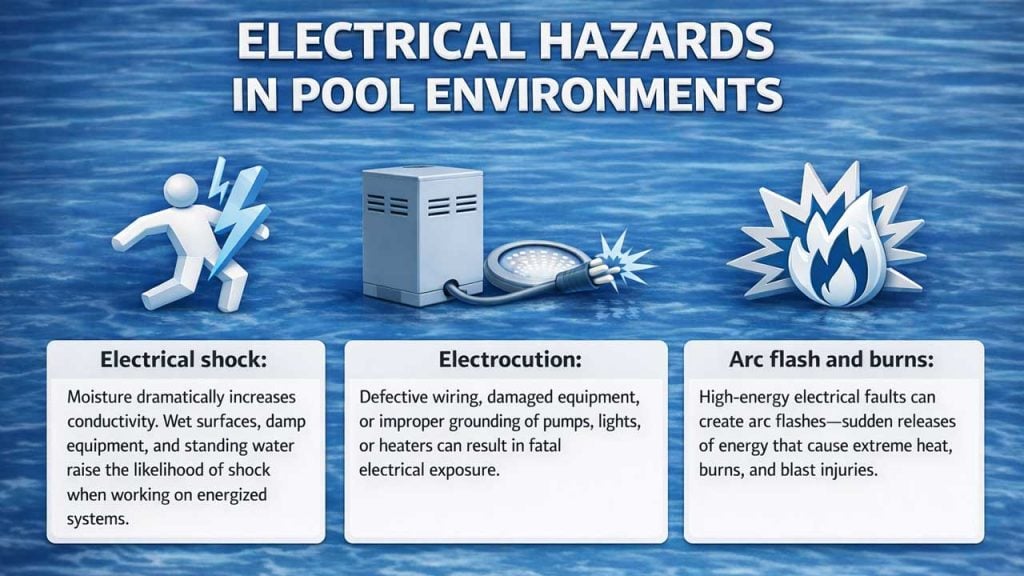
Electrical shock is one of the most common risks pool technicians face. Moisture dramatically increases conductivity, meaning that wet surfaces, damp equipment, or standing water can allow electricity to travel through unintended paths. When technicians are working around energized equipment, even relatively low voltages can produce severe shocks that lead to muscle contractions, loss of control, or serious injury.
In more extreme situations, electrical hazards can lead to electrocution. Defective wiring, damaged equipment, or improperly grounded components such as pumps, heaters, and pool lights can expose technicians or swimmers to dangerous electrical currents. While electrocution incidents are rare, they are often fatal when they occur, which is why strict electrical safety protocols are required around aquatic environments.
Another major concern is arc flash. An arc flash occurs when electrical energy suddenly discharges through the air during a fault condition. These events generate extreme heat and intense pressure that can cause severe burns, blast injuries, and significant equipment damage. Technicians working near electrical panels or high-powered pool systems must always be aware of this potential hazard.
Because of these risks, electrical work in and around pools demands careful planning, proper equipment, and strict adherence to safety procedures.
Key OSHA Electrical Safety Standards for Pool Technicians
General Electrical Safety (OSHA 29 CFR 1910.303)
OSHA requires all electrical systems to be designed and maintained to prevent hazards. For pool operations, this includes:
• Overcurrent protection: Circuits must be protected by properly rated circuit breakers or fuses to prevent overheating and fires.
• Grounding and bonding: All electrical equipment must be correctly grounded and bonded. Ground-Fault Circuit Interrupters (GFCIs) are critical in pool environments and should be used on all applicable outlets and equipment.
• Proper wiring: Cables and conductors must be adequately insulated and protected from moisture, corrosion, and physical damage.
Electrical Installation Near Pools
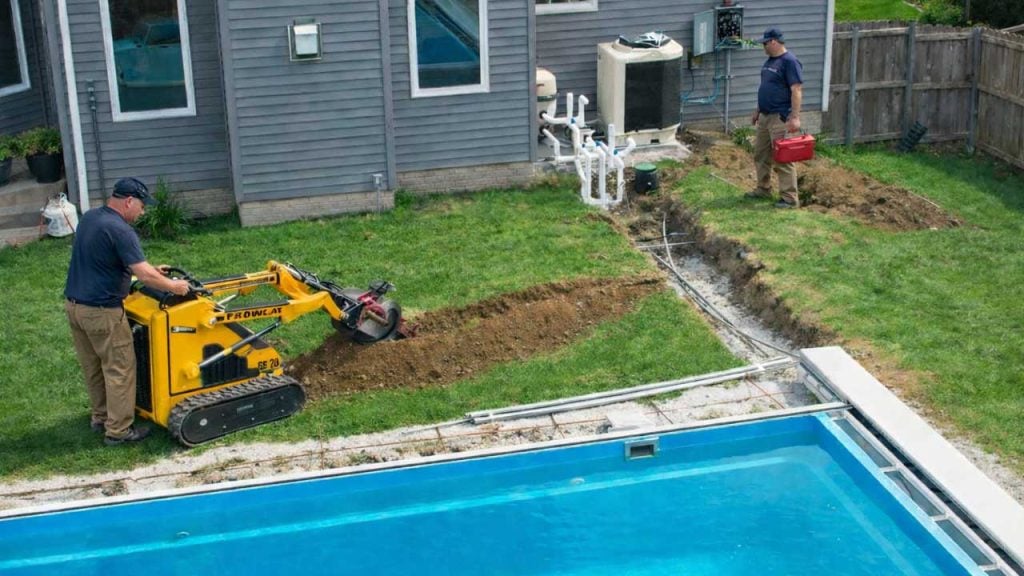
Electrical installations around pools must also follow the National Electrical Code (NEC), which sets specific requirements for aquatic facilities.
• Safe distances: Electrical outlets, switches, and junction boxes must be installed at regulated distances from the water—generally between 5 and 10 feet, depending on the equipment.
• Approved equipment: Only electrical components specifically designed and listed for wet or damp locations should be used. Pool equipment should be UL-listed and rated for aquatic environments.
Lockout/Tagout Procedures (OSHA 29 CFR 1910.147)
One of the most critical safety practices for pool technicians is lockout/tagout. This procedure prevents equipment from being accidentally energized while maintenance or repairs are being performed.
Before starting electrical work, technicians must:
• Turn off and isolate the power source.
• Apply a lock and tag to the disconnecting device.
• Verify that the system is de-energized using an approved voltage tester.
Skipping lockout/tagout is one of the leading causes of serious electrical injuries in maintenance work.
Personal Protective Equipment (PPE)
OSHA requires workers to use appropriate PPE when exposed to electrical hazards. For pool professionals, this may include:
• Insulated gloves: Rubber or electrically rated gloves help protect against shock.
• Insulated footwear: Rubber-soled boots reduce the risk of grounding through the body.
• Eye protection: Safety glasses protect against sparks, debris, and arc flash.
• Arc flash protection: When working with higher voltage systems, flame-resistant clothing and face shields may be required.
PPE should never replace proper procedures—but it provides an essential layer of protection.
Training and Competency
Technical knowledge alone is not enough. OSHA emphasizes that workers must be properly trained to recognize and control electrical hazards.
Effective training should include:
• Identifying electrical risks in pool environments.
• Proper use of tools, PPE, and testing devices.
• Safe de-energizing and lockout/tagout practices.
• Emergency response procedures, including CPR and first aid for electrical injuries.
Employers are responsible for ensuring technicians receive adequate training and understand safe work practices.
Inspections and Preventive Maintenance
Regular inspections play a major role in preventing electrical incidents. Pool professionals should routinely:
• Inspect pumps, heaters, lighting, and control panels for damage or wear.
• Test GFCI devices monthly.
• Check for exposed wiring, corrosion, or water intrusion.
• Replace damaged components immediately.
Proactive maintenance reduces downtime and significantly lowers the risk of accidents.
Common Electrical Safety Violations in Pool Work
Some of the most frequent OSHA violations seen in the pool industry include:
• Missing or non-functional GFCIs.
• Improper grounding or bonding of equipment.
• Failure to follow lockout/tagout procedures.
• Not wearing required PPE.
• Using non-rated equipment in wet locations.
These violations not only increase injury risk but can also result in fines and liability for employers.
Safety Is Not An Option
Electrical safety is a critical responsibility for every pool professional. The combination of water and electrical systems creates an environment where small mistakes can lead to severe injuries or fatalities.
By following OSHA standards, using proper PPE, maintaining equipment, and committing to ongoing training, pool technicians can dramatically reduce electrical risks. Safe work practices protect employees, customers, and businesses alike—making electrical safety not just a requirement, but a professional obligation.
Electrical safety education is available through industry-specific training programs, including OSHA 10 in General Industry for Pool Professionals, where technicians learn how to apply OSHA principles directly to real-world pool environments.
In the pool industry, safety is not optional—it’s essential.


Pool News
The Water District & ISHOF Spotlight Water Safety at USLA Championships
The Water District and International Swimming Hall of Fame are using the USLA National Lifeguard Championships in Fort Lauderdale to spotlight drowning prevention and year-round water safety education.


Summary: As Presenting Sponsors of the USLA National Lifeguard Championships, taking place on Fort Lauderdale Beach as Ocean Rescue marks its 100th anniversary, The Water District and ISHOF spotlight their shared commitment to water safety education.
FORT LAUDERDALE, Fla., Aug 3, 2026 — The Water District and the International Swimming Hall of Fame (ISHOF) are supporting the United States Lifesaving Association (USLA) National Lifeguard Championships as this year’s Presenting Sponsor. Taking place August 4–7 in Fort Lauderdale, the Championships are hosted by Fort Lauderdale Ocean Rescue as the agency celebrates its 100th anniversary, and are held as part of Drowning Impact Awareness Month, observed each August. More than 800 competitors from USLA chapters nationwide will compete in ocean swimming, surfski, rescue board, beach, and team events, and the Championships are free and open to the public.
“Our lifeguards save hundreds of lives on this beach each year, and most people never realize how close the calls really are,” said Fort Lauderdale Ocean Rescue Chief Alex Bagwell. “Hosting this Championship in our 100th year lets us put that message in front of more people than ever.”

Ocean Rescue is urging beachgoers to swim near a lifeguard, watch the flags, and check conditions on arrival. That day-to-day type of vigilance is what The Water District and ISHOF are working to support well beyond the competition.
“Drowning prevention isn’t seasonal, and neither is our commitment to it,” said Mario Caprini, CEO of Capital Group Ventures. “That’s why water safety education will have a permanent home at The Water District, long after the Championships end.”
ISHOF shares that commitment. “This year alone, we funded more than 13,800 swim lessons for over a thousand kids,” said Dr. Bill Kent, Chairman of the International Swimming Hall of Fame. “Every one of those lessons is a life that’s safer around water. That’s the legacy we’re building on through our partnership with The Water District.”
Drowning is the leading cause of accidental death for Florida children ages one to four, and nearly all of those deaths are preventable.
Both organizations built their plans around water safety. In 2026 alone, ISHOF’s Every Child a Swimmer program awarded swim lesson scholarships to 1,184 children and invested over $442,000 to help prevent drowning — work that will have a new home at The Water District.

The $220 million destination, under construction at 501 Seabreeze Boulevard, will house the reimagined ISHOF experience in tandem with The Fort Lauderdale Aquarium, offering youth programming, school field trips, and year-round experiential water safety education for South Florida families, and drawing visitors from around the world to experience it firsthand.
These are long-term commitments; the six layers below can start protecting a family immediately.
Six Layers That Save Lives
Used together, these six layers cut drowning risk the most. The Water District and ISHOF are urging families to put all six in place this August, and beyond:
Know the hazard: Understand that drowning happens fast and silently, often without splash or sound.
Supervise closely: Always keep eyes on children and have them within arm’s reach in and around water.
Install alarms: Add door chimes and pool alarms so a child heading toward water unsupervised is heard immediately.
Fence the pool: Install four-sided fencing with self-latching gates, separated from the house, to stop unsupervised access.
Enroll Kids in Swimming Lessons: Enroll children in formal swim lessons.
Learn CPR: Know how to act if every other layer fails, in the minutes before rescuers arrive.
Within The Fort Lauderdale Aquarium, a dedicated water safety exhibit will feature interactive rescue displays for visitors of all ages.
About The Water District
The Water District, a $220 million development at 501 Seabreeze Boulevard in Fort Lauderdale, is set to open in late 2028. A Public-Private Partnership (P3) between Hall of Fame Partners, the International Swimming Hall of Fame, and the City of Fort Lauderdale, it will feature The Fort Lauderdale Aquarium, premier dining, and event spaces. With no upfront cost to taxpayers and over $53 million in public infrastructure upgrades, The Water District will be a world-class destination for aquatic sports and education, benefiting both locals and visitors. For more information visit thewaterdistrict.com.
About the International Swimming Hall of Fame
The International Swimming Hall of Fame has honored the legends of aquatic sport since 1965 and is the only institution of its kind in the world. It advances water safety worldwide through its Every Child a Swimmer program.


For most people, Cammile Adams is synonymous with elite swimming. A two-time Olympian, Adams spent years competing at the highest level of the sport, where speed, endurance, and technique defined success.
Today, however, her priorities look very different.
As a mother and owner of a Houston swim school, Adams says the rules she enforces with her own children have very little to do with producing great swimmers. Instead, they’re designed to prevent tragedy.

With World Drowning Prevention Day on July 25, Adams hopes families will rethink what water safety really means. Her message is simple: knowing how to swim is important, but it’s only one layer of protection.
Based on both her experience as an Olympic swimmer and as a mother, Adams recommends that every family adopt a few simple habits:
- Require children to ask permission before entering any pool, lake, beach, or other body of water—and never allow them to enter the water unless an adult is actively watching.
- Assign a dedicated “Water Watcher” whose only responsibility is supervising swimmers—no phones, no reading, and no distractions.
- Inspect safety barriers and rescue equipment regularly, including fences, self-latching gates, pool alarms, life rings, and reaching poles.
- Don’t mistake confidence for competence. A child who enjoys the water or has completed swim lessons may still lack the skills to recover from an emergency.
- Get in the water with young children whenever possible, especially while they’re still developing their swimming skills and judgment.
- Start swim lessons early, with infant and parent classes available as early as four months of age, to build water familiarity and foundational safety skills.
A Parent’s Perspective Changed Everything
“When I was training and competing, everything was about speed, technique, and performance—not about water safety,” said Adams.
“Becoming a parent shifted my focus entirely.”
Today, whenever she sees a swimming pool, lake, or even a bathtub, she views it through a different lens.

“I’m thinking, ‘If something unexpected happened, would my child or another child in the body of water know what to do?'”
Rather than simply teaching children to float, Adams wants them to actively move toward safety.
“We never want a child to be able to just jump in and float. That will do them no good at some point. We want them moving towards safety.”
Swim Lessons Are Just the First Step
Most parents walking into Adams’ swim school for the first time already know they’re learning from a two-time Olympian. But what she hears from them is often the same:
“We don’t want our child to be a competitive swimmer—we just want them to be safe in the water.”
It’s a response Adams has become used to hearing.
“As a mom, I completely understand that,” she said. “Even though swimming took me to the Olympics and will always be a huge part of my life, that’s not what I want parents to focus on. The most important thing to me is that every child learns to be safe, confident, and capable in the water.”
Swim lessons, she emphasizes, are not about creating elite athletes—they’re about giving children the skills and judgment they need to survive.
Even then, she cautions, lessons are only one piece of the puzzle.
“Swim lessons are one of the best things you can do for your child, but they don’t make a child drown-proof,” Adams said. “Sometimes, as kids become more comfortable and confident in the water, parents naturally start to relax a little—and that’s when it’s most important to stay vigilant.”
Starting Kids Off Early
As childhood drowning has become the leading cause of death for young children in the United States, more parents are introducing their children to swim lessons at an earlier age. Adams says many families are surprised to learn those lessons can begin as early as four months old.
That doesn’t mean infants are learning to swim laps. Instead, she says early lessons are designed to build water familiarity while laying the foundation for self-rescue skills that develop over time.
“At that age, we’re not teaching different strokes,” Adams explained. “We’re building water familiarity and the foundational skills that lead to self-rescue later, like comfort with submersion, learning to roll and float.”
She says one of the biggest misconceptions is that parents expect babies to come out of lessons effectively knowing how to swim.
“That’s not the goal. The goal is removing fear and building the base that everything else gets built on.”
Parent-and-child classes also teach moms and dads how to safely introduce children to the water and reinforce pool safety habits from the very beginning.
But Adams cautions that starting early—or even years of swim lessons—should never create a false sense of security.
Water Confidence Can Create a False Sense of Security
One of Adams’ biggest concerns is the misconception that a child who appears comfortable in the water is automatically prepared for an emergency.
“I see it all the time,” she said. “A child who has had swimming lessons might jump into the pool without hesitation, smile the whole time, or want to swim on their own. To a parent, that can look like they’re completely capable in the water. But confidence and competence are two very different things.”
Children who feel confident in the water are often the most likely to jump in without thinking—especially if they believe they already know how to swim. That’s why Adams strongly reinforces a non-negotiable rule: children must ask permission and confirm that an adult is actively watching before entering the water.
A child may willingly jump into a pool yet lack the skills necessary to recover if something unexpected happens.
“They may not know how to recover after jumping in awkwardly, roll onto their back to rest, or make it safely to the wall.”
Rather than simply rescuing her own children at the first sign of difficulty, Adams uses controlled situations as teaching moments.
“I’m constantly asking, ‘What’s your plan?’ I want them to think before they act.”
One Adult, One Job
If Adams could convince every family to adopt just one new habit today, it would be assigning a dedicated Water Watcher whenever children are around water.
“There needs to be one adult whose only job is to watch the kids—no phone, no reading, no conversations that pull your attention away,” she said.
“The reason I’m so passionate about this is that most drownings don’t happen when no one is around. They happen when everyone assumes someone else is watching.”
In group settings, Adams recommends rotating the Water Watcher every 15 to 20 minutes to help maintain focus.
“It’s such a simple thing to do, but it’s one of the most effective ways to keep kids safe around water.”
Water Safety Works Best in Layers
As communities observe World Drowning Prevention Day, Adams hopes parents remember one simple principle: no single precaution is enough.
“One of the biggest mistakes I see is parents feeling like they can relax once their child has had swim lessons,” she said.
“I always tell families to think about water safety in layers.”
Those layers include swim lessons, attentive supervision, secure fencing and self-latching gates, and emergency preparedness.
“When those layers work together, that’s when you’re giving your child the best protection possible.”
For Adams, that’s the lesson that matters most.
“No single layer is enough on its own. Even kids who swim well still need someone watching them, because accidents can happen to anyone. That’s why I never let my guard down with my own kids, and it’s the same advice I give every family who walks through our doors.”
Featured Photo Credit: Safe Splash Swim School


As communities across the country prepare for another summer swim season, the U.S. Consumer Product Safety Commission is increasing its focus on one of the most persistent safety issues surrounding residential pools and spas: child drownings. This week, the CPSC announced it is making up to $4 million in pool safety grants through Pool Safely, providing financial support to state, local, tribal, and territorial governments working to strengthen pool safety enforcement and drowning prevention initiatives.
The announcement comes as federal data continues showing troubling trends involving pediatric drownings. According to statistics cited by the CPSC and CDC, drowning remains the leading cause of death for children between the ages of one and four and continues ranking among the leading causes of accidental death for older children nationwide.
Between 2020 and 2022, an average of 357 children under the age of 15 died annually in pool- or spa-related drownings. Hundreds of additional non-fatal submersion incidents also required emergency medical treatment during that same period, many resulting in long-term neurological injuries.
The latest grant funding initiative reflects growing concern among regulators and safety organizations that progress made over the last two decades may be slowing as drowning fatalities trend upward again following years of decline.
Federal Officials Shift Focus Toward Enforcement
The Pool Safely Grant Program operates under the Virginia Graeme Baker Pool and Spa Safety Act, legislation passed in 2007 following the death of 7-year-old Virginia Graeme Baker, who became trapped by the suction force of a spa drain.
The law dramatically reshaped public pool safety standards nationwide by requiring compliant anti-entrapment drain covers and additional circulation safety systems in public pools and spas. Its impact was immediate.
According to figures referenced by the CPSC, there has not been a reported child death involving drain entrapment in a public pool or spa in the United States since implementation of the Virginia Graeme Baker Act.
Federal regulators are now applying similar pressure toward broader residential drowning prevention efforts, particularly in areas where enforcement and compliance vary significantly from one jurisdiction to another.

Communities receiving pool safety grants may qualify for awards ranging from $50,000 to $400,000, with at least half of the money required to support enforcement-related activities such as inspections, staffing, and training. Remaining funds may be used for public education campaigns, outreach programs, and water safety initiatives.
The emphasis on enforcement highlights a growing concern that many residential pool safety regulations already exist on paper, but compliance oversight often depends heavily on local resources and staffing levels.
In some municipalities, pool barrier inspections and residential code enforcement remain aggressive and highly structured. In others, enforcement may be complaint-driven or limited by staffing shortages and budget constraints.
Older residential pools can also complicate compliance efforts, particularly in neighborhoods where construction predates modern barrier standards and updated safety requirements.
Most Incidents Continue Occurring in Residential Settings
One of the more sobering realities surrounding child drownings is how often they occur outside of active recreational swimming.
According to data cited by the CPSC, nearly 70% of toddler drownings happen during non-swim times rather than organized pool activity.
That statistic has played a major role in reshaping how safety organizations approach drowning prevention messaging. Much of the conversation now centers around restricting unsupervised access to water rather than focusing exclusively on recreational swim safety.
Residential barriers remain one of the most heavily emphasized components of modern pool safety programs, particularly:
• Four-sided isolation fencing
• Self-closing, self-latching gates
• Door alarms
• Safety covers
• Pool alarms
• Compliant anti-entrapment drain covers
Safety advocates increasingly describe drowning prevention as a layered strategy rather than a single-product solution. Physical barriers, supervision, swim instruction, alarms, and CPR preparedness are all viewed as overlapping safeguards designed to reduce the likelihood of unsupervised water access and improve emergency response when incidents occur.
The broader discussion has also evolved alongside newer pool technologies. Cameras, motion sensors, smart alerts, and connected automation systems have become more common in residential environments, though safety organizations continue warning against relying too heavily on technology without maintaining physical barriers and direct supervision.
Swim Education and Water Competency Continue Drawing Attention
The latest drowning statistics have also renewed focus on disparities involving swim instruction and water competency access.
According to figures referenced by the CPSC, Black children and American Indian/Alaska Native children continue experiencing disproportionately higher drowning rates compared to white children, particularly in swimming pools.
Many organizations involved in water safety outreach have attributed those disparities to unequal access to swim lessons, aquatic facilities, and community education programs.
Over the last several years, municipalities and nonprofit groups have expanded subsidized swim lesson programs aimed at younger children and underserved communities, particularly in areas lacking affordable aquatic education opportunities.
Additional grant funding distributed through the Pool Safely program could help expand some of those local initiatives moving forward.
A Renewed National Focus Ahead of Summer
Applications for the latest round of pool safety grants are being accepted through July 13, 2026 through the federal Grants.gov portal under grant opportunity CP-VGB-26-01.
The funding initiative arrives at a time when pool safety organizations, regulators, and local governments are placing renewed emphasis on drowning prevention ahead of peak summer swimming activity.
For federal agencies, the concern extends beyond statistics alone. Rising pediatric drowning fatalities have increasingly become a public health issue tied not only to residential pool access, but also to enforcement consistency, swim education availability, and long-term community safety infrastructure.
The latest funding effort suggests regulators are preparing for a more aggressive push toward residential pool safety compliance and broader public awareness campaigns over the next several years as communities continue searching for ways to reverse a trend that has become increasingly difficult to ignore.
Read the Summer Issue of Pool Magazine

See more of our coverage in your search results
 Sponsored Advertisement
 Soake Pools Bolsters National Growth With Four Key Hires
 Hayward Holdings Names New Chief Accounting Officer
 Daldorado Names Marcia Gyles Director of Sales
 Landmark Aquatic Brings Poolside Adventures Attractions Nationwide
 Shasta Pools Hires 30-Year Builder to Head Residential Construction
 Watershape University Announces Fall 2026 Session in San Diego
 NTCA Welcomes Jennifer Ibe and Rachel Smith to the Team

 Warning Signs of a Worn-out Pool
 Brenntag Hacked by DarkSide, Pays $4.4m Ransomware Attack
 PHTA Issues Call for Participation on Revision of Suction Outlet Fitting Assemblies Standard, Successor Standard for VGBA
 CCEI USA offers energy efficient controller
 Seen In The Wild, Pool Service Cybertrucks Hit The Open Road
 Why Measuring Flow, Not Just Setting Speed, Is What Makes a Pool System Efficient
 Poolwerx Appoints Global CEO to Propel Future Growth

 Sponsored Advertisement
 Pool News3 weeks ago
Leslie’s Reportedly Prepares for Chapter 11 Bankruptcy as Possible Nasdaq Delisting Looms

 Pool News2 weeks ago
Leslie’s Files Chapter 11, Lenders Set to Take Control in Major Restructuring

 Features2 weeks ago
A New Era at POOLCORP: John Watwood Focuses on Customers and the Fundamentals

 Pool Equipment2 weeks ago
AquaLink® EDGE™ and trackr iO Signal a New Direction for Pool Automation

 Press Releases4 weeks ago
Soake Pools Launches Dual Pool Packages

 Pool Equipment4 weeks ago
Hayward Issues Recall for Universal Pool Heaters Over Carbon Monoxide Risk

 Press Releases3 weeks ago
FSPA and PHTA Reunite Through Historic Affiliation

 Press Releases4 weeks ago
Automatic Pool Covers Expands National Sales Team
You must be logged in to post a comment Login