





News
The Swimming Pool From It’s a Wonderful Life


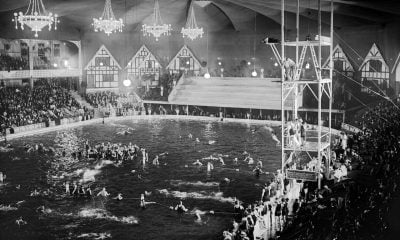
Recently while watching It’s a Wonderful Life, I noticed the swimming pool scene where George Bailey (Jimmy Stewart) and Mary Hatch (Donna Reed) are at the school dance. It’s a defining scene where a retractable basketball court opens up to reveal a hidden swimming pool beneath it. As George & Mary are dancing they don’t notice the floor begin to open. The cheering crowds spur them on even further, as they think everyone is cheering their dancing they fail to see they are dancing right over the edge and plunge into the pool.
The Pool Scene from It’s a Wonderful Life
Many of the other people at the dance dive right on in and an impromptu pool party ensues. It’s a touching scene in a must see movie that should be at the top of everyones holiday movie list. Many people believe that the swimming pool wasn’t real. Frank Capra the director of the film had the entire set of the town of Bedford Falls created on an 89 acre back lot at RKO Pictures in Culver City.
The set was actually inspired from the real life town of Seneca Falls in New York. Film buffs suggested that the pool itself was also a prop. As it turns out, according to Snopes.com who did the fact checking for us, the pool has been identified and is real. It’s known as the Swim Gym and is a Beverly Hills landmark. The pool was built by the WPA historical pool contractors in their own right, and designed by Stiles O. Clements in 1939.

Historical Land Mark Swimming Pool Has Been in Many Movies
The retractable pool belongs to Beverly Hills High School and was actually used in the filming of the movie. What’s even more interesting is that the pool is still around today! The pool itself is 25 yards long and is still used in swimming competitions. With the turn of a key the inground swimming pool the retractable pool cover converts back to a basketball court / dance floor.

It’s a wonderful life (east coast feed) about to show the pool under the basketball court that still is there at my high school. #Beverly
— Adam Wohl (@adamwohl) December 25, 2012


Pool Builder
Ownership Group Acquires Shasta Pools, Announces Expansion Plans to Offer Complete Home Services
Dansons Capital Group, Accrual Equity Partners, and Hydro Construction purchased Arizona’s premier pool builder with eye on developing national brand


SCOTTSDALE, Arizona (August 31, 2026) – Dansons Capital Group, in partnership with Accrual Equity Partners (AEP) and Hydro Construction (HydroCon), completed the acquisition of Shasta Pools, Phoenix Metro’s most recognized pool builder, and announced an immediate expansion into the broader home services market with plans to grow the brand into a national powerhouse. Founded in 1966 by brothers Bob and Skip Ast, the third-generation, family-owned pool business has built or renovated more than 150,000 pools across Maricopa County and is among the country’s top premier pool builders. The acquisition, finalized August 6, positions the company with a competitive edge as it enters a new phase of accelerated growth
Building on Shasta’s track record of success, the ownership group will grow the company’s core business divisions, including residential and commercial pool construction and renovation, Shasta Signature Series luxury pool designs, backyard hardscaping solutions, extended warranties, and e-commerce supplies. The deal also directs new capital into Shasta’s high-volume, recurring pool maintenance business, establishing a scalable foundation for an expanded home services portfolio.
Expanding the Home Services Model

Shasta Pools will also debut Shasta Home Services, the first step in the company’s expansion into a comprehensive home services platform. Shasta enters the space with more than 200,000 customer relationships, route density in Central Arizona, and a 60-year brand homeowners have entrusted with their homes. The company plans to aggressively expand the platform organically and through partnership across the essential services every home depends on.
In addition, work has begun on a new, state-of-the-art design center and headquarters in Scottsdale that will centralize operations and give customers a welcoming, creative atmosphere to reimagine their yards. The campus will also anchor a technology-driven contact center staffed by a world-class team that creates a single point of contact for every Shasta customer, from pool service to the company’s expanding home services platform.
A Partnership Rooted in Shared Values
Dansons Capital Group, a family business led by CEO Dan Thiessen, President Jeff Thiessen, and COO Jordan Thiessen, built and grew a portfolio of backyard-focused businesses including Pit Boss Grills, which they scaled into a worldwide brand before selling in June 2023.
Jeff Thiessen sparked a relationship with the Ast family during the construction of his own backyard pool, a personal experience that gave him firsthand insight into the industry’s potential. Recognizing the Ast family’s shared values and significant opportunity with strategic investment, he partnered with AEP and HydroCon to pursue that growth together.

“Shasta Pools has national industry brand recognition and has been an Arizona legacy for the last 60 years and we’re excited to reinvest in the company and catapult its growth into the next 60 years,” said Jeff Thiessen, President, Dansons Capital Group. “We’ve already met with more than 200 employees to learn what they love about Shasta Pools and hear their ideas of how we can grow the company and continue providing our customers with amazing customer service.”
Dan Thiessen will serve as Chairman and lead the new ownership team to identify and hire top industry talent and grow Shasta’s home services platform to develop it into a national brand.
Legacy Preserved, Future Secured
“This was the right time to bring in a new ownership team to take Shasta Pools to the next level and the next generation of growth,” said Skip Ast Jr., who served as president at Shasta Pools. “My father and my family built this company on a commitment to quality to every homeowner who trusted us with their backyard, their budget, and their own family. We’re confident that the new leadership team’s commitment to uphold that will never change. Knowing this team shares our values and will invest in our team gives Shasta Pools the foundation to grow stronger than ever.”
Ast helped build Shasta Pools to a dominant force in the industry, with multiple divisions topping $100 million in combined revenue. The company holds membership in the prestigious Master Pools Guild, one of only 110 members globally.
A Different Approach to Private Equity
“Partnering with Shasta Pools represents the future of home services. A trusted, generational brand, Shasta brings 200,000 loyal customer relationships with a genuine commitment to the people who serve them every day,” said Jacob Tilzer, Co-Founder and Managing Partner at Accrual Equity Partners. “Together with our partners at Dansons Capital Group and Hydro Construction, we all share a belief that enduring businesses are built on trust, earned one customer at a time. We’re proud to build alongside this team as Shasta grows into a nationwide home services brand.”
The new ownership group brings more than 150 years of combined expertise in building, scaling, and optimizing service industry brands. Each company shares a faith-based approach to business grounded in stewardship, integrity, and care for the communities they serve. Shasta Pools’ brand will continue its community programs, including swim lessons, support for foster care, and initiatives serving first responders.
ABOUT DANSONS CAPITAL GROUP:
Dansons Capital Group, headquartered in Scottsdale, Arizona, is a family-owned and family-managed investment firm built on shared values, integrity and long-term vision. The firm was established by the founders of Dansons, Inc., the company that launched and sold Pit Boss Grills. The company takes a hands-on approach, actively seeking opportunities across global markets and multiple asset classes. Its growing portfolio includes strategic real estate development holdings across multiple countries, oil drilling technologies, and limited partnership investments. Guided by a deep commitment to quality and the communities they serve, the Thiessen family leads with gratefulness for the blessings God has given them and in turn supports those less fortunate. Dansons Capital Group continues to identify and cultivate opportunities that reflect their family’s values and generational vision.
ABOUT ACCRUAL EQUITY PARTNERS:
Accrual Equity Partners (AEP) is a founder-led, privately funded private equity group built on the belief that every person, every percentage, and every product matters. This commitment, known as the “Power of One,” drives AEP’s mission to empower businesses and secure legacies across fragmented, service-based industries. AEP partners with founder-led and family-owned businesses to overcome barriers and unlock their full potential through strategic investment, operational performance enhancement, and advisory services. For more information, visit accrualequitypartners.com/
ABOUT SHASTA POOLS:
Shasta Pools is Arizona’s trusted name in custom pool building, proudly serving the Valley since 1966. For 60 years, Shasta has transformed backyards into beautiful, functional spaces where families relax, entertain and enjoy life. The company specializes in new pool construction, remodeling, pool service and landscape design with plans for expansion into the home services market to provide customers with complete home care solutions. Learn more at ShastaPools.com.
ABOUT HYDRO CONSTRUCTION:
Hydro Construction, LLC (HydroCon) was founded in 1986 to serve Arizona’s commercial pool construction and renovation market. Under the leadership of Curt Lonsdale, the company’s commercial pool construction division now manages some of the largest and most complex projects in the country.


JED Pool Tools, manufacturer of swimming pool maintenance equipment and accessories, is pleased to announce the availability of its new, comprehensive 2027 catalog of products. This newly printed catalog offers 40 pages of color photography showing all of JED’s maintenance equipment products and accessories—from its award-winning hoses to its innovative, patented products like the FLAS ladder anchor saver! The catalog even highlights its many “Made in the USA” products including those manufactured at the JED facility in Pennsylvania.
“We are pleased to offer the pool industry this printed catalog which can also be accessed online, 24/7 and showcases the many products we make at our facility or are made within the US,” says Rob Heyen, Account Executive at JED Pool Tools.
Those interested in downloading or ordering the catalog, should visit:
www.JEDPoolTools.com
570-344-4137
About JED Pool Tools
JED Pool Tools has been making high-quality pool tools and pool accessories in the USA for over 30 years. JED Pool Tools sells over 400 different products including residential and commercial skimmers, leaf rakes, poles, wall brushes and vacuum heads as well as hoses and through-wall skimmer parts. JED is a family-run company with 3-generations of Heyen family working for the company and is committed to creating and providing jobs for residents of Scranton, PA. JED is proud of and committed to manufacturing in the USA, many it its own facility in Scranton, PA. To learn more about the company and its products visit www.JEDPoolTools.com.

CCEI introduces new color for its pH & ORP monitoring and dosing controllers in a sleek new, modern, white color design that blends into any pump room! CCEI’s pH & ORP controllers automatically manage pool water chemistry using the free Vigipool app. The Phileo pH and Oxeo ORP controllers are simple to set up and easy to use. They monitor and dose pool water and alert pool owners and service professionals when pool water falls out of balance. The dosing pump lights up in various colors to alert you of your pool’s pH and ORP levels. Designed to help pool professionals profits by upgrading clients with the Phileo pH & Oxeo ORP measuring and dosing chemical controllers!
www.ccei-pool.com/en-us
424-800-2191
CCEI USA Inc.
808 Hindry Ave, Suite G
Inglewood, CA 90301
https://www.instagram.com/cceipool_na/

Read the Summer Issue of Pool Magazine

See more of our coverage in your search results
 Sponsored Advertisement
 Inside the 2026 Million Dollar Pool Design Challenge
 Franklin Electric Shares Global Water Perspectives Through Art Exhibit
 SafeSplash Highlights Early Water Safety During Baby Safety Month
 5 Ways Jandy’s New AquaLink® EDGE™ Is Changing the Game for Pool Pros
 Why Pools Matter: Pool Horizons Takes Its Message Global
 Ownership Group Acquires Shasta Pools, Announces Expansion Plans to Offer Complete Home Services
 RicoRock Introduces Compact 18-Inch Pool Waterfall

 Fiberglass: The Friendly Pool Contractor Product
 Automatic Spa Covers
 Creating Fun & Excitement In The Pool With Riverflow
 Anthony & Sylvan Pools Announces Bonnie Chong as President & Chief Executive Officer
 Everything You Need To Know About Pool Chemicals before Summer
 Pool Acoustics: Orchestrating a Symphony of Water Sounds with Pool Features
 Orenda (a HASA Company) and Skimmer to Revolutionize Pool Maintenance with New Partnership
 Sponsored Advertisement
 Sponsored Advertisement
 Industry News3 weeks ago
Landmark Aquatic Names Jason Hill Kansas City General Manager

 Pool News3 weeks ago
New FCC Robotics Rules Could Affect Future Robotic Pool Cleaners

 Press Releases3 weeks ago
Veridian Service Partners Names Dave Peterson Chief Sales Officer

 Pool News3 weeks ago
Amazon Drone Drops Package Into Swimming Pool — And It’s Not the First Mishap

 Press Releases4 weeks ago
Natalie Hood Swims for Every Child A Swimmer

 Manufacturer3 weeks ago
TPSC Launches East Green Teak Collection

 Press Releases4 weeks ago
Pentair Pool Earns Top Safety Honors in North Carolina

 Manufacturer3 weeks ago
Pentair Pool and Pool Brain Launch Technology Integration to Deliver Smarter, More Proactive Pool Service
Dede Vidal
December 27, 2021 at 5:34 pm
Donna Reed’s character name is Mary, not Martha
Joe Trusty
December 27, 2021 at 5:51 pm
Thanks Dede.. what’s funny is I watched it 3 times this year and I still managed to mess her name up lol