Pool News
Anatomy of a Botched Remodel: What Sank the Lincoln Memorial Reflecting Pool Restoration?

When the federal government completed a massive $14.7 million makeover of the historic Lincoln Memorial Reflecting Pool ahead of the nation’s America 250 celebrations, the project quickly ran into an operational nightmare of peeling, blistering, tearing and widespread delamination.
Initial reports from administration officials pointed to potential vandalism, leading to high-profile destruction-of-property charges against several individuals, including a former Olympic athlete. Federal prosecutors later dropped the charges after court filings and project documents pointed instead to a rushed, flawed installation process.
Atlantic Industrial Coatings, the contractor tapped for the renovation, later identified problems in its own work, including insufficient primer in some areas and issues involving the materials used in the coating assembly. The disaster is a textbook case study in the unforgiving nature of large-scale concrete vessels, the importance of coating compatibility and application timing, and why an immersed-water structure cannot be approached like a standard industrial floor.


The Credentials Gap
From an engineering standpoint, the Lincoln Memorial Reflecting Pool is a roughly century-old reinforced-concrete water vessel on an enormous scale. Yet, when the National Park Service awarded the project, the choice of contractor immediately raised eyebrows among commercial aquatics veterans.
Atlantic Industrial Coatings was not a household name in the commercial aquatic world. The company’s public portfolio does not heavily advertise swimming-pool expertise, and the Reflecting Pool contract marked its first federal construction job. Public reports indicate that Atlantic had previously worked on swimming pools at a Trump golf club in Sterling, Virginia. But that is a vastly different logistical and structural challenge from restoring a high-profile national landmark.
“When the project was first made public, I naturally assumed the contract would go to an established builder or waterproofing specialist I knew in our field,” recalls Vito Mariano, president of Basecrete Technologies, who has spent decades specializing in waterproofing complex concrete structures. “As it turned out, I had never even heard of the firm selected for the installation.”

Inadequate Substrate Prep
Because an aquatic vessel behaves dynamically, any underlying weaknesses in the shell can quickly telegraph to the surface. The Reflecting Pool basin had spent years exposed to weather, water, treatment chemicals, biological growth and the normal wear that comes with operating an enormous outdoor public-water feature.
That aging concrete matrix can carry a massive hidden deficit beneath the visible surface: weak surface paste, old coating residue, microcracking, moisture-related issues, chemical exposure and years of organic buildup.


“You have a vessel that’s sitting there in a concrete shell for close to 20 years, and they’ve had an algae problem in it since the beginning,” Mariano explains. “The amount of deficiency that concrete has absorbed, I don’t know to what extent they went to remove it before they put any coating on it.”
Without rigorous remediation, a new coating can be set up to fail before it ever leaves the sprayer. Mariano sees substrate preparation as the heart of the installation’s failure.
“Really digging into it, that would’ve been the first thing that I would look at—is how to remove the absorbency of all the degraded material that’s inside it that the concrete sucked up,” he says. “I don’t think they spent enough time doing it to get it prepped, and they should have. I’m completely convinced in my mind this failure occurred because of a lack of prep work.”
While the public record has not produced a final forensic ruling that prep alone caused the breakdown, commercial builders know that on a restoration project of this scope, prep is not a side task—it is the entire job.
Missing the Window: The Mechanics of Delamination
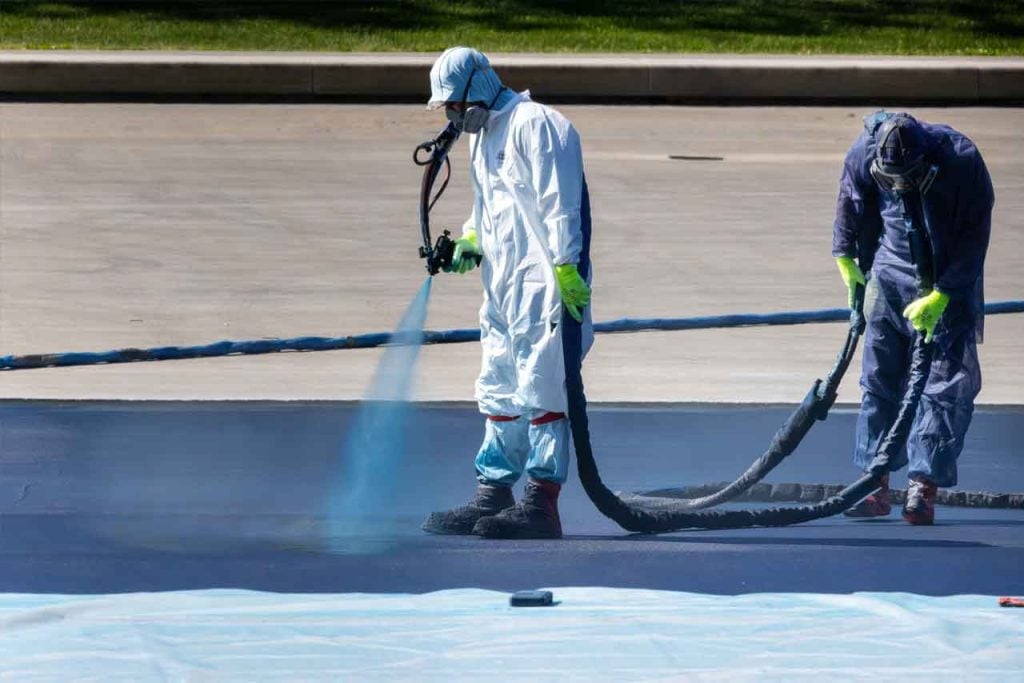
The project specifications bypassed conventional pool paint or plaster in favor of a multi-layer Rhino Linings system: Rhino 406 epoxy primer over the concrete, topped with a dark-blue Rhino Pipeliner 5000 hybrid-polyurea membrane applied at roughly 100 mils thick. The assembly was designed to perform as one integrated, monolithic waterproofing system.
For that system to succeed, every chemical interface has to work. The primer must bond to the concrete, the polyurea membrane must bond to the primer, and separately sprayed field sections must knit seamlessly together at the seams.
The system had two different clocks running, and both mattered. The Rhino 406 primer gave the crew up to 24 hours to get the Pipeliner 5000 membrane down. At one documented failure location, the coating went on outside that primer-to-membrane window.
Mariano warns that missing a manufacturer’s application window creates a serious barrier to adhesion.
“The primer underneath it had a tight window for the next coat,” he notes. “That kind of timing is everything. Once you get outside the manufacturer’s window, you have to treat it differently before you keep building the system.”
Then there was the issue with seams. Pipeliner 5000 had its own much tighter, roughly four-hour wet-on-wet window. In five documented failure areas, five hours or more passed between adjacent spray applications of the dark-blue material. At that point, the crew was no longer stitching fresh material into fresh material. They were trying to marry a new spray pass to an edge that had already started to cure.
“On a project this size, outdoors, under a hard political deadline, timing becomes a logistical knife fight,” Mariano says. “You are chasing weather, temperature, substrate conditions, equipment, crew movement, thickness, overlap and cure time while the clock is running in every direction.”

Atlantic Industrial Coatings later reported to investigators that insufficient primer application in some areas and material incompatibility contributed to widespread blistering. The contractor said the upper membrane layers heated beyond what the underlying layer could tolerate, creating a failure path between the coats.
The failure also drew congressional scrutiny. In a June 24 letter to Atlantic Industrial Coatings, Rep. Robert Garcia of California requested project specifications, coating performance standards, testing records and communications concerning deficiencies and corrective work. Garcia also asked the contractor to explain the system’s “apparent failure” and detail what was being done to address it.
“The American people deserve better management of their tax dollars,” Garcia wrote. “They also deserve to know how the contractors selected to do this work were vetted and how they plan to address their shoddy work moving forward.”
What those adhesion failures meant once the pool returned to service became increasingly visible. With little holding portions of the coating system to the substrate, isolated defects could quickly become much larger areas of delamination.
“Once it starts to delaminate, you can start peeling it back pretty easy,” Mariano explains. “The adhesion rate was minute. It was coming off in sheets, and you can pull it from one end to the other because there was very little bonding in it.”
For Mariano, the scale of the failure also points to a larger issue with approaching an immersed concrete vessel as though it were conventional industrial flatwork. Pools impose their own demands on materials, preparation and application that aren’t necessarily encountered on other concrete projects.
“Swimming pools are extremely temperamental, and our material choices are highly restricted,” Mariano emphasizes. “You can’t just take a standard industrial coating system and assume it will perform in a swimming pool.”


The Algae Debacle
The coating failure unfolded alongside a secondary public-relations nightmare: a highly visible algae problem. While the public record does not establish that delamination itself caused the biological growth, the two issues quickly became intertwined in the public eye and triggered millions in additional water-treatment spending.
To combat the murky green water ahead of the holiday events, the National Park Service awarded an emergency $1.7 million contract to Ohio-based Green Water Solutions for an ozone-nanobubble water-purification system. The system was intended to continuously inject ozone nanobubbles to destroy contaminants, while Interior officials said hydrogen peroxide was also used as part of the treatment response.
The response did not deliver a lasting operational fix. Once temporary equipment was taken offline, algae returned, and the pool remained associated with green water and the visibly failing blue coating. The government subsequently awarded another $2.7 million contract to American Ag Energy, Inc. to maintain, repair and rebuild the pool’s water-purification and sewage-treatment infrastructure.
Add the original renovation, the emergency nanobubble system and the secondary water-treatment award together, and publicly reported financial commitments reached at least roughly $19.1 million.

The Lesson Learned
The ultimate irony of the compressed schedule is how little the pool was actually utilized. The Reflecting Pool officially reopened June 6, showing off its new “American flag blue” appearance. Within days, the liner was peeling from the concrete floor in massive sheets. By mid-July—effectively a target window of only a few weeks—the pool had been drained again for repairs.
Atlantic Industrial Coatings returned to the site to address the failed lining under warranty, with Rhino Linings saying it was supporting the remediation effort. The pool was drained and closed during the reported repair period, and federal officials had not announced a firm reopening date in the reports reviewed for this story.
The rush to finish the project for the July 4 celebrations sits squarely at the center of the failure. Federal prosecutors ultimately described the installation process as rushed and flawed.
That artificial timeline compression squeezed the non-negotiable fundamentals that give an immersed coating system its chance to survive: deep substrate decontamination, uniform primer coverage, environmental controls, strict application timing and proper seam detailing. When those engineering steps get compromised, the failure waits patiently until water pressure, ambient heat and structural movement expose the weak interfaces.
“I think the push to finish by July 4 was the number one issue,” Mariano concludes. “Everybody was working against a hard deadline, and that is when problems start. When a job gets rushed, critical steps get squeezed. That never changes—and when it happens on a project this size, it gets expensive fast. That’s the lesson, if there’s anything to learn from this.”
Featured Photo Credit: Rob Atherton
You must be logged in to post a comment Login