Pool Service
How Jobber Is Helping Pool Pros Build Smarter, More Profitable Businesses

Pool service companies rarely grow all at once.
A manageable weekly route becomes a larger customer base. Then comes another technician, another truck, repair work, equipment installations, office staff, sales and marketing. Eventually, the owner is no longer just managing pools—they are managing a growing organization.
That was the progression for Scott Reynolds, owner of Purpose Pools in Las Vegas.


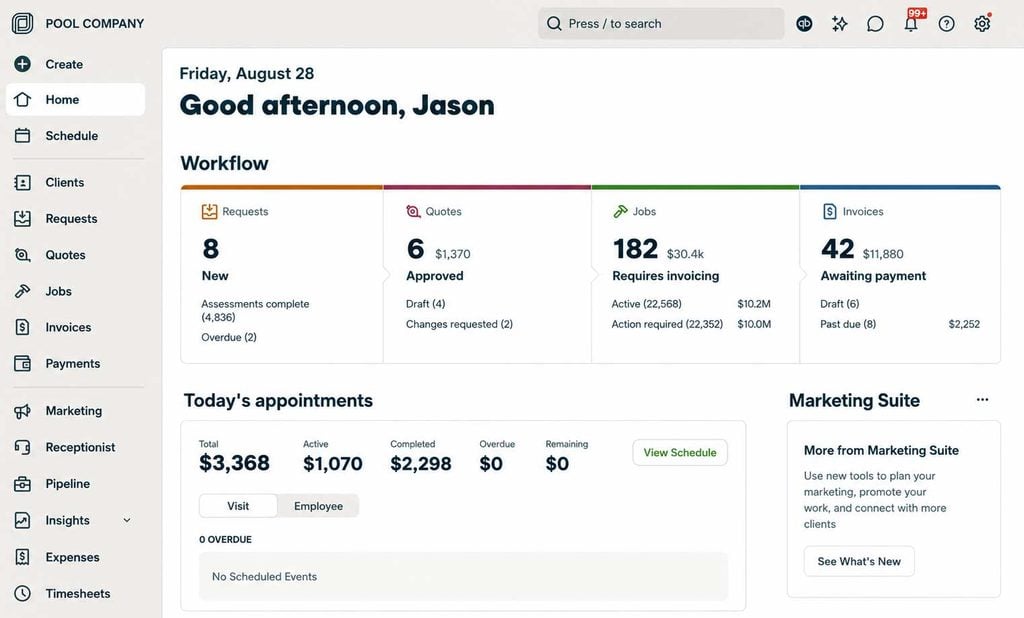
Jobber, a field-service management platform for scheduling, customer communication, estimates, invoicing and related operations, has become part of the company’s operating infrastructure as Purpose Pools has expanded. More recently, Reynolds has focused on a different challenge: using the company’s data to make smarter decisions about marketing, profitability and growth.
His experience reflects a broader shift among service contractors.
Software Is Becoming a Business Essential
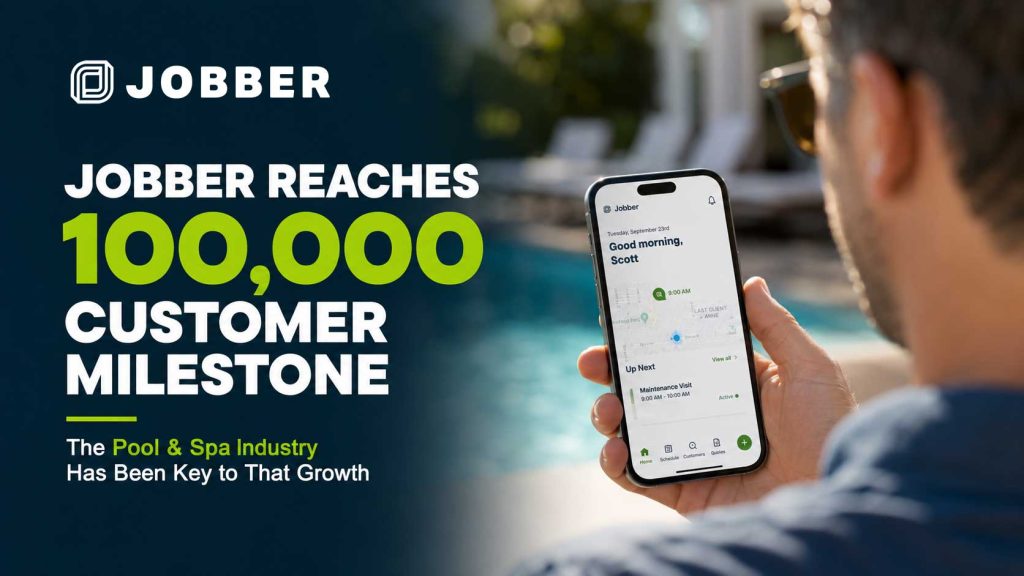
Jobber recently surpassed 100,000 paid customers. Moly Milosovic, Jobber’s Head of Community, says service professionals in the pool and spa industry have been a key part of their growth story.
“I’ve been going to trade shows for years, including a lot of pool industry shows, and back then the rebuttal I always heard was, ‘I want to learn more, but I don’t think I need it yet,’” Milosovic said. “I don’t hear that anymore.”
Milosovic said contractors increasingly recognize that operational software is not something to postpone until the company reaches a certain number of employees, trucks or accounts.

“There’s so much more awareness that software doing work and tracking work for you is a smart investment as soon as you can afford it,” Milosovic said. “It’s become more like table stakes.”
For Purpose Pools, that investment has supported a transition from a relatively simple cleaning route to a more complex service and repair operation.
Choosing a System That Can Scale
Reynolds began his search for field management software in 2022. He had prior experience with enterprise software and knew that a platform with extensive functionality was not necessarily the easiest system to operate.
“I came from a corporate background where we relied heavily on Salesforce, so I’m used to all the bells, whistles and features, but it’s extremely complex,” Reynolds said.
Before adopting a new system, Purpose Pools had worked through other solutions and developed a clearer understanding of its needs.
“I was looking for a really robust platform, and we finally landed on Jobber,” Reynolds said. “It was super straightforward and easy to use.”
For a service business, usability matters because the platform needs to work for office staff, salespeople, technicians and management—not just the person responsible for implementing it.

Support Beyond Onboarding
Reynolds said the company’s rapid adoption of Jobber has also been shaped by the personal attention he receives from his account specialist.
“Probably what has impressed me most has been the support,” he said.
He initially expected a typical onboarding period, followed by a more self-directed relationship with the platform. Instead, Jobber continued to provide assistance as Purpose Pools added people, services and workflows.
“I thought it might just be that first 90 days of, ‘Let’s get you started and make sure you’re successful,’ but since we signed up in 2022, that support has continued all the way through today,” Reynolds said.
Growth Creates More Moving Parts
“When we first started out, we were just doing weekly cleanings,” Reynolds said. “Now we push about 100 customers a week through the platform between service calls, cleanings and repairs.”
The team has grown alongside the customer base, with employees now working across sales, administration and operations.
“As we’ve grown our customer base, we’ve also grown the team and added people to sales, administration and operations,” Reynolds said. “Jobber makes it easy to get them up to speed and onboarded because the tool set continues to be straightforward and simple.”
Avoiding Costly Operational Gaps
The need for an integrated system usually becomes apparent when information starts falling through the cracks.
A technician may forget a follow-up. An estimate may not receive a response. A repair could be completed without an invoice being sent. A customer note may exist only in a text message or handwritten file.
“Think about when you lost track of something you wrote down, or when you literally forgot to invoice someone for a job worth thousands of dollars,” Milosovic said.
Those breakdowns become more expensive as a company handles greater volume.
“One of the biggest things Jobber helps us with is avoiding that memory lapse,” Reynolds said.
Faster Repair Follow-Up
At Purpose Pools, Jobber helps centralize customer communication and task management across recurring service and repair work.
That structure has helped the company reduce its repair sales cycle.
“Our entire sales cycle is less than 40 hours,” Reynolds said. “From the time someone submits a request or makes a phone call, we can be completing the repair.”
The system allows customers to respond when it is convenient for them instead of forcing every interaction into a phone call or office-hours conversation.
“They can answer the text when they want, or log into the Client Hub when they’d like to,” Reynolds said. “Jobber is always working for us, but it’s also working on the customer’s timetable.”
Empowering Pool Pros To Answer Bigger Questions
Once Purpose Pools established stronger systems for managing jobs and customer communication, Reynolds turned his attention to marketing efficiency.
“For us, the shift probably happened about a year ago,” Reynolds said. “We went from, ‘Let’s just spend. The top line looks really good,’ to asking how we could become more efficient.”
For many pool companies, advertising platforms provide useful—but incomplete—data. They can show impressions, clicks, calls and submitted forms, but they do not always reveal whether those leads became paying customers or generated meaningful revenue.
“We wanted to know where the lead was coming from, what channel produced it and what that lead cost us,” Reynolds said. “Ultimately, we wanted to know what revenue it generated.”

Connecting Ad Spend to Revenue
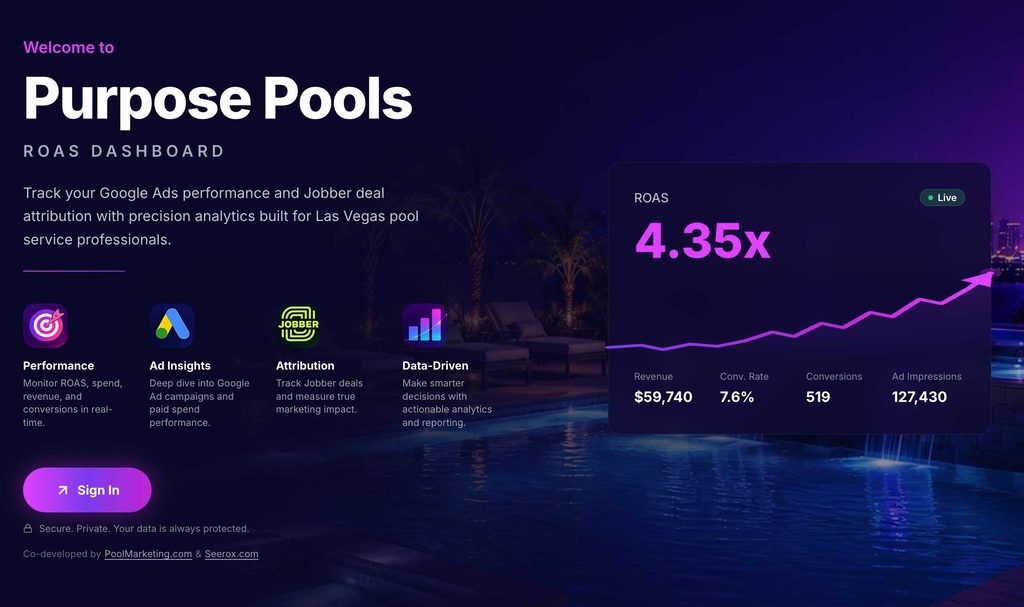
Working with digital agency PoolMarketing.com, Purpose Pools developed a custom return-on-ad-spend dashboard that connects advertising performance with customer, sales and revenue data flowing through Jobber’s API.
The dashboard is a custom integration built by PoolMarketing.com, rather than a native Jobber reporting feature. It allows Reynolds to track a lead after it enters the business, including the source, current sales stage and outcome.
“Now I’m able to tell when a lead hit the system, what stage it’s in and what the response was,” Reynolds said. “That allows us to make more efficient decisions.”
Better Data Creates Better Decisions
At scale, modest improvements in advertising efficiency can have a significant impact.
“As you grow, even being able to save a couple of percentage points on ad spend and reallocate that money somewhere else is a really big deal,” Reynolds said.
A channel that produces low-cost leads is not necessarily the best channel if those leads do not become profitable jobs. On the other hand, a higher-cost source may warrant greater investment if it consistently produces valuable repair work, installations or recurring service accounts.
The objective is not simply to identify wasted spend. It is also to invest more heavily in the channels that consistently generate worthwhile customers.
“I think that’s what a lot of owner-operators miss out on—really working through the efficiency of their costs and expenses and knowing where the money goes and why it goes there,” Reynolds said. “In our case, we can double down and spend more on the channels that are working because we have the data in front of us.”
Turning Operational Data Into Insight
Jobber occupies an important place as the source of truth in the attribution process because the ultimate value of a marketing lead is determined by what happens after the initial inquiry.
Customer records, estimates, jobs, invoices and revenue data provide the operational information needed to evaluate whether an advertising source actually produces profitable work.
For Jobber, that represents an evolution in the role of field-service software. The platform is not only a scheduling and communication tool; it can also become a source of business intelligence.
“It takes that kind of discipline—knowing your numbers and making those percentage-type decisions,” Milosovic said. “You need that visibility.”
Demand for Better Reporting
Milosovic said the Purpose Pools dashboard illustrates the type of analysis that a growing number of contractors want.
“That dashboard looks amazing,” she said. “I would love to see a dashboard like that in Jobber. We’re investing in helping customers understand their numbers better so they can make those kinds of high-growth decisions.”
Jobber has seen similar demand since introducing its own marketing tools.
“When we launched our marketing suite, the response was immediate: ‘How do you give me more information to make smarter decisions?’” Milosovic said. “We’ve continued investing in those marketing tools to give people that kind of visibility because there absolutely is demand for it.”
Revenue Alone Does Not Equal Success
For Reynolds, marketing attribution is part of a broader shift in how he measures the health of Purpose Pools.
“I think when most pool companies start out, we generally chase that vanity top line of, ‘Hey, I’m doing X amount of revenue,’ but we’re not really understanding the profit margins,” Reynolds said.
He said he often hears similar stories from other contractors who have built significant revenue but still struggle financially.
“I’ll hear, ‘We’re doing X amount a year or X amount a month, and that’s really good—but I’m also kind of going broke,’” Reynolds said.
A company can look successful on paper while dealing with poor pricing, escalating labor costs, weak material markups, excessive overhead or unprofitable marketing spend.
Knowing the Cost of the Work
Purpose Pools has responded by becoming more intentional about job costs and pricing.
“We need to understand our costs,” Reynolds said. “We’ve created a tiered cost ladder so we know what a job costs and what markup needs to go with it. That helps make sure we’re hitting our bottom-line numbers at the end of the week, quarter or year.”
That level of discipline becomes increasingly important as a business grows. More jobs do not automatically create more profit. In some cases, growth can magnify inefficiencies that were less noticeable when the company was smaller.
Jobber’s reports and operational data can support that analysis by giving contractors a clearer view of the work being performed, the revenue being generated, and the processes behind it.

Pool Service: A Key Piece of the Puzzle
Across Jobber’s customer base, the volume of operational information has grown substantially. The company says its 100,000 customers have completed nearly 90 million jobs representing more than $100 billion in services.
Pool service and repair represent an important piece of that growing field-service economy. Unlike businesses built primarily around one-time projects, pool companies often combine recurring maintenance with repair and installation work, sending technicians into the field day after day while managing an ongoing relationship with the customer. It’s a model Milosovic sees as particularly well aligned with the platform Jobber has built.
“Pool service is huge. It’s growing. It’s year-round outdoor work, and it’s exactly who Jobber was built for — people who are going to homes and commercial properties,” Milosovic said.
As those companies grow, the information generated through their day-to-day operations can become increasingly valuable. For Milosovic, the opportunity is to turn that data into actionable business guidance.
“We have this exciting opportunity because you’re already doing your work in Jobber and all of those numbers are in there,” she said. “The question becomes: How do we surface that information so you can get advice that helps you make more money?”
For Jobber, that is the larger opportunity: becoming more than a platform for scheduling and job management.
“We want to be your most trusted partner, your most trusted employee and your most trusted advisor,” Milosovic said. “We want to help surface those opportunities.”
Ready to take a deeper dive?
Listen to the full conversation with Moly Milosovic and Scott Reynolds for a practical look at how Purpose Pools uses Jobber and custom reporting to manage service work, track marketing results, improve operational follow-through and make more informed decisions about growth and profitability.
You must be logged in to post a comment Login