





Features
Movable Floors Are Taking Flexibility Of Indoor And Outdoor Living To A Whole New Level


Recently a video of Tieleman Pool Technology went absolutely viral with over 13 million views on Pool Magazine’s TikTok and over 14 million views on Tieleman’s Instagram account. The video showed a residential movable floor of 8.80 x 5.65m (28.87 x 18.54ft) in an indoor pool located in the United Kingdom. “We know we are engineering and installing a unique product that we felt would amaze many people, but we never imagined it would blow up like this,” says Marijn, Project Manager of the Netherlands-based manufacturer Tieleman Pool Technology.
“This is engineering from another planet… how does that work?”
Just one of the many comments given to the video of the movable floor. Of course, going viral with a video like this will lead to getting countless questions. Questions such as where does the water go when you lower the floor, what system is beneath the movable floor deck and much more. Below you will find some of the most frequently asked questions answered.

- What happens when you lower the floor?
The movable floor is a safe and rigid floating platform controlled by means of a push button, touch screen or a mobile device. When you push the button to lower the floor, the water hydraulic cylinder pulls the movable floor underwater. When the floor is moved, the water will gently flow through the small gap between the floor and the pool wall (so the water always remains in the pool). Within about five minutes your swimming hall, patio or living space is transformed into a full-size swimming pool.
- What if you want to raise the floor? How does that work?
When you want to raise the floor to a higher position, the cylinder pressure is released in a controlled way and the floor will rise automatically as a result of the upward pressure caused by the integrated buoyancy.
- How much weight can a movable floor hold when up?
The bearing capacity of a movable floor starts at a minimum of 100kg per m2 (220lbs per 10.76 ft2). This makes the safe floor deck in a closed position extremely suitable to serve as a patio, party venue or extension of the indoor/outdoor living space.
- How do you clean under the movable floor?
A hatch is made in the construction of the movable floor, the tile located above the hatch can be removed. This allows Tieleman’s service technicians (who are A-1 certified divers) to dive under the movable floor. This way they can easily vacuum the bottom of the pool and inspect and maintain the movable floor system properly.
If your question is not answered here you should definitely check Tieleman’s FAQ page to learn more about the fundamentals of a movable floor.



Definitely not a mainstream product for the average pool owner
A movable floor, as it might suggest, is a product that belongs in the category of ultimate luxury. While the videos are becoming increasingly popular on social media, and homeowners might be wondering if they can have one of their own; this is still a pool feature reserved for the elite. This is not surprising when you consider the level of engineering and high quality materials it takes to manufacture and install this kind of product.


The history of the movable floor
You might not be expecting it, but the product has actually been on the market for quite a long time. For example, Tieleman Pool Technology has been developing customized pool solutions since 1970. To this day, the movable floor has been especially common for hydrotherapy purposes in medical institutions such as rehabilitation clinics, healthcare facilities and hospitals. In order to achieve optimal results with hydrotherapy, variation in depth is the key factor for success. To meet this specific need of the medical sector, the movable floor was developed back in the days.

Over the years, the product has evolved into a state-of-the-art pool solution that is not only suitable for medical institutions, but has also made its way into the public and residential market. Technology has been highly improved and there are countless add-on options for movable floors nowadays. These include integrated stairs (corner stairs, full width stairs and more), integrated sun decks/lounge areas and swim-out benches.
What does a proper movable floor consist of?
There are, of course, plenty of DIY videos of movable floors and other pool solutions. But what should a proper movable floor consist of if it wants to guarantee quality, a long lifespan and low maintenance?
First of all the construction beneath the floor deck must be resistant to corrosion and chlorides. That is why the unique Tieleman movable floor system, in contrast to others, consists of a Marine grade 316L stainless steel construction. For applications with highly corrosive environments, such as swimming pools, Marine grade 316L stainless steel is far superior and will have an extended lifespan compared with 304 grade. This is because Marine grade 316L stainless steel contains high levels of nickel, chromium and molybdenum. The molybdenum is added to protect the stainless steel from the elements such as chlorine and increases corrosion resistance, making this type of steel extremely suitable for use in swimming pools.


Secondly, no oil contamination of the pool can take place. Therefore the unique Tieleman system is powered by a water hydraulic cylinder. This technology eliminates the risk of (oil) contamination to the pool. And last but not least, Tieleman offers excellent service. At Tieleman, we can proudly state that we have been the preferred service provider for decades for our client base. With over 50 years of expertise in all areas of pool technology, Tieleman is your best choice to service your movable floor, says Koen, Marketing & Communications manager at Tieleman.
All the above makes a Tieleman movable floor an extremely durable system with a lifespan of up to 25-30 years.


A great opportunity for high-end U.S. pool builders and contractors to become a certified dealer
The most interesting part for pool builders is that a movable floor not only ensures ultimate safety, it also provides the versatility to create unique pool environments that are multi-use spaces. For example, you can use the floor deck (in a closed position) as a basketball court or even a party venue. This is perhaps the most appealing aspect for pool builders.
Since companies that manufacture, install and maintain movable floors generally do not build the pool itself, this offers excellent business opportunities for pool builders and others. For example the construction of the pool, the water treatment and the tiling of the movable floor needs to be done by a (local) contractor or pool builder. This is most definitely the right time for high-end pool builders, architects and contractors to make their move by partnering with a movable floor builder like Tieleman.


A pool service technician in Charlotte County, Florida, suffered multiple facial fractures when a pressurized pool filter lid blew off and struck him in the face. Weslee Blakeslee spent two nights in the hospital after the Nov. 4 incident.
Blakeslee told the station he was working on a pool filter when pressure built rapidly. A lid came off, cutting his cheek and knocking him to the ground. Nearly a week later, the swelling had gone down, but he said the left side of his face was still numb, making it difficult to brush his teeth. Even wearing glasses put pressure on his injured nose.
“This was just a regular Wednesday, and it could have been so much worse,” Blakeslee told Gulf Coast News, which originally broke the story.

A GoFundMe co-organized by his wife, Ana Blakeslee, says he was transferred to a hospital in Fort Myers for specialist evaluation. The family’s account describes nine fractures in his face, including his jaw, cheek, nose, and bones surrounding his eye.
Pool filter failures have caused deaths and serious injuries in the past
Blakeslee acknowledged how fortunate he was that his injuries weren’t far worse, and is currently recovering at home. Other pool workers have died in similar incidents. In June 2023, a worker opening a residential pool in Sandy, Utah, was killed when a filter lid blew off and struck him in the face. The investigation summary says it remains unclear what he was doing when the lid separated.
In December 2012, a filter housing lid struck a worker in the head at a residential pool, causing facial fractures and putting him in the hospital for two weeks. OSHA’s accident summary noted deformation on the ring clamp that secured the lid. Investigators reported that the bolt holding the clamp together appeared to have pulled free under excessive pressure.
A similar injury happened to a Florida homeowner. In a 2020 investigation, Tampa Bay’s WFTS reported that David Shimkus had just finished cleaning his pool filter in Belleair Bluffs when the metal top blew off and struck him in the forehead. He told the station he was still dealing with daily pain from the injury about a year later.
For service crews, the clamp on a split-tank filter is a pressure-retaining component. The ANSI/APSP/ICC standard for above-ground and on-ground residential pools addresses that hazard directly. It calls for perimeter-clamped filter tanks to release air pressure gradually before the clamp disengages the tank halves. The Florida incident leaves an open question about which component failed. The earlier cases show how serious the consequences can be when a lid separates.


BREVARD COUNTY, FL — For swimming pool builders along Florida’s Space Coast, Monday, November 2, was anything but business as usual. An extraordinary rainfall event inundated portions of Brevard County, flooding neighborhoods, closing roads and turning active swimming pool construction sites into muddy reservoirs.
According to The Washington Post, portions of Florida’s Space Coast received as much as 28 inches of rain in approximately 36 hours, equivalent to nearly half the region’s typical annual rainfall. The relentless downpours overwhelmed drainage systems, flooded residential neighborhoods and brought construction activity to a standstill.
In some of the hardest-hit communities, nearly two feet of rain fell as a slow-moving weather system repeatedly delivered heavy downpours across the region. The National Weather Service characterized rainfall in portions of southern Brevard County as a 1-in-1,000-year event, a statistical designation indicating a 0.1% probability of rainfall of that magnitude occurring in any given year.
By Tuesday, November 3, the storm had claimed at least two lives. Joshua Bennett, 34, was found dead in his truck in a flooded area of southeastern Palm Bay, while Archie Richards, 78, was discovered inside his Toyota Tacoma in a canal near his home in Malabar. Emergency crews rescued hundreds of people as rising water inundated residential neighborhoods and left vehicles stranded.
Preliminary rainfall reports showed 23.69 inches in Grant-Valkaria, 23.44 inches in Malabar and 19.75 inches in Palm Bay. The extraordinary rainfall overwhelmed drainage systems, flooded homes and brought construction activity to a standstill in affected neighborhoods.
For Jeff Jones, owner and builder at Spacefront Pool & Spa, the storm struck directly at the communities he serves. Several of his active construction projects were caught in the flooding.

From Active Construction Sites to Underwater Excavations
Before the storm, Jones’s crews had been progressing through the normal stages of swimming pool construction. Excavations had been completed, plumbing installed and, at some locations, steel reinforcement and forming were already underway.
“Today was one of those days that reminds you just how unpredictable the construction industry can be, especially here on Florida’s Space Coast,” Jones said. “Today we had multiple swimming pool construction sites flood, freshly excavated pools filling with water and surrounding soil washing back into the pools.”
For a pool builder, an open excavation represents considerably more than a hole in the ground. By the time plumbing, rebar, and forms are installed, crews have already invested substantial labor and materials into preparing the site for the next phase of construction.
Flooding at this stage can undo days of work and leave contractors facing costly repairs. But before Jones could begin assessing the damage, there were more immediate concerns.

A Builder’s First Priority: Safety
“Even with roads closed due to flooding, I made it out to our job sites to assess the situation and address immediate hazards,” Jones said. “One of my biggest concerns was the electrical equipment associated with our pumps.”
With floodwaters rising, he worked to disconnect electrical power safely and remove pumps where conditions allowed.
“Some of my pumps were a foot below water.”
The danger wasn’t limited to electrical equipment. Submerged excavations concealed steel reinforcement, unstable soil and other hazards that could pose serious risks to anyone attempting to recover materials or equipment.
Jones understood there was a point where the effort to protect a construction site just had to stop.
“You can rebuild a swimming pool. You can’t replace someone’s life.”
But the damage to his construction sites wasn’t the only thing weighing on Jones.
“What made this situation even more devastating was that some of our customers’ homes were flooding as well,” Jones said.
“As a business owner, your first instinct is to protect your work and your investment. But you quickly realize there’s a much bigger picture.”
The flooding had turned what began as a construction emergency into something far more personal, with Jones balancing the responsibility of protecting his business against the immediate needs of the families he serves.

Weeks of Recovery Ahead
With the immediate danger beginning to subside, Jones faces the difficult task of assessing what can be salvaged from his flooded construction sites.
The damage to an unfinished swimming pool can extend well beyond the water visible in an excavation. Heavy runoff carries soil, sand, and debris into the work area, potentially compromising excavation walls, displacing forms, and undermining surrounding ground. Plumbing and steel may also require inspection or repair before construction can resume.
Some projects may need little more than pumping and cleanup. Others could require extensive excavation repairs, re-forming and additional inspections. Saturated soil and elevated groundwater levels can further complicate recovery, making it necessary to evaluate site conditions before removing accumulated water.
“This is going to set us back weeks,” Jones said.
The setbacks come with additional labor costs, equipment expenses and the challenge of coordinating crews and subcontractors around work that must now be repeated. For a pool builder managing several projects at different stages of construction, those disruptions can ripple through the entire schedule.
Florida contractors are accustomed to dealing with unpredictable weather, but the magnitude of this event illustrates how even experienced builders can find themselves facing circumstances beyond their control.
Jones has spent years working in an industry where weather is an unavoidable part of the business. His experience has taught him the importance of job-site drainage, protecting equipment and preparing crews to respond when conditions improve. Yet even those precautions have their limits.
“Preparation is everything, but even the best preparation can’t prevent Florida from being Florida on a random Monday in November.”
For now, the work ahead involves assessing the damage, restoring affected construction sites, and getting projects moving again. The financial consequences have yet to be fully determined, but the delays are already a certainty.
As Jones put it, “Mother Nature doesn’t care about your construction schedule.”
Photographs courtesy of Jeff Jones, Spacefront Pool & Spa.
Equipment Supplies
iGarden K Series Review: What We Learned After Months in a Customer’s Pool


Robotic pool cleaners can look impressive under controlled conditions. The more meaningful test isn’t how a cleaner performs in a demonstration environment, but how it handles real-world conditions in an actual swimming pool over time.
Leaves, dirt, pet hair, changing weather, irregular pool geometry and everyday use can expose things that simply don’t show up during a short product demonstration.
That was the idea behind Pool Magazine’s recent evaluation of the iGarden K Series robotic pool cleaner.

Rather than conduct a short-term test, we placed the K Series with pool professional Kelli Clancy, owner of Legacy Pool and Spa in Sacramento, who installed the unit in one of her customer’s pools. The homeowner used the cleaner over an extended period, while Clancy monitored its performance and gathered feedback about what worked well and where the cleaner had limitations.
The result was a practical assessment of a cordless robotic cleaner that Clancy believes could make a compelling option for homeowners buying their first robot.
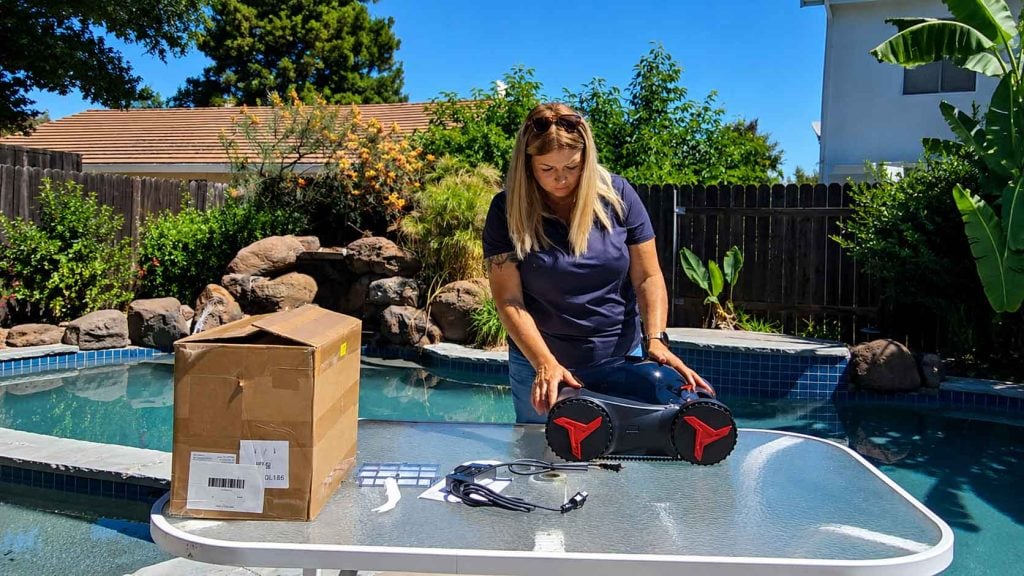
A Real Backyard Instead of a Test Tank
Clancy deliberately selected a pool that would give the K Series plenty to contend with.
“I chose this particular pool for a variety of reasons,” Clancy explained. “One, I knew the customer would give me honest feedback. I knew she would try and get everything she wanted out of the cleaner and give an honest review.”
The surrounding landscape also created a good mixture of debris.

“They had small leaves, big leaves, pine trees,” Clancy said. “So it was a variety of debris I wanted to be able to know if it could pick up.”
As luck would have it, an unrelated issue had also temporarily taken the pool’s circulation system offline, leaving the water somewhat dirtier than usual when the K Series arrived. That provided another opportunity to see how the cleaner handled real debris rather than a carefully prepared demonstration.
The pool itself presented an additional challenge. It was an older freeform gunite pool with curves, varying radiuses and features that would test the cleaner’s ability to navigate something considerably more complicated than a rectangular test pool.
For Clancy, that distinction matters when evaluating robotic cleaners.
“It’s not as authentic as putting it into somebody’s pool in an everyday yard where you have, you know, squirrels, and dogs, and wind, and rain, and all these varieties of things going on,” she said of controlled product demonstrations.
Strong First Impressions
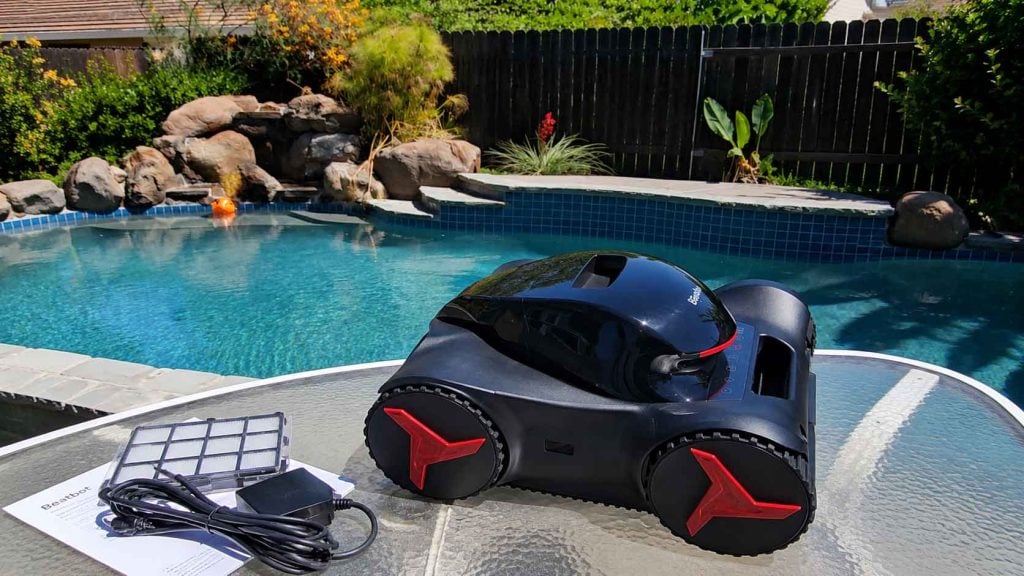
Out of the box, the K Series made a favorable impression.
“I thought it had a very sleek look,” Clancy said. “It has a great look to it, you know, very modern. It wasn’t too bulky, which I did like about it.”
More important than aesthetics was the filtration system. The cleaner includes a fine-mesh filter that fits onto the debris canister, allowing it to capture smaller material in addition to larger debris.
“I really liked that it came with that so it can catch that fine debris such as dog hair or dirt,” Clancy said.
The cordless design was another immediate positive for the homeowner. She had previously owned another robotic cleaner that required placement on a charging base. The K Series offered a simpler arrangement.
“She liked on this one you could just plug it anywhere,” Clancy said. “You didn’t have to put it on a base, and it charged within three hours. She really liked that aspect of it.”
For a homeowner who wants a cleaner without adding another permanent charging station around the pool area, that simplicity can be an attractive feature.
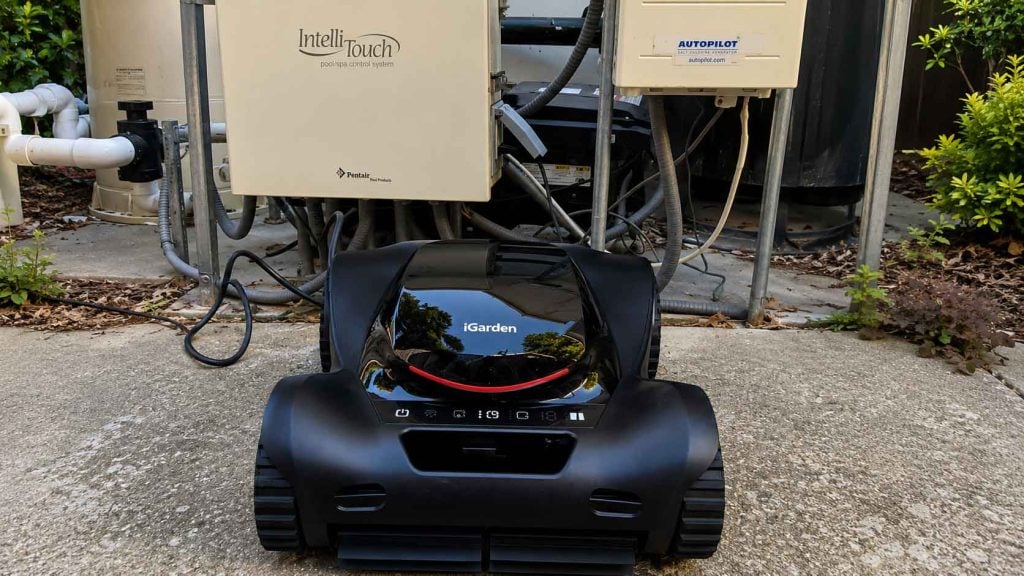
Cleaning the Floor, Walls and Waterline
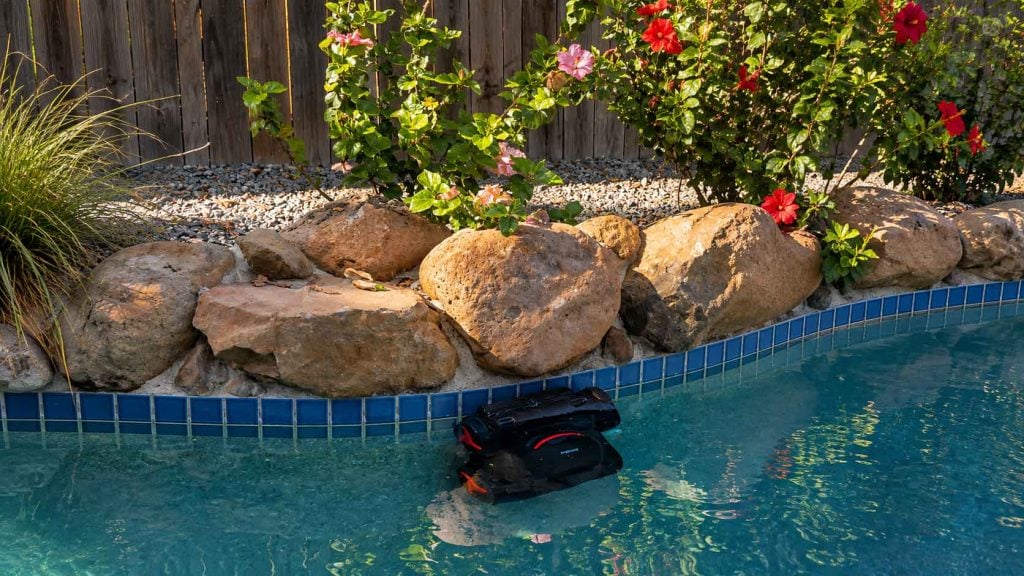
The K Series provides operating modes for floor cleaning as well as floor-and-wall cleaning. Once operating in the latter mode, Clancy found that the robot was capable of climbing the pool walls all the way to the waterline.
“It did go up the walls and did a good job at cleaning them,” she said. “So I really liked that about it.”
That capability stood out to the homeowner because previous cleaners she had owned did not provide the same wall-cleaning performance.
“That was a feature she really enjoyed,” Clancy said.
The robot also surprised Clancy by making its way onto the pool’s tanning ledge.
“It went up onto the tanning ledge. And that was surprising to me,” she said.
What impressed her most, however, was how quickly the K Series could make a noticeable difference.
“Me personally, watching it, I thought the cleaner did really well. I found that it cleaned the pool fairly quickly, which was really nice,” Clancy said. “So then if you have a party, you can just toss that in there and know within an hour that pool’s gonna be ready to go.”
Its ability to reach the waterline added another layer of cleaning.
“It climbs all the way up to clean the tile line, so that was really nice, too, if you haven’t brushed your tile in a while and have some leaves along there this will do a great job with that,” she added.
Handling Real Backyard Debris
Ultimately, a pool cleaner needs to pick things up, and Clancy came away impressed with the K Series’ ability to collect larger debris.
She specifically pointed to the tracks and intake design at the front of the cleaner.
“I think they got right with the tracks on the front where it’s collecting the debris,” Clancy said. “Those were very grippy, and when I watch it go over a pile of leaves, it was able to pull it in easily.”
Combined with the fine-mesh filtration, that gave the cleaner the ability to contend with the mixture commonly found in residential pools, including dirt, dog hair, leaves and pine needles.
Clancy sees that versatility as increasingly important as backyard landscaping becomes more elaborate and homeowners expect robotic cleaners to handle more than one specific type of debris.
Where Pool Geometry Matters
No robotic cleaner is necessarily going to perform identically in every swimming pool, and the K Series was no exception.
The test pool presented a particularly challenging combination of freeform curves and relatively narrow steps. The K Series has a fairly wide wheelbase, and Clancy observed that it could climb some steps but had difficulty stabilizing on others.
Importantly, she believed some of that behavior was specific to the dimensions of this particular pool.
“This particular issue may not be an issue in other pools, depending on the width of the steps,” Clancy explained. The steps in the test pool were approximately 10 inches wide, and she felt even slightly wider steps could have made it considerably easier for the robot to stabilize.
The irregular curves of the older freeform pool also occasionally presented navigation challenges. Based on what she observed, Clancy believes the K Series is likely to perform at its best in more geometrically shaped pools.
That doesn’t negate its performance in the test pool. The cleaner still climbed walls, reached the tile line, accessed the tanning ledge and collected a wide range of debris. It does, however, underscore something consumers should consider with any robotic cleaner: pool shape and feature dimensions can influence performance.
An Area With Room for Improvement
The primary area Clancy would like to see improved is app connectivity when the cleaner is submerged.
“The app needs a little improvement,” she said, noting that communication with the unit became less reliable once it was underwater.
For routine operation, however, Clancy found the cleaner itself straightforward to set up and use. When asked what might distinguish the K Series for someone comparing similarly priced robotic cleaners, she immediately pointed to that simplicity.
“Easy to program,” Clancy said. “It was pretty easy to program. I think that thing took maybe five minutes tops to program completely.”
The homeowner also appreciated a decidedly low-tech feature: the retrieval hook.
“That was one thing the homeowner did love was the hook that came with the cleaner actually worked,” Clancy said. Compared with another robot the homeowner had used, retrieving the K Series from the pool was considerably easier.
It may seem like a small consideration, but usability extends beyond how well a robot cleans. Charging it, programming it, removing it from the water and emptying the debris can determine whether a homeowner actually enjoys owning the product.

A Strong Entry Point Into Robotic Cleaning
With robotic cleaners now available across a wide range of prices and feature sets, one of the biggest questions is where a particular product fits.
For Clancy, the K Series occupies an appealing position for consumers who want to move into robotic cleaning without immediately jumping to the highest-priced equipment on the market.
“I would say it’s gonna be that middle ground customer, someone who’s looking for something that’s not the cheapest but not the most expensive,” she said. “Maybe more of your entry level robotic owner.”
Ease of use strengthens that argument.
“Overall, it seemed very easy to use for anybody, even somebody who doesn’t have ever used a robot,” Clancy said.
That may ultimately be one of the K Series’ strongest selling points. Robotic cleaners have become increasingly sophisticated, but sophistication isn’t necessarily what every homeowner wants. For someone purchasing their first cordless robotic cleaner, being able to charge it, program it quickly, drop it into the pool and retrieve a canister full of debris without a steep learning curve has considerable value.
Clancy’s final assessment carries additional weight because she doesn’t automatically endorse every cleaner she encounters.
“I could see this being a cleaner that I would recommend to people,” she said. “And I don’t recommend just any cleaner. I want something that actually works because, you know, it’s not a small price tag to get a robotic.”
After months in an actual customer’s backyard, the iGarden K Series showed itself to be an approachable cordless robotic cleaner with good debris pickup, wall and waterline cleaning, straightforward programming, convenient charging and thoughtful everyday usability.
There are areas where future generations could improve, particularly app connectivity and navigation around certain freeform curves or narrow features. Those considerations are worth understanding when matching any cleaner to a particular pool.
For homeowners looking to make the jump from traditional pool cleaning equipment to their first robotic cleaner, however, the K Series offers many of the capabilities that make robots attractive in the first place without making the experience unnecessarily complicated.
Should You Buy the iGarden K Series?
Yes.
The iGarden K Series makes the most sense for someone who wants to get into robotic pool cleaning without paying a premium for features they may not need. It’s a practical entry point into the category and, based on our real-world testing, capable enough to justify the investment.
That doesn’t mean it’s the perfect cleaner for every pool. More complex pool shapes and features deserve some consideration, and buyers expecting flawless app control may want to temper their expectations. But those shortcomings weren’t significant enough to change our overall opinion of the product.
What matters is whether the K Series delivers enough cleaning capability, convenience and usability to make owning one worthwhile. We think it does.
If you’ve been considering making the jump to a cordless robotic cleaner and want a capable unit without immediately moving into the upper end of the category, the iGarden K Series earns our recommendation.
And for an entry-level robotic cleaner, getting those fundamentals right matters most.
Ready to take a deeper dive?
Listen to our entire interview with Kelli Clancy about the iGarden K Series robot on the Pool Magazine podcast.
Read the Fall Issue of Pool Magazine

See more of our coverage in your search results
 Sponsored Advertisement
 Pool Filter Explosion Leaves Service Technician With Serious Facial Injuries
 Latham Pools Unveils 2026 Photo Contest Winners
 Historic Rain in Florida Takes Toll on Pool Job Sites
 Pool Manager Charged Over Stolen Equipment Sold on eBay
 JED Pool Tools CEO Featured on ‘Growing Up B2B’
 Scott Jones Named CEO of Landmark Aquatic
 Haviland Pool & Spa Invests $26 Million in Indiana Facility
 Step Into Swim Is Turning Industry Giving Into Life-Saving Impact
 Honoring the 2025 Lifetime Achievement Pool Pro Award Winners With Pentair Pool
 Pentair Rings the Opening Bell at the New York Stock Exchange
 Thursday Pools’ Dealer Conference, Kicks Off Learning Series for Builders-Dealers
 Latham Marks 70 Years with Product Debuts and National Partnership
 Acid Washing Safety: What Every Pool Pro Should Know
 2026 Coverings Installation & Design Award Winners Announced
 Sponsored Advertisement
Pool Magazine Podcast
 What’s Your Pool Company Really Worth? – Pool Magazine Podcast With Weld Valuations
 iGarden K Series Review: A Pool Pro Puts It to the Test
 Why Waiting Until Spring to Remodel Your Pool Could Cost You Time & Money
 Ready When You Are: The Changing Role of Automatic Pool Covers
 What’s Hot & Trending in Fire Pits and Fire Tables for 2026


 Pool News3 weeks ago
Sacred Geometry: Where Architecture, Mathematics and Mosaics Collide

 Pool News3 weeks ago
Anatomy of a Botched Remodel: What Sank the Lincoln Memorial Reflecting Pool Restoration?
 Pool Builder1 week ago
Historic Rain in Florida Takes Toll on Pool Job Sites

 Equipment Supplies3 weeks ago
iGarden K Series Review: What We Learned After Months in a Customer’s Pool

 Press Releases2 weeks ago
Watson’s Acquires Tampa Bay Spas, Enters Tampa Bay Market

 Contractors and Builders3 weeks ago
What’s Hiding Beneath The Surface: Artificial Rock Features

 Pool News3 weeks ago
Landmark Aquatic Taps Britton Nielsen and Tim Garner to Lead Utah Growth

 Equipment Supplies3 weeks ago
Hayward Bets Big on Decentralized Automation With OmniX
You must be logged in to post a comment Login