





Products
Elevating Your Outdoor Oasis: PAL Lighting Landscape Lighting Technology


When it comes to creating an outdoor oasis that exudes elegance and charm, the power of lighting cannot be underestimated. Whether you’re hosting a vibrant summer poolside party or seeking a tranquil escape amidst your landscape, synchronized lighting coordination can transform your outdoor space into a harmonious visual masterpiece. PAL Lighting’s landscape lighting technology is the key to unlocking this transformative potential, allowing homeowners to craft unforgettable moments under the enchanting glow of radiant colors.
Crafting a Harmonious Visual Experience
The outdoor space around your home is an extension of your lifestyle and personal aesthetic. To fully harness its potential, a well-coordinated lighting system is essential. PAL Lighting‘s technology is designed to synchronize various lighting elements, from poolside luminaires to landscape fixtures, seamlessly blending them into a unified and harmonious visual experience.


A Symphony of Colors for Every Occasion
With this revolutionary new technology, homeowners have the power to set the mood for any occasion. Whether it’s a vibrant summer poolside party, a cozy evening for two, or a family gathering, you can effortlessly switch between various color schemes and intensities to complement the atmosphere. From warm and inviting tones to cool and calming hues, PAL Lighting provides a full spectrum of color options, ensuring that your outdoor space adapts to your every desire.
Creating Lasting Memories
The magic of synchronized lighting doesn’t just stop at aesthetics; it’s about crafting unforgettable moments. Imagine the joy of your children splashing in the pool under a canopy of vibrant colors or the romantic ambiance as you and your loved one share a quiet evening under the stars. PAL Lighting helps you create these cherished memories that will stay with you for a lifetime.

Discover the Potential of Lighting Artistry with Pal Lighting

In a world where outdoor living is increasingly becoming an integral part of our lifestyles, PAL Lighting stands at the forefront of lighting artistry. With their state-of-the-art technology and a commitment to quality, they offer a seamless and luxurious way to bring your outdoor oasis to life. The possibilities are endless, and it all begins with Pal Lighting.
Transform your outdoor living space into a masterpiece of lighting coordination, where every moment is a work of art. Experience the magic of synchronized lighting and unlock the potential of your landscape with PAL Lighting.
Photo Credits: Ryan Hughes Design / Build


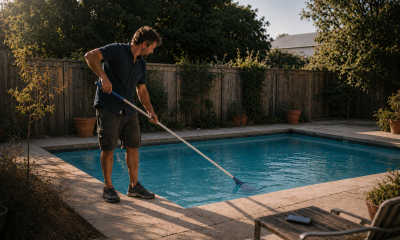





As homes get smarter, homeowners are expecting the same intelligence and control from their pool. Today, that means a fully integrated, smart backyard that gives them the same level of control they have inside the house. For today’s pool professionals, managing those expectations while dealing with labor shortages, complex wiring schematics, and the inevitable weekend service emergency can feel like a juggling act.
Jandy’s AquaLink® EDGE™ automation system puts an end to the manual juggling. Designed with pool professionals in mind, the EDGE platform delivers pool automation that connects people, equipment, and experiences seamlessly. It represents a massive leap forward in pool service
Here are five groundbreaking features within the EDGE platform that can simultaneously elevate the customer experience while making the service pro’s everyday operations significantly easier.

1. Integrated Architecture
Field labor is at an absolute premium today, so every minute saved at the equipment pad has an impact on a business’s bottom line. Traditional automation setups frequently require mounting external power supplies, sub-panels, and secondary control boxes to handle peripheral features like low-voltage lighting or saltwater chlorination.
AquaLink® EDGE™ uses preassembled kits and a highly integrated internal architecture that streamlines the entire automation setup. It features the industry’s first integrated low-voltage LED power supply built directly into the system, eliminating the need for standalone external transformers. Plus, a built-in saltwater card utilizes the exact same internal power architecture, creating a completely streamlined system.
By removing extra wiring bottlenecks and points of failure, crews can complete high-end installations with greater speed, consistency, and confidence.
“I like this unification of it where it’s more like creating an operating system that everything can plug into,” notes Ryan of Prestige Pool and Patio. “The professionals do the professional things and the customer gets to do the customer things.”
2. EDGE Insight
Historically, service companies have operated reactively. It’s a blistering-hot Saturday, and homeowners are calling left and right for emergency service.
EDGE Insight is a diagnostic system that provides real-time visibility into equipment health and system performance. Instead of waiting for a component to fail completely, EDGE Insight monitors performance metrics and sends proactive notifications regarding system anomalies directly to the professional. Technicians can spot declining flow rates, chemical variances, or heater communication glitches before the pool owner ever notices a change in their water.
It’s all easily managed through the Fluidra Pro app for 24/7 insight to customers’ systems.
Mike Donnelly of Crystal Beach Pools stresses the value of this insight: “I really like the idea of getting a heads up before a client knows… If I’m getting a message telling me this isn’t working now and I can get it dealt with before the person even notices, that makes my life measurably better.”
3. Integrated Touchscreen
It’s a horror story that’s all too common: a technician stands in the blazing sun or pouring rain at an equipment pad, struggling to sync a mobile app over a weak backyard WiFi signal just to check a relay or test an actuator.
AquaLink® EDGE™ eliminates this frustration via an integrated touchscreen right on the local control panel that’s glove-and-wet-hand-friendly. Technicians have complete, immediate access to system configuration, diagnostic logs, schedules, and manual overrides directly at the pad—no laptop, smartphone, or internet connection required.
Plus, that insight through the Fluidra Pro app will help you prepare before you even get to the jobsite. “It’s telling you before you even know it yourself, which is beautiful,” says Kelsey Wolfenbarger of Republic Pools/Pool Service Bros.
There’s no reliance on a home’s network during a standard service routine, so crews can execute diagnostics, address a problem, and move on to the next job quickly. If an accidental setting change ever does occur, the cloud-based EDGE Vault automatically backs up system configurations, allowing a technician to restore complex schedules instantly and prevent costly downtime.
4. Personalized User Profiles
User error can be a huge pain point in pool management. Homeowners hoping to avoid the cost of a service call dive into advanced settings, accidentally altering pump speeds or filtration cycles and disrupting their pool’s hydraulic balance. Innocent mistakes can have big consequences in the finely-tuned machinery of a pool.
AquaLink® EDGE™ mitigates this problem with structured User Profiles. The software establishes a clean line of demarcation between the professional installer and the consumer.
- Homeowners get a beautiful, intuitive in-home interface focused on lifestyle features like “Scenes,” temperature adjustments, and lighting controls.
- Service companies can assign individual logins to their staff members, allowing them to track system changes via an Activity Log without ever sharing client passwords.
This separation allows the homeowner to retain control over the aesthetic features that matter most to them, without wandering into the technical weeds.
“I love the fact that there’s a pro side and a customer-friendly side… you’re not bogging down the customer with all the things they really don’t need to see,” says Edwin Escobar of Regal Pools.
5. Localized Control
App control is convenient, but relying 100% on the cloud could lead to troubleshooting calls if a homeowner upgrades their router or experiences a local ISP outage.
EDGE provides a convenient, always available, always ready interface via a dedicated in-home touchscreen tablet, the Home Hub. The tablet communicates locally with the equipment pad, providing full access to personalized scenes, schedules, and equipment controls entirely independent of an internet connection. If the home’s WiFi drops, the pool is still within the customer’s (and your) control.
“Honestly, coming with the in-home controller for the customer because losing internet access, meaning they lose control of their pool, is just a nightmare for us… obviously, all that being local is going to make a huge difference,” explains a representative from Aqua Doctors/Azurion.
Future-Proofing the Backyard
The one constant in the technological age is change. Homeowner expectations change, technology innovates. The true value of any automation system is its ability to keep up. Rather than forcing pool pros into a continuous loop of hardware replacements, AquaLink EDGE enables automatic software updates that continually deliver new features, expanded equipment compatibility, and performance enhancements wirelessly through the Fluidra Evolve framework.
AquaLink® EDGE™ transforms the equipment pad from a fragmented group of components into a cohesive, continually learning operating system. This innovation is a win-win for pool owners and service pros alike. Homeowners get a worry-free luxury experience, while pros get the tools they need to diagnose and fix issues faster, and spend more time scaling their businesses.


Pixel by Wow Design is a new porcelain format that reinterprets the language of mosaic through a precisely engraved grid, combining material continuity with visual richness.
Available in the Sukabumi, Marble, Sabil, and Vestige collections, Pixel demonstrates how a single geometry can transform the expression of different material concepts.
Designed for swimming pools, spas, and wellness interiors, Pixel transforms the interaction between water, light, and ceramics into surfaces of remarkable visual depth.


Pixel is born from the interaction between water, light, and ceramics. Designed for swimming pools, spas, and wellness interiors. The new format by WOW Design transforms reflections, texture, and colour into an experience defined by serenity and wellbeing.
Pixel introduces a new interpretation of the ceramic surface through a precisely engraved grid that transforms the perception of the material. Available across a selection of WOW Design collections, the new format combines the continuity of a 15×15 cm porcelain tile with the visual language of mosaic.
Although each tile is presented as a continuous surface, the engraved geometry creates small tesserae of approximately 3.5 x 3.5 cm, generating a new interaction between texture, light and colour.

The continuity of a tile. The visual richness of a mosaic.
Pixel’s precisely engraved grid brings a new dimension to the ceramic surface. In aquatic environments, the reflections and movement of water intensify this effect, enriching chromatic nuances and creating a richer perception of the material.
Designed for swimming pools, spas, wellness interiors, and other wet areas, Pixel responds to a growing demand for surfaces capable of bringing texture and visual richness to spaces shaped by water.

One format, multiple expressions.
Pixel is available in the Sukabumi, Marble, Sabil, and Vestige collections, preserving the identity of each while transforming its visual expression.
Inspired by the natural stone traditionally used in aquatic environments, Sukabumi finds a new chromatic intensity through Pixel, amplifying the vibrancy of its green tones and the movement of its reflections beneath the water. Marble translates the timeless elegance of marble into a more dynamic scale, where veins and mineral nuances acquire a renewed reading through the engraved grid.
In Sabil, the richness of the glazes and tonal variations takes centre stage, creating surfaces full of movement and nuance. Meanwhile, Vestige finds in Pixel a way to reinforce the expressive character of its textures inspired by the passage of time, enhancing both visual depth and the tactile quality of the material.
Features
Scuppers Are Reshaping Modern Pool Design
Explore how scuppers are redefining modern pool design and the latest trends shaping luxury outdoor living spaces.


Scuppers have evolved far beyond their original purpose.
Once viewed primarily as simple water outlets or decorative spillways, they’ve become one of the most versatile design elements in modern pool construction. Today’s scuppers shape not only how a backyard looks, but how it sounds, flows, and feels. Designers are using them to create architectural rhythm, soften noisy environments, divide spaces, introduce movement, and completely transform the atmosphere of an outdoor living environment.
That shift was the focus of a recent Pool Magazine Podcast discussion with AquaBlu Mosaics’ Frank Vitori and The Outdoor Plus National Director of Sales Chuck Nitschke, who explored how scuppers are being used in today’s modern high-end pool projects — and what designers often get wrong when it comes to their use.
The Rise of Architectural Water Features
According to Vitori, modern pool design is becoming increasingly minimalist and intentional, with builders gravitating toward water features that reinforce strong geometric layouts and contemporary architecture.
“We’re seeing designers moving toward clean architectural lines and looking for accent pieces that really support that,” said Vitori.
That trend has fueled the rise of sheer descent-style scuppers and flush-mounted spillways designed to create uninterrupted sheets of flowing water. Rather than showcasing the hardware itself, the goal is often to make the water appear as though it’s emerging seamlessly from the wall.
“It creates a dramatic look of a long linear sheet of water flowing out of the wall into the pool,” Vitori explained.
The effect is sleek, modern, and highly architectural — but it’s also unforgiving when executed poorly.


What Designers Are Getting Wrong
Designers often underestimate the technical precision required to make scuppers perform correctly. Many installations fail not because of the product itself, but because of mistakes in planning, plumbing, placement, or execution.
Chuck Nitschke explained that sheer-style scuppers leave very little margin for error.
“If the water flow isn’t perfectly even or the unit isn’t designed right internally, you’re going to see breaks in that sheet, turbulence, or inconsistent flow,” said Nitschke. “That completely takes away from the aesthetic.”
Poor flow management is one of the most common issues. Underfeeding a scupper creates broken streams instead of a smooth sheet. Restrictive plumbing layouts, hard elbows, or poor water delivery can introduce turbulence before the water even reaches the feature.
Leveling issues are another major culprit.
“These features are not very forgiving,” said Nitschke. “If the scupper is even slightly out of level, the water is going to favor one side.”
That imbalance immediately disrupts the symmetry designers are trying to achieve.
Vitori agreed that even builders often overlook how sensitive these features are to installation details.
“The whole appeal to these sheer descents is that clean, undisturbed sheet of flowing water,” he said.
Another mistake discussed by both pros was overuse.
Scuppers can dramatically elevate a project, but too many competing water features can clutter a design instead of enhancing it. The most successful projects tend to use scuppers intentionally — integrating them into the architecture rather than scattering them throughout the space simply because they’re available.
Material mismatch also came up as a frequent design issue.
A modern stainless steel spillway may look out of place on a rustic Mediterranean build. Likewise, heavily ornamental copper scuppers may conflict with minimalist contemporary architecture. The key, according to both experts, is understanding the story the space is trying to tell and selecting a water feature that supports that aesthetic.

Rainfall Scuppers and the Rise of Immersive Design
At the same time, designers are getting far more creative with how scuppers are being used.
One of the fastest-growing trends in modern pool design has been the rise of overhead rainfall scuppers — systems that create vertical curtains of water rather than horizontal spillways.
“We’re seeing an increase in overhead installations,” said Vitori.
Unlike sheer descents, rainfall scuppers introduce texture and movement into a space. Instead of creating a sharp architectural line, they soften the environment and create a more immersive atmosphere.
What makes these features particularly interesting is how designers are using them to divide and shape outdoor living spaces.
“One of the great things we’re seeing with rainfall scuppers is the ability to create division of a space, but in a way that is aesthetically pleasing,” said Vitori.
Rather than installing physical walls or barriers, builders are using rainfall curtains to create subtle visual separation between swim areas, lounge spaces, outdoor kitchens, and entertainment zones. Because the falling water remains semi-transparent, the space still feels open while gaining definition and structure.
The effect has become especially popular in luxury backyard projects where homeowners want multiple functional “zones” without making the yard feel compartmentalized.

Using Water to Create Ambience
Rainfall scuppers also bring another important element into play: sound.
“That rainfall effect gives you more sound as it’s hitting the water, which is great for masking noise,” Nitschke explained.
In urban environments or properties near roads, designers are intentionally using rainfall features to drown out traffic and neighborhood noise. In quieter settings, the same effect creates a more spa-like atmosphere.
“You can absolutely use that same feature to create more of a relaxing, immersive space,” Nitschke added.
That idea of creating “experiences” rather than simply building pools came up repeatedly throughout the conversation.
For years, water features were often treated as standalone add-ons. A raised wall here. A spillway there. But today’s builders are increasingly thinking in layers — using multiple water elements together to shape the emotional tone of a backyard.
“A lot of builders are getting really creative,” said Nitschke. “They’ll combine that sheer descent for the architectural look and then use that rainfall scupper to soften it and add a little contrast.”
That layering effect has become one of the defining characteristics of high-end outdoor design. Builders are mixing clean linear spillways with textured rainfall effects, integrating fire elements alongside water features, and using combinations of sound, light, and movement to create more immersive environments.
Layering Elements Together
Part of the reason scuppers have become such an important design tool in modern outdoor living spaces is that they don’t just add water movement, but help to orchestrate the entire environment, and increasingly, builders are using them to guide how homeowners interact with the space itself.
Long linear scuppers can visually anchor a feature wall. Repeating smaller scuppers across a structure creates rhythm and cadence. Overhead rainfall effects can direct traffic flow or subtly signal transitions between one section of the yard and another.
“We’re definitely seeing builders combine multiple units to build rhythm across a wall,” said Nitschke. “Instead of it just being one long continuous run.”
That approach reflects a much more architectural mindset than what the industry traditionally associated with water features.
Scuppers are no longer simply decorative accessories. They’re being used compositionally — almost like lighting, hardscape materials, or structural elements.

Customization Is Changing the Category
Undeniably, customization has become increasingly important. Rather than forcing designers to build around fixed product dimensions, manufacturers are seeing more demand for custom widths, oversized installations, and specialty finishes that align with the overall aesthetic of the project.
“At The Outdoor Plus, we can custom build that in-house,” said Nitschke. “If you want to go 20 feet long, we can do that.”
That flexibility allows designers to think beyond standard applications.
On large commercial projects, oversized scuppers can become massive architectural focal points. In residential environments, custom sizing allows designers to maintain symmetry and scale across feature walls, outdoor kitchens, or perimeter structures.
Ornamental Scuppers Are Making a Comeback
But even with all the innovation happening in contemporary design, ornamental scuppers continue to maintain a strong presence.
In fact, Vitori believes decorative scuppers are making a comeback precisely because many homeowners want water features that intentionally stand out.
“Scuppers were meant to be visual,” said Vitori. Traditional cannon scuppers, radius spillways, V-shaped designs, and sculptural bowl scuppers are increasingly being used as statement pieces rather than hidden design accents. And unlike sheer descents, which are often designed to disappear into the architecture, ornamental scuppers embrace visibility.
Copper cannon scuppers projecting from a textured wall create a completely different emotional tone than a flush-mounted stainless spillway. One leans old-world and dramatic. The other feels sleek and contemporary.
Popular Scupper Styles This Pool Season


According to Nitschke, builders are selecting these styles based less on technical specs and more on the personality of the space.
“The cannon style scupper tends to lean a little bit more toward traditional or Mediterranean styles,” he explained. “The V-shapes are much more contemporary and geometric.”
Some of the more sculptural designs blur the line between water feature and artwork entirely.
One standout this season is the Maya Scupper — a wall-mounted bowl-style feature that Vitori described as looking “almost like a floating sconce.”
Nitschke explained that products like the Maya are becoming popular because they remain visually compelling even when the water is turned off.
“They’re not just mounted — they’re displayed,” he said.

More Than Just a Finishing Touch
That statement may best summarize where the category is headed overall. Today’s scuppers are increasingly architectural, experiential, and artistic all at once.
Builders are no longer simply selecting spillways. They’re choosing sound profiles, water textures, finishes, placement strategies, and visual rhythms that shape how an entire backyard functions.
And when done right, scuppers stop feeling like accessories and start feeling like part of the architecture itself — adding movement, sound, depth, and personality to a backyard in ways homeowners immediately feel the moment they step outside.
Ready to take a deeper dive?
Listen to our entire discussion about scuppers with Frank Vitori and Chuck Nitschke on the Pool Magazine Podcast.
Photos Courtesy: The Outdoor Plus
Read the Summer Issue of Pool Magazine

See more of our coverage in your search results
 Sponsored Advertisement
 Soake Pools Bolsters National Growth With Four Key Hires
 Hayward Holdings Names New Chief Accounting Officer
 Daldorado Names Marcia Gyles Director of Sales
 Landmark Aquatic Brings Poolside Adventures Attractions Nationwide
 Shasta Pools Hires 30-Year Builder to Head Residential Construction
 Watershape University Announces Fall 2026 Session in San Diego
 NTCA Welcomes Jennifer Ibe and Rachel Smith to the Team

 Women of Water – Empowerment, From Entry-Level to Executive
 TV Actress’s Husband Dies After Swimming in Freezing Pool
 Greenstory Global Pool & Spa Filtration Announces The Launch Of Their Complete New Line of Clorox® Pool & Spa Filters
 Pentair Announces Leadership Transition for Pentair Pool
 What is a Buying Group and How Can Joining One Benefit Your Business?
 Neighbors Demand To Use Pool, Homeowners Say ‘Stop Asking’
 Pool Automation Technology Spotlight: The Attendant


 Sponsored Advertisement
 Pool News4 weeks ago
Leslie’s Reportedly Prepares for Chapter 11 Bankruptcy as Possible Nasdaq Delisting Looms

 Pool News3 weeks ago
Leslie’s Files Chapter 11, Lenders Set to Take Control in Major Restructuring

 Features3 weeks ago
A New Era at POOLCORP: John Watwood Focuses on Customers and the Fundamentals

 Pool Equipment3 weeks ago
AquaLink® EDGE™ and trackr iO Signal a New Direction for Pool Automation

 Press Releases4 weeks ago
FSPA and PHTA Reunite Through Historic Affiliation
 Pool News2 weeks ago
Shasta Pools Hires 30-Year Builder to Head Residential Construction

 Retail3 weeks ago
Nasdaq to Suspend Trading in Leslie’s Stock on October 6

 Manufacturer4 weeks ago
CCEI Taps Benoit Masse for Sales
You must be logged in to post a comment Login