





Pool Equipment
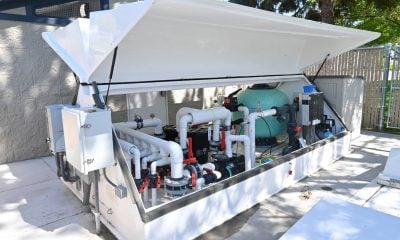
Drought Has Pool Pros Looking For Ways To Recycle Backwash
The drought in California has pool pros looking for ways to recycle backwash and conserve water in swimming pools.


The ongoing drought in the Western states suddenly has pool professionals looking at innovative new ways to conserve water. Consequently, one new approach has been to recycle the backwash from filter cleanings.
Drought Puts Pools Directly In Cross Hairs of Water Conservationists
The drought that has plagued many parts of the United States in recent years has been nothing short of disastrous. Record low levels of precipitation have led to widespread water shortages, with many states implementing mandatory water restrictions. The situation has been particularly dire in California, which recorded the driest 22-year period in at least 1,200 years, according to a new study.
Recent storms have added to the snowpack in the Sierras which supplies 30% of California’s water. Experts however say that it isn’t enough. While these storms have provided some relief, they are unlikely to have a significant impact on the mega-drought that California has been experiencing.

For now, major cities like Los Angeles have managed to avoid instituting measures that would prevent homeowners from filling swimming pools. The problem does however make a good case for backwash recycling as it has a direct impact on water usage.
Conservation Study Shows Primary Culprits of Water Loss
A study conducted in 2010 by the California Urban Water Conservation Council looked at ways that water is lost in swimming pools. The study pointed out that the primary causes of water loss in pools are leaks, splash out, evaporation, disinfection, and filter operation.
The topic was certainly a hot-button issue at last year’s Pool Industry Expo in Monterrey, CA. It’s also a reason why products like Best Clear System have suddenly become very relevant to the conversation about water conservation. The system promises to help homeowners save thousands of gallons of water while keeping their pool filters effortlessly clean and helping protect the environment.
Recycling Backwash Conserves Water
To get a better understanding of what the Best Clear System actually does, we spoke with industry veteran and CEO of Aquos Pools, Harold Tapley.
“In a nutshell, the Best Clear System actually clears the water so you don’t have to dump it on the ground and lose it,” said Tapley.


Why Recycle?
“When you’re discharging, be it backwashing or when you’re washing the cartridge out, you’re getting salts into our fresh water supply. It’s going into the ground or drain in the street and down to the creeks and streams,” explained Tapley, “that creates a conundrum for our industry because it’s almost like Vegas. What happens in Vegas stays in Vegas. Well, what happens in the backyard sort of stays in the backyard because you can’t really see what’s going on. When you see that big white stain in the gutter from D.E. being discharged or somebody out there hosing a cartridge off in the gutter, that really brings it to your attention.”
“If you’re backwashing, the things that are in that backwash, besides salts and chlorine are metals. Typically it’s copper which is deadly to algae in a pool, of course, but when it enters our ecosystem, it creates a lot of problems,” said Tapley, “the discharge itself typically is just sediments of clay or sand, but it does have some stuff in it that’s not good for the environment.”
Pool Pros Put On Notice
Many pool professionals have already begun getting fined according to Tapley. “Here where I live in the Central Valley, the city has actually hired water patrol police. We need real police, but the water patrol, they’re out. There are huge stiff fines for wasting water and dumping it into storm drains and improper disposal is costing pool service technicians a ton of money when they don’t do things the right way. At P.I.E. I ran into several service guys that told me that they had already been fined up to $1,000 for backwashing cartridges in the street,” said Tapley.
By The Numbers
To put the numbers into the proper context, Tapley explained just how much water is used in backwashing filters each year. “A typical backwash for a sand filter is 200 to 250 gallons and it’s recommended to backwash them once a week,” explained Tapley, “that’s over 5,000 gallons a year of freshwater that you have to put back in the pool to replace it. Keep in mind that the skimmer starts grabbing air because the water level drops. So you got to double that. I mean, you’re really talking about 10,000 gallons per pool.”
“When you’re cleaning the filter and you dump a couple of hundred gallons of water out of the ground, you lose that pretreated water,” explained Tapley, “and when you’re putting the fresh water back in, then you got to go right back to your test kit and start readjusting the pool. The service guys realize that every time that they have to put more chlorine in because they just top the pool back up and give it a couple of hundred gallons of water. So that said, I feel like when we have pretreated water that we’re capturing and putting it right back in, that is a savings right there itself. If it is a saltwater pool, of course, then we’re saving the salt water.”
Interested in learning more about recycling backwash using the Best Clear System? Listen to our entire conversation with Harold Tapley on the Pool Magazine podcast.







Rico Rock now offers a compact, lightweight, cast concrete modular water fountain that is easily mortared together to create a consistently beautiful waterfall for pools. This low-profile waterfall is easily integrated into any pool design using multiple base pieces that even allow for installation on a radius. Unlike real stone that is heavy and can be hard to manipulate into a functional, aesthetically pleasing fountain, this modular fountain package is designed to always look great—without the worries of leaks or awkwardly stacked stones. Shown here with an optional side boulder. Perfect renovation add-on to any existing pool—for added fall revenue.
Rico Rock, Orlando, FL
(888) 717-3100
www.ricorock.com


Partnership adds local sales and factory-authorized service support for two of the industry’s most widely used commercial robotic pool cleaners
Landmark Aquatic, a nationwide provider of commercial aquatic facility design, construction, and maintenance services, has announced a partnership with Maytronics to bring the Dolphin WAVE 100 and WAVE 200 XL robotic pool cleaners to commercial aquatic facilities across the United States.


Under the agreement, select Landmark Aquatic locations will also become official Maytronics service providers, giving aquatic facility managers a local, single-source solution for both equipment and ongoing cleaner maintenance — reducing downtime and eliminating the need to ship units out for repair.
The Dolphin WAVE 100 and Dolphin WAVE 200 XL are proven workhorse cleaners trusted by aquatic facility managers nationwide. Designed for mid-range commercial pools as well as large community and resort pools respectively, the WAVE 100 cleans pool floors, walls while the WAVE 200XL is engineered to handle commercial pools of any shape, up to Olympic sized pools. Because the robots operate independently of a facility’s main circulation pump, they can also help reduce energy consumption and labor demands associated with manual vacuuming. Additionally, these cleaners use Dolphin’s CleverClean™ smart navigation system for complete pool coverage.
“For many years, we have proudly partnered with Maytronics as their commercial pool vacuums deliver outstanding quality, reliability, and performance,” explains Brian Spear, General Manager for Landmark Aquatics in Indiana. “Their commitment to excellence has enabled us to provide a truly unique in-house Maytronics Authorized Service Center that sets Landmark Aquatic apart from the competition. Together, this long-standing partnership has allowed us to exceed customer expectations by combining our experience with premium equipment and personalized service. We value this relationship with Maytronics and look forward to continuing to deliver exceptional results for our customers for years to come.”
Facility managers can learn more about the Dolphin WAVE commercial line at maytronics.com/en-us/robots-commercial-pools.html or contact their local Landmark Aquatic office.
About Landmark
Landmark Aquatic is a nationwide provider of commercial aquatic facility design, construction, and maintenance services, with more than six decades of industry experience. Serving clients across most of the U.S., Landmark delivers construction-led solutions and on-going support through its AquatiCare maintenance team, ensuring excellence “for the life of your pool.” Committed to the full lifecycle of every facility, Landmark prioritizes long-term partnerships while adapting to client needs through exceptional service, operational excellence, and forward-thinking solutions. For more about Landmark Aquatic visit www.landmarkaquatic.com.
About Maytronics
Maytronics is a global leader in the swimming pool industry, specializing in pool water solutions. Maytronics’ Dolphin pool cleaning robots are a highly recognized global brand. Dolphin robotic pool cleaners continuously set new industry standards for innovative technology, design, reliability, service and most important, meeting our brand promise of exceptional pool water experience – bringing a superior level of cleaning to the pool water. Their flagship Dolphin cleaners are renowned for being “plug-and-play” autonomous machines that operate independently from the pool’s main pump, which lowers energy consumption and reduces chemical usage. The robotic cleaners typically feature advanced navigation, multi-directional scrubbing, and smart app capabilities. Learn more about their commercial cleaners at
https://www.maytronics.com/en-us/robots-commercial-pools.html.


Variable-speed pumps are the standard on nearly every pad now, thanks to the DOE efficiency rule that took effect in 2021 (Federal Register, DOE Energy Conservation Standards for Dedicated-Purpose Pool Pump Motors). Most pool professionals already know that story. What gets less attention is a more useful question: once a pump can run at any speed, what should it actually be basing that speed on?
The answer matters more than the mandate itself. A pump that sets its speed off an accurate, real-time flow measurement, rather than off a preset RPM or an estimate, doesn’t just save energy. It changes how well the heater, the filter, the sanitizer, and the plumbing all work together, because every one of those components was designed around a target flow rate, not a target speed.
The Physics Behind the Savings
The energy case for variable speed starts with the pump affinity laws. Flow rate scales roughly linearly with motor speed, but the power required to move that water scales with the cube of speed. Cut motor speed in half, and flow drops by half, while power consumption falls to roughly one-eighth of what it was (Pentair, “Pump Affinity Laws and Energy Savings”). That cubic relationship is why ENERGY STAR certified pool pumps are rated to use roughly 70% less energy than single-speed models over a season (ENERGY STAR, Pool Pumps).

That math only holds, though, if the pump actually knows what flow rate it’s producing. Running slower saves energy only when the resulting flow still does the job the system needs done. Guess wrong in either direction, too low and the water isn’t turning over or sanitizing properly, too high and the savings disappear, and the pump stops being an efficiency upgrade and starts being a liability.
Why an Accurate Flow Rate Changes Everything Downstream
Every piece of equipment on a pad, not just the pump, is engineered around a specific flow window, and that’s where basing pump operation on measured flow rather than estimated flow starts to pay off across the whole system.
Heat pumps and gas heaters have minimum and maximum GPM requirements. Fall outside that window and the equipment throws error codes, cycles inefficiently, or simply underperforms, wasting the energy it does use. Salt chlorine generators typically need roughly 20 to 25 GPM to activate the flow switch that tells them water is moving; a flow number that’s off by even a modest margin can mean a salt cell that isn’t producing chlorine consistently, even though the pump appears to be running fine. Sand and cartridge filters are rated for a specific flow rate per square foot of filtration area, and running above or below that rate affects both water clarity and how long the filter media lasts.
Turnover time (how long it takes to circulate a volume of water equal to the pool’s total capacity) ties all of this together. It’s the benchmark that determines whether sanitizer actually reaches the whole body of water on schedule, and it’s explicitly defined and capped for public pools under the CDC’s Model Aquatic Health Code, the model framework many state and local health departments use (CDC, Model Aquatic Health Code). A pump that’s only holding a preset RPM has no way to confirm turnover is actually happening on schedule once a filter starts loading or a valve gets adjusted. A pump that’s tracking real flow can hold that target and adjust automatically as conditions change.
The compounding effect is the real story here. A system running on accurate flow data tends to need less chemical correction, because circulation stays consistent. It puts less strain on the motor and bearings, because the pump isn’t overworking to compensate for a resistance change it can’t see. It produces fewer callbacks for cloudy water or error codes, because the equipment stays inside its designed operating window instead of drifting out of it as the season goes on. None of those benefits show up on a spec sheet next to the wattage number, but they’re where a lot of the real value, and the avoided service calls, actually live.

What This Looks Like in Practice
Most variable-speed pumps today are open-loop: they hold whatever RPM was programmed in, regardless of what’s happening in the plumbing. Some newer models estimate flow indirectly, using motor load at a given speed compared against a factory-built pump curve. That’s an improvement over a bare RPM dial, but it’s still inference, not measurement, and it can drift as a filter loads or a motor ages.
One pump closes that loop directly. H2Flow Controls’ Nautis VSF pairs a built-in FlowVis flow meter with its Eco-Flow control system to hold a target GPM within roughly plus or minus 2%, adjusting motor speed automatically as real-world conditions shift rather than holding a fixed RPM. It’s a useful illustration of the underlying principle: when the pump’s decisions are based on the actual flow rate moving through the system, everything downstream, the heater, the filter, the sanitizer, the plumbing, benefits from it.
For installers and service techs, that’s the more useful question to bring into the next conversation about a pump replacement. Not just “is it variable speed,” but “what is it using to decide how fast to run?” The pump that knows its real flow rate is the one that keeps the rest of the system running the way it was designed to.
Read the Summer Issue of Pool Magazine

See more of our coverage in your search results

 RENOLIT Launches ONE Augmented Reality Pool Design App
 Inside the 2026 Million Dollar Pool Design Challenge
 Franklin Electric Shares Global Water Perspectives Through Art Exhibit
 SafeSplash Highlights Early Water Safety During Baby Safety Month
 5 Ways Jandy’s New AquaLink® EDGE™ Is Changing the Game for Pool Pros
 Why Pools Matter: Pool Horizons Takes Its Message Global
 Ownership Group Acquires Shasta Pools, Announces Expansion Plans to Offer Complete Home Services

 Hate Cleaning Your Pool? Aiper Launches New Scuba Series Collection
 Florida Swimming Pool Association (FSPA) Scores $20 Million Industry Win with Florida Department of Health
 A New Name Reflecting a Legacy of Innovation and a Commitment to the Future
 PoolCorp Announces Investor Day
 Jandy JXiQ – A SMARTER Way to Heat The Pool
 Paragon Pools Wins GOLD in 2026 Vegas Viewer’s Choice Awards
 Maxi Pool Introduces New 2025 Formula Chlorine Tablets for Superior Pool Care
 Sponsored Advertisement
 Sponsored Advertisement
 Industry News4 weeks ago
Landmark Aquatic Names Jason Hill Kansas City General Manager

 Pool News4 weeks ago
New FCC Robotics Rules Could Affect Future Robotic Pool Cleaners

 Press Releases3 weeks ago
Veridian Service Partners Names Dave Peterson Chief Sales Officer

 Pool News3 weeks ago
Amazon Drone Drops Package Into Swimming Pool — And It’s Not the First Mishap

 Manufacturer3 weeks ago
TPSC Launches East Green Teak Collection

 Press Releases4 weeks ago
Natalie Hood Swims for Every Child A Swimmer

 Manufacturer3 weeks ago
Pentair Pool and Pool Brain Launch Technology Integration to Deliver Smarter, More Proactive Pool Service

 Press Releases4 weeks ago
Pentair Pool Earns Top Safety Honors in North Carolina
You must be logged in to post a comment Login