





Pool Service News
How One Pool Company Is Using Its Field Service Management System to Service Regionally and Sell Nationally


Small businesses are an engine of growth in the U.S.: accounting for 99.9% of all companies, delivering 46% of the nation’s GDP, and employing 45.9% of all Americans in the workforce. While service-oriented small businesses often begin by selling to a local client base, they typically must transform processes to expand. SaaS-based field service management (FSM) platforms with automated processes help small businesses scale efficiently to serve a regional customer base while maintaining service quality with a personal touch. And if service companies branch out into offering products, they can also use these same tools to streamline customer interactions, ship products, and compete against a wider range of companies.
Increasing Operational Efficiency with Zuper’s FSM Platform
Cowboy Pools is an Austin, TX-based company owned and operated by Aaron Weiss and Amanda Shaftel. The company has developed a popular smaller-scale, above-ground preassembled stock tank pool, The Honcho, that can be quickly and cost-effectively installed in most backyards.
With business booming, Weiss and Shaftel went looking for a solution to optimize operations and workflows further. The company was using a legacy solution with disconnected processes, increasing staff work strain and delaying job completion. It typically took Cowboy Pools one hour to schedule a pool install in their Austin and Houston markets as staff navigated disjointed processes, email, and other tools.

Cowboy Pools’ owners wanted to use automation to increase staff productivity and improve the customer experience. This was the start of our partnership with Cowboy Pools. With Zuper, they easily automated and linked customer service, field service teams, and back-office staff to work productively to complete jobs end-to-end.
For Cowboy Pools, three process changes were key to the company’s rapid growth over the last 12 months:
Automating Scheduling and Dispatching
The Cowboy Pools team uses Zuper’s integrated calendar and automated scheduling and dispatching functionality to plan site visits, installations, and repairs. These tools give Cowboy Pools a top-down view of business activities and staff to maximize field service efficiency. “We can now do all scheduling and dispatching within Zuper, which wasn’t possible with our previous tool. As a result, we have become more organized and responsive to customer needs,” says Aaron Weiss, Co-founder of Cowboy Pools.
With automated scheduling and dispatching, the company has decreased the timeframe to order and install a pool regionally by 80%. Not only is manual back office schedule management streamlined, but technician utilization is improved because the technology ensures staff are allocated to the job best fit for their skills and schedule. In addition, increasing responsiveness has strengthened customer relationships. The company’s net promoter score (NPS) has increased.
Since today’s customers expect a heavily automated experience, automating scheduling and accelerating job completion time can help small businesses start relationships on the right foot, leading to great online reviews, higher NPS scores, and more new business due to social proof.

Using a Mobile App
At Cowboy Pools, each field service technician completes 2-7 daily jobs. As a result, staff must be able to work efficiently across locations and in different conditions.
Zuper provides job management tools that techs can access and use, even when cell service isn’t available, keeping them productive and able to complete jobs more easily. With mobile, all job details exist in one place. For Cowboy Pools, this ensures customer satisfaction is maintained because every technician has access to the history of the account and previous service and can share before and after pictures directly with the customer. The mobile app ensures regular communication with the customer enhancing the overall experience.
“Our field services team uses the mobile app to see all of their jobs at a glance, including the data and tools they need to complete jobs effectively and efficiently,” says Weiss. Tools such as asset management and service checklists help keep staff focused on completing their day’s jobs and ensuring that every customer receives the same high standard quality of care.

Field technicians want to use apps that offer guided workflow, so they don’t have to carry physical paperwork or navigate broken processes. Small businesses that move from paper-based processes to automated job management can typically achieve productivity gains of 20-30% on average. Pairing automation with training and upskilling can also help improve technician retention.
“We view our FSM tool as key to keeping our field teams happy. These employees are in high demand in our regional market and finding ways to make their jobs easier is important for morale.” In the last several months, Cowboy Pools has improved field staff retention by 30%.
Sending Automated Invoices and Payment Reminders
Invoice automation simplifies the billing process significantly for Cowboy Pools by calendar customization reducing manual work for back-office staff, eliminating errors and automating payment reminders. As a result, they can focus on proactive customer outreach to earn business and reduce day sales outstanding (DSO), improving the organization’s capital position.
Back-office teams that automate formerly disconnected invoicing and payment processes can expect to reduce DSO and focus teams on customer communications and exception management. That means better working capital and less bad debt.
Galvanizing Growth with Streamlined Processes
Cowboy Pools is now selling its standardized product, The Honcho, nationwide. By automating back-office processes and improving daily technician efficiency, the company has been able to expand its offering beyond the Houston and Austin regions.
Other pool or service-based companies can learn from Cowboy Pools’ success and embrace full-service field management software to streamline workflows, accelerate job completion, and ensure timely invoicing and payment. With these capabilities, they can enter new geographic markets, compete with a broader range of businesses, and deliver exceptional service that wins new customers and delights existing ones. And by managing growth efficiently, they’ll also notch greater profitability.


A pool service technician in Charlotte County, Florida, suffered multiple facial fractures when a pressurized pool filter lid blew off and struck him in the face. Weslee Blakeslee spent two nights in the hospital after the Nov. 4 incident.
Blakeslee told the station he was working on a pool filter when pressure built rapidly. A lid came off, cutting his cheek and knocking him to the ground. Nearly a week later, the swelling had gone down, but he said the left side of his face was still numb, making it difficult to brush his teeth. Even wearing glasses put pressure on his injured nose.
“This was just a regular Wednesday, and it could have been so much worse,” Blakeslee told Gulf Coast News, which originally broke the story.

A GoFundMe co-organized by his wife, Ana Blakeslee, says he was transferred to a hospital in Fort Myers for specialist evaluation. The family’s account describes nine fractures in his face, including his jaw, cheek, nose, and bones surrounding his eye.
Pool filter failures have caused deaths and serious injuries in the past
Blakeslee acknowledged how fortunate he was that his injuries weren’t far worse, and is currently recovering at home. Other pool workers have died in similar incidents. In June 2023, a worker opening a residential pool in Sandy, Utah, was killed when a filter lid blew off and struck him in the face. The investigation summary says it remains unclear what he was doing when the lid separated.
In December 2012, a filter housing lid struck a worker in the head at a residential pool, causing facial fractures and putting him in the hospital for two weeks. OSHA’s accident summary noted deformation on the ring clamp that secured the lid. Investigators reported that the bolt holding the clamp together appeared to have pulled free under excessive pressure.
A similar injury happened to a Florida homeowner. In a 2020 investigation, Tampa Bay’s WFTS reported that David Shimkus had just finished cleaning his pool filter in Belleair Bluffs when the metal top blew off and struck him in the forehead. He told the station he was still dealing with daily pain from the injury about a year later.
For service crews, the clamp on a split-tank filter is a pressure-retaining component. The ANSI/APSP/ICC standard for above-ground and on-ground residential pools addresses that hazard directly. It calls for perimeter-clamped filter tanks to release air pressure gradually before the clamp disengages the tank halves. The Florida incident leaves an open question about which component failed. The earlier cases show how serious the consequences can be when a lid separates.


Pool service companies rarely grow all at once.
A manageable weekly route becomes a larger customer base. Then comes another technician, another truck, repair work, equipment installations, office staff, sales and marketing. Eventually, the owner is no longer just managing pools—they are managing a growing organization.
That was the progression for Scott Reynolds, owner of Purpose Pools in Las Vegas.

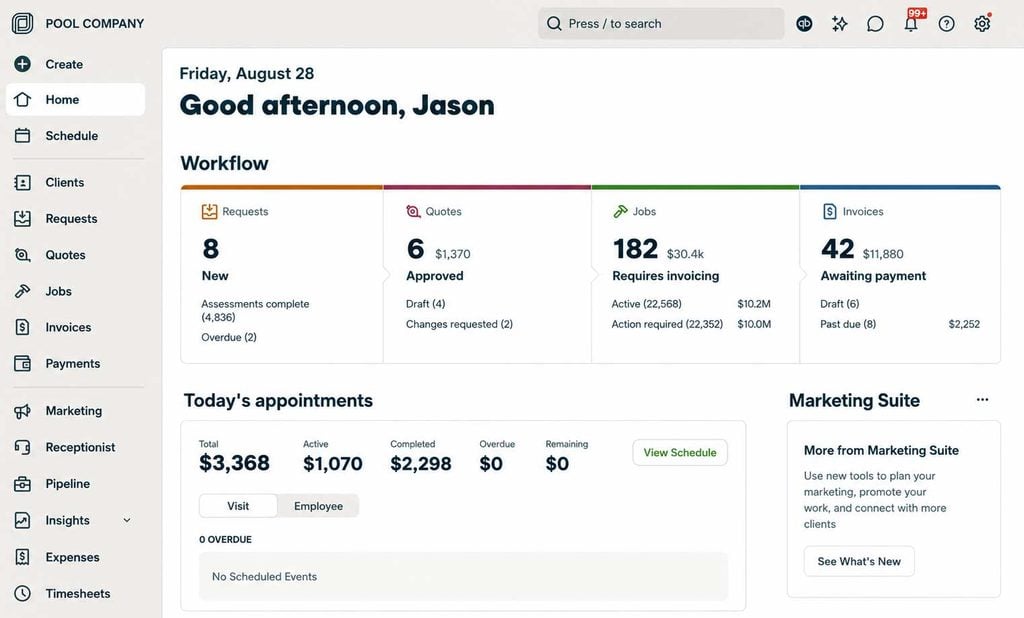
Jobber, a field-service management platform for scheduling, customer communication, estimates, invoicing and related operations, has become part of the company’s operating infrastructure as Purpose Pools has expanded. More recently, Reynolds has focused on a different challenge: using the company’s data to make smarter decisions about marketing, profitability and growth.
His experience reflects a broader shift among service contractors.
Software Is Becoming a Business Essential
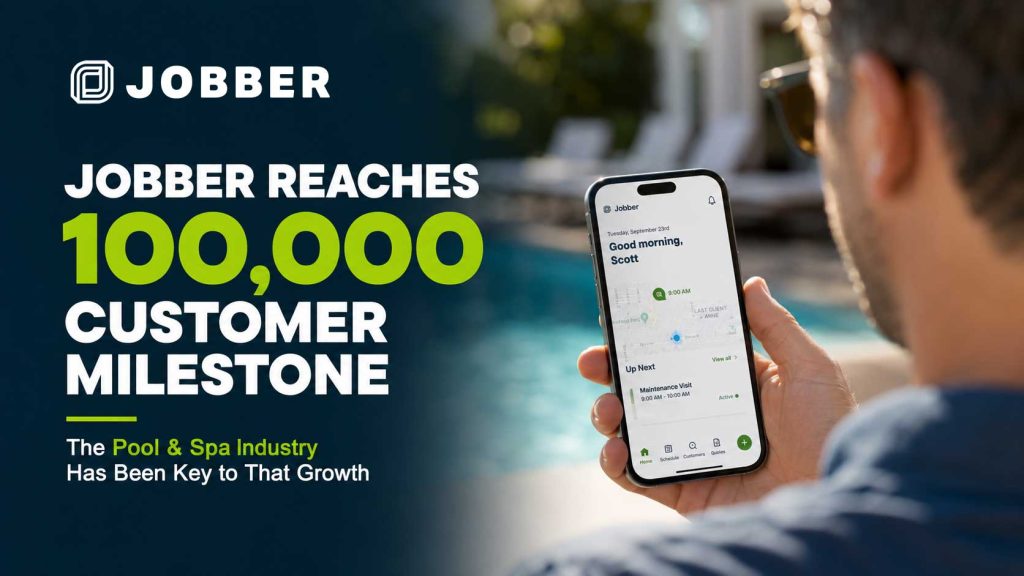
Jobber recently surpassed 100,000 paid customers. Moly Milosovic, Jobber’s Head of Community, says service professionals in the pool and spa industry have been a key part of their growth story.
“I’ve been going to trade shows for years, including a lot of pool industry shows, and back then the rebuttal I always heard was, ‘I want to learn more, but I don’t think I need it yet,’” Milosovic said. “I don’t hear that anymore.”
Milosovic said contractors increasingly recognize that operational software is not something to postpone until the company reaches a certain number of employees, trucks or accounts.

“There’s so much more awareness that software doing work and tracking work for you is a smart investment as soon as you can afford it,” Milosovic said. “It’s become more like table stakes.”
For Purpose Pools, that investment has supported a transition from a relatively simple cleaning route to a more complex service and repair operation.
Choosing a System That Can Scale
Reynolds began his search for field management software in 2022. He had prior experience with enterprise software and knew that a platform with extensive functionality was not necessarily the easiest system to operate.
“I came from a corporate background where we relied heavily on Salesforce, so I’m used to all the bells, whistles and features, but it’s extremely complex,” Reynolds said.
Before adopting a new system, Purpose Pools had worked through other solutions and developed a clearer understanding of its needs.
“I was looking for a really robust platform, and we finally landed on Jobber,” Reynolds said. “It was super straightforward and easy to use.”
For a service business, usability matters because the platform needs to work for office staff, salespeople, technicians and management—not just the person responsible for implementing it.
Support Beyond Onboarding
Reynolds said the company’s rapid adoption of Jobber has also been shaped by the personal attention he receives from his account specialist.
“Probably what has impressed me most has been the support,” he said.
He initially expected a typical onboarding period, followed by a more self-directed relationship with the platform. Instead, Jobber continued to provide assistance as Purpose Pools added people, services and workflows.
“I thought it might just be that first 90 days of, ‘Let’s get you started and make sure you’re successful,’ but since we signed up in 2022, that support has continued all the way through today,” Reynolds said.
Growth Creates More Moving Parts
“When we first started out, we were just doing weekly cleanings,” Reynolds said. “Now we push about 100 customers a week through the platform between service calls, cleanings and repairs.”
The team has grown alongside the customer base, with employees now working across sales, administration and operations.
“As we’ve grown our customer base, we’ve also grown the team and added people to sales, administration and operations,” Reynolds said. “Jobber makes it easy to get them up to speed and onboarded because the tool set continues to be straightforward and simple.”
Avoiding Costly Operational Gaps
The need for an integrated system usually becomes apparent when information starts falling through the cracks.
A technician may forget a follow-up. An estimate may not receive a response. A repair could be completed without an invoice being sent. A customer note may exist only in a text message or handwritten file.
“Think about when you lost track of something you wrote down, or when you literally forgot to invoice someone for a job worth thousands of dollars,” Milosovic said.
Those breakdowns become more expensive as a company handles greater volume.
“One of the biggest things Jobber helps us with is avoiding that memory lapse,” Reynolds said.
Faster Repair Follow-Up
At Purpose Pools, Jobber helps centralize customer communication and task management across recurring service and repair work.
That structure has helped the company reduce its repair sales cycle.
“Our entire sales cycle is less than 40 hours,” Reynolds said. “From the time someone submits a request or makes a phone call, we can be completing the repair.”
The system allows customers to respond when it is convenient for them instead of forcing every interaction into a phone call or office-hours conversation.
“They can answer the text when they want, or log into the Client Hub when they’d like to,” Reynolds said. “Jobber is always working for us, but it’s also working on the customer’s timetable.”
Empowering Pool Pros To Answer Bigger Questions
Once Purpose Pools established stronger systems for managing jobs and customer communication, Reynolds turned his attention to marketing efficiency.
“For us, the shift probably happened about a year ago,” Reynolds said. “We went from, ‘Let’s just spend. The top line looks really good,’ to asking how we could become more efficient.”
For many pool companies, advertising platforms provide useful—but incomplete—data. They can show impressions, clicks, calls and submitted forms, but they do not always reveal whether those leads became paying customers or generated meaningful revenue.
“We wanted to know where the lead was coming from, what channel produced it and what that lead cost us,” Reynolds said. “Ultimately, we wanted to know what revenue it generated.”
Connecting Ad Spend to Revenue
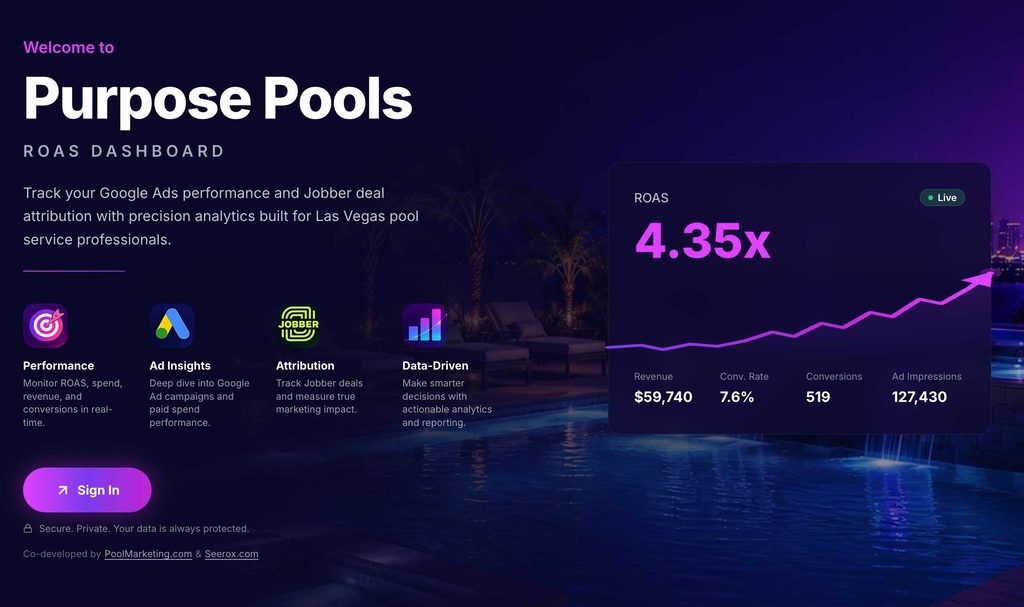
Working with digital agency PoolMarketing.com, Purpose Pools developed a custom return-on-ad-spend dashboard that connects advertising performance with customer, sales and revenue data flowing through Jobber’s API.
The dashboard is a custom integration built by PoolMarketing.com, rather than a native Jobber reporting feature. It allows Reynolds to track a lead after it enters the business, including the source, current sales stage and outcome.
“Now I’m able to tell when a lead hit the system, what stage it’s in and what the response was,” Reynolds said. “That allows us to make more efficient decisions.”
Better Data Creates Better Decisions
At scale, modest improvements in advertising efficiency can have a significant impact.
“As you grow, even being able to save a couple of percentage points on ad spend and reallocate that money somewhere else is a really big deal,” Reynolds said.
A channel that produces low-cost leads is not necessarily the best channel if those leads do not become profitable jobs. On the other hand, a higher-cost source may warrant greater investment if it consistently produces valuable repair work, installations or recurring service accounts.
The objective is not simply to identify wasted spend. It is also to invest more heavily in the channels that consistently generate worthwhile customers.
“I think that’s what a lot of owner-operators miss out on—really working through the efficiency of their costs and expenses and knowing where the money goes and why it goes there,” Reynolds said. “In our case, we can double down and spend more on the channels that are working because we have the data in front of us.”
Turning Operational Data Into Insight
Jobber occupies an important place as the source of truth in the attribution process because the ultimate value of a marketing lead is determined by what happens after the initial inquiry.
Customer records, estimates, jobs, invoices and revenue data provide the operational information needed to evaluate whether an advertising source actually produces profitable work.
For Jobber, that represents an evolution in the role of field-service software. The platform is not only a scheduling and communication tool; it can also become a source of business intelligence.
“It takes that kind of discipline—knowing your numbers and making those percentage-type decisions,” Milosovic said. “You need that visibility.”
Demand for Better Reporting
Milosovic said the Purpose Pools dashboard illustrates the type of analysis that a growing number of contractors want.
“That dashboard looks amazing,” she said. “I would love to see a dashboard like that in Jobber. We’re investing in helping customers understand their numbers better so they can make those kinds of high-growth decisions.”
Jobber has seen similar demand since introducing its own marketing tools.
“When we launched our marketing suite, the response was immediate: ‘How do you give me more information to make smarter decisions?’” Milosovic said. “We’ve continued investing in those marketing tools to give people that kind of visibility because there absolutely is demand for it.”
Revenue Alone Does Not Equal Success
For Reynolds, marketing attribution is part of a broader shift in how he measures the health of Purpose Pools.
“I think when most pool companies start out, we generally chase that vanity top line of, ‘Hey, I’m doing X amount of revenue,’ but we’re not really understanding the profit margins,” Reynolds said.
He said he often hears similar stories from other contractors who have built significant revenue but still struggle financially.
“I’ll hear, ‘We’re doing X amount a year or X amount a month, and that’s really good—but I’m also kind of going broke,’” Reynolds said.
A company can look successful on paper while dealing with poor pricing, escalating labor costs, weak material markups, excessive overhead or unprofitable marketing spend.
Knowing the Cost of the Work
Purpose Pools has responded by becoming more intentional about job costs and pricing.
“We need to understand our costs,” Reynolds said. “We’ve created a tiered cost ladder so we know what a job costs and what markup needs to go with it. That helps make sure we’re hitting our bottom-line numbers at the end of the week, quarter or year.”
That level of discipline becomes increasingly important as a business grows. More jobs do not automatically create more profit. In some cases, growth can magnify inefficiencies that were less noticeable when the company was smaller.
Jobber’s reports and operational data can support that analysis by giving contractors a clearer view of the work being performed, the revenue being generated, and the processes behind it.
Pool Service: A Key Piece of the Puzzle
Across Jobber’s customer base, the volume of operational information has grown substantially. The company says its 100,000 customers have completed nearly 90 million jobs representing more than $100 billion in services.
Pool service and repair represent an important piece of that growing field-service economy. Unlike businesses built primarily around one-time projects, pool companies often combine recurring maintenance with repair and installation work, sending technicians into the field day after day while managing an ongoing relationship with the customer. It’s a model Milosovic sees as particularly well aligned with the platform Jobber has built.
“Pool service is huge. It’s growing. It’s year-round outdoor work, and it’s exactly who Jobber was built for — people who are going to homes and commercial properties,” Milosovic said.
As those companies grow, the information generated through their day-to-day operations can become increasingly valuable. For Milosovic, the opportunity is to turn that data into actionable business guidance.
“We have this exciting opportunity because you’re already doing your work in Jobber and all of those numbers are in there,” she said. “The question becomes: How do we surface that information so you can get advice that helps you make more money?”
For Jobber, that is the larger opportunity: becoming more than a platform for scheduling and job management.
“We want to be your most trusted partner, your most trusted employee and your most trusted advisor,” Milosovic said. “We want to help surface those opportunities.”
Ready to take a deeper dive?
Listen to the full conversation with Moly Milosovic and Scott Reynolds for a practical look at how Purpose Pools uses Jobber and custom reporting to manage service work, track marketing results, improve operational follow-through and make more informed decisions about growth and profitability.
Pool Service News
SPS PoolCare Celebrates Five Years, 50,000 Recurring Customers
Nation’s largest pool services company enters the Atlanta market with Good Boy Pool Services acquisition


SPS PoolCare, the largest swimming pool services company in the United States, celebrated its fifth anniversary by completing its acquisition of Good Boy Pool Services and reaching the milestone of 50,000 recurring maintenance customers. The acquisition expands SPS PoolCare’s service area to the Atlanta market and marks more than 220 acquisitions since its founding.
Backed by Storr Group, SPS PoolCare operates across Texas, Florida, Arizona, Nevada, and Georgia, serving more than 50,000 weekly recurring residential and commercial customers and performing over 2.5 million pool services annually. SPS PoolCare leverages technology to streamline operations, enhance service delivery, and elevate the customer experience across every market it serves.
“This anniversary marks five years of building something the pool industry has never seen before, and our Atlanta market expansion with Good Boy Pool Services is proof that we are not slowing down,” said Lance Martin, CEO of SPS PoolCare. “Our exceptional team and technology-forward approach gives us the tools to grow quickly while never losing sight of what matters most: delivering exceptional service to every customer, every time.”

SPS PoolCare’s growth trajectory includes recent landmark acquisitions of Pool Troopers and the majority of the pool service operations of Amenity Pool Services, two of the largest pool service companies in the United States. Those acquisitions significantly expanded SPS PoolCare’s geographic presence across the Sunbelt, added thousands of new customers, and established the foundation for the company’s continued expansion into new markets, including Atlanta.
“Five years ago, we set out with a simple goal: build the most trusted pool services company in the country,” said Fraser Ramseyer, Founder of SPS PoolCare and Founder and CEO of Storr Group. “More than 220 acquisitions later, that mission remains unchanged. Every business that joins SPS strengthens our ability to invest in our people, technology, and local operations while preserving the customer relationships that made those businesses successful.”
SPS PoolCare continues to pursue acquisitions in existing and new markets as it works toward becoming the most comprehensive pool services platform in the nation.
About SPS PoolCare:
As the #1 swimming-pool services company in the United States, SPS PoolCare is on track to perform over 2,500,000 weekly recurring pool services in 2026 and employs more than 1,300 staff across five states. Backed by Storr Group, the company is focused on growing its family of brands across the Sun Belt as it continues to make owning a pool a joy. SPS PoolCare is committed to creating a world-class service experience for its customers and being an employer-of-choice for its team members. Read more at spspoolcare.com

About Storr Group:
Storr Group is an operationally focused lower-middle-market private equity firm that backs, builds, and scales industry-leading platforms. With a rich background in business building, Storr combines world-class operators with strategic M&A, deep integration, and sophisticated technology to drive sustainable growth and long-term value. Storr Group has offices in West Palm Beach, New York City, and Austin. To partner today, visit storrgroup.com
Read the Fall Issue of Pool Magazine

See more of our coverage in your search results
 Sponsored Advertisement
 Aiper Advances the Intelligent Pool Cleaning with Evolved AI and Solar Automation at PSP Expo 2026
 Pool Magazine Announces Strategic Partnership with MyEstimator.pro to Provide Real-Time Pool Pricing
 Solenis to Unveil Revolutionary Smart Pool Technology at PSP Expo
 Pool Corporation to Acquire Team Horner, Expanding Distribution Network in Florida
 PHTA Announces 2027 Board of Directors
 Poolwerx Opens Second Northeast Florida Store on Amelia Island
 Pool Industry Heads to New Orleans for the 2026 PSP Expo
 Rolls-Royce Recreates One of Rock’s Most Infamous Poolside Legends
 Soake Pools Launches Dual Pool Packages
 Pebble Technology International Introduces PebbleTec Glass Tile
 Texas Pool Freeze Risk Returns as Arctic Cold Puts Major Markets to the Test
 Skimmer Launches Working Capital Through Stripe, Giving Pool Service Professionals Access to Fast, Flexible Financing
 Pentair Pool and Pool Brain Launch Technology Integration to Deliver Smarter, More Proactive Pool Service
 Maytronics Debuts Dolphin EON — The World’s Most Meticulous Pool Cleaning Robot
 Sponsored Advertisement
Pool Magazine Podcast
 What’s Your Pool Company Really Worth? – Pool Magazine Podcast With Weld Valuations
 iGarden K Series Review: A Pool Pro Puts It to the Test
 Why Waiting Until Spring to Remodel Your Pool Could Cost You Time & Money
 Ready When You Are: The Changing Role of Automatic Pool Covers
 What’s Hot & Trending in Fire Pits and Fire Tables for 2026
 Sponsored Advertisement
 Pool News1 day ago
Pool Corporation to Acquire Team Horner, Expanding Distribution Network in Florida

 Pool News4 weeks ago
Sacred Geometry: Where Architecture, Mathematics and Mosaics Collide

 Pool News4 weeks ago
Anatomy of a Botched Remodel: What Sank the Lincoln Memorial Reflecting Pool Restoration?

 Pool Builder2 weeks ago
Historic Rain in Florida Takes Toll on Pool Job Sites

 Equipment Supplies4 weeks ago
iGarden K Series Review: What We Learned After Months in a Customer’s Pool

 Press Releases3 weeks ago
Watson’s Acquires Tampa Bay Spas, Enters Tampa Bay Market

 Pool News4 weeks ago
Landmark Aquatic Taps Britton Nielsen and Tim Garner to Lead Utah Growth

 Contractors and Builders4 weeks ago
What’s Hiding Beneath The Surface: Artificial Rock Features
You must be logged in to post a comment Login