





Contractors and Builders
Rise of the Movable Pool Floor: Tieleman Pool Technology


Founded in 1970, Tieleman Pool Technology, began as a family-run business specializing in hydrotherapy. In the early days, the company focused on addressing the needs of patients requiring low-impact movement to enhance their rehabilitation. Marijn Tieleman, who eventually took over the company with his cousin about a decade ago, reflects on the company’s origins: “There was a lot of demand for movable floors and different heights. In the ’70s, we were experimenting a lot with trial and error. The focus was on creating solutions for hydrotherapy, but as we advanced, the technology began to catch on for other applications.”
Tieleman recalls, “We transitioned from a purely medical focus to exploring private residential markets. Our hydrotherapy systems had proven their reliability and efficiency in hospitals, so we wondered if we could adapt this technology for home use.” This shift was not without challenges, but it opened up new possibilities for residential applications, leading to the development of movable pool floors that could transform private backyards.

The Technology Behind Movable Pool Floors
Movable pool floor technology, once a niche innovation, is now making waves in the residential market. Tieleman explains, “The technology involves a frame made of high-grade 316 stainless steel, equipped with a hydraulic system. This system, which uses water hydraulics rather than oil, allows the floor to adjust seamlessly to various depths.” The floor operates as a floating platform, which can be raised or lowered via a touch screen control panel. This flexibility enables homeowners to customize their pool’s depth, creating multi-use spaces that can transition from a swimming pool to a functional area for other activities.


Market Appeal
The appeal of a movable pool floor lies in its versatility. Tieleman describes how this technology can transform a backyard: “If you have limited space, a movable floor allows you to use your pool area for different purposes. For example, you can have a pool that doubles as an entertainment space. When the floor is raised, it becomes a level surface suitable for placing furniture or hosting events.” This adaptability is particularly valuable for those with smaller yards or who wish to maximize the functionality of their outdoor spaces.
The speed at which the floor adjusts is one of its most impressive features. “Typically, it takes about 4 to 5 minutes to raise or lower the pool floor,” Tieleman says. This rapid adjustment allows homeowners to transform the pool area quickly, making it ideal for spontaneous gatherings or activities. For smaller changes in depth, the adjustment can be even faster, offering a high degree of flexibility.
When it comes to depth, the possibilities are virtually limitless. Tieleman notes, “The depths we can build these pools are endless, really. We’ve actually built a couple of diving pits that go all the way down to 50, 60 feet for commercial diver training. We can’t use the same cylinder we normally do, of course; it has a little different pulley system on it. But basically, there’s no limitations.”

When considering a movable pool floor, pricing inevitably becomes a factor that would preclude this as a product you’re bound to see everywhere. Tieleman explains, “Pricing really depends on how many options you wish to do. But if you have some stairs or some odd shapes, or unique features it can cost more. I would guess in between 150K to endless, really. But for entry-level, around $150,000. That’s around where you start off with a movable floor,” said Tieleman.
One of the main advantages of Tieleman’s system is its durability and ease of maintenance. “Our systems are built to withstand heavy use,” Tieleman notes. “We use chlorine and salt-resistant materials, and maintenance is minimal. We typically perform annual checks and repairs if needed, ensuring the system remains in top condition.” This emphasis on longevity and reliability adds to the appeal of movable pool floors, making them a practical investment for homeowners.

The design options for these systems are extensive. Tieleman elaborates, “Customization is a significant part of our offering. We’ve created everything from movable jacuzzis and swim-out benches to pool covers with integrated lighting. The possibilities are endless, limited only by the homeowner’s imagination.”
A Recent Case Study
One standout example of Tieleman Pool Technology’s innovation is an ongoing project in the Bahamas. Tieleman shares, “In this project, we designed a pool with two movable floors, each capable of reaching different depths. It was an ambitious undertaking that required meticulous planning and engineering.” The dual-floor system allowed the homeowners to adjust the pool’s depth for various activities, from swimming to hosting large events.

Tieleman elaborates, “The complexity of the project came from ensuring the two floors operated seamlessly together. Each floor needed to function independently while maintaining precise alignment. Our team worked closely with the clients to tailor the system to their specific needs and ensure it met all safety and operational standards.” The project involved integrating advanced hydraulic systems and custom controls, reflecting the high level of sophistication that Tieleman Pool Technology brings to its designs.

This unique movable pool is a prime example demonstrating the potential of movable pool floors in creating unique and versatile outdoor environments. “The feedback from the clients has been overwhelmingly positive,” Tieleman says. “They were thrilled with the flexibility the system offered. It allowed them to have a stunning pool that could adapt to their needs, whether they were hosting a party or enjoying a quiet swim.”
European Design Trend Becoming More Popular With U.S. Builders
As the technology gains traction, its adoption in the U.S. market is growing. Tieleman notes, “In Europe, the response has been phenomenal. In the U.S., it’s starting to catch on as builders and homeowners become more familiar with the technology. The key challenge here is educating the market about how it works and its benefits.”
The trend towards movable pool floors reflects a broader shift in outdoor living, where functionality and aesthetics converge. Tieleman highlights, “People are looking for ways to make their outdoor spaces more versatile. A movable pool floor offers a unique solution, allowing for a customizable environment that can adapt to various needs.”
As movable pool floors become more popular, the notion of keeping up with the Joneses is evolving. It’s no longer just about having a pool in your backyard; it’s about having one that remains hidden until you want to reveal it. This innovation represents a new frontier in outdoor living, where the ordinary becomes extraordinary through advanced technology and thoughtful design.
In an era where backyard spaces are increasingly valued for their multifunctionality, a pool that can seamlessly transition between different uses may well become the ultimate status symbol. For homeowners looking to elevate their outdoor living experience, embracing movable pool floor technology might just be the next big leap.
Ready to Take a Deeper Dive?
Listen to our entire conversation with Marijn Tieleman on the Pool Magazine Podcast.


Artificial rock waterfalls, grottoes, and slides can be some of the most impressive features in a backyard swimming pool. Properly designed and constructed, they can support thousands of pounds of concrete while creating spaces meant to be climbed, walked across and enjoyed for years.
But when the structure hidden beneath that concrete is built incorrectly, the consequences can be far more serious than a few cosmetic cracks.
That became startlingly clear when Jason Lewis of Rockworks Inc. was called to inspect an artificial rock water feature at a home in Arizona. The homeowner had initially contacted Lewis after noticing deterioration in the structure. Lewis warned him that the feature appeared to be approaching failure, but other work was being done around the property and repairs were postponed.

Then the homeowner called again.
“My son fell through the top of it,” the homeowner told Lewis.
Fortunately, the child wasn’t seriously injured. The incident, and the videos Lewis subsequently shared showing what was happening inside the structure, attracted hundreds of thousands of views online.
What viewers saw was alarming. Reinforcing steel that should have been supporting thousands of pounds of concrete had deteriorated so badly that pieces of rebar could be broken apart by hand.

“That was only six years old,” Lewis said. “We opened it up, and he reached his hand in there and just started knocking number three-inch rebar into dust.”
For Lewis, who has spent more than three decades building real and artificial rock features, the failure itself wasn’t particularly unusual. Today, he estimates approximately 70% of his work involves structural repairs, demolition, or rebuilding existing features rather than new construction.
What concerned him was how quickly this particular structure had deteriorated—and how little indication homeowners may have of what’s happening underneath the surface.
How a Pool Feature Can Rot From the Inside Out
The fundamental problem Lewis encounters repeatedly is improperly protected reinforcing steel.
Artificial rock structures rely on steel reinforcement to carry and distribute the tremendous weight of their concrete shells. That steel isn’t supposed to simply sit inside an open cavity. It needs to be properly positioned and encased in concrete.
“The steel has to be encased in concrete, or there’s no long-term structural integrity,” Lewis explained. “I’m not saying anybody’s doing this on purpose, but if you don’t know, you don’t know.”
When rebar remains exposed inside a hollow artificial rock feature, moisture can reach it. Small cracks in the concrete make the situation worse.
“These things do crack. The earth moves, you get hairline cracks,” Lewis said. “You build up some moisture inside there, and you add a lot of water to that if it does crack, and that rust takes off like cancer.”
As steel corrodes, it expands and flakes apart. Eventually, the reinforcement that was intended to support the concrete can effectively disappear.
“They’re holding up thousands of pounds of concrete,” Lewis said. “So when that steel is gone, the concrete just falls in on itself.”
Continuous operation of waterfalls can also contribute to the problem when moisture finds a path into the structure. Lewis advises homeowners to operate these features when they want to enjoy them rather than automatically running them for long periods every day.
“No matter how much you seal it, it’s a big giant concrete sponge,” he said.
On one recent inspection, Lewis drilled two holes into the bottom of an artificial rock feature and estimated that roughly five gallons of trapped water drained out.
Warning Signs Homeowners Shouldn’t Ignore
The difficulty is that an artificial rock feature can still look relatively normal from across the pool while significant deterioration is occurring internally.
Lewis said slides are among the features where he most frequently sees structural problems.
Ordinary hairline cracking doesn’t necessarily mean a structure is about to collapse. Concrete moves, and minor cracking can occur. The warning becomes more serious when those cracks begin separating or when adjoining surfaces move onto different planes.
“When you see those cracks heave, like split and become on two different planes,” Lewis said, “that’s a huge indication that you have a structural problem.”
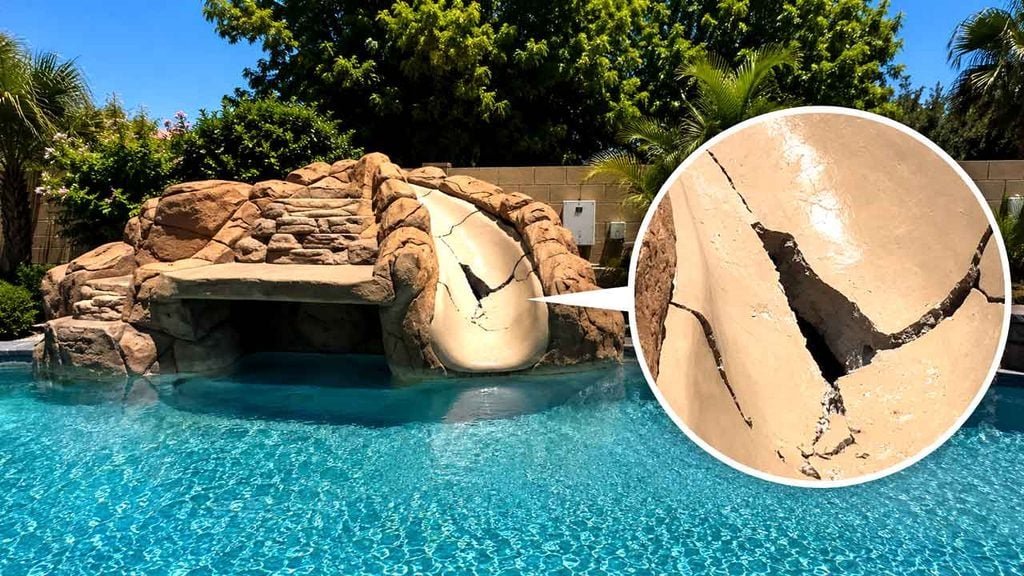
On artificial rock slides, homeowners should pay particular attention to the areas where the slide trough meets the surrounding rockwork. Lewis frequently sees consistent cracking develop along the inside and outside radiuses as the underlying reinforcement begins deteriorating.
In severe cases, gaps may become obvious, stairs may begin separating, or pieces of concrete may loosen or fall away.
His advice to homeowners is straightforward.
“Use your common sense. If it looks dangerous, it’s dangerous. It’s not perfect one day, and then it just falls apart. You can see the degradation over time.”
If cracking begins changing noticeably, sections are separating, concrete is falling away, or a step or walking surface feels compromised, the feature shouldn’t continue being used while everyone waits to see what happens next.
“Let’s stay off this. Let’s just be careful. Let’s call somebody to come and look at it,” Lewis said.
The challenge is that even an experienced contractor may not be able to determine the full condition of the reinforcement from the exterior.
“I don’t know until I open it up,” Lewis said.
On some inspections, Rockworks creates access openings specifically to examine the structure from inside. In one case, stairs had already failed, yet the adjoining slide still appeared remarkably sound. Once the structure was opened, Lewis discovered virtually none of the original reinforcing steel remained.
When a Repair Isn’t Really a Repair
Not every crack requires demolition. Rockworks routinely repairs and refinishes artificial rock features when the underlying structure remains viable.
The distinction is whether the problem is cosmetic or structural.
“When the slide is heaving, when you have chunks of concrete falling off, and you can look inside and there’s not a stitch of steel left, it needs to be torn down,” Lewis said.
That can leave homeowners facing a difficult financial decision. Some choose to remove the unsafe feature and replace it with simpler rockwork rather than reconstructing the original waterfall or slide. Others elect to demolish everything and build a new feature correctly.
What Lewis won’t do is disguise a known structural failure with a cosmetic repair.
He learned how problematic that can become through a project several years ago. Lewis inspected a slide where part of the surrounding rockwork had settled approximately three inches away from the trough. He advised that patching it wouldn’t solve the structural problem.
The homeowner nevertheless wanted it cosmetically repaired for the summer and signed a waiver acknowledging the repair wasn’t structural.
When the feature subsequently failed, the entire matter went before the Arizona Registrar of Contractors. According to Lewis, the pool company he was subcontracted to was ultimately required to correct the problem despite the homeowner’s waiver.
“You guys as contractors should know better,” Lewis recalled the ROC telling the pool builder. “You can’t be fixing things that you know are gonna fail, then ask the homeowner to take the responsibility.”
The experience changed the way Lewis approaches compromised structures.
“You couldn’t give me $100,000 to patch a job that I know it was gonna fall apart in six weeks,” he said. “It’s not ethical to do, and you’re still liable for it. I don’t want anybody getting hurt.”
What Proper Construction Looks Like
Avoiding those failures starts long before anyone applies the final texture and color that make concrete resemble natural stone.
It starts with engineering.
Rockworks spaces material behind the reinforcing steel so concrete can completely surround the structural rebar when gunite or shotcrete is applied. Lewis compares the concept to constructing a swimming pool shell, where reinforcing steel is elevated from the soil rather than lying directly against it.
“We make sure we encase all the structural rebar, so it has the strength that the engineering requires to hold up the load,” Lewis said.
On a recent San Tan Valley project, Rockworks used approximately 34 yards of shotcrete before the finish coat was applied. The grotto incorporated No. 4 rebar in a double mat, with the structure formed, poured and vibrated in an effort to ensure the reinforcement was completely encased.
The additional effort isn’t always obvious once the project is finished. In fact, that’s part of the problem when homeowners or even pool builders compare bids. Two completed artificial rock structures can look similar while being constructed very differently underneath.
Lewis said proper construction can require several additional days of labor compared with competing approaches.
“A lot of builders, again, people don’t know what they don’t know,” he said. “The price point ends up being more important than the structure itself because they don’t know if it’s being done incorrectly.”
For pool builders vetting a rockwork contractor, Lewis recommends asking specifically how the structure will be built, whether engineering requirements will be followed and how the reinforcing steel will be protected. He also photographs his projects during construction so there is a record of what’s behind the finished surface.
One project demonstrates what can happen when that attention to structure is combined with collaboration and ambitious design.
Working alongside Arizona pool builder Premier Paradise, Rockworks helped create an elaborate backyard featuring a perimeter-overflow pool, grotto, slide, jumping area and extensive artificial rockwork.

“The most important thing is we followed the engineering and built it correctly,” Lewis said.
The grotto lid was supported by engineered columns and heavily reinforced before the surrounding rockwork was constructed.
“The amount of steel and concrete they put in that lid, that thing is a helicopter landing pad on steroids,” Lewis said. “So he poured it, vibrated it, and then I came in and built my rock work around it and then did the texture coat. So it definitely was a collaboration between the two of us.”
Several years later, the feature continues to perform as intended.
“The homeowners are happy. To this day they don’t have any problems with it,” Lewis said.
That contrast—between a feature still being enjoyed years later and another only six years old with reinforcement crumbling into dust—illustrates why what’s underneath artificial rock matters as much as what homeowners see from the pool deck.
Waterfalls, grottoes and slides aren’t merely decorative sculptures. They’re engineered structures supporting substantial loads, often in environments where people climb, jump, sit and play.
For homeowners who already have one, visible deterioration shouldn’t be dismissed as simply an aging finish. Cracks that are widening or heaving, separating sections, failing stairs and loose concrete all warrant closer inspection.
For homeowners considering a new feature, the questions asked before construction ever even begins may prove even more important.
Ready to take a deeper dive?
Listen to our entire conversation with Jason Lewis of Rockworks Incorporated on the Pool Magazine Podcast.
Contractors and Builders
Extending The Pool Season With a Radiant Heated Pool Deck
Radiant Heating and Snowmelt System Transform Outdoor Living Area into a Four-Season Retreat


Radiant-heated pool decks have long carried a reputation as a luxury reserved for high-end homes and commercial properties. Today, however, advances in heating technology are making them a realistic option for homeowners in colder climates, especially when paired with modern pool equipment and smart controls.
More importantly, heated decks address a simple, everyday problem: in many regions, beautiful pools sit unused for months because the surrounding hardscape is too cold, slick, or unsafe to walk on. By keeping the deck surface warm and free of snow and ice, radiant systems extend the usable season of the pool area and add an extra layer of safety around the water.
For builders and remodelers, that shift moves radiant heat from a “nice touch” to a practical solution that improves comfort and access during the shoulder seasons. It becomes another tool to help clients get more value and more time out of their outdoor spaces.

One recent project in a cold-climate backyard shows what this looks like when everything comes together—a radiant-heated pool deck that turns a short summer swim season into a year-round gathering place.

This Radiant-Heated Pool Deck Keeps Outdoor Living Accessible Year-Round
In Ottawa, Ontario, New Year’s Day temperatures are typically well below freezing, often ranging between 14°F and 20°F (-10°C to -7°C). At that time of year, most backyard pools are closed for the season—but not every homeowner is ready to pack away summer just because winter has arrived.
That was the case for one homeowner just outside Ottawa, who envisioned a luxury clubhouse where family and friends could gather for an outdoor New Year’s Eve pool party despite the frigid conditions. Bringing that vision to life fell to James Armstrong and Joey Zdrilich of True North Mechanical, two passionate professionals with more than 30 years of combined industry experience. The company has built a reputation for exceptional craftsmanship, attention to detail, and extensive experience working on high-end custom homes.
Turning this homeowner’s vision into reality, however, would require far more than simply heating a pool. The project called for a carefully engineered hydronic system capable of keeping outdoor walking surfaces clear of snow and ice while providing safe, reliable access between the clubhouse and surrounding amenities throughout the winter months.
The finished clubhouse features a heated pool and hot tub, a wood stove, full kitchen, wine cellar, gymnasium, three-car garage, guest bedroom, and generous entertainment spaces. Designed as a four-season retreat, it gives the homeowners a place to gather with family and guests long after the traditional swimming season has ended.

Naturally, the homeowner wanted to celebrate the completion of the project in style—with an outdoor New Year’s Eve pool party in the middle of a Canadian winter.

Taking on the Challenge: True North Mechanical
To keep the property usable throughout the year, the team designed a multi-zone radiant heating and snowmelt system. In addition to improving comfort, the system helps keep walking surfaces clear and allows the pool area and surrounding outdoor amenities to remain safely accessible during Ottawa’s long winters.
One of the project’s unique challenges involved the automatic pool cover, which operates on a track system. To prevent the mechanism from freezing in sub-zero temperatures, True North Mechanical installed radiant panels and flexible PEX-a pipe into the track to keep the controls functioning throughout the winter.
“We lined the trough of the pool with Uponor Joist Trak™ heat-transfer panels to radiate heat,” explains Armstrong. “Because, if this thing freezes and the pool cover can’t open or close, then we’re getting a phone call.”
With Ottawa receiving heavy snowfall each winter, the radiant snowmelt system also helps keep the surrounding deck and walkways free of snow and ice, providing safer access to the outdoor living space all season long.

A Closer Look at the Heating System
While the snowmelt system keeps the outdoor spaces clear, the interior of the clubhouse also benefits from radiant heating. Inside, True North Mechanical installed Uponor PEX-a pipe in a concrete overpour application beneath a four-inch slab to deliver consistent, energy-efficient warmth throughout the building.
“We’ve installed about 12,000 feet of Uponor PEX-a pipe for the snowmelt and the indoor radiant layout,” says Armstrong. “The manifolds are also Uponor. Inside, there are four of them, and outside, for the snowmelt, there are two. We also have hydronic air handlers in the garages for heat recovery when the doors open for a little bit. All the lines from the mechanical room to the hydraulic air handlers are Uponor, too.”
With the installation nearing completion, the homeowners will have several months to enjoy their new pool house and outdoor living space before welcoming family and friends for their planned New Year’s Eve celebration.


Every pool builder or contractor has heard it—or said it—at some point:
“But it passed inspection.”
Those words often come up in courtrooms, after a project has gone sideways and litigation is underway. It’s a phrase meant to shift blame, to suggest that because an inspector signed off, everything must have been done correctly. Unfortunately, that’s not how the law works.
Passing inspection does not equal being code-compliant. And when problems arise, it’s the builder or designer, not the inspector, who carries the legal and financial responsibility for non-compliance. Understanding how building standards are adopted, enforced, and referenced is critical for every professional in the pool and spa industry.
Understanding How Standards Become Law
Most contractors know that building codes exist, but fewer understand how those codes are structured. Many of the technical details that govern your work are not printed in the state building code itself. Instead, they’re part of what’s known as “adopted by reference”—external standards that are legally binding even though they aren’t printed word for word in the codebook.
For example, the International Code Council’s International Swimming Pool and Spa Code (ICC-ISPSC) is one of the most widely adopted pool construction standards in the country. Many states have formally adopted the ISPSC by reference through their residential or building code appendices. That means that even though you won’t find every detail of the ISPSC spelled out in the printed state code, it carries the full weight of law.
How “Adopted by Reference” Works
When you look at your state’s residential building code, you’ll often find an appendix titled “Referenced Standards.” This section lists all of the national and international standards the state has chosen to adopt for that code cycle.
Most of the larger, more populous states are on a three-year code revision cycle, staying current with the ICC and IAPMO (International Association of Plumbing and Mechanical Officials) updates. Smaller states tend to move on longer cycles, sometimes adopting every six or nine years.
Instead of reprinting the full ISPSC document, the state code typically includes a short statement that ties the local law directly to that standard.
For example:
•. In the 2015 Texas Residential Code, section 326.1 states: “The design and construction of pools and spas shall comply with the International Swimming Pool and Spa Code.”
•. The 2018 Tennessee Residential Building Code uses nearly identical language in its own section 326.1.
This simple line means that the entire ISPSC—every clause, every diagram, every standard—becomes part of that state’s enforceable building law.

What’s Inside the ISPSC?
When a standard is adopted by reference, you’re bound to comply with all of it. That includes requirements for:
•. Water circulation rates and line velocities
•. Floor contours, slope transitions, and steps
•. Handholds and ladder spacing
•. Anti-entrapment and anti-drowning features
•. Safety barriers, fencing, and alarms
•. Structural load and shell integrity
•. Equipment placement, bonding, and electrical standards
In short, “adopted by reference” brings the entire ISPSC—and all of its subsections—into play for every new pool or spa construction project in that jurisdiction.
When Local Jurisdictions Modify the Code
Local municipalities do have some authority to modify state codes, but they can’t do it informally. To avoid enforcing specific portions of the state building code, a local government must pass a formal resolution listing every section of the state code that they are choosing not to adopt.
This is rare, but it happens. For example, California and Florida both have their own pool-specific codes that go beyond the ISPSC. These state-level codes are considered more stringent than the ICC’s model code, so they don’t need to reference it directly.
However, for the vast majority of states, the ISPSC—or another comparable standard—is part of the law by reference.
Inspectors Are Not the Final Authority
Here’s where many builders get tripped up: local inspectors do not routinely read or study the building codes in full detail.
Most inspectors rely on experience and precedent. It’s not until they review a set of plans that cites a specific code section or standard that they realize a particular provision applies. That’s why a project can “pass inspection” even though it’s not fully compliant with the adopted standards.
In these situations, ignorance of the code is not a defense—for the inspector or the builder. But while inspectors are largely protected by sovereign immunity, meaning they can’t be sued for missing violations, builders and designers are not.
If a defect later leads to injury or property damage, the responsibility lands squarely on the contractor or design professional. Courts have consistently ruled that “passing inspection” does not exempt a builder from liability if the work fails to meet applicable codes and standards.

The Legal and Financial Reality
In personal injury or construction defect litigation, one of the first questions attorneys ask is: “Was the work code-compliant?”
If the answer is no, it doesn’t matter that the project was approved by a local inspector. The standard of care in these cases is what the law requires, not what the inspector accepted.
Builders and designers are legally responsible for:
•. Knowing which codes apply in their jurisdiction
•. Keeping current with code updates and revisions
•. Ensuring that all referenced standards are followed
•. Documenting compliance throughout the project
Failing to do so can expose contractors to claims of negligence, breach of contract, or professional misconduct, even years after the project is complete.
“It Passed Inspection” Is Not a Defense
The concept of sovereign immunity exists to protect public officials, including building inspectors, from lawsuits when they make honest mistakes. That protection does not extend to private builders.
In the eyes of the law, you’re the expert. You’re expected to know the applicable codes and standards. When a violation exists, you can’t rely on an inspector’s oversight as a shield.
Saying, “But it passed inspection,” is equivalent to admitting you didn’t understand your own obligations under the law.
Staying Ahead of the Curve
So, where should builders go to stay informed? The most accessible resource is UpCodes, an online library that provides searchable access to state-specific building codes and referenced standards.
UpCodes makes it easy to:
•. Search your state’s adopted code cycles
•. Review appendices for referenced standards
•. Track amendments or local modifications
•. Stay up to date on pending revisions
It’s also a good practice to maintain a copy of the current ICC-ISPSC or your state’s equivalent pool code in your office or jobsite trailer. Regularly reviewing it with your design and field teams helps prevent costly oversights.
A Builder’s Responsibility
Complying with building codes and referenced standards isn’t about passing inspections—it’s about protecting lives, property, and your professional reputation.
Builders who study their codes, document compliance, and communicate clearly with inspectors and clients show the kind of professionalism that defines true craftsmanship.
Codes aren’t arbitrary red tape; they’re the accumulation of decades of engineering, safety research, and field experience. When you follow them—not just the parts you know, but the full scope of what’s adopted by reference—you’re doing more than meeting legal requirements. You’re building with integrity.
Final Thoughts on the Subject
The next time you hear someone say, “But it passed inspection,” remember this: inspections are a checkpoint, not a certification of compliance. The responsibility—and the liability—always comes back to the builder.
Do your homework, know your state’s adopted standards, and make compliance a cornerstone of every project. It’s not just good business—it’s the law.
Read the Fall Issue of Pool Magazine

See more of our coverage in your search results
 Sponsored Advertisement
 iGarden K Series Review: What We Learned After Months in a Customer’s Pool
 Sacred Geometry: Where Architecture, Mathematics and Mosaics Collide
 Anatomy of a Botched Remodel: What Sank the Lincoln Memorial Reflecting Pool Restoration?
 Pool Equipment Theft Is Becoming a Bigger Problem Than Most Homeowners Realize
 Nidec Names New Pool/Spa Motors National Account Manager
 Hayward Bets Big on Decentralized Automation With OmniX
 What’s Hiding Beneath The Surface: Artificial Rock Features

 Insta VS Reality Sets In For Pool-Seeking Tourists
 Pool Prices Are Going Up… Again
 Pure Swim’s Rich Gallo Named 2025 Talking Pools Podcast Mentor of the Year
 2020 PHTA Awards of Excellence: Gold Winners of Exceptional Pool Builds and Designs
 Programming a Pump Has Never Been So Fast and Easy
 Say No To Doing Free Pool Designs
 The Rain Oculus, A Case Study in Sustainability
 Sponsored Advertisement
 Sponsored Advertisement
 Pool News4 weeks ago
Leslie’s Reportedly Prepares for Chapter 11 Bankruptcy as Possible Nasdaq Delisting Looms

 Pool News3 weeks ago
Leslie’s Files Chapter 11, Lenders Set to Take Control in Major Restructuring

 Pool Equipment3 weeks ago
AquaLink® EDGE™ and trackr iO Signal a New Direction for Pool Automation

 Features3 weeks ago
A New Era at POOLCORP: John Watwood Focuses on Customers and the Fundamentals
 Pool News13 hours ago
Sacred Geometry: Where Architecture, Mathematics and Mosaics Collide

 Press Releases4 weeks ago
FSPA and PHTA Reunite Through Historic Affiliation

 Pool News2 weeks ago
Shasta Pools Hires 30-Year Builder to Head Residential Construction

 Retail3 weeks ago
Nasdaq to Suspend Trading in Leslie’s Stock on October 6
You must be logged in to post a comment Login