




Equipment Supplies
Where’s The Jellyfish Cleaner?!


The evolution of automatic pool cleaners over the last forty years has been remarkable. Many professionals who have been in the industry long enough remember the Arneson Pool Sweep — the “jellyfish cleaner,” as I called it when I was a child — pulsing its way across the pool floor. Others recall the Ray-Vac, which, to my young imagination, looked exactly like a stingray gliding along the bottom. These early hydraulic cleaners were simple, mechanical, and surprisingly effective for their time, even if most of us didn’t fully understand how they worked.
Today’s Pool Cleaning Landscape
Today, modern pools may rely on in-floor cleaning systems, robotic cleaners, suction-side units, or pressure-side cleaners. Each of these technologies has a legitimate place in the industry, but none of them is universally appropriate. Cleaner selection must be based on hydraulics, debris load, regional environment, and overall system design. It cannot be reduced to brand familiarity or homeowner preference alone.
When a client contacts me about replacing a pool sweep, the evaluation begins long before I recommend a product. I start by examining the filtration system, pump type, plumbing layout, and overall equipment condition. I walk the property and assess the surrounding landscape — not just the client’s trees, but the neighbors’ as well. My mother, who serviced pools long before I did, taught me that anything within a five-mile radius can eventually end up in a pool. She wasn’t exaggerating. That principle still guides my assessments today. Cleaner selection is not a one-size-fits-all decision. It is a hydraulic engineering decision.


Pressure-Side Cleaners Have Their Place
Pressure-side cleaners rely on return-side pressure to move throughout the pool and collect debris. They excel in high-foliage environments because they capture medium-to-large debris in an onboard bag, keeping it out of the pool’s suction plumbing. Booster pump models provide consistent performance and maintain cleaning efficiency regardless of filter condition, though they require dedicated plumbing and increase energy consumption. Non-booster models depend heavily on system hydraulics and can quickly lose effectiveness when filters are dirty, cartridges are failing, or plumbing is undersized. Tires, belts, bearings, and debris bags are the most common wear items. Pressure-side cleaners are particularly effective in heavily landscaped yards, where their wide intake and debris bag help prevent clogging and maintain reliable performance.

Suction-Side Cleaners and System Load
Suction-side cleaners operate using the pool’s existing filtration system and are well-suited for fine debris, dust, and small leaves. They perform especially well in desert environments or pools with minimal foliage, provided the filter is properly sized and well-maintained. Because suction cleaners increase filter load, they require more frequent filter cleanings to maintain performance. Their effectiveness is directly tied to filter condition and pump speed, and they benefit significantly from the addition of an inline leaf canister to help prevent plumbing blockages.
One of the most important lessons I learned early in my career came from trying to help a budget-conscious homeowner. Her older pool lacked a dedicated cleaner line, so I installed a suction cleaner through the skimmer. The cartridges were failing, the hydraulics were weak, and a massive oak tree overshadowed the pool. The cleaner simply could not keep up. It underperformed, I refunded her money, and ultimately lost the client. That experience reinforced a critical truth: cleaner selection must be based on system capability, not just cost.

In-Floor Cleaning Systems
In-floor cleaning systems are engineered directly into the pool structure and rely on pop-up heads to push debris toward the main drain. When properly designed, they provide excellent circulation and a clean aesthetic with no visible cleaner in the pool. However, they require strong pump performance and regular head maintenance, and they can be expensive to repair or retrofit. When the hydraulics are correct, they are highly effective. When they are not, they can become a long-term liability.

Robotic Pool Cleaners
Robotic cleaners operate independently from the pool’s circulation system and offer some of the highest filtration capabilities available today. Many models filter down to 2–5 microns, significantly reducing the workload placed on the pool’s primary filtration system. They excel at wall climbing, tile-line scrubbing, and energy efficiency. Because they operate on low voltage, they must be plugged into a GFCI-protected outlet, and the transformer must be positioned at least ten feet away from the water. Robots should never be operated while swimmers are in the pool.

Despite their advantages, robotic cleaners do have limitations. Motor blocks typically last three to five years, and some units struggle with complex baja shelves, irregular steps, or pools with heavy dog use. Still, for many modern pools, they provide the best overall cleaning performance available today.

Variable-Speed Pumps Changed Everything
Cleaner performance is inseparable from hydraulic conditions. A mismatch between cleaner type and system capability can lead to cavitation, low-flow alarms, heater shutdowns, poor debris removal, excessive filter pressure, and premature equipment wear.
Variable-speed pumps add another layer of complexity. If a pump is programmed too low, suction cleaners stall, pressure cleaners lose drive pressure, in-floor systems fail to pop properly, and heaters or flow switches may shut down.
The best practice is to program a dedicated cleaner speed directly into the automation or pump schedule. For suction cleaners, installing an actuator to isolate the cleaner line during non-cleaning cycles can help preserve skimmer efficiency and extend the cleaner’s lifespan.
Why Geography Matters
Cleaner selection must also account for regional differences. Fine dust in desert climates requires different filtration capabilities than large leaves in wooded environments. Coastal regions introduce sand and silt. High-pollen areas demand stronger micron filtration.
Surface type, pool geometry, and local energy regulations — especially Title 20 and Title 24 requirements in California — all influence cleaner performance and overall system compatibility. A cleaner that performs flawlessly in Northern California may struggle in North Carolina or Southern California simply because of environmental differences.
The Real Lesson Behind the “Jellyfish Cleaner”
The Arneson “jellyfish cleaner” may now be a nostalgic memory, but it still represents an enduring truth: a cleaner only works when it matches the pool’s hydraulics, environment, and system design. Modern cleaners are more advanced, more specialized, and more capable than ever before, but they are also more dependent on proper selection and configuration.
As professionals, our responsibility is to evaluate every pool as a unique hydraulic system and recommend the cleaner that will perform reliably within that environment. Cleaner selection is not a sales decision. It is a technical decision. When done correctly, it leads to cleaner pools, happier clients, and fewer callbacks — a win for both the homeowner and the professional.

Observations From The Field
JR Ramos, Popas’ Pools — Placerville, CA

“We service more than 500 pools each week using a wide variety of cleaners, including pressure-side, return-side, suction-side, and robotic units.
In my experience, the Polaris 280 pressure-side cleaner stands out as one of the sleekest and most durable cleaners on the market, with one of the largest debris bags available.
While replacement parts are affordable, it does require a booster pump, so it may not be the most energy-efficient option. That said, it remains incredibly reliable.”
Dan Lenz — Manhattan, IL

“Before robotics, I was a pressure-side guy. I think it stemmed from the days of the Arneson Pool Sweep and later expanded into Polaris pressure-side cleaners. I was never a fan of suction-side cleaners. In the Midwest, they would clog skimmer or pump baskets too quickly with debris and put major strain on the pump. Cavitation and shaft seal failures were common.
My own pool, which I built in 2006 in the shape of a famous rodent, proved to be a challenge for pressure-side cleaners because, at the time, most had a maximum hose length of only 30 feet. The pool was 48 feet wide and 36 feet tall, and the head alone was a 30-foot-diameter circle. The pressure-side cleaner could barely cover it.
To compensate, I installed in-floor cleaning in the ears. What I didn’t anticipate was that every time the pressure-side cleaner headed toward an ear, the hose would pull tight, causing the cleaner to do a wheelie and fall onto its side, wasting valuable cycle time before righting itself. The ears were always spotless thanks to the in-floor system, and I eventually wished I had installed it throughout the entire pool.
Years later, my pressure cleaner finally died. While waiting for parts, I brought home a demo robotic cleaner from Maytronics. The thing had a 60-foot cord. It rolled over my in-floor heads like roadkill, scooping up debris before the heads even had a chance to rotate. For the first time, I was no longer limited by hose length.
In the twenty years since building that pool, it has basically become a crash-test dummy for everything in the swimming pool industry — pumps, salt systems, ORP and pH metering systems, automation systems from just about every manufacturer you can think of. I’ve probably tested nearly every pool cleaner on the market, and none of them compare to robotics.”



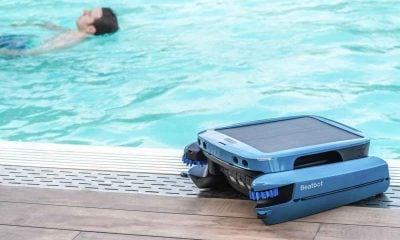



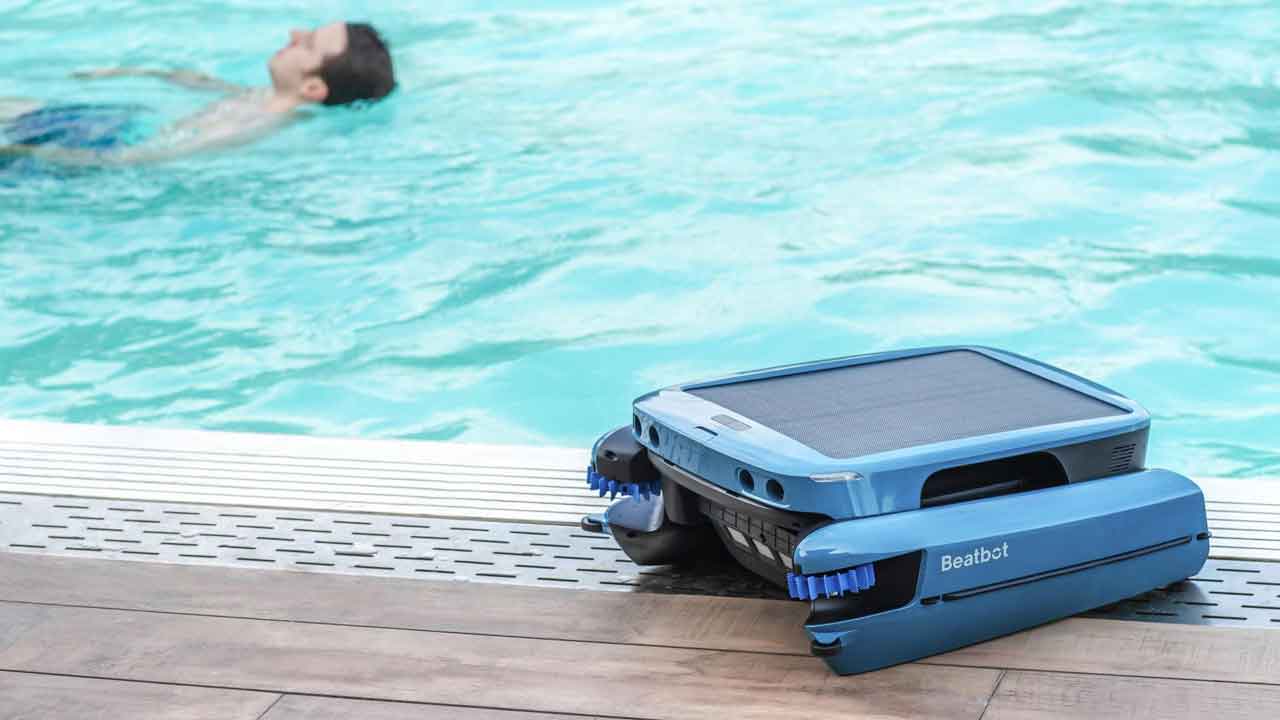
Beatbot has been gaining serious traction in the robotic pool cleaner space with its AquaSense and Sora lines, establishing itself as a legitimate contender in a category long dominated by legacy brands. Now, the company is making a calculated move into robotic pool skimmers with the launch of the iSkim and iSkim Ultra, bringing a layered approach to the category and offering two distinct tiers that target very different types of pool owners.
Why Robotic Skimmers Are Gaining Momentum
Surface debris has always been one of the most persistent pain points in pool maintenance. Leaves, pollen, bugs, grass clippings, and fine dust collect on the surface long before they ever make it to the floor. Once they sink, they’re harder to remove, placing more strain on filtration systems and robotic cleaners.
Robotic skimmers aim to solve that problem at the source—continuously patrolling the waterline and removing debris before it becomes a bigger issue. Solar-powered designs have made this category even more appealing, allowing for extended runtimes with minimal user intervention.

That’s the opportunity Beatbot is leaning into.
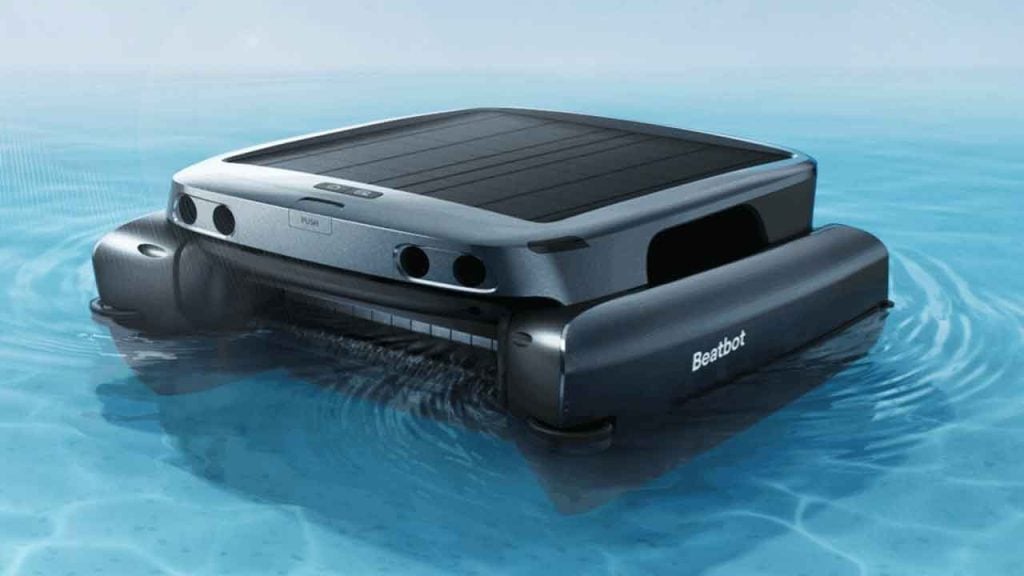
Beatbot iSkim: Built for Continuous Surface Cleaning
The iSkim is positioned as the more accessible entry point into Beatbot’s skimmer lineup, but it still brings a solid feature set designed for real-world pool conditions.
At its core is a large 9-liter debris basket, giving it the capacity to handle significant surface load without constant emptying. That matters in environments where leaves and organic debris are a daily occurrence. The unit is designed for continuous operation, powered by a solar panel and backed by a 10,000mAh battery, with manufacturer claims of up to 28 hours of runtime without sunlight.
From a mechanical standpoint, the iSkim uses a three-motor system, including dual motor propulsion. That means it’s actively driving itself across the pool surface using two independent propulsion motors, allowing it to steer and reposition rather than simply drifting. Navigation is handled through a combination of basic sensors and random movement with smart rerouting.
It also includes features that are quickly becoming standard in the category: app integration, scheduled cleaning, smart automatic parking, one-click app parking, and an anti-spill basket design with one-click debris release.

Where the iSkim keeps things simple is in its cleaning approach. It focuses on broad surface coverage rather than precision navigation, making it a strong fit for homeowners who want a set-it-and-forget-it solution that runs long and handles the bulk of surface debris without complication.
No products found.
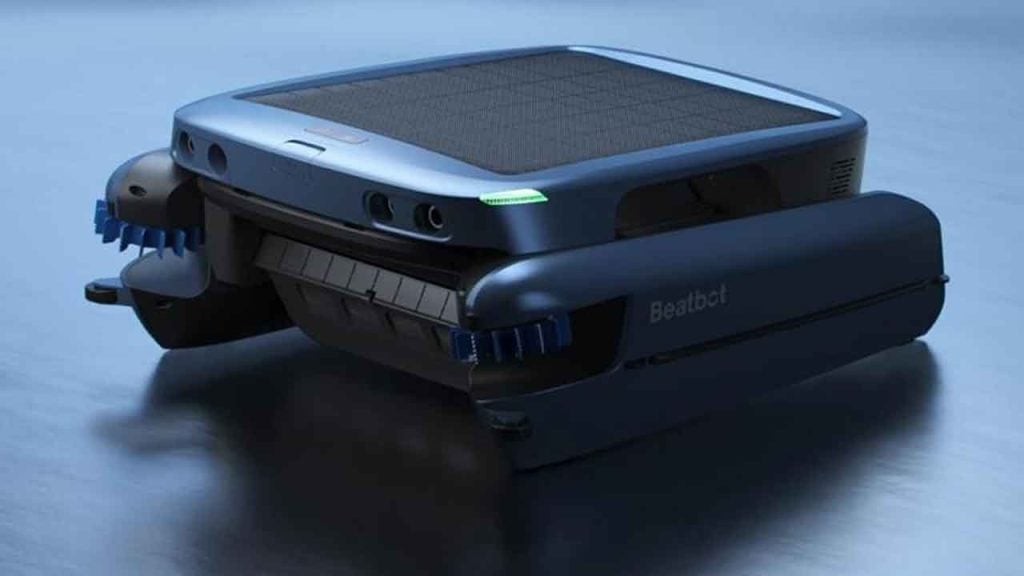
Beatbot iSkim Ultra: A Step Into Smart Surface Care
The iSkim Ultra takes a very different approach. While it shares the same 9-liter basket and 10,000mAh battery platform, everything else about the unit pushes it into a higher tier.
This model is built around a seven-motor system and a 20-sensor array, dramatically increasing its ability to navigate, detect obstacles, and clean with intention rather than randomness. Instead of relying on passive coverage, the iSkim Ultra uses an S-path cleaning pattern, allowing it to systematically cover the pool surface.
One of the biggest hardware upgrades is the addition of dual-side brushes and an expanded wheel system, which improve its ability to reach edges and corners—areas where surface debris tends to accumulate but where many skimmers struggle.
The Ultra also introduces environmental awareness features, including water temperature detection, along with voice broadcast capabilities for system status updates. These additions reinforce its positioning as a connected, smart device rather than just a cleaning tool.
But the standout feature—and the one that truly separates it from the base model—is the integrated water clarification system. The iSkim Ultra can actively contribute to water quality by dispensing clarifying agents, helping improve water appearance while it performs surface cleaning. That moves it beyond simple debris removal and into a more holistic surface-care role.
Charging is also upgraded, with the Ultra supporting magnetic wireless charging in addition to solar and adapter-based charging.
No products found.
Where Beatbot Fits in the Market
The robotic skimmer category is no longer niche. Brands like Aiper, WYBOT, Dolphin, and Betta have already proven there’s demand for automated surface cleaning, especially in markets where debris load is high and homeowners want to reduce manual maintenance.
Beatbot’s entry stands out because it doesn’t just compete on price or basic functionality. Instead, it introduces a clearer segmentation within its own lineup.
The iSkim targets homeowners who want reliable, continuous surface cleaning with long runtime and minimal complexity. The iSkim Ultra targets a different buyer—someone looking for smarter navigation, better edge performance, and additional water care features.
That distinction matters, because one of the biggest challenges in this category has been bridging the gap between simple floating skimmers and truly intelligent systems.
The Bigger Picture for Pool Automation
What Beatbot is doing here mirrors a broader trend across the pool industry: moving toward specialized, connected devices that each handle a specific part of pool care.
Instead of relying on a single piece of equipment to do everything, homeowners are increasingly building out systems—one robot for floors and walls, another for surface cleaning, and potentially additional tools for water monitoring and treatment.
With the addition of iSkim and iSkim Ultra, Beatbot is positioning itself to be part of that ecosystem conversation, not just as a cleaner manufacturer but as a broader automation player.
Final Thoughts
The launch of iSkim and iSkim Ultra signals that Beatbot is serious about expanding beyond traditional robotic cleaners and into a more complete pool-care lineup.
The iSkim delivers what many pool owners are looking for: long runtime, large capacity, and consistent surface cleaning without added complexity. The iSkim Ultra, on the other hand, pushes the category forward with smarter navigation, improved edge performance, and integrated water clarification.
Together, they give Beatbot a foothold in one of the most active segments in pool automation—and set the stage for even more competition in the robotic skimmer space moving forward.
Equipment Supplies
Under The Hood: A Close Look at Aiper Scuba V3, The World’s #1 Pool Cleaner
Thinking about the Aiper Scuba V3? Get full specs, features, pros & cons, and see how it compares to top robotic pool cleaners.


If you’ve been digging around for Scuba V3, Scuba V3 reviews, or trying to make sense of the Aiper Scuba V3 specs and features, you’re not alone. This thing has quickly become one of the most talked-about robotic pool cleaners in the game—and not just because of marketing hype.
The Scuba V3 is part of a new wave of cleaners that are trying to move beyond random navigation and brute-force cleaning. This one’s built around AI vision, adaptive routing, and cordless operation, putting it firmly in the premium cordless category.
Let’s break it down properly—what it does, how it performs, and how it stacks up against other cleaners in its class.

What Is the Scuba V3?
The Scuba V3 by Aiper is a cordless robotic pool cleaner designed for in-ground pools, capable of cleaning the floor, walls, and waterline while using onboard AI to improve efficiency.
Aiper calls it the “World’s No. 1” smart robotic pool cleaner, a claim tied to global sales volume—but what makes the Scuba V3 relevant isn’t just how many units they’ve moved. It’s that the product actually delivers in the areas that matter.
Instead of blindly covering the pool, it uses an AI camera-based system to detect debris and adjust its cleaning path in real time, actively routing toward problem areas rather than relying on random movement. In other words, it makes smarter decisions about how to best clean your swimming pool as it runs.
Scuba V3 Specs & Features That Matter
This is where the V3 separates itself from most of the competition.

Cognitive AI Navigation (Navium™ + VisionPath™)
At the core of the Scuba V3 is its AI-driven navigation system.
• Detects debris in real time
• Avoids obstacles and adjusts routes dynamically
• Reduces overlap and missed areas
It’s not just mapping—it’s reacting mid-clean.

AI Patrol Cleaning & Smart Optimization
The system continuously adapts to pool conditions.
• Learns pool layout over time
• Adjusts to debris levels
• Optimizes cleaning patterns
It’s not fully autonomous yet—but it’s clearly heading that direction.

Dual LED Vision System
A subtle but important upgrade.
• Improves visibility for onboard AI
• Enables better low-light performance
• Supports nighttime cleaning cycles
Most cleaners in this class don’t offer this.

JetAssist™ Waterline Cleaning
Waterline cleaning is where a lot of robots fall apart. This one holds its position.
• Maintains consistent contact at the tile line
• Reduces slipping during scrubbing
• Improves perimeter cleaning

Dual Brushes + High Suction Power
This is where performance comes together.
• Dual active brushes loosen debris
• Strong suction pulls it in
• Handles both large debris and fine particles

MicroMesh™ Multi-Layer Filtration
Built to capture everything from leaves to silt.
• Outer basket handles larger debris
• Inner mesh captures fine particles
• Delivers excellent water clarity
Trade-off: takes a little more effort to clean.

Featherlight Design & Easy Retrieval
• Around 18 lbs
• Easier to lift than most competitors
• Waterline parking simplifies removal

Wireless Charging Dock
• No cables to manage
• Clean, simple charging setup
• Faster turnaround between cycles
Scuba V3 Specs
• Runtime: Up to 180 minutes
• Charging Time: ~4–5 hours
• Coverage: Up to ~1,600 sq ft
• Weight: ~18 lbs
• Cleaning: Floor, walls, waterline
• Suction: ~4800 GPH
• Filtration: Dual-layer MicroMesh™
• Connectivity: Wi-Fi + Bluetooth
Within the sub-$1,000 cordless cleaner category, that runtime is one of its stronger advantages—especially for a unit handling full pool coverage.

Scuba V3 Reviews: Our Analysis
Cleaning Power
• Handles leaves, dirt, and fine debris effectively
• Strong suction paired with smart routing
• Delivers consistent results in a single cycle
Navigation & Coverage
• Targets debris zones
• Revisits missed areas
• Reduces unnecessary movement
It cleans with intent, not randomness.
Battery Life
At around 170–190 minutes per cycle, the Scuba V3 delivers strong runtime for a full-coverage cordless cleaner.
Compared to other units in the sub-$1,000 range, that’s a meaningful advantage—especially when factoring in wall and waterline cleaning.
Ease of Use
• Lightweight
• Cordless
• Simple drop-in operation
One of the easiest cleaners to use day-to-day.
Maintenance
• Excellent filtration performance
• Fine mesh requires a bit more effort to rinse out

How the Scuba V3 Stacks Up Against the Competition
Here’s how it compares against similar cordless cleaners.
| Model | Navigation | Runtime | Cleaning Coverage | Filtration | Weight | Smart Features | Standout Feature |
|---|---|---|---|---|---|---|---|
| Aiper Scuba V3 | AI Vision + Adaptive Routing | ~180 min | Floor, Walls, Waterline | Dual-layer fine + coarse | ~18 lbs | App control | AI-powered debris detection |
| WYBOT C2 | Smart Path (Gyro-based) | ~150–180 min | Floor, Walls | Dual-layer | ~20+ lbs | App control | Strong wall climbing |
| Beatbot Sora 70 | AI Path Planning + Smart Sensors | ~150–180 min | Floor, Walls, Waterline | Large-capacity multi-stage | ~20 lbs | App + automation | High debris capacity + strong all-surface cleaning |
| iGarden K Pro | Smart Navigation | ~120–150 min | Floor, Walls | Standard filtration | ~20+ lbs | Touch/app features | Budget-friendly smart cleaner |
Where the Scuba V3 Wins
• Advanced AI-driven navigation
• Lightweight and easy to handle
• Strong all-around cleaning performance
• One of the better runtime profiles in its class
• True cordless convenience
Where the Scuba V3 Falls Short
There’s a lot to appreciate about this cleaner, though if we were to identify a few areas for improvement, the following stand out:
• No surface skimming — floating debris like pollen, leaves, and bugs still need to be handled separately or by a different product
• Debris basket release button on the nose can be triggered on hard impacts with walls or corners
• Larger or complex pools may require multiple cleaning cycles
• Navigation can struggle around benches, tanning ledges, and irregular pool shapes
• Price sits at the higher end of the category, which raises expectations for some buyers
Who the Scuba V3 Is Really For
Best fit for:
• Medium-sized in-ground pools
• Buyers who want cordless simplicity
• Users who value smarter navigation
• Service pros looking for a lighter, more efficient unit
Not ideal for:
• Very large or highly complex pools
• Buyers focused strictly on budget
• Anyone expecting surface cleaning
Final Verdict: Is the Aiper Scuba V3 Worth It?
The Scuba V3 is one of the most forward-thinking robotic pool cleaners available today.
It’s not perfect—but it’s pushing the category forward in a meaningful way.
You’re getting:
• Smarter navigation
• Strong cleaning performance
• A runtime profile that holds up well against similarly priced cordless competitors
Plain and simple—it’s one of the most complete cordless cleaners you can buy right now.
No products found.
Photo Credits: Aiper

When pool season kicks off, there’s one piece of equipment that turns into the quiet workhorse of summer: the robotic pool cleaner. It’s the thing that shows up, does the dirty work, and doesn’t ask you to babysit it. Floors, walls, waterline, fine dust, leaves, “what even is that?” debris — a good robot handles it while you’re living your life.
And every year, the category gets a little more interesting. In 2026, we’re seeing smarter navigation that’s leaning into vision systems and mapping, more cordless options with better battery management, filtration that’s getting finer (and bigger), and a serious push toward convenience — app controls, scheduling, easier retrieval, and specialty modes for waterlines, corners, steps, and sun ledges.
Below is our breakdown of 10 new and notable robotic pool cleaners to watch in 2026, followed by a feature matrix to help you compare them side-by-side.

New Robotic Pool Cleaners in 2026

Aiper Scuba V3
Aiper keeps swinging for the fences in cordless cleaning, and the Scuba V3 is one of the more feature-forward models in the 2026 mix. The big headline here is Aiper’s navigation stack: the Scuba V3 is built around “VisionPath™,” which combines AI vision and dToF (depth/Time-of-Flight style sensing) to map and plan routes. In normal-people terms, it’s trying to “see” and understand the pool instead of just bouncing around like a Roomba with a chlorine habit.
The Scuba V3 is positioned as a floor, wall, and waterline cleaner, with a specific callout for horizontal waterline work via “JetAssist™.” That matters because waterline cleaning is where a lot of robots talk tough and then leave you with that grimy sunscreen ring anyway.
No products found.
Key features include:
• VisionPath™ navigation using AI vision + dToF sensing
• JetAssist™ horizontal waterline cleaning
• Dual brushes with 4,800 GPH suction
• MicroMesh™ multi-layer filtration
• Multiple cleaning modes, including AI-driven route behaviors
Who it’s for:
Homeowners who want a modern cordless cleaner with a stronger emphasis on “smart” routing and better waterline attention than the average set-it-and-pray robot.

Beatbot Sora 70
Beatbot’s Sora 70 comes in with a very clear value proposition: long runtime, big coverage, and a filtration setup that’s spelled out in actual numbers instead of marketing fog. The company positions it as a cordless cleaner built for comprehensive cleaning, but what makes it stand out in a crowded field is the published endurance and capacity.
Beatbot lists up to 5 hours of continuous floor cleaning and up to 7 hours of water-surface cleaning, with coverage claims up to 3,230 square feet. That’s a big deal for larger pools, for households that want fewer “charging breaks,” or for anyone who wants to run longer cycles without wondering if the thing is going to die in the deep end.
Filtration is also clearly specified: a 6-liter, 150-micron filter as standard, with an optional 3-micron filter accessory noted as coming later.
No products found.
Key features include:
• Cordless operation with long runtime claims (up to 5h floor / up to 7h surface)
• Coverage claim up to 3,230 sq ft
• 6L / 150µm filter, with optional 3µm filter accessory (noted as coming later)
• Waterline cleaning behaviors described by the manufacturer
• App-style control and smart convenience features (parking/retrieval concepts are called out)
Who it’s for:
Pool owners who care about runtime and capacity — especially bigger pools — and want a modern robot with clearly stated filtration and coverage targets.

Betta Flex
Let’s get something straight: Betta Flex is not an underwater vacuum robot. It’s a solar-powered, completely cordless surface skimmer — a different job, different lane, and honestly, a smart one.
Surface debris is the stuff that annoys you daily: leaves, bugs, pollen, grass clippings. If it floats long enough, it eventually sinks and becomes a bigger problem. A surface skimmer robot like Betta Flex is basically “preventative cleaning.” It keeps the top of the pool looking sharp and reduces how much junk makes it to the floor.
Betta positions the Flex as solar powered and cordless, with dual cleaning modes (Eco and Normal), and “24/7 continuous cleaning.” It’s also marketed as compatible with infinity pools, above-ground pools, and in-ground pools. For homeowners who hate manual skimming, this thing can quickly become the one robot you notice the most — because you see the results constantly.
No products found.
Key features include:
• Solar-powered operation and completely cordless
• Continuous surface skimming concept (marketed as 24/7 cleaning)
• Dual cleaning modes (Eco and Normal)
• Compatibility claims: infinity / above-ground / in-ground
• Stated pool size coverage up to 40 ft × 60 ft
Who it’s for:
Anyone who’s tired of skimming, or anyone who wants to pair a surface skimmer robot with a separate underwater cleaner for a one-two punch.

Mova Diver A10
MOVA Diver A10 is the “serious suction, serious waterline” entry in the 2026 lineup. It’s positioned as a cordless, AI-powered robotic pool cleaner designed to balance strong mechanical performance with smarter path planning — and if you’ve ever watched a robot miss the waterline ring or take inefficient zig-zag laps across the floor, you’ll understand why that pitch matters.
According to the published specs, the Diver A10 is built for in-ground and above-ground pools up to approximately 1,900 square feet. It features a 6,000 GPH suction system powered by triple brushless motors, along with EdgePulse™ and PoolNavi™ adaptive navigation designed to improve route efficiency and full-pool coverage. One of its standout differentiators is dual-pass waterline scrubbing, with the ability to reach slightly above the waterline to tackle oils, algae, and residue buildup more aggressively than single-pass systems.
The Diver A10 also includes a 3.5-liter debris basket with ultra-fine filtration, plus an optional 3-micron ultra-fine screen for capturing smaller particulate matter. App-based scheduling allows up to four cleanings per week, and the unit can remain submerged in standby mode and automatically reactivate for scheduled cycles. Runtime is listed at up to 4 hours, with auto-parking and easy-lift retrieval built into the design.
No products found.
Key features include:
• 6,000 GPH suction powered by triple brushless motors
• EdgePulse™ and PoolNavi™ adaptive navigation
• Dual-pass waterline scrubbing reaching slightly above the waterline
• 3.5L debris basket with ultra-fine filtration and optional 3µm screen
• App-based scheduling (up to four cleanings per week)
• Runtime claim up to 4 hours
Who it’s for:
Pool owners who want stronger suction and more deliberate waterline cleaning in a cordless robot — especially in mid-to-large residential pools where performance and scheduling flexibility matter more than novelty features.

WYBOT S2 Solar Vision
WYBOT’s S2 Solar Vision is one of the more interesting “hybrid power + smart behavior” releases for 2026. The big hook is in the name: solar-assisted charging paired with a vision-based mode. WYBOT positions it as an underwater solar-powered robotic pool cleaner with dual charging methods (Solar and DC).
The key nuance here — and it matters — is that WYBOT’s “AI Vision Mode” is described as floor-only. That means if you’re buying it specifically because you think the camera/vision system is going to hunt debris on walls and waterlines, you’ll want to understand that limitation. Still, as a cordless robot with solar assist and app scheduling, it’s trying to reduce the “charge anxiety” that comes with battery units.
WYBOT lists a runtime of 2.5 hours+ and coverage up to 3,229 square feet. The filtration system is described as a 180-micron filter box plus an ultra-fine sponge layer.
No products found.
Key features include:
• Dual charging: Solar & DC
• “AI Vision Mode” noted as floor-only
• 2.5h+ runtime claim
• Coverage claim up to 3,229 sq ft
• Filtration: 180µm filter box + ultra-fine sponge
• App control and scheduling functions
Who it’s for:
Sunny-climate pool owners who like the idea of solar assist, want cordless convenience, and want a clearer expectation around where vision mode applies.

Dolphin Nautilus EON 120D
The Dolphin Nautilus EON 120D is the flagship cordless cleaner from Maytronics’ new EON series, built to deliver extended performance and true total pool coverage. Positioned above its EON 100 sibling, the 120D adds professional-level features for debris handling and runtime — and if you’ve ever watched a conventional robot struggle on sun ledges, steps, or waterline buildup, you’ll appreciate what this machine brings to the table.
According to the product details, the EON 120D is engineered to handle floors, walls, waterlines, corners, steps, and ultra-shallow ledges with a combination of SmartMap navigation and JetIQ design that helps it adapt to pool geometry and clean efficiently end-to-end. Its patented DebrisLock closed filtration technology not only traps ultra-fine particles, it also auto-backwashes to reduce how often you have to interrupt cycles for filter cleaning — a significant convenience for busy pool owners.
One of the most talked-about aspects of the EON 120D is its UltraRun scheduling concept, which Maytronics positions as capable of keeping the entire pool clean for up to 2.5 weeks on a single battery charge when used with lighter scheduled cycles. App control via the Maytronics One app brings scheduling, remote monitoring, and troubleshooting to your phone, reducing the time you spend managing maintenance.
No products found.
Key features highlighted include:
• Cordless freedom with no cable to manage
• UltraRun cleaning scheduler, capable of long-interval coverage
• SmartMap navigation that learns pool shape and obstacles
• DebrisLock closed filtration with auto backwash
• App-based scheduling, monitoring, and alerts
• Total pool coverage including floors, walls, waterline, steps, sun ledges, and corners
Who it’s for:
Pool owners who want a premium cordless robotic cleaner with next-level filtration and scheduling, minimal maintenance interruptions, and the ability to cover every inch of the pool — even areas many robots can’t consistently reach.

Dreame Z1 Pro
Dreame enters the pool-cleaning world with a cordless product that reads like it came from a robotics company first and a pool company second — which can be a good thing when software and mapping are improving faster than traditional categories.
The Dreame Z1 Pro is a floor/wall/waterline cleaner with strong published flow numbers. The company lists suction performance up to 8,000 GPH, runtime stated as over 180 minutes (depending on the version/config shown), and charging time listed in the 4–6 hour range. Coverage is listed up to 2,160 square feet.
Those are the kinds of specs shoppers can actually compare — and it puts Z1 Pro in a pretty competitive part of the cordless market where buyers want performance without paying “flagship tax.”
No products found.
Key features include:
• Cordless cleaning for floor, walls, and waterline
• Suction claim up to 8,000 GPH
• Runtime listed as 180+ minutes
• Charging time listed as 4–6 hours
• Coverage claim up to 2,160 ft²
Who it’s for:
Homeowners who want a serious cordless cleaner with published suction and runtime specs they can weigh against other 2026 releases.

iGarden K Pro Pool Cleaner
The iGarden K Pro is the outlier in this lineup — in a good way — because the runtime and coverage claims are wildly beyond what most people expect from cordless robots.
iGarden markets the K Pro with a stated 10 hours of runtime and up to 15,500 square feet of coverage (noted on a floor-cleaning basis). If those numbers translate into real-world consistency, this is the kind of unit that shifts how people think about battery robots. Instead of “run a cycle, recharge, run again,” the concept becomes “this thing can live in the pool and just keep going.”
The K Pro positioning leans hard into app control and smart route optimization, paired with high-capacity operation that’s clearly aimed at large residential pools, high-use pools, and owners who want fewer interruptions.
No products found.
Key features include:
• Runtime claim up to 10 hours
• Coverage claim up to 15,500 ft² (floor cleaning basis)
• App-enabled control and route optimization positioning
• High-end endurance positioning relative to typical cordless robots
Who it’s for:
Big pools, high debris environments, and pool owners who want maximum runtime without constantly managing charging cycles.

Seauto SAT40
Seauto’s SAT40 is a cordless cleaner that spells out its cleaning modes clearly — and that’s important, because for many pool owners the real value isn’t “can it clean?” It’s “can I tell it exactly what to clean today?”
The SAT40 is described with four modes: Auto, Waterline, Floor-only, and Wall-only. It also calls out horizontal waterline cleaning via “WaveLine Technology,” plus a dual filtration setup that includes a 250-micron filter basket and an ultra-fine 2-micron filter. Basket capacity is listed at 5 liters with top-load access. Pool coverage is listed up to 2,150 square feet.
No products found.
Key features include:
• Cordless operation
• Four cleaning modes: Auto, Waterline, Floor-only, Wall-only
• Horizontal waterline cleaning claim (WaveLine Technology)
• Dual filtration: 250µm basket + 2µm ultra-fine filter
• 5L top-load debris basket
• Coverage claim up to 2,150 sq ft (in-ground)
Who it’s for:
Pool owners who want targeted modes (especially waterline), plus a filtration setup that’s designed to catch both big debris and fine particulate.

Talosbo Pleco Pro
Talosbo’s Pleco Pro comes in as a cordless, in-ground focused robot built to cover the full “floor/walls/waterline” workload with published suction numbers and a straightforward spec sheet.
The Pleco Pro lists suction power at 4,000 GPH and positions itself for pools up to about 2,153 square feet (200㎡). It also calls out brushless motors — both for the drive system and pump motor — which is generally a good sign for efficiency and long-term durability.
Key features include:
• Cordless cleaning for floor, walls, and waterline
• Suction claim: 4,000 GPH
• Pool size claim: 2,153 sq ft / 200㎡
• Brushless drive motors and brushless pump motor (as listed)
Who it’s for:
Buyers who want a cordless, all-surfaces robot with clear suction and pool-size targets, without getting lost in gimmicks.
2026 Robotic Pool Cleaner Comparison Matrix
| Model | Cordless | Solar | Coverage | Scheduling | Runtime |
|---|---|---|---|---|---|
| Aiper Scuba V3 | Yes | No | Floor / Wall / Waterline | Brand-noted | Up to 150 minutes |
| Beatbot Sora 70 | Yes | No | Surface / Floor / Wall / Waterline | Yes | Up to 5h floor / 7h surface |
| Betta Flex | Yes | Yes | Surface only | Mode selection | Solar continuous concept |
| MOVA Diver A10 | Yes | No | Floor / Wall / Waterline | Yes (App scheduling) | Up to 4h |
| WyBot S2 Solar Vision | Yes | Yes | Floor / Wall / Waterline (AI Vision floor-only) | Yes | 2.5h+ |
| Dolphin Nautilus EON 120D | Yes | No | Floor / Wall / Waterline / Steps / Sun ledge / Corners | Yes (App scheduling) | Up to 2.5-week cleaning concept |
| Dreame Z1 Pro | Yes | No | Floor / Wall / Waterline | Brand-noted | 180+ minutes |
| iGarden K Pro | Yes | No | Floor (primary published basis) | Yes (App scheduling) | Up to 10h |
| Seauto SAT40 | Yes | No | Floor / Wall / Waterline | Mode selection | Not clearly published |
| Talosbo Pleco Pro | Yes | No | Floor / Wall / Waterline | Not specified | Not clearly published |
Why Investing in a Robotic Pool Cleaner Still Makes Sense
Here’s the truth: the best robotic pool cleaner doesn’t just save time — it changes how your pool feels day-to-day. Cleaner water, less debris cycling through the system, fewer “I’ll do it tomorrow” moments, and a pool that looks maintained even when life gets busy.
Robots also help reduce the burden on your main circulation system because they’re capturing debris in their own filters and scrubbing surfaces directly. That can mean less manual brushing, fewer leaf piles sitting on the floor, and less grime building up at the waterline.
If you’re shopping for a new robotic pool cleaner in 2026, you’ve got more legitimate options than ever: long-runtime cordless models, solar-assisted units, specialized surface skimmers, and “smarter” navigation systems that are actually being marketed with real specs you can compare. Hopefully this roundup makes the buying decision a little easier — and gets you one step closer to a summer where the robot does the work and you just enjoy the pool.
Read the Summer Issue of Pool Magazine

See more of our coverage in your search results
 Sponsored Advertisement
 NTCA Welcomes Jennifer Ibe and Rachel Smith to the Team
 Darlly Filtration Partners With The Grit Game on Private Label Pool Filters
 A New Era at POOLCORP: John Watwood Focuses on Customers and the Fundamentals
 King Technology Opens $17M Manufacturing and Distribution Center
 Landmark Aquatic Partners With AngelEye on Drowning Detection Technology
 POOLCORP to Distribute Blue Mar Nova Light Series in North America
 Nasdaq to Suspend Trading in Leslie’s Stock on October 6

 AvenBlu Launches Free Pool Chemistry Hub and Calculator
 Navigating California’s 2025 Electrical Regulations for Swimming Pools
 Swimming Pool Maintenance with Enzymes
 Famous Pool Painting Becomes Most Expensive Painting Ever Sold
 Ceramic Tile Coalition Files Anti-Dumping Appeal with USCIT
 PHTA Launches New Jobseeker Website: WorkInAquatics.com
  Pool Metals and Metal Staining
Sponsored Advertisement
 Sponsored Advertisement
 Products4 weeks ago
5 Ways Jandy’s New AquaLink® EDGE™ Is Changing the Game for Pool Pros

 Pool News7 days ago
Leslie’s Reportedly Prepares for Chapter 11 Bankruptcy as Possible Nasdaq Delisting Looms

 Pool News3 weeks ago
Inside the 2026 Million Dollar Pool Design Challenge

 Press Releases2 weeks ago
Soake Pools Launches Dual Pool Packages

 Industry News4 weeks ago
Why Pools Matter: Pool Horizons Takes Its Message Global

 Pool News3 weeks ago
RENOLIT Launches ONE Augmented Reality Pool Design App
 Features10 hours ago
A New Era at POOLCORP: John Watwood Focuses on Customers and the Fundamentals

 Pool Equipment2 weeks ago
Hayward Issues Recall for Universal Pool Heaters Over Carbon Monoxide Risk
You must be logged in to post a comment Login