





Pool News
Pool Protection Technologies’ S.A.M. Offers a Fresh Take on Algae Control
Discover how S.A.M. by Pool Protection Technologies is changing pool maintenance with ultrasonic algae prevention.


Pool Protection Technologies, a dynamic startup based in Athens, Georgia, is making waves in the pool industry with its innovative approach to algae prevention. Co-founded by Garrett Stigall, a former pool maintenance professional turned engineer, the company has introduced the Sound Amplifying Machine—better known as S.A.M. This new pool maintenance device leverages sound technology to tackle a persistent problem in the pool industry: algae growth.
The Story Behind Pool Protection Technologies
Garrett Stigall’s journey into the pool industry began early. “Ever since I was 11, I was cleaning pools in my neighborhood,” Stigall shared. His hands-on experience continued through high school, fostering a deep understanding of pool maintenance and its challenges. After pursuing a civil engineering degree in college, Stigall felt a pull back to his roots. “I realized I could use my engineering expertise to help the pool industry in ways that hadn’t been seen before.”
This vision led to the creation of Pool Protection Technologies. Recognizing a lack of innovation in the pool space, Stigall and co-founder Guy Gober sought to develop solutions that prioritized sustainability and cost-effectiveness. Their mission culminated in the development of S.A.M., an award-winning device designed to reduce chemical dependency in pools.

What is S.A.M.?
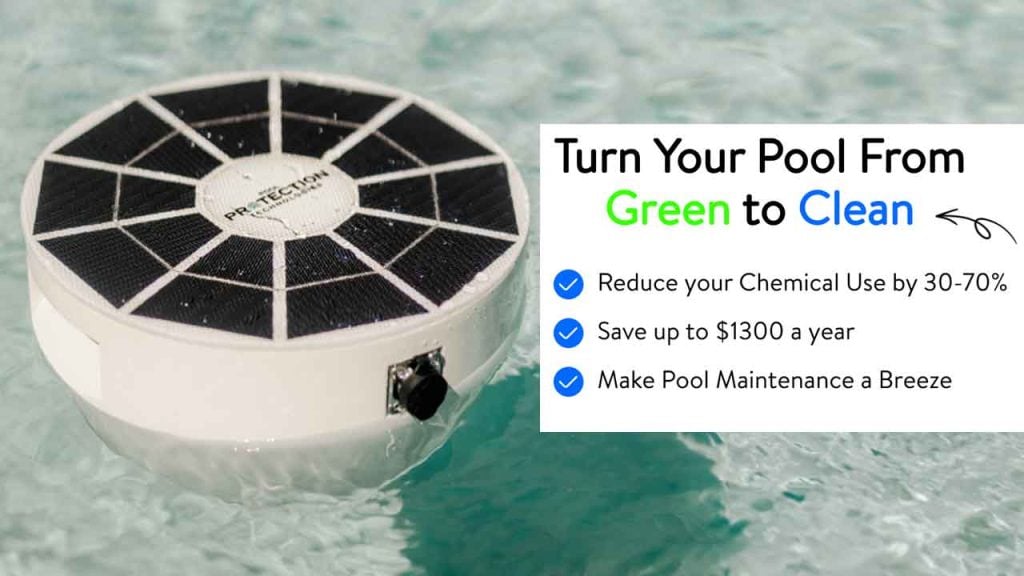
S.A.M. is a compact, basketball-sized device that employs ultrasonic sound waves to prevent algae growth in pools. While sound-based technology has been used in large-scale water reservoirs to manage algae and biofilm, Stigall and his team adapted the concept for residential and commercial pools. “If it can be done in a huge body of water, why can’t it be done in a small body of water like a pool?” Stigall questioned.
Reservoirs and large lakes have utilized sound wave technology for years to combat algae and biofilm buildup, often employing massive equipment. Stigall’s team recognized the potential to miniaturize this technology for backyard pools. “The systems used in reservoirs are massive,” Stigall explained. “We had to condense that into something compact and practical for backyard pools.”
After years of research and development, the team engineered a device that effectively reduces algae growth without relying on chemicals. The product’s small size and solar-powered design make it both efficient and sustainable.
How Does S.A.M. Work?
S.A.M. operates using ultrasonic sound waves that target algae at a cellular level. “We send out sound waves that match the cell size of the algae we’re targeting,” Stigall explained. Algae cells exposed to these sound waves cannot reproduce, leading to their eventual demise. The device emits a variety of sound wave frequencies to address the thousands of algae species found in pools.
By preventing algae growth, S.A.M. significantly reduces the demand for chlorine and other chemicals. “Most of our pool owners have gone from adding chlorine two to three times a week to just once every other week,” Stigall noted. This reduction not only saves money but also extends the lifespan of pool equipment and liners.

The Impact on Pool Owners
Since its rollout in 2023, S.A.M. has demonstrated impressive results. According to data collected from pool owners in Georgia, the device reduces chemical usage by 30 to 70%, saving pool owners up to $1,300 annually. “As chlorine prices continue to rise, these savings become even more significant,” Stigall emphasized.
Beyond financial benefits, S.A.M. offers environmental advantages. “When we backwash pools, chemically treated water often ends up in the environment,” Stigall explained. “By reducing chemical usage, we’re minimizing this impact. One of our customers saw grass regrow in an adjacent field where their backwash water drained.”
Additionally, reducing chemical usage helps address long-standing environmental concerns associated with pool maintenance. Chlorine and other chemicals, when backwashed, often flow into nearby ecosystems, potentially harming plants and wildlife. With S.A.M., the need for such high levels of chemicals diminishes, leading to a more eco-friendly pool management process. “It’s about making those small changes that add up over time,” Stigall said.
The long-term impact extends beyond the immediate environment. For pool owners who maintain their pools year-round, reduced chemical usage means less wear and tear on pool equipment. Filters and liners last longer when exposed to fewer chemicals, translating into lower maintenance costs over time.
The Engineering Journey
Developing S.A.M. was no easy feat. Stigall’s background in civil engineering didn’t directly align with the intricacies of designing a mechanical device that uses sound waves. “I had to step outside my comfort zone,” he admitted. “We spent countless hours researching sound technology and consulting with experts in related fields.”
Miniaturizing existing technology was a critical part of the process. Reservoir systems rely on large, meter-sized equipment powered by industrial-grade batteries. “We had to engineer that down to a basketball-sized device powered by a 12-volt battery,” Stigall explained. This involved refining components and ensuring that the device could operate efficiently in a residential setting.
To make S.A.M. even more efficient, the team incorporated a solar panel into its design. This feature allows the device to operate sustainably, reducing its reliance on external power sources. “Sustainability is at the core of what we do,” Stigall emphasized. “Every aspect of S.A.M. is designed with the environment in mind.”
Recognition and Growth
The innovative design and effectiveness of S.A.M. have not gone unnoticed. Pool Protection Technologies earned the Audience Choice Award and the Grand Prize at the Columbus Biz Pitch competition, as well as the $10,000 Grand Prize winner of the University of Georgia’s FABricate Entrepreneurial Initiative. “These accolades validate our efforts and inspire us to keep improving,” said Stigall.
Looking ahead, the company plans to expand its reach within the pool industry. “In 2025, we’ll be attending industry-specific trade shows to introduce S.A.M. to a wider audience,” Stigall revealed. Participation in these events is expected to help the company gain traction among pool professionals and homeowners alike.
A Sustainable Future for Pools
At its core, Pool Protection Technologies aims to revolutionize pool maintenance with sustainable solutions. S.A.M.’s solar-powered design and chemical-reduction capabilities align with this mission. “Even small changes can make a big difference,” Stigall said, reflecting on the environmental benefits of their product.
For entrepreneurs aspiring to enter the pool industry, Stigall offers this advice: “Know your customers and their pain points. Talk to them, understand their challenges, and design solutions that address those needs.” His hands-on approach, which involved speaking directly with hundreds of pool owners, underscores the importance of understanding customer needs before bringing a product to market.
While it’s too early to declare S.A.M. a game-changer, it is certainly on our list of new products to watch. The approach taken by Pool Protection Technologies is encouraging, showing how startups can bring fresh perspectives and innovative solutions to long-standing challenges in pool maintenance.
Ready to take a deeper dive and learn more about S.A.M.? Listen to our entire conversation, co-founder of Pool Protection Technologies, on the Pool Magazine Podcast.







Poolside Adventures and Landmark Aquatic have joined forces to bring big-impact attractions with a small footprint to aquatic facilities across the country. The partnership pairs Poolside Adventures’ AquaClimb®, AquaZip’N® and AquaNinja® FLX attractions with Landmark’s expansive nationwide reach and proven expertise in aquatic facility design, construction, renovation, and maintenance.
Poolside Adventures attractions add excitement to aquatic facilities without a major renovation because they anchor directly to an existing pool deck with no water hookups, special tools or added concrete and reinforcement. In fact, the modular AquaClimb® walls can start with one section and grow with budgets. The AquaZip’N® is rapidly becoming a new, safer alternative to diving boards as it only requires four feet of water depth, can be installed in just a few hours, and has a throughput of six riders a minute.
“Some municipalities can’t afford a new water park or perhaps cannot renovate their pool this year,” said Cherie Moy, VP of Marketing and Strategic Partnerships for Poolside Adventures. “Our products are an easy answer: a big impact with a small footprint, adding an ‘active attraction’ that makes the pool more exciting.”

“Landmark has a large footprint across the country, and we’re especially excited about their reach into HOA communities, a growing market where our partnership has already led to multiple installations,” said Moy. “Together, we will help clients find the right fit for their space, their budget and to add action and adventure to their pool experience.”
Matt Cappello, Vice President of Design at Landmark Aquatic agrees saying, “We’re excited to collaborate with Poolside Adventures to promote the versatility, ease of installation and entertainment value their products will bring to more pools across the country.”
About Landmark
Since 1967, Landmark Aquatic has helped communities and organizations bring complex aquatic facilities to life and keep them performing. Today, we are the nation’s largest integrated commercial aquatics platform, providing design, construction, renovation, restoration, and maintenance services nationwide. Our construction-led expertise and long-term service capabilities give customers one trusted partner across every stage of a facility’s lifecycle. For the life of your pool. Learn more at www.landmarkaquatic.com.
About Poolside Adventures
For more than 20 years, Poolside Adventures’ flagship AquaClimb® has led the market for poolside climbing walls. Its full line, including the AquaClimb® Luxe, AquaZip’N® and AquaNinja® FLX, delivers challenging, safe fun for swimmers of all ages. For more about Poolside Adventures visit www.aquaclimb.com.


Vic Harshman brings extensive pool building experience to key leadership role
- Decades of proven pool construction experience across Nevada, Arizona and Texas
- Previously served as Shasta Pools’ exclusive excavation contractor
- Predecessor handpicked Harshman to grow position under new leadership team
SCOTTSDALE, Arizona (October 5, 2026) – Shasta Pools, Phoenix Metro’s most recognized pool builder, named Vic Harshman as Head of Residential Construction. Harshman joins the new leadership team with more than three decades of hands-on industry experience and a long-standing relationship with the company to one of its most critical leadership roles.
Harshman has held senior construction leadership positions in Arizona and Texas, and worked closely with Shasta Pools, developing firsthand knowledge about the company’s standards, culture and customers. The appointment reflects the momentum Shasta Pools has built since its August 6 acquisition by Dansons Capital Group, Accrual Equity Partners, and Hydro Construction, and positions the full-service 60-year old pool company for continued growth.
Leadership Perspective
“Vic brings exactly the kind of no-nonsense, customer-first leadership our residential construction division needs,” said Jeff Thiessen, President, Dansons Capital Group. “His philosophy is deeply aligned with ours. Keeping customers’ needs as the foremost priority at every stage of the build process is at the center of everything we do, and Vic lives that every day.”
Harshman’s career in pool construction began at age 19, when he purchased a backhoe and launched a business digging plumbing trenches and footings. When the housing market declined in the late 1980s, he relocated to Las Vegas and began excavating swimming pools, a move that led to the creation of Harshman Excavating.
Harshman built and operated excavation businesses in Nevada, Arizona and Texas, primarily serving the pool industry, and served for a period as Shasta’s exclusive excavation contractor.
In 2012, Harshman joined A&A Manufacturing, serving pool builders across an eight-state region and growing annual sales by 10x. In 2020, he joined Keith Zars Pools in Texas as Director of Construction, where he brought together decades of ownership, leadership and industry knowledge.
A Return Rooted in Relationships
“I have always believed that strong relationships, hard work, accountability and taking care of people are the foundation of a successful business,” said Vic Harshman, Head of Residential Construction, Shasta Pools. “Shasta has been a meaningful part of my career for many years. I am genuinely excited to come back and help lead this team into a very exciting future.”

Harshman steps into the role with the full support of Dan Thiessen, Chairman of the new ownership team, and John Mortensen, the outgoing head of residential construction. Mortensen recommended Harshman for the position and will now serve as the company’s lead trainer. That transition reflects Shasta Pools’ commitment to investing in its people and preserving institutional knowledge as the organization continues to grow.
ABOUT SHASTA POOLS:
Shasta Pools is Arizona’s trusted name in custom pool building, proudly serving the Valley since 1966. For 60 years, Shasta has transformed backyards into beautiful, functional spaces where families relax, entertain and enjoy life. The company specializes in new pool construction, remodeling, pool service and landscape design with plans for expansion into the home services market to provide customers with complete home care solutions. Learn more at ShastaPools.com.
ABOUT DANSONS CAPITAL GROUP:
Dansons Capital Group, headquartered in Scottsdale, Arizona, is a family-owned and family-managed investment firm built on shared values, integrity and long-term vision. The firm was established by the founders of Dansons, Inc., the company that launched and sold Pit Boss Grills. The company takes a hands-on approach, actively seeking opportunities across global markets and multiple asset classes. Its growing portfolio includes strategic real estate development holdings across multiple countries, oil drilling technologies, and limited partnership investments. Guided by a deep commitment to quality and the communities they serve, the Thiessen family leads with gratefulness for the blessings God has given them and in turn supports those less fortunate. Dansons Capital Group continues to identify and cultivate opportunities that reflect their family’s values and generational vision.
ABOUT ACCRUAL EQUITY PARTNERS:
Accrual Equity Partners (AEP) is a founder-led, privately funded private equity group built on the belief that every person, every percentage, and every product matters. This commitment, known as the “Power of One,” drives AEP’s mission to empower businesses and secure legacies across fragmented, service-based industries. AEP partners with founder-led and family-owned businesses to overcome barriers and unlock their full potential through strategic investment, operational performance enhancement, and advisory services. For more information, visit AccrualEquityPartners.com.
ABOUT HYDRO CONSTRUCTION:
Hydro Construction, LLC (HydroCon) was founded in 1986 to serve Arizona’s commercial pool construction and renovation market. Under the leadership of Curt Lonsdale, the company’s commercial pool construction division now manages some of the largest and most complex projects in the country.

Flowood, MS, October 1 – The National Tile Contractors Association (NTCA) is pleased to announce the addition of Jennifer Ibe as Membership and Sponsorship Sales Manager and Rachel Smith as Membership Marketing Manager. The two new positions strengthen NTCA’s focus on membership growth, retention, engagement, and delivering greater value to members.
“Growing and strengthening our membership is a key priority for the NTCA, and Jennifer and Rachel bring the experience and expertise to help us do that,” said Jeremy Sax, Deputy Director of NTCA. “Their complementary skills will allow us to take a more strategic approach to both membership development and the overall member experience.”
Jennifer Ibe, Membership and Sponsorship Sales Manager
Ibe brings more than 10 years of experience in association events, sales, sponsorships, relationship management, and strategic growth. Most recently, she served as Director of Sponsorship and Sales for the Global Workspace Association, where she led major conferences, sponsorship development, budgets, and initiatives that increased attendance by 33% and profitability by 30%.
At the NTCA, Ibe will lead membership recruitment, retention, re-engagement, and relationship development while supporting sponsorship and partner revenue opportunities. She will also represent the NTCA at major industry events and help strengthen relationships with members and prospective members.
Ibe holds a B.A. in Communications from the University of Illinois at Chicago.
Rachel Smith, Membership Marketing Manager
Smith brings extensive association experience in membership, communications, digital engagement, and member programming. Most recently, she served as Digital Communications Manager for the Association of Electric Companies of Texas. Previously, as Director of Membership for the Texas Economic Development Council, she managed more than 1,000 members and developed programs to increase member engagement and networking. She also served as Membership Coordinator for the Texas Association of Community Health Centers, where she managed more than 5,000 members and led new-member onboarding and retention initiatives.

At NTCA, Smith will focus on member onboarding, retention campaigns, communications, digital engagement, webinars, events, and community development. She will also support membership analytics and digital initiatives aimed at strengthening the member experience.
Smith holds a B.A. in Communications with a minor in Social Justice from West Virginia Wesleyan College.
“Jennifer’s focus on relationship-building and membership development, combined with Rachel’s experience in member communications and engagement, gives us a strong team focused on every stage of the member journey,” Sax added. “We’re excited about what this means for our members and for the future growth of NTCA.”
About NTCA
Established in 1947, the National Tile Contractors Association (NTCA) is a nonprofit trade association dedicated to the professional installation of ceramic tile and natural stone. It is widely recognized as the largest and most respected tile contractors’ association in the world. For those seeking to improve their tile business, NTCA provides unparalleled educational experiences, supportive peer interaction, unique cost-savings programs, and a commitment to help develop the skills needed to improve your work, recruit, train, and manage your employees, and ultimately, make your business more profitable. Find out more at www.tile-assn.com.
Read the Summer Issue of Pool Magazine

See more of our coverage in your search results
 Sponsored Advertisement
 Pentair Names Josh Cowley Executive Vice President and Chief Executive Officer, Pentair Pool
 Soake Pools Bolsters National Growth With Four Key Hires
 Hayward Holdings Names New Chief Accounting Officer
 Daldorado Names Marcia Gyles Director of Sales
 Landmark Aquatic Brings Poolside Adventures Attractions Nationwide
 Shasta Pools Hires 30-Year Builder to Head Residential Construction
 Watershape University Announces Fall 2026 Session in San Diego

 Jandy JXiQ – A SMARTER Way to Heat The Pool
 Florida Swimming Pool Association Hires Pool Industry Veteran
 Poolside by CGT offers new CARRERA MARBLE
 Seen In The Wild, Pool Service Cybertrucks Hit The Open Road
 Amurjo Natural Pool: The Longest Pool in Europe
 Homeowner Hits the Jackpot: Finds $800K in Gold During Pool Construction
 POOLCORP to Distribute Blue Mar Nova Light Series in North America


 Sponsored Advertisement
 Pool News4 weeks ago
Leslie’s Reportedly Prepares for Chapter 11 Bankruptcy as Possible Nasdaq Delisting Looms

 Pool News3 weeks ago
Leslie’s Files Chapter 11, Lenders Set to Take Control in Major Restructuring

 Features3 weeks ago
A New Era at POOLCORP: John Watwood Focuses on Customers and the Fundamentals

 Pool Equipment3 weeks ago
AquaLink® EDGE™ and trackr iO Signal a New Direction for Pool Automation

 Press Releases4 weeks ago
FSPA and PHTA Reunite Through Historic Affiliation
 Pool News2 weeks ago
Shasta Pools Hires 30-Year Builder to Head Residential Construction

 Retail3 weeks ago
Nasdaq to Suspend Trading in Leslie’s Stock on October 6

 Manufacturer4 weeks ago
CCEI Taps Benoit Masse for Sales
You must be logged in to post a comment Login