





Products
Enhancing Water Shapes With In-Floor Cleaning Systems
Paramount’s in-floor cleaning system remains a top choice for maintaining the aesthetic of the swimming pool canvas.


In the ever-evolving world of pool technology, Paramount Pool & Spa Systems has emerged as a frontrunner, boasting over 90% market share in the in-floor cleaning sector. Established in the late ’60s by the Ghiz Family and later acquired by Hayward, the company’s commitment to innovation and customer service has propelled it to the forefront of the industry. Today, Paramount’s in-floor cleaning system has become a cornerstone of pool maintenance in many custom inground pools and a game-changer in enhancing the overall swimming pool experience.
John Anderson, Regional Manager for Paramount, explained why forward-thinking pool builders are leaning toward in-floor systems as a way to maintain the integrity of the swimming pool in the overall scheme of the backyard canvas.
Changing Perceptions About In-Floor Cleaning Technology
“When I was building pools, electronics controls were very simple. These days, everything’s gotten extremely complicated,” explained Anderson, “We went from the Flintstones to the Jetsons in less than 20 years.”

“Many builders today still don’t truly understand in-floor systems. I’ll be honest with you, back when I was building pools, I didn’t either. I wasn’t into plumbing a whole bunch of pipe on the bottom of the floor and the additional cost associated with that,” said Anderson.
“What I found out later on was that a lot of high-end builders with unique circumstances didn’t want a robotic pool cleaner or hoses floating in their work of art. In the course of those 20 years, we went from swimming pools to water shapes. Now the entire industry is looking at how the backyard is more of a work of art than a cement pond,” explained Anderson.

Science Behind The System
At the heart of Paramount’s in-floor cleaning system lies a specific water curtain design coupled with its patented PCC system which effectively cleans 99% of a swimming pool’s surface. Tailored to accommodate the unique dimensions of each pool, this system boasts a patented “Collection Zone” and automated debris removal functionality.
Operating on the principle of pressurized water, the PCC system efficiently suspends dirt, facilitating its removal by the pool’s filtration system. The system’s innovation lies in its patented water-actuated distributor valve, strategically directing the flow of water to various cleaning nozzles in a sequential manner. This ensures a thorough and systematic cleaning process, optimizing the overall performance of the pool cleaning and circulation system.
Ease of Installation
Ease of integration is a big factor of why more pool builders than ever are looking to in-floor as a viable solution explained Anderson. “What’s nice about our system is that it’s 100% hydraulically driven. Our systems integrate with any pump and any smart technology,” said Anderson.
“All installers really need to do is get water to the valve, and we’ll take care of the rest,” said Anderson, “that’s all part of our design. We do a CAD drawing that lays everything out specifically and tells the contractor where to plumb, where to put all our products laid out with the schematics that are required for the plumbers to do what they need to do and then the process for the finishers to do their work.”
Technology Innovations
Paramount’s flagship product has undoubtedly been the PCC system, however, the PVR system continues to gain traction in the market. “One of the systems I push the most for new builders is our PVR system. Out of the dealers I’ve signed the past twelve months, 99% of them opted to go with the PVR because it’s easier to install,” said Anderson. “It’s a ratcheted, self-cleaning nozzle that’ll clean anywhere from six to ten feet.”
“We’ve innovated on that because a lot of pools are nine feet deep or more,” explained Anderson, “the sweep radius up to the rear wall usually inhibits standard in-floor system cleaners, because they won’t rotate properly. On the PVR the head actually rotates.”

“We have an MDX-R3 safety drain, which is VGB compliant and LA County approved,” explained Anderson, “we also use a BuzzTop, which is basically just a channel drain with a lid that allows debris to be captured. Our application also features a canister that’s in the deck, or can be stationed back by the equipment pad.”

Multiple Applications
While Paramount’s in-floor cleaning technology has been a mainstay in custom concrete inground pools for years, they have also developed applications for vinyl liner and fiberglass swimming pools as well. “Our Vanish line is ideal for the vinyl market and actually is flush to the finish of the vinyl liner. Our Vantage products are used by a lot of dealers venturing into fiberglass pools,” said Anderson.
What Makes In-Floor So Appealing?
For those embarking on a swimming pool project, an in-floor cleaning system is an exhilarating prospect, offering near maintenance-free benefits. Paramount’s in-floor cleaning systems go beyond mere cleaning by actively circulating water and chemicals in pools from the bottom up. This dynamic circulation not only ensures a consistently clean and swim-ready pool but also serves as an eco-friendly solution. In-floor systems enhance both the aesthetic and functional aspects of a swimming pool, promising pristine water and cost-effective maintenance; making it a no-brainer for many pool owners.

A Top Choice For Professionals
In-floor cleaning technology has become a favored choice among today’s top pool designers seeking to preserve the pristine aesthetics of their meticulously crafted waterscapes. Paramount’s in-floor cleaning system, in particular, addresses the concerns of designers who aim to maintain a clean and clutter-free canvas without the intrusion of hoses or robotic cleaners within the pool.
High-end pool designers often work with unique circumstances, such as custom shapes, negative edge basins, spas, or lazy rivers. Paramount’s in-floor system’s adaptability to various pool types and styles makes it an ideal choice for designers dealing with unconventional and bespoke projects. This flexibility ensures that the swimming pool remains true to the designer’s vision.
Listen to our entire interview with John Anderson on the Pool Magazine podcast.


Robotic pool cleaners can look impressive under controlled conditions. The more meaningful test isn’t how a cleaner performs in a demonstration environment, but how it handles real-world conditions in an actual swimming pool over time.
Leaves, dirt, pet hair, changing weather, irregular pool geometry and everyday use can expose things that simply don’t show up during a short product demonstration.
That was the idea behind Pool Magazine’s recent evaluation of the iGarden K Series robotic pool cleaner.

Rather than conduct a short-term test, we placed the K Series with pool professional Kelli Clancy, owner of Legacy Pool and Spa in Sacramento, who installed the unit in one of her customer’s pools. The homeowner used the cleaner over an extended period, while Clancy monitored its performance and gathered feedback about what worked well and where the cleaner had limitations.
The result was a practical assessment of a cordless robotic cleaner that Clancy believes could make a compelling option for homeowners buying their first robot.
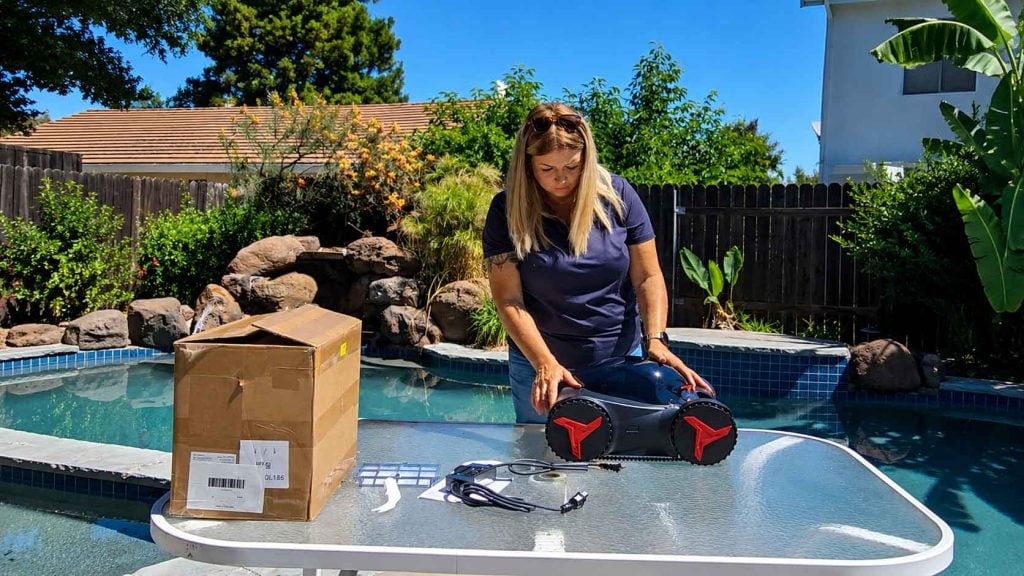
A Real Backyard Instead of a Test Tank
Clancy deliberately selected a pool that would give the K Series plenty to contend with.
“I chose this particular pool for a variety of reasons,” Clancy explained. “One, I knew the customer would give me honest feedback. I knew she would try and get everything she wanted out of the cleaner and give an honest review.”
The surrounding landscape also created a good mixture of debris.

“They had small leaves, big leaves, pine trees,” Clancy said. “So it was a variety of debris I wanted to be able to know if it could pick up.”
As luck would have it, an unrelated issue had also temporarily taken the pool’s circulation system offline, leaving the water somewhat dirtier than usual when the K Series arrived. That provided another opportunity to see how the cleaner handled real debris rather than a carefully prepared demonstration.
The pool itself presented an additional challenge. It was an older freeform gunite pool with curves, varying radiuses and features that would test the cleaner’s ability to navigate something considerably more complicated than a rectangular test pool.
For Clancy, that distinction matters when evaluating robotic cleaners.
“It’s not as authentic as putting it into somebody’s pool in an everyday yard where you have, you know, squirrels, and dogs, and wind, and rain, and all these varieties of things going on,” she said of controlled product demonstrations.
Strong First Impressions
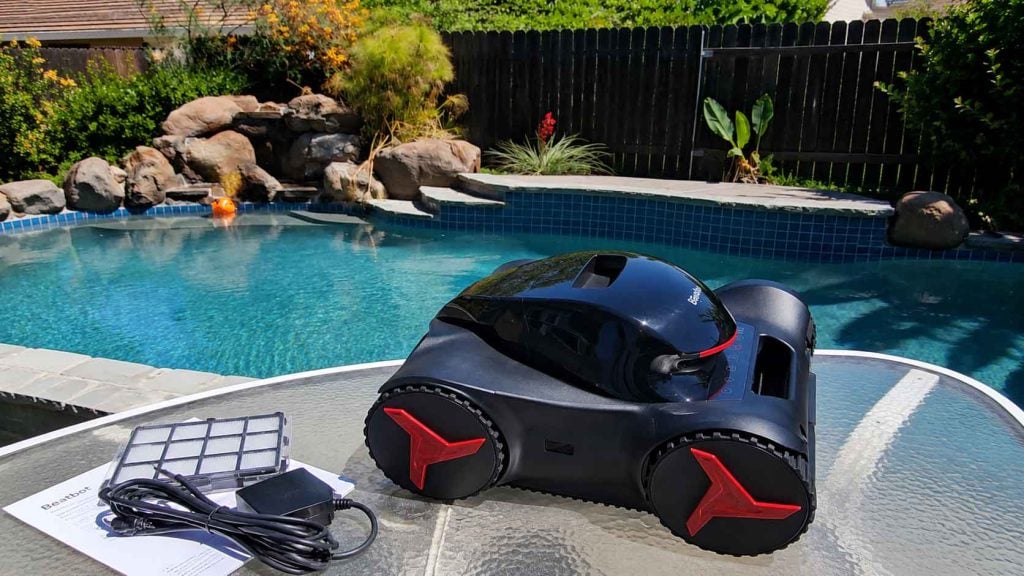
Out of the box, the K Series made a favorable impression.
“I thought it had a very sleek look,” Clancy said. “It has a great look to it, you know, very modern. It wasn’t too bulky, which I did like about it.”
More important than aesthetics was the filtration system. The cleaner includes a fine-mesh filter that fits onto the debris canister, allowing it to capture smaller material in addition to larger debris.
“I really liked that it came with that so it can catch that fine debris such as dog hair or dirt,” Clancy said.
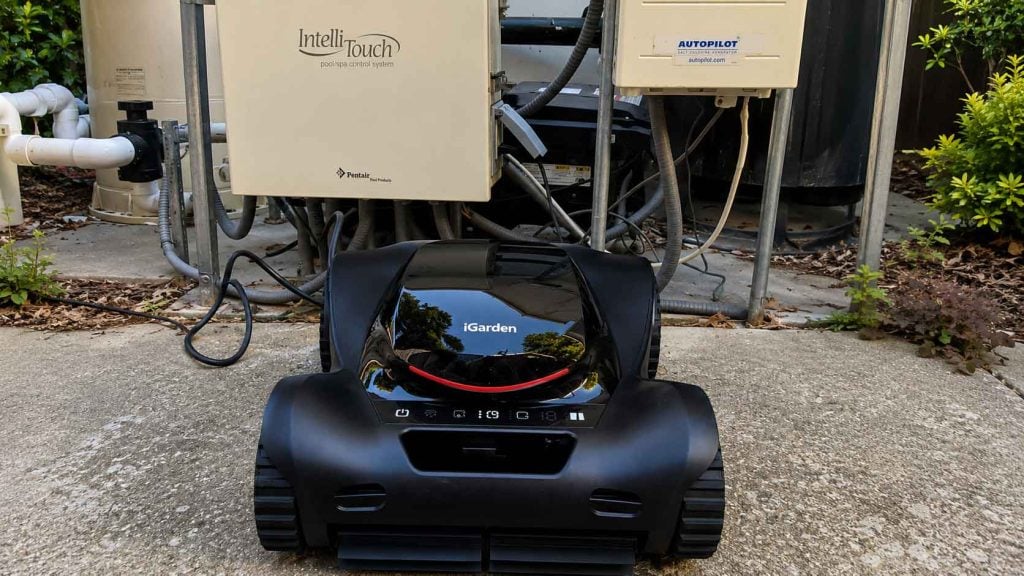
The cordless design was another immediate positive for the homeowner. She had previously owned another robotic cleaner that required placement on a charging base. The K Series offered a simpler arrangement.
“She liked on this one you could just plug it anywhere,” Clancy said. “You didn’t have to put it on a base, and it charged within three hours. She really liked that aspect of it.”
For a homeowner who wants a cleaner without adding another permanent charging station around the pool area, that simplicity can be an attractive feature.
Cleaning the Floor, Walls and Waterline
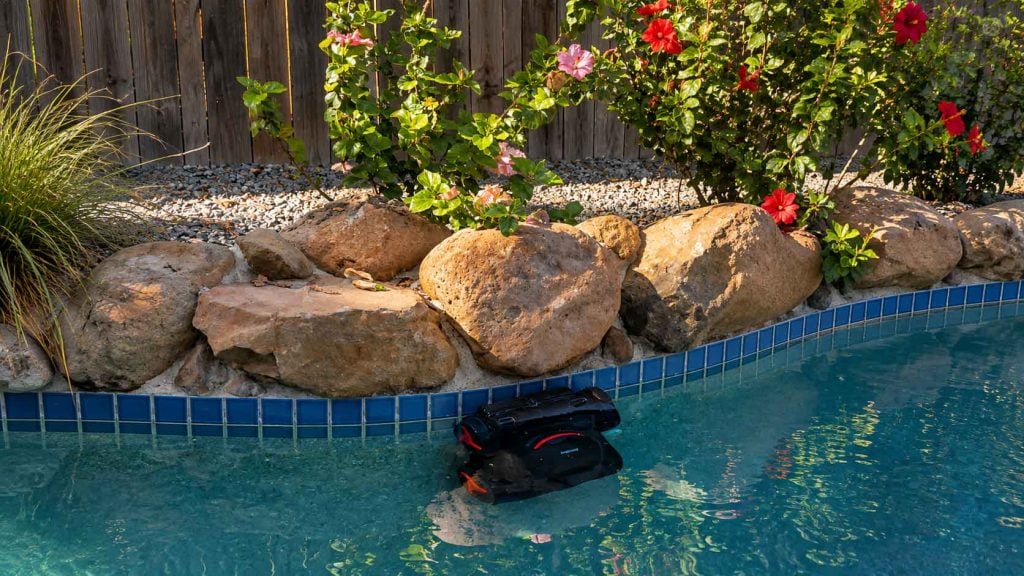
The K Series provides operating modes for floor cleaning as well as floor-and-wall cleaning. Once operating in the latter mode, Clancy found that the robot was capable of climbing the pool walls all the way to the waterline.
“It did go up the walls and did a good job at cleaning them,” she said. “So I really liked that about it.”
That capability stood out to the homeowner because previous cleaners she had owned did not provide the same wall-cleaning performance.
“That was a feature she really enjoyed,” Clancy said.
The robot also surprised Clancy by making its way onto the pool’s tanning ledge.
“It went up onto the tanning ledge. And that was surprising to me,” she said.
What impressed her most, however, was how quickly the K Series could make a noticeable difference.
“Me personally, watching it, I thought the cleaner did really well. I found that it cleaned the pool fairly quickly, which was really nice,” Clancy said. “So then if you have a party, you can just toss that in there and know within an hour that pool’s gonna be ready to go.”
Its ability to reach the waterline added another layer of cleaning.
“It climbs all the way up to clean the tile line, so that was really nice, too, if you haven’t brushed your tile in a while and have some leaves along there this will do a great job with that,” she added.
Handling Real Backyard Debris
Ultimately, a pool cleaner needs to pick things up, and Clancy came away impressed with the K Series’ ability to collect larger debris.
She specifically pointed to the tracks and intake design at the front of the cleaner.
“I think they got right with the tracks on the front where it’s collecting the debris,” Clancy said. “Those were very grippy, and when I watch it go over a pile of leaves, it was able to pull it in easily.”
Combined with the fine-mesh filtration, that gave the cleaner the ability to contend with the mixture commonly found in residential pools, including dirt, dog hair, leaves and pine needles.
Clancy sees that versatility as increasingly important as backyard landscaping becomes more elaborate and homeowners expect robotic cleaners to handle more than one specific type of debris.
Where Pool Geometry Matters
No robotic cleaner is necessarily going to perform identically in every swimming pool, and the K Series was no exception.
The test pool presented a particularly challenging combination of freeform curves and relatively narrow steps. The K Series has a fairly wide wheelbase, and Clancy observed that it could climb some steps but had difficulty stabilizing on others.
Importantly, she believed some of that behavior was specific to the dimensions of this particular pool.
“This particular issue may not be an issue in other pools, depending on the width of the steps,” Clancy explained. The steps in the test pool were approximately 10 inches wide, and she felt even slightly wider steps could have made it considerably easier for the robot to stabilize.
The irregular curves of the older freeform pool also occasionally presented navigation challenges. Based on what she observed, Clancy believes the K Series is likely to perform at its best in more geometrically shaped pools.
That doesn’t negate its performance in the test pool. The cleaner still climbed walls, reached the tile line, accessed the tanning ledge and collected a wide range of debris. It does, however, underscore something consumers should consider with any robotic cleaner: pool shape and feature dimensions can influence performance.
An Area With Room for Improvement
The primary area Clancy would like to see improved is app connectivity when the cleaner is submerged.
“The app needs a little improvement,” she said, noting that communication with the unit became less reliable once it was underwater.
For routine operation, however, Clancy found the cleaner itself straightforward to set up and use. When asked what might distinguish the K Series for someone comparing similarly priced robotic cleaners, she immediately pointed to that simplicity.
“Easy to program,” Clancy said. “It was pretty easy to program. I think that thing took maybe five minutes tops to program completely.”
The homeowner also appreciated a decidedly low-tech feature: the retrieval hook.
“That was one thing the homeowner did love was the hook that came with the cleaner actually worked,” Clancy said. Compared with another robot the homeowner had used, retrieving the K Series from the pool was considerably easier.
It may seem like a small consideration, but usability extends beyond how well a robot cleans. Charging it, programming it, removing it from the water and emptying the debris can determine whether a homeowner actually enjoys owning the product.

A Strong Entry Point Into Robotic Cleaning
With robotic cleaners now available across a wide range of prices and feature sets, one of the biggest questions is where a particular product fits.
For Clancy, the K Series occupies an appealing position for consumers who want to move into robotic cleaning without immediately jumping to the highest-priced equipment on the market.
“I would say it’s gonna be that middle ground customer, someone who’s looking for something that’s not the cheapest but not the most expensive,” she said. “Maybe more of your entry level robotic owner.”
Ease of use strengthens that argument.
“Overall, it seemed very easy to use for anybody, even somebody who doesn’t have ever used a robot,” Clancy said.
That may ultimately be one of the K Series’ strongest selling points. Robotic cleaners have become increasingly sophisticated, but sophistication isn’t necessarily what every homeowner wants. For someone purchasing their first cordless robotic cleaner, being able to charge it, program it quickly, drop it into the pool and retrieve a canister full of debris without a steep learning curve has considerable value.
Clancy’s final assessment carries additional weight because she doesn’t automatically endorse every cleaner she encounters.
“I could see this being a cleaner that I would recommend to people,” she said. “And I don’t recommend just any cleaner. I want something that actually works because, you know, it’s not a small price tag to get a robotic.”
After months in an actual customer’s backyard, the iGarden K Series showed itself to be an approachable cordless robotic cleaner with good debris pickup, wall and waterline cleaning, straightforward programming, convenient charging and thoughtful everyday usability.
There are areas where future generations could improve, particularly app connectivity and navigation around certain freeform curves or narrow features. Those considerations are worth understanding when matching any cleaner to a particular pool.
For homeowners looking to make the jump from traditional pool cleaning equipment to their first robotic cleaner, however, the K Series offers many of the capabilities that make robots attractive in the first place without making the experience unnecessarily complicated.
Should You Buy the iGarden K Series?
Yes.
The iGarden K Series makes the most sense for someone who wants to get into robotic pool cleaning without paying a premium for features they may not need. It’s a practical entry point into the category and, based on our real-world testing, capable enough to justify the investment.
That doesn’t mean it’s the perfect cleaner for every pool. More complex pool shapes and features deserve some consideration, and buyers expecting flawless app control may want to temper their expectations. But those shortcomings weren’t significant enough to change our overall opinion of the product.
What matters is whether the K Series delivers enough cleaning capability, convenience and usability to make owning one worthwhile. We think it does.
If you’ve been considering making the jump to a cordless robotic cleaner and want a capable unit without immediately moving into the upper end of the category, the iGarden K Series earns our recommendation.
And for an entry-level robotic cleaner, getting those fundamentals right matters most.
Ready to take a deeper dive?
Listen to our entire interview with Kelli Clancy about the iGarden K Series robot on the Pool Magazine podcast.


There is a point in luxury pool design where the materials stop functioning merely as finishes and begin defining the character of the space.
For Frank Vitori, co-founder of AquaBlu Mosaics and designer of the new Sand Pearl Series, the opportunity was to rethink some of the patterns currently influencing pool and architectural design without relying on the contrasting colors traditionally used to create them.
When Pool Magazine spoke with Vitori about the collection, he explained that the idea behind Sand Pearl began with a deceptively simple question: What if the pattern could be created by light instead of color?

“The concept behind Sand Pearl was to take patterns we’re seeing throughout contemporary design—checkerboards, stripes and offset stripes—and reinterpret them through finish and light,” Vitori explained. “Instead of using contrasting colors to define the pattern, we’re using the same color in matte and iridescent glass. As the light changes, the pattern reveals itself.”
That distinction is central to understanding Sand Pearl, the latest AquaBlu Signature Collection from AquaBlu Mosaics.
Rather than simply assembling existing tile into a new assortment, AquaBlu developed Sand Pearl as an original, coordinated design collection. Each colorway brings together monochromatic glass, complementary finishes, contemporary patterns, coordinating field tile and curated grout selections to create a complete material system for pools and architectural spaces.
It is a concept rooted in what Vitori describes as a quieter approach to luxury.
“Luxury doesn’t always need to announce itself,” Vitori said. “Sometimes it’s the detail you notice as you move through a space—the way a surface changes in the light or the way water completely transforms the material.”

Reinventing Pattern Through Light
Pattern is hardly new to tile.
Checkerboards, stripes and running patterns have appeared in architecture and interior design for generations. What has changed is how designers are using them.
As contemporary tile trends move toward more intentional patterns and sophisticated material combinations, Sand Pearl approaches those familiar geometries from a different direction.
The collection does not need a dark tile beside a light tile to create a checkerboard. It does not require two opposing colors to make a stripe visible.
Instead, matte and iridescent versions of the same color work together to create the pattern.
From certain angles, the distinction can appear subtle. Then sunlight moves across the installation, the viewing angle changes or water begins flowing over the surface, and individual sections of iridescent glass catch the light differently from their matte counterparts.
Suddenly, the pattern becomes more pronounced.
The effect allows a surface to remain monochromatic while still having considerable visual depth and movement. Rather than placing the emphasis on color contrast, Sand Pearl uses reflection itself as a design element.
That becomes particularly compelling in a swimming pool, where very little about the visual environment remains static.
Sunlight changes position throughout the day. Ripples continuously alter reflections. Water depth influences perceived color. Landscaping, coping, interior finishes and surrounding architecture all contribute additional tones and reflected light.
Sand Pearl was designed to interact with those variables rather than compete with them.
The collection draws its palette from sun-bleached beaches, shallow coastal water, sea glass and other subdued coastal tones, but the coastal influence provides the backdrop rather than defining the entire concept.
The real story is what happens when pattern, finish, and changing light intersect.
Contemporary Patterns, Reinterpreted
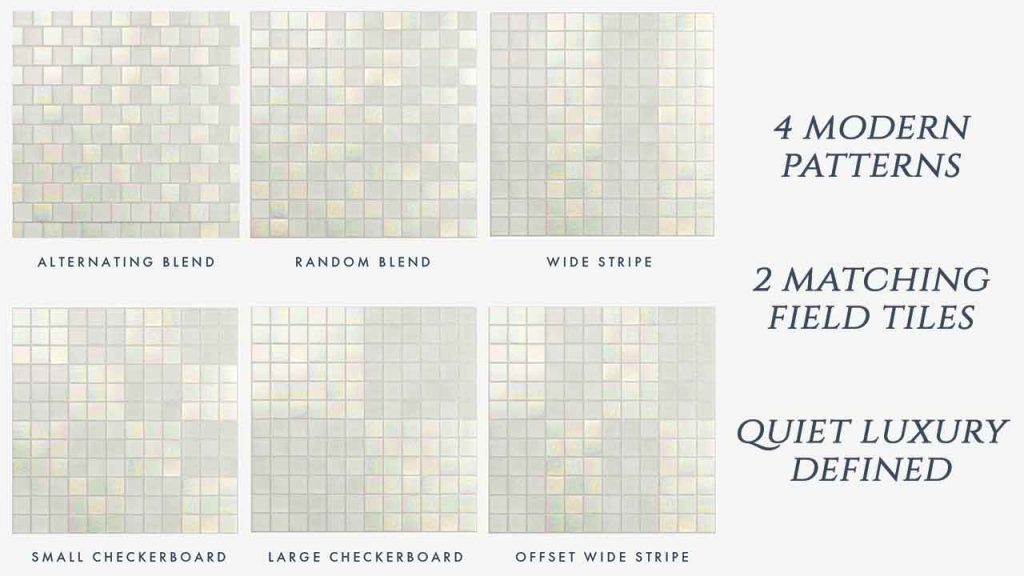
Sand Pearl takes several of today’s most recognizable tile patterns and reconstructs them using matte and iridescent finishes.
The checkerboard pattern provides perhaps the clearest demonstration of the concept. Instead of alternating contrasting colors, the pattern alternates finishes within the same color family. The checkerboard may appear subdued under one lighting condition and considerably more pronounced under another.
The striped pattern applies the same principle in a more linear composition, creating alternating bands of matte and reflective glass. It can introduce direction and rhythm across a waterline, raised spa, feature wall or other architectural surface without introducing another color into the palette.
The offset stripe pattern adds another level of movement by shifting that linear geometry, creating a more dynamic arrangement while retaining the collection’s monochromatic character.
These patterns are complemented by two coordinating field-tile formats: stacked and staggered.
That addition gives designers considerably more flexibility when specifying the collection across an entire project.
A checkerboard, stripe or offset stripe might be used to establish a focal point on a raised spa, water feature or architectural wall, while the coordinating stacked or staggered field tile can finish the surrounding space in the same color and material language.
Alternatively, the field tile can be carried across a larger surface where a quieter treatment is desired.
The result is not simply a selection of individual mosaics. It is a coordinated collection that allows designers to change pattern and visual intensity while maintaining continuity of color and material.

Six Coastal-Inspired Colorways
Sand Pearl is offered in six primary colorways—Marelle, Caspia, Brisa, Calista, Marea and Aurelia—ranging from luminous whites and soft sand tones to aqua, sea-glass greens and deeper coastal blues and grays.
Caspia provides one of the collection’s lightest treatments with a pearlescent white appearance suited to bright contemporary environments. Brisa moves toward tropical aqua, while Marea introduces softer sea-glass tones. Marelle and Calista bring cooler, deeper shades into the collection, while Aurelia introduces the warmth of sand and champagne.
The restrained palette is intentional.
Because the visual interest is being created through the relationship between matte and iridescent finishes, the colors themselves do not need to compete for attention. That allows designers to select a palette based on the architecture and surrounding environment while allowing changing light to bring the pattern forward.
Grout Becomes Part of the Design
AquaBlu has taken that coordination one step further by pairing Sand Pearl designs with curated Starlike PRO grout selections.
That is an important detail because grout can substantially change the appearance of a mosaic installation. With small-format glass tile in particular, grout becomes part of the visible composition rather than simply the material filling the joints.
For Sand Pearl, the grout selection is treated as another component of the design.
Each recommended grout is chosen to complement the intended color and pattern combination, helping maintain the collection’s monochromatic character rather than introducing an unintended grid or competing visual element.
The curated Starlike PRO grout options give designers and installers a defined starting point for achieving the intended finished appearance.
That level of coordination reinforces Sand Pearl’s position as an AquaBlu Signature Collection. The concept extends beyond selecting an attractive glass tile. Color, finish, pattern, field tile and grout are considered together as parts of the same visual system.
Designed for Water, Architecture and Quiet Luxury
The interaction between matte and iridescent glass becomes especially interesting when Sand Pearl enters an aquatic environment.
Water is constantly changing what we see.
Glass naturally reflects and refracts light differently than many conventional pool finishes. An iridescent surface introduces another variable because its appearance changes depending on viewing angle and illumination.
Combine those characteristics with moving water and a monochromatic pattern can behave differently from one moment to the next.
In an infinity-edge pool, the effect can help visually connect the tile with an ocean, lake or distant horizon. On raised spas, water walls, spillways and perimeter-overflow details, moving water continuously changes which portions of the pattern catch and return light.
Even a traditional waterline can become more dimensional because the pattern is not dependent on a fixed contrast between two colors.
The installation effectively changes throughout the day.
That ability gives pool builders and designers another way to create visual interest without adding more colors, decorative elements or competing materials to the project.
More Than a Waterline Tile
Although glass mosaic remains closely associated with swimming pool waterlines, Sand Pearl was developed for considerably broader use.
The collection can extend across pools and spas as well as kitchens, backsplashes and architectural feature walls, allowing designers to carry the same material language between indoor and outdoor environments.
That continuity has become increasingly relevant as homeowners treat outdoor living areas as extensions of the home.
Large sliding and folding glass doors have blurred the traditional boundary between interior and exterior spaces. Outdoor kitchens increasingly mirror their indoor counterparts. Pool houses, cabanas, fire features and covered entertaining areas are frequently designed as elements of a single architectural composition.
Sand Pearl’s coordinating patterns and field tiles make it possible to continue a color throughout those spaces while adjusting the intensity of the pattern according to the application.
A feature wall might employ the checkerboard or offset stripe as a stronger architectural statement. A surrounding surface could transition into stacked or staggered field tile. A raised spa or water feature could then reintroduce the pattern outside.
The material remains connected even as its role changes.
For pool builders and designers, glass mosaics also offer opportunities far beyond a six-inch waterline. Raised bond beams, vanishing edges, spillways, fountains, spas and other water features can become integral parts of the architecture when tile is allowed to play a larger role in the overall design.
Sand Pearl’s monochromatic approach makes that possible without requiring the tile to dominate the project.
Built for Aquatic Environments
Visual design is only part of the equation when specifying tile for a swimming pool.
Materials used in aquatic environments must tolerate constant water exposure, pool chemicals, temperature changes and, depending on the application, continuous submersion.
Sand Pearl is crafted in the United States and TCNA-tested for performance, positioning the collection for demanding aquatic installations as well as interior architectural applications.
Proper installation remains critical with any glass mosaic. Substrate preparation, setting materials, grout selection, expansion considerations and adherence to manufacturer installation requirements can ultimately matter just as much as the tile itself.
For homeowners considering glass, working with a qualified pool professional or experienced tile installer remains particularly important.

A Different Expression of Quiet Luxury
Perhaps the most interesting aspect of Sand Pearl is how naturally the collection fits within the broader movement toward quiet luxury in residential design.
Luxury does not necessarily have to announce itself.
Some of today’s most sophisticated swimming pools rely on relatively simple geometry, carefully selected materials and exceptional craftsmanship rather than an abundance of decorative features. Their visual interest comes from proportion, texture and the way materials respond to the surrounding environment.
Sand Pearl applies that philosophy directly to mosaic tile.
There is shimmer, but it is controlled.
There is pattern, but it does not depend on dramatic color contrast.
There is movement, but much of it comes from the environment itself.
A checkerboard can almost disappear before sunlight reveals it again. An iridescent stripe becomes more pronounced as the viewer changes position. Water moving across a raised spa can alter the appearance of an offset pattern from one second to the next.
What appears restrained on a sample board can become surprisingly dynamic once installed in the environment for which it was designed.
That is ultimately what distinguishes the collection.
Designed by Frank Vitori, co-founder of AquaBlu Mosaics, the AquaBlu Signature Collection reinterprets contemporary tile patterns by allowing finish, reflection, and changing light to create the contrast.


Robotic pool cleaners have become one of the fastest-moving equipment categories in the pool industry. Cordless operation, smarter navigation, app connectivity and increasingly autonomous cleaning have changed what pool owners expect from these machines—and created an increasingly crowded field of manufacturers looking for their attention.
WYBOT may appear to be one of the newer names competing for a piece of that market. The company behind the brand, however, is anything but new to robotic pool cleaning.
“We’ve actually been around for 20-plus years manufacturing robotic pool cleaners,” said Nathaniel Michaelis, General Manager and Vice President of the Americas for WYBOT. “About three years ago, we were innovating on behalf of other brands and we said, ‘Hey, why aren’t we doing this for ourselves?’”

That decision marked an important change in strategy. Rather than continuing to put its newest engineering behind other brands, the company began concentrating those innovations under WYBOT. Michaelis said the company continues to manufacture for some well-known brands in the pool industry, but its latest technology is now being developed for its own product lineup.
That history provides some useful context in a category where new robotic cleaner brands seem to appear almost overnight. WYBOT is a relatively young consumer-facing brand backed by considerably older manufacturing and engineering experience.
The bigger question is how the company intends to distinguish itself in an increasingly competitive market.
Where WYBOT Achieves Differentiation
Michaelis points to what WYBOT calls “meaningful innovation”—features designed to eliminate an actual step in pool maintenance rather than simply adding another feature or gimmick.
“I think the perfect example there is our newest launch, the WYBOT S3, which is the first self-emptying robotic pool cleaner,” Michaelis said. “So it’ll actually go out, clean your pool, come back, dock itself in the water, and empty all the debris that it just picked up.”

For Michaelis, that is representative of WYBOT’s larger philosophy.
“That tells the story of who we are and how we’re differentiating ourselves,” he said, describing an approach centered on meaningful innovation that improves the overall pool ownership experience.
That philosophy becomes easier to understand when looking at WYBOT’s two principal product families, the C Series and S Series.
While there is some crossover in technology, they occupy distinctly different positions in the lineup.

“The C Series is our core,” Michaelis explained. “C stands for core. And the C Series is where we try to bring the most meaningful innovation at the most accessible price points.”
In practical terms, the C Series is designed around the everyday residential pool owner. These are self-contained, battery-powered robotic cleaners intended to provide many of the capabilities consumers increasingly expect from cordless cleaners without moving into the price and feature territory of WYBOT’s flagship models.
That includes technology such as AI Vision, which Michaelis said allows the cleaner to identify and prioritize dirtier areas of the pool rather than treating every section of the vessel exactly the same.
“When you take a step up into the S Series, that’s when you get into our more premium products,” Michaelis said. “So you’ll get longer run times and battery life, more square footage for larger pools, and then that’s where we start to introduce some of those really cool features like in-the-water charging and self-emptying.”
Cutting the Cord Was Only the Beginning
Cordless operation itself represents an important shift in robotic pool cleaning. Traditional suction-side cleaners require hoses, while earlier generations of robotic cleaners remained tethered to power supplies. Removing those connections changes the ownership experience.
With WYBOT’s cordless technology, the process is intentionally straightforward: charge the cleaner, place it in the pool and select the appropriate cleaning mode. Depending on the model and setting, the robot can address the pool floor, walls, waterline and steps.
Once cleaning is complete, it returns to its retrieval point. WYBOT includes a hook that attaches to a standard pool pole, allowing the cleaner to be brought to the surface.
“What we’re trying to do with cordless technology is really simplify that experience of cleaning the pool,” Michaelis said.
The S Series starts from that cordless foundation and asks a different question: how many of those remaining interactions can be eliminated too?
Cordless cleaners solved the cord problem, but they created another routine. The cleaner still has to be removed from the pool to recharge.
Michaelis said WYBOT heard that complaint directly from customers.
“Yeah, it’s great that I don’t have a hose, which is truly something I’m looking for, but that one step further that I wish I didn’t have to take is removing the cleaner from the pool every time that it needs to be charged.”
That feedback led to the S2 Solar and S2 Solar Vision.

Instead of requiring the owner to retrieve the cleaner and connect it to a charger after each cycle, the robots can dock themselves along the side of the pool. A solar-powered dock charges the cleaner while it remains in the water.
“The sun charges the base. The base then charges the robot,” Michaelis explained. “The robot then can be set on a schedule to run Monday, Wednesday, Friday or however many days the pool owner would like it to run during the week.”

The result is a robotic cleaner beginning to function more like permanent automated pool equipment than an accessory that must manually be deployed and retrieved.
But WYBOT kept listening, and customers identified yet another point of friction.
“Our customers said, that’s great that it’s charging in the water,” Michaelis recalled hearing, “but I have to take the robot out to clean the basket.”
That became the problem targeted with the latest iteration, the S3, which incorporates the functionality of the S2 Solar Vision and now adds self-emptying capability. After completing its cleaning cycle, the robot returns to the dock and transfers collected debris into a separate poolside bin.
“All the pool owner or the pool pro is doing is taking that tray out and emptying that tray of all the debris and putting that tray back in,” Michaelis explained.
It’s a relatively simple action, but it represents something bigger happening within the category. First the hose disappeared. Then the power cord. Now charging, scheduling, docking and even emptying the onboard debris basket are becoming automated.

The Push Toward Less Human Interaction
That trajectory is familiar territory for Michaelis, whose background before joining WYBOT was in consumer robotics at iRobot.
“In any robotics industry, your goal is to make the user experience as autonomous as possible,” he said. “You want as little human interaction with your robots.”
The pool industry is beginning to follow the same path already seen in other consumer robotics categories. Navigation is becoming more sophisticated. AI-assisted systems can influence where a cleaner goes and how it approaches the pool. Battery technology has removed the tether. App connectivity provides another layer of control, while docking, solar charging and scheduled cleaning are reducing the need for owners to deploy equipment manually.
“Where I see the robotic pool cleaning industry heading is trying to make it as autonomous as possible,” Michaelis said, “trying to reduce the amount of human interaction that you have with your robots, and ensuring that they’re doing the jobs that they’re set out to do.”
For homeowners, that means convenience. For pool professionals, it can have an entirely different value proposition.
A Better Ownership Experience Builders Can Sell
For builders trying to connect with increasingly tech-savvy pool buyers, equipment has become another opportunity to differentiate the finished project.
A self-parking, self-charging and self-emptying robotic pool cleaner isn’t simply another piece of equipment sitting in the pool. It’s the kind of feature a builder can demonstrate during turnover and immediately show a customer how much of the routine maintenance process can happen automatically.
Michaelis sees that as a potential finishing touch on a premium pool package.
“On the builder side, it’s really going back to that innovation piece,” he said. “It’s a surprise and delight moment at the time of purchase.”
When builders are assembling an equipment package for a prospective pool owner, he said, “adding some self-emptying robotic pool cleaner is just the cherry on top for that customer and really provides that top-notch experience.”
That’s an important part of WYBOT’s positioning. The company isn’t simply trying to connect with consumers shopping online for another cleaner. It’s developing features that builders, retailers, and service professionals can put in front of their own customers as part of a better pool ownership experience.
For service companies, meanwhile, the conversation moves from convenience to productivity.
Why Service Pros Are Paying Attention
Discerning service companies looking to recommend best-in-class robotic cleaning technology have good reason to gravitate toward products offering greater autonomy and less human interaction.
The robot isn’t replacing the service professional. Instead, it can work in the background during the six days between weekly service visits, continually handling a portion of the physical cleaning workload before the technician ever arrives.
Michaelis said some pool companies already view robotic cleaners as an efficiency tool rather than an optional accessory.
“We constantly hear feedback from service companies on how many more doors they’re able to service, how many more pools they’re able to service, how quickly they can get pools done so that they can get to the next customer, and how many more they can fit within their route,” he said.
In fact, some have made automated cleaning a prerequisite for taking on a customer.
“We actually have some service companies that actually won’t service clients unless they have some sort of robotic cleaner in their pool so that they can be the most efficient when they’re stopping by on a weekly basis,” Michaelis said.
That changes the role a robotic cleaner can play in the relationship between the pool professional and homeowner.
A service company recommending a premium robotic cleaner isn’t necessarily selling its customer a replacement for professional service. It’s giving that customer a machine capable of working between visits while simultaneously giving its technicians a cleaner pool to work with when they arrive.
And as those robots become increasingly autonomous, the value proposition gets stronger.
A cleaner that has to be manually deployed, retrieved, charged, and emptied still asks quite a bit from the homeowner. A cleaner capable of following a schedule, parking itself, recharging and transferring its own debris asks considerably less.
For WYBOT, that’s where the S Series—and particularly products such as the S3—begins to stand out. It’s also where two decades of manufacturing robotic cleaners starts to matter more than how recently consumers began seeing the WYBOT name.
The brand may be relatively new to some pool owners and professionals, but the company behind it isn’t. Now, rather than innovating behind the scenes for other brands, WYBOT is putting that experience behind products designed to connect directly with homeowners and the professionals serving them.
Ready to take a deeper dive?
Listen to our entire conversation with Nathaniel Michaelis, General Manager and Vice President of the Americas for WYBOT on the Pool Magazine Podcast.
Read the Summer Issue of Pool Magazine

See more of our coverage in your search results
 Sponsored Advertisement
 iGarden K Series Review: What We Learned After Months in a Customer’s Pool
 Sacred Geometry: Where Architecture, Mathematics and Mosaics Collide
 Anatomy of a Botched Remodel: What Sank the Lincoln Memorial Reflecting Pool Restoration?
 Pool Equipment Theft Is Becoming a Bigger Problem Than Most Homeowners Realize
 Nidec Names New Pool/Spa Motors National Account Manager
 Hayward Bets Big on Decentralized Automation With OmniX
 What’s Hiding Beneath The Surface: Artificial Rock Features

 Pool Owners Face Costly Consequences of Freezing Temperatures
 Adding a Fire Feature to your Backyard Pool
 Pool Hygiene: Should You Shower After Swimming In The Pool?
 Texas Pool Freeze Risk Returns as Arctic Cold Puts Major Markets to the Test
 Incident at BioLab Facility Sparks Local Area Evacuations
 Optimizing Your Pool Business For Success With Jacob Durand of J&M Pools
 Heritage Pool Supply Group Acquires AquaCentral and its Eight Leading Independent Companies
Sponsored Advertisement
 Sponsored Advertisement
 Pool News4 weeks ago
Leslie’s Reportedly Prepares for Chapter 11 Bankruptcy as Possible Nasdaq Delisting Looms

 Pool News3 weeks ago
Leslie’s Files Chapter 11, Lenders Set to Take Control in Major Restructuring

 Pool Equipment3 weeks ago
AquaLink® EDGE™ and trackr iO Signal a New Direction for Pool Automation

 Features3 weeks ago
A New Era at POOLCORP: John Watwood Focuses on Customers and the Fundamentals

 Press Releases4 weeks ago
FSPA and PHTA Reunite Through Historic Affiliation
 Pool News3 hours ago
Sacred Geometry: Where Architecture, Mathematics and Mosaics Collide

 Pool News2 weeks ago
Shasta Pools Hires 30-Year Builder to Head Residential Construction

 Retail3 weeks ago
Nasdaq to Suspend Trading in Leslie’s Stock on October 6
You must be logged in to post a comment Login