





Features
Custom Luxury Pools With Rising Star Lance Irby


The world of luxury pools is a rigid dichotomy between design and function. For average homeowners it’s often difficult to achieve a balance between what’s appealing to the eye and what our wallets can afford. Quite often luxury homeowners tend to fall in love with what they’ve seen on Pinterest. During the dream building phase, money is no object. For some that holds true well into the building phase of turning that dream into a reality. No one is more familiar with helping homeowners capture their grand vision for a high-end custom luxury pool than Lance Irby, one of the lead designers for Premier Pools & Spas of Sacramento. Recently we had the chance to catch up with this rising star in the pool industry.
Luxury Pool Designer Lance Irby
Irby first got his start in the pool industry ironically enough when he bumped into Keith Harbeck, the owner of the Sacramento branch of Premier Pools & Spas. Harbeck was a member of the gym that Irby was a Sales Manager at the time. “He’d always whisper in my ear to come sell pools for him, I never took it too seriously.” said Irby.

Irby had a background growing up around construction and doing landscaping in the summers. His focus in school was in design and architecture. After completing a four year internship with a local architecture firm working as a draftsman, Irby began to have a change of heart. As he embarked on establishing a family, he decided to take a leap of faith and reached back out to Harbeck to see what the pool industry had to offer.

“I had some design background, drafting background, construction background. I had skills that would translate well, but I had no idea that they would translate well to the pool industry.” said Irby, “If Keith hadn’t offered me the position and if my life circumstances hadn’t changed, I don’t know that I would have took the chance.”
In reflection Irby says the gamble to shift career paths towards the pool industry has paid off tremendously. “I can’t think of anything that fits me better.” said Irby, “I really enjoy what I do. It’s fulfilling and satisfying to feel like you’ve found something you’re going to do forever.”
Pool Industry Is The Perfect Fit
Irby who is entering his 9th year in the pool industry says that he’s found his niche. “Whatever life throws at me, I just feel like the pool industry is a great fit for my personality. It’s dynamic, it’s always different, it’s always changing. It’s creative and I love it.” said Irby.

Irby certainly seems to have discovered a dormant and hidden talent for creating luxurious over the top backyard resorts. Like many other professionals in the pool industry looking to further and expand on their education, Irby has begun pursuing a path towards becoming SWD Registered with Genesis.
Seeking a Higher Path With Education
“It’s given me the ability to get outside of my comfort zone and become a better designer, a better builder.” explained Irby, “and focus on the aspects and core principles that Genesis teaches, to try and be better and raise my level of competence in the pool industry.”

Many builders, designers, and landscape architects credit programs like Genesis with helping them expand their accumen in the realm of high end luxury pools. Irby says that his entire team is now attending the course, crediting owner Keith Harbeck with investing in the educational pursuits of his sales team. Of course, if it helps them become better builders and leads to more luxury pool projects it’s obviously money well spent.

When discussing what constitutes a luxury pool the definition always varies. Irby said that as a top design consultant for high end custom pools, the vision for a luxury pool is very personal and unique to the homeowner.
What Constitutes a Luxury Pool?
“That’s not a black and white answer. I think what’s luxurious to one person, may not be to another. I think it has to be something that is very fulfilling to a client, that brings a level of satisfaction of elegance. It’s something they desired or are proud of, it’s a combination of probably all those things” said Irby.
Creating a luxury pool for a client does not have a minimum or maximum budget. There is no guidelines that say a pool needs to have certain features or amenities or cost a certain price in order to qualify as a custom luxury pool.

“Sometimes you would associate a luxury pool with something very high end or very expensive, but that doesn’t necessarily make it luxurious by my definitions or standards.” said Irby, explaining how the definition differs for the individual consumer. “Everybody has different tastes and styles,” said Irby, “and if you can hit the nail on the head perfectly for that client and can provide them exactly what they wanted and something they are proud of and in love with then I think you have created a luxury pool for a client.”
Unprecedented Demand for Luxury Pools
The push to create a luxury custom outdoor living environment has led to a tremendous increase in homeowners looking to build a swimming pool. Across the globe a trend has developed since 2020, but nowhere in the United States has this been more true than in states like Texas, Florida, and California. In Irby’s stomping grounds of Sacramento, a mass influx of new residents from the Bay Area have caused local home prices to sky rocket. The migration has also seen many well heeled homeowners with cash to invest in their backyards.
“People are looking for a nicer more complete product, with the total environment and a higher end look. They’re coming from equity strong positions and they’re able to put nicer backyards together or build luxury pools almost instantaneously – it’s not a big financing conversation or ‘I need to save up money for this type of project’.”

In discussing what constitutes a high end luxury pool, one thing is clear. The design of the pool itself needs to be visually compelling. Irby explained how he works with homeowners to help them articulate their vision for the ultimate backyard.
“If it’s a design that’s high end, it needs to be exciting.” said Irby, “It can’t be something that’s redundant or cut and paste. You need to really take into account their needs. Listen to them alot, talk with them. Get to know them as a client. Find out why they want a pool, how that pool is going to change their life.” explained Irby; who goes above and beyond with his designs to help paint a complete portrait of what the overall end result of the backyard design will look like.
Hot New Design Trends For Custom Pools in 2021
We discussed some of the hot new design trends that homeowners are looking for in a luxury pool in 2021. Irby who is on the cutting edge of design gave us a list of some of the features homeowners are looking for in a luxury pool this summer.
“Definitely unique textures, wooden decks around pools. Large format tiles. Color and texture is something that is very popular. People are looking for alternatives for the decking solutions around pools.” explained Irby, “Fire and water always have a nice play off of each other. Those are very popular on high end projects. Water in motion and working with different elevations are also popular with customers these days.” continued Irby.

Irby has established himself locally as an expert design consultant in custom luxury inground pools and frequently works with some of the leading home builders in the area. Recently boutique custom home builder Zak Mougharbel of Sheba Development LLC brought in Irby and Premier Pools & Spas to help them provide an incredible resort style luxury pool for a homeowner in Granite Bay, CA.
Showcased here this unique water shape comprises an incredible luxury pool with 180 degree panoramic views of the Sacramento skyline. A truly breathtaking and unique one of a kind pool concept that expertly combines elements of fire and water into the perfect marriage of both.

A nod to Grand Effects for the incredible fire features that help accentuate the dramatic overall canvas of this masterpiece. The sunken firepit and fire woks are some truly high end amenities to incorporate into a luxury pool concept that make great use of different elevations.
This pool is a prime example of why Lance Irby is fast on his way towards establishing himself as a respected design consultant and one of the top pool designers to watch in the next few upcoming years.
If you’d like to learn even more about this pool project, listen to our complete interview with Lance Irby on the Pool Magazine podcast.
Video Credit: Jovan Valdez / Sarah Ramalho
Home Builder: Sheba Development LLC.
Pool Builder: Premier Pools & Spas Sacramento
Pool Designer: Lance Irby


BREVARD COUNTY, FL — For swimming pool builders along Florida’s Space Coast, Monday, November 2, was anything but business as usual. An extraordinary rainfall event inundated portions of Brevard County, flooding neighborhoods, closing roads and turning active swimming pool construction sites into muddy reservoirs.
According to The Washington Post, portions of Florida’s Space Coast received as much as 28 inches of rain in approximately 36 hours, equivalent to nearly half the region’s typical annual rainfall. The relentless downpours overwhelmed drainage systems, flooded residential neighborhoods and brought construction activity to a standstill.
In some of the hardest-hit communities, nearly two feet of rain fell as a slow-moving weather system repeatedly delivered heavy downpours across the region. The National Weather Service characterized rainfall in portions of southern Brevard County as a 1-in-1,000-year event, a statistical designation indicating a 0.1% probability of rainfall of that magnitude occurring in any given year.

By Tuesday, November 3, the storm had claimed at least two lives. Joshua Bennett, 34, was found dead in his truck in a flooded area of southeastern Palm Bay, while Archie Richards, 78, was discovered inside his Toyota Tacoma in a canal near his home in Malabar. Emergency crews rescued hundreds of people as rising water inundated residential neighborhoods and left vehicles stranded.
Preliminary rainfall reports showed 23.69 inches in Grant-Valkaria, 23.44 inches in Malabar and 19.75 inches in Palm Bay. The extraordinary rainfall overwhelmed drainage systems, flooded homes and brought construction activity to a standstill in affected neighborhoods.
For Jeff Jones, owner and builder at Spacefront Pool & Spa, the storm struck directly at the communities he serves. Several of his active construction projects were caught in the flooding.

From Active Construction Sites to Underwater Excavations
Before the storm, Jones’s crews had been progressing through the normal stages of swimming pool construction. Excavations had been completed, plumbing installed and, at some locations, steel reinforcement and forming were already underway.
“Today was one of those days that reminds you just how unpredictable the construction industry can be, especially here on Florida’s Space Coast,” Jones said. “Today we had multiple swimming pool construction sites flood, freshly excavated pools filling with water and surrounding soil washing back into the pools.”

For a pool builder, an open excavation represents considerably more than a hole in the ground. By the time plumbing, rebar, and forms are installed, crews have already invested substantial labor and materials into preparing the site for the next phase of construction.
Flooding at this stage can undo days of work and leave contractors facing costly repairs. But before Jones could begin assessing the damage, there were more immediate concerns.

A Builder’s First Priority: Safety
“Even with roads closed due to flooding, I made it out to our job sites to assess the situation and address immediate hazards,” Jones said. “One of my biggest concerns was the electrical equipment associated with our pumps.”
With floodwaters rising, he worked to disconnect electrical power safely and remove pumps where conditions allowed.
“Some of my pumps were a foot below water.”
The danger wasn’t limited to electrical equipment. Submerged excavations concealed steel reinforcement, unstable soil and other hazards that could pose serious risks to anyone attempting to recover materials or equipment.
Jones understood there was a point where the effort to protect a construction site just had to stop.
“You can rebuild a swimming pool. You can’t replace someone’s life.”
But the damage to his construction sites wasn’t the only thing weighing on Jones.
“What made this situation even more devastating was that some of our customers’ homes were flooding as well,” Jones said.
“As a business owner, your first instinct is to protect your work and your investment. But you quickly realize there’s a much bigger picture.”
The flooding had turned what began as a construction emergency into something far more personal, with Jones balancing the responsibility of protecting his business against the immediate needs of the families he serves.

Weeks of Recovery Ahead
With the immediate danger beginning to subside, Jones faces the difficult task of assessing what can be salvaged from his flooded construction sites.
The damage to an unfinished swimming pool can extend well beyond the water visible in an excavation. Heavy runoff carries soil, sand, and debris into the work area, potentially compromising excavation walls, displacing forms, and undermining surrounding ground. Plumbing and steel may also require inspection or repair before construction can resume.
Some projects may need little more than pumping and cleanup. Others could require extensive excavation repairs, re-forming and additional inspections. Saturated soil and elevated groundwater levels can further complicate recovery, making it necessary to evaluate site conditions before removing accumulated water.
“This is going to set us back weeks,” Jones said.
The setbacks come with additional labor costs, equipment expenses and the challenge of coordinating crews and subcontractors around work that must now be repeated. For a pool builder managing several projects at different stages of construction, those disruptions can ripple through the entire schedule.
Florida contractors are accustomed to dealing with unpredictable weather, but the magnitude of this event illustrates how even experienced builders can find themselves facing circumstances beyond their control.
Jones has spent years working in an industry where weather is an unavoidable part of the business. His experience has taught him the importance of job-site drainage, protecting equipment and preparing crews to respond when conditions improve. Yet even those precautions have their limits.
“Preparation is everything, but even the best preparation can’t prevent Florida from being Florida on a random Monday in November.”
For now, the work ahead involves assessing the damage, restoring affected construction sites, and getting projects moving again. The financial consequences have yet to be fully determined, but the delays are already a certainty.
As Jones put it, “Mother Nature doesn’t care about your construction schedule.”
Photographs courtesy of Jeff Jones, Spacefront Pool & Spa.
Equipment Supplies
iGarden K Series Review: What We Learned After Months in a Customer’s Pool


Robotic pool cleaners can look impressive under controlled conditions. The more meaningful test isn’t how a cleaner performs in a demonstration environment, but how it handles real-world conditions in an actual swimming pool over time.
Leaves, dirt, pet hair, changing weather, irregular pool geometry and everyday use can expose things that simply don’t show up during a short product demonstration.
That was the idea behind Pool Magazine’s recent evaluation of the iGarden K Series robotic pool cleaner.

Rather than conduct a short-term test, we placed the K Series with pool professional Kelli Clancy, owner of Legacy Pool and Spa in Sacramento, who installed the unit in one of her customer’s pools. The homeowner used the cleaner over an extended period, while Clancy monitored its performance and gathered feedback about what worked well and where the cleaner had limitations.
The result was a practical assessment of a cordless robotic cleaner that Clancy believes could make a compelling option for homeowners buying their first robot.
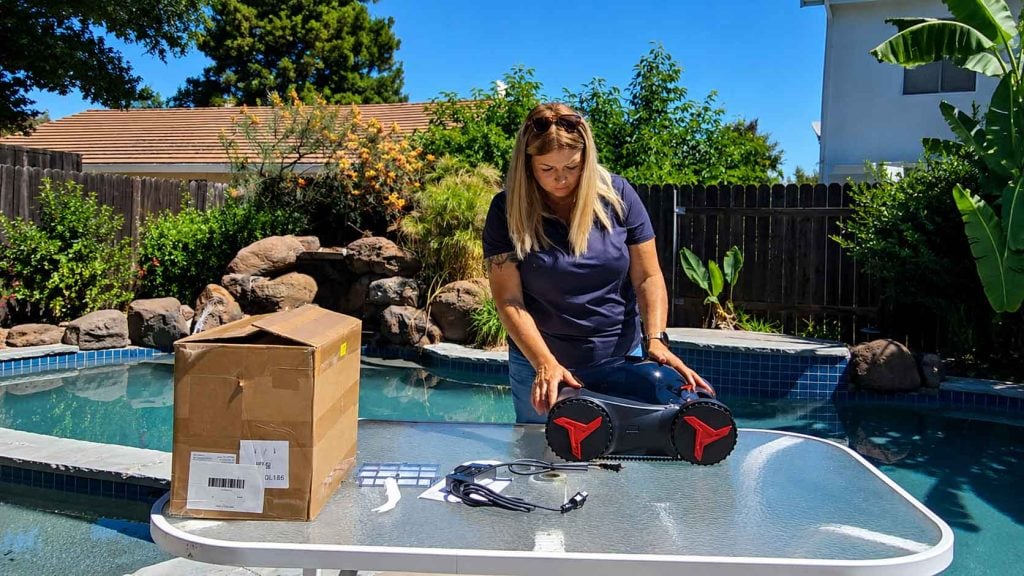
A Real Backyard Instead of a Test Tank
Clancy deliberately selected a pool that would give the K Series plenty to contend with.
“I chose this particular pool for a variety of reasons,” Clancy explained. “One, I knew the customer would give me honest feedback. I knew she would try and get everything she wanted out of the cleaner and give an honest review.”
The surrounding landscape also created a good mixture of debris.

“They had small leaves, big leaves, pine trees,” Clancy said. “So it was a variety of debris I wanted to be able to know if it could pick up.”
As luck would have it, an unrelated issue had also temporarily taken the pool’s circulation system offline, leaving the water somewhat dirtier than usual when the K Series arrived. That provided another opportunity to see how the cleaner handled real debris rather than a carefully prepared demonstration.
The pool itself presented an additional challenge. It was an older freeform gunite pool with curves, varying radiuses and features that would test the cleaner’s ability to navigate something considerably more complicated than a rectangular test pool.
For Clancy, that distinction matters when evaluating robotic cleaners.
“It’s not as authentic as putting it into somebody’s pool in an everyday yard where you have, you know, squirrels, and dogs, and wind, and rain, and all these varieties of things going on,” she said of controlled product demonstrations.
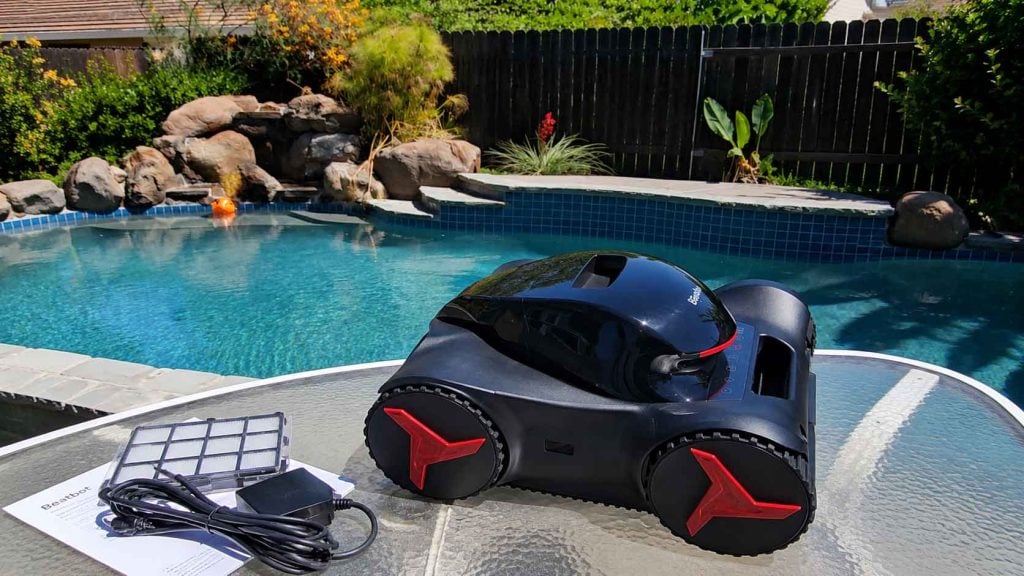
Strong First Impressions
Out of the box, the K Series made a favorable impression.
“I thought it had a very sleek look,” Clancy said. “It has a great look to it, you know, very modern. It wasn’t too bulky, which I did like about it.”
More important than aesthetics was the filtration system. The cleaner includes a fine-mesh filter that fits onto the debris canister, allowing it to capture smaller material in addition to larger debris.
“I really liked that it came with that so it can catch that fine debris such as dog hair or dirt,” Clancy said.
The cordless design was another immediate positive for the homeowner. She had previously owned another robotic cleaner that required placement on a charging base. The K Series offered a simpler arrangement.
“She liked on this one you could just plug it anywhere,” Clancy said. “You didn’t have to put it on a base, and it charged within three hours. She really liked that aspect of it.”
For a homeowner who wants a cleaner without adding another permanent charging station around the pool area, that simplicity can be an attractive feature.
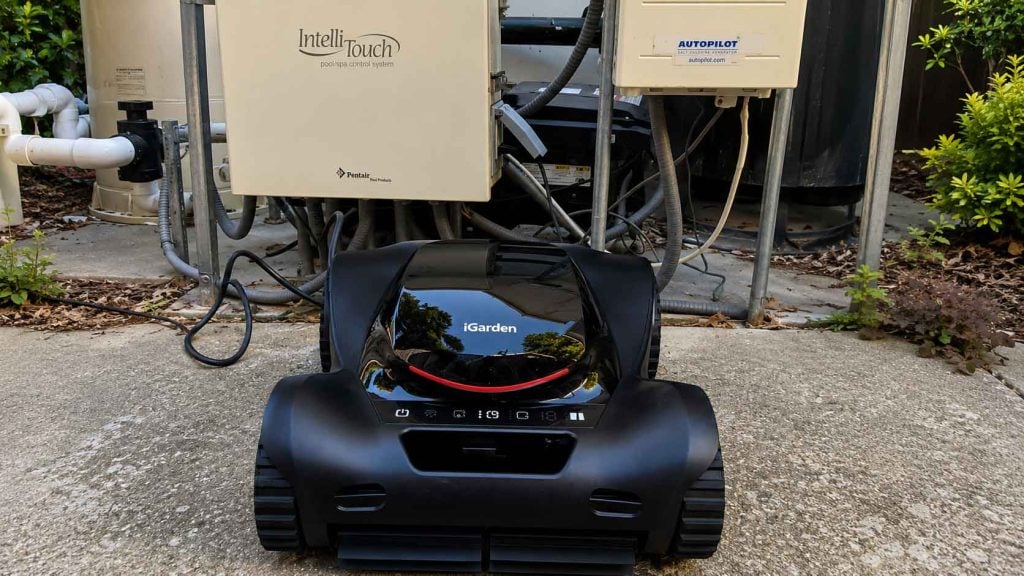
Cleaning the Floor, Walls and Waterline
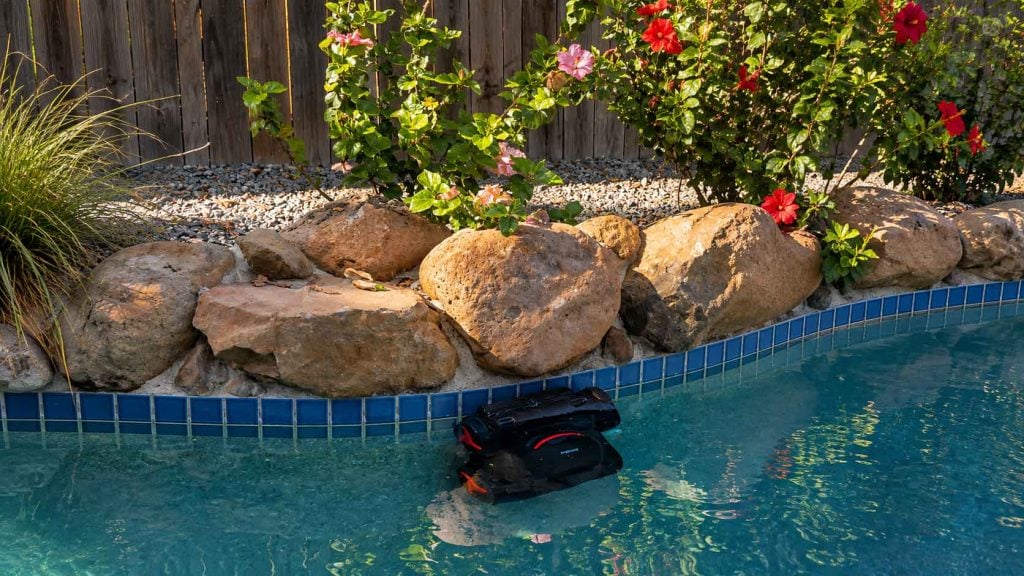
The K Series provides operating modes for floor cleaning as well as floor-and-wall cleaning. Once operating in the latter mode, Clancy found that the robot was capable of climbing the pool walls all the way to the waterline.
“It did go up the walls and did a good job at cleaning them,” she said. “So I really liked that about it.”
That capability stood out to the homeowner because previous cleaners she had owned did not provide the same wall-cleaning performance.
“That was a feature she really enjoyed,” Clancy said.
The robot also surprised Clancy by making its way onto the pool’s tanning ledge.
“It went up onto the tanning ledge. And that was surprising to me,” she said.
What impressed her most, however, was how quickly the K Series could make a noticeable difference.
“Me personally, watching it, I thought the cleaner did really well. I found that it cleaned the pool fairly quickly, which was really nice,” Clancy said. “So then if you have a party, you can just toss that in there and know within an hour that pool’s gonna be ready to go.”
Its ability to reach the waterline added another layer of cleaning.
“It climbs all the way up to clean the tile line, so that was really nice, too, if you haven’t brushed your tile in a while and have some leaves along there this will do a great job with that,” she added.
Handling Real Backyard Debris
Ultimately, a pool cleaner needs to pick things up, and Clancy came away impressed with the K Series’ ability to collect larger debris.
She specifically pointed to the tracks and intake design at the front of the cleaner.
“I think they got right with the tracks on the front where it’s collecting the debris,” Clancy said. “Those were very grippy, and when I watch it go over a pile of leaves, it was able to pull it in easily.”
Combined with the fine-mesh filtration, that gave the cleaner the ability to contend with the mixture commonly found in residential pools, including dirt, dog hair, leaves and pine needles.
Clancy sees that versatility as increasingly important as backyard landscaping becomes more elaborate and homeowners expect robotic cleaners to handle more than one specific type of debris.
Where Pool Geometry Matters
No robotic cleaner is necessarily going to perform identically in every swimming pool, and the K Series was no exception.
The test pool presented a particularly challenging combination of freeform curves and relatively narrow steps. The K Series has a fairly wide wheelbase, and Clancy observed that it could climb some steps but had difficulty stabilizing on others.
Importantly, she believed some of that behavior was specific to the dimensions of this particular pool.
“This particular issue may not be an issue in other pools, depending on the width of the steps,” Clancy explained. The steps in the test pool were approximately 10 inches wide, and she felt even slightly wider steps could have made it considerably easier for the robot to stabilize.
The irregular curves of the older freeform pool also occasionally presented navigation challenges. Based on what she observed, Clancy believes the K Series is likely to perform at its best in more geometrically shaped pools.
That doesn’t negate its performance in the test pool. The cleaner still climbed walls, reached the tile line, accessed the tanning ledge and collected a wide range of debris. It does, however, underscore something consumers should consider with any robotic cleaner: pool shape and feature dimensions can influence performance.
An Area With Room for Improvement
The primary area Clancy would like to see improved is app connectivity when the cleaner is submerged.
“The app needs a little improvement,” she said, noting that communication with the unit became less reliable once it was underwater.
For routine operation, however, Clancy found the cleaner itself straightforward to set up and use. When asked what might distinguish the K Series for someone comparing similarly priced robotic cleaners, she immediately pointed to that simplicity.
“Easy to program,” Clancy said. “It was pretty easy to program. I think that thing took maybe five minutes tops to program completely.”
The homeowner also appreciated a decidedly low-tech feature: the retrieval hook.
“That was one thing the homeowner did love was the hook that came with the cleaner actually worked,” Clancy said. Compared with another robot the homeowner had used, retrieving the K Series from the pool was considerably easier.
It may seem like a small consideration, but usability extends beyond how well a robot cleans. Charging it, programming it, removing it from the water and emptying the debris can determine whether a homeowner actually enjoys owning the product.

A Strong Entry Point Into Robotic Cleaning
With robotic cleaners now available across a wide range of prices and feature sets, one of the biggest questions is where a particular product fits.
For Clancy, the K Series occupies an appealing position for consumers who want to move into robotic cleaning without immediately jumping to the highest-priced equipment on the market.
“I would say it’s gonna be that middle ground customer, someone who’s looking for something that’s not the cheapest but not the most expensive,” she said. “Maybe more of your entry level robotic owner.”
Ease of use strengthens that argument.
“Overall, it seemed very easy to use for anybody, even somebody who doesn’t have ever used a robot,” Clancy said.
That may ultimately be one of the K Series’ strongest selling points. Robotic cleaners have become increasingly sophisticated, but sophistication isn’t necessarily what every homeowner wants. For someone purchasing their first cordless robotic cleaner, being able to charge it, program it quickly, drop it into the pool and retrieve a canister full of debris without a steep learning curve has considerable value.
Clancy’s final assessment carries additional weight because she doesn’t automatically endorse every cleaner she encounters.
“I could see this being a cleaner that I would recommend to people,” she said. “And I don’t recommend just any cleaner. I want something that actually works because, you know, it’s not a small price tag to get a robotic.”
After months in an actual customer’s backyard, the iGarden K Series showed itself to be an approachable cordless robotic cleaner with good debris pickup, wall and waterline cleaning, straightforward programming, convenient charging and thoughtful everyday usability.
There are areas where future generations could improve, particularly app connectivity and navigation around certain freeform curves or narrow features. Those considerations are worth understanding when matching any cleaner to a particular pool.
For homeowners looking to make the jump from traditional pool cleaning equipment to their first robotic cleaner, however, the K Series offers many of the capabilities that make robots attractive in the first place without making the experience unnecessarily complicated.
Should You Buy the iGarden K Series?
Yes.
The iGarden K Series makes the most sense for someone who wants to get into robotic pool cleaning without paying a premium for features they may not need. It’s a practical entry point into the category and, based on our real-world testing, capable enough to justify the investment.
That doesn’t mean it’s the perfect cleaner for every pool. More complex pool shapes and features deserve some consideration, and buyers expecting flawless app control may want to temper their expectations. But those shortcomings weren’t significant enough to change our overall opinion of the product.
What matters is whether the K Series delivers enough cleaning capability, convenience and usability to make owning one worthwhile. We think it does.
If you’ve been considering making the jump to a cordless robotic cleaner and want a capable unit without immediately moving into the upper end of the category, the iGarden K Series earns our recommendation.
And for an entry-level robotic cleaner, getting those fundamentals right matters most.
Ready to take a deeper dive?
Listen to our entire interview with Kelli Clancy about the iGarden K Series robot on the Pool Magazine podcast.


Artificial rock waterfalls, grottoes, and slides can be some of the most impressive features in a backyard swimming pool. Properly designed and constructed, they can support thousands of pounds of concrete while creating spaces meant to be climbed, walked across and enjoyed for years.
But when the structure hidden beneath that concrete is built incorrectly, the consequences can be far more serious than a few cosmetic cracks.
That became startlingly clear when Jason Lewis of Rockworks Inc. was called to inspect an artificial rock water feature at a home in Arizona. The homeowner had initially contacted Lewis after noticing deterioration in the structure. Lewis warned him that the feature appeared to be approaching failure, but other work was being done around the property and repairs were postponed.
Then the homeowner called again.
“My son fell through the top of it,” the homeowner told Lewis.
Fortunately, the child wasn’t seriously injured. The incident, and the videos Lewis subsequently shared showing what was happening inside the structure, attracted hundreds of thousands of views online.
What viewers saw was alarming. Reinforcing steel that should have been supporting thousands of pounds of concrete had deteriorated so badly that pieces of rebar could be broken apart by hand.

“That was only six years old,” Lewis said. “We opened it up, and he reached his hand in there and just started knocking number three-inch rebar into dust.”
For Lewis, who has spent more than three decades building real and artificial rock features, the failure itself wasn’t particularly unusual. Today, he estimates approximately 70% of his work involves structural repairs, demolition, or rebuilding existing features rather than new construction.
What concerned him was how quickly this particular structure had deteriorated—and how little indication homeowners may have of what’s happening underneath the surface.
How a Pool Feature Can Rot From the Inside Out
The fundamental problem Lewis encounters repeatedly is improperly protected reinforcing steel.
Artificial rock structures rely on steel reinforcement to carry and distribute the tremendous weight of their concrete shells. That steel isn’t supposed to simply sit inside an open cavity. It needs to be properly positioned and encased in concrete.
“The steel has to be encased in concrete, or there’s no long-term structural integrity,” Lewis explained. “I’m not saying anybody’s doing this on purpose, but if you don’t know, you don’t know.”
When rebar remains exposed inside a hollow artificial rock feature, moisture can reach it. Small cracks in the concrete make the situation worse.
“These things do crack. The earth moves, you get hairline cracks,” Lewis said. “You build up some moisture inside there, and you add a lot of water to that if it does crack, and that rust takes off like cancer.”
As steel corrodes, it expands and flakes apart. Eventually, the reinforcement that was intended to support the concrete can effectively disappear.
“They’re holding up thousands of pounds of concrete,” Lewis said. “So when that steel is gone, the concrete just falls in on itself.”
Continuous operation of waterfalls can also contribute to the problem when moisture finds a path into the structure. Lewis advises homeowners to operate these features when they want to enjoy them rather than automatically running them for long periods every day.
“No matter how much you seal it, it’s a big giant concrete sponge,” he said.
On one recent inspection, Lewis drilled two holes into the bottom of an artificial rock feature and estimated that roughly five gallons of trapped water drained out.
Warning Signs Homeowners Shouldn’t Ignore
The difficulty is that an artificial rock feature can still look relatively normal from across the pool while significant deterioration is occurring internally.
Lewis said slides are among the features where he most frequently sees structural problems.
Ordinary hairline cracking doesn’t necessarily mean a structure is about to collapse. Concrete moves, and minor cracking can occur. The warning becomes more serious when those cracks begin separating or when adjoining surfaces move onto different planes.
“When you see those cracks heave, like split and become on two different planes,” Lewis said, “that’s a huge indication that you have a structural problem.”
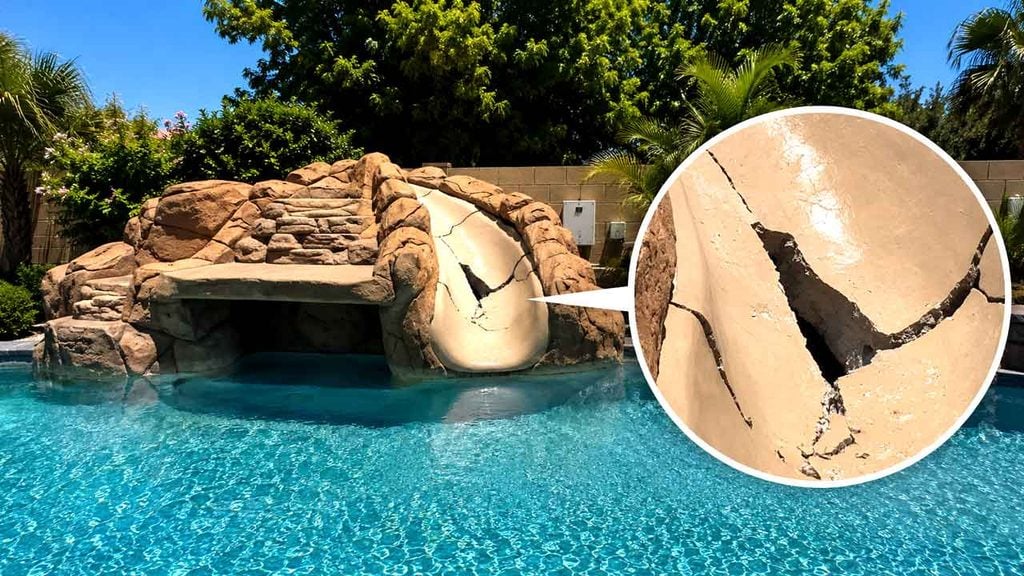
On artificial rock slides, homeowners should pay particular attention to the areas where the slide trough meets the surrounding rockwork. Lewis frequently sees consistent cracking develop along the inside and outside radiuses as the underlying reinforcement begins deteriorating.
In severe cases, gaps may become obvious, stairs may begin separating, or pieces of concrete may loosen or fall away.
His advice to homeowners is straightforward.
“Use your common sense. If it looks dangerous, it’s dangerous. It’s not perfect one day, and then it just falls apart. You can see the degradation over time.”
If cracking begins changing noticeably, sections are separating, concrete is falling away, or a step or walking surface feels compromised, the feature shouldn’t continue being used while everyone waits to see what happens next.
“Let’s stay off this. Let’s just be careful. Let’s call somebody to come and look at it,” Lewis said.
The challenge is that even an experienced contractor may not be able to determine the full condition of the reinforcement from the exterior.
“I don’t know until I open it up,” Lewis said.
On some inspections, Rockworks creates access openings specifically to examine the structure from inside. In one case, stairs had already failed, yet the adjoining slide still appeared remarkably sound. Once the structure was opened, Lewis discovered virtually none of the original reinforcing steel remained.
When a Repair Isn’t Really a Repair
Not every crack requires demolition. Rockworks routinely repairs and refinishes artificial rock features when the underlying structure remains viable.
The distinction is whether the problem is cosmetic or structural.
“When the slide is heaving, when you have chunks of concrete falling off, and you can look inside and there’s not a stitch of steel left, it needs to be torn down,” Lewis said.
That can leave homeowners facing a difficult financial decision. Some choose to remove the unsafe feature and replace it with simpler rockwork rather than reconstructing the original waterfall or slide. Others elect to demolish everything and build a new feature correctly.
What Lewis won’t do is disguise a known structural failure with a cosmetic repair.
He learned how problematic that can become through a project several years ago. Lewis inspected a slide where part of the surrounding rockwork had settled approximately three inches away from the trough. He advised that patching it wouldn’t solve the structural problem.
The homeowner nevertheless wanted it cosmetically repaired for the summer and signed a waiver acknowledging the repair wasn’t structural.
When the feature subsequently failed, the entire matter went before the Arizona Registrar of Contractors. According to Lewis, the pool company he was subcontracted to was ultimately required to correct the problem despite the homeowner’s waiver.
“You guys as contractors should know better,” Lewis recalled the ROC telling the pool builder. “You can’t be fixing things that you know are gonna fail, then ask the homeowner to take the responsibility.”
The experience changed the way Lewis approaches compromised structures.
“You couldn’t give me $100,000 to patch a job that I know it was gonna fall apart in six weeks,” he said. “It’s not ethical to do, and you’re still liable for it. I don’t want anybody getting hurt.”
What Proper Construction Looks Like
Avoiding those failures starts long before anyone applies the final texture and color that make concrete resemble natural stone.
It starts with engineering.
Rockworks spaces material behind the reinforcing steel so concrete can completely surround the structural rebar when gunite or shotcrete is applied. Lewis compares the concept to constructing a swimming pool shell, where reinforcing steel is elevated from the soil rather than lying directly against it.
“We make sure we encase all the structural rebar, so it has the strength that the engineering requires to hold up the load,” Lewis said.
On a recent San Tan Valley project, Rockworks used approximately 34 yards of shotcrete before the finish coat was applied. The grotto incorporated No. 4 rebar in a double mat, with the structure formed, poured and vibrated in an effort to ensure the reinforcement was completely encased.
The additional effort isn’t always obvious once the project is finished. In fact, that’s part of the problem when homeowners or even pool builders compare bids. Two completed artificial rock structures can look similar while being constructed very differently underneath.
Lewis said proper construction can require several additional days of labor compared with competing approaches.
“A lot of builders, again, people don’t know what they don’t know,” he said. “The price point ends up being more important than the structure itself because they don’t know if it’s being done incorrectly.”
For pool builders vetting a rockwork contractor, Lewis recommends asking specifically how the structure will be built, whether engineering requirements will be followed and how the reinforcing steel will be protected. He also photographs his projects during construction so there is a record of what’s behind the finished surface.
One project demonstrates what can happen when that attention to structure is combined with collaboration and ambitious design.
Working alongside Arizona pool builder Premier Paradise, Rockworks helped create an elaborate backyard featuring a perimeter-overflow pool, grotto, slide, jumping area and extensive artificial rockwork.

“The most important thing is we followed the engineering and built it correctly,” Lewis said.
The grotto lid was supported by engineered columns and heavily reinforced before the surrounding rockwork was constructed.
“The amount of steel and concrete they put in that lid, that thing is a helicopter landing pad on steroids,” Lewis said. “So he poured it, vibrated it, and then I came in and built my rock work around it and then did the texture coat. So it definitely was a collaboration between the two of us.”
Several years later, the feature continues to perform as intended.
“The homeowners are happy. To this day they don’t have any problems with it,” Lewis said.
That contrast—between a feature still being enjoyed years later and another only six years old with reinforcement crumbling into dust—illustrates why what’s underneath artificial rock matters as much as what homeowners see from the pool deck.
Waterfalls, grottoes and slides aren’t merely decorative sculptures. They’re engineered structures supporting substantial loads, often in environments where people climb, jump, sit and play.
For homeowners who already have one, visible deterioration shouldn’t be dismissed as simply an aging finish. Cracks that are widening or heaving, separating sections, failing stairs and loose concrete all warrant closer inspection.
For homeowners considering a new feature, the questions asked before construction ever even begins may prove even more important.
Ready to take a deeper dive?
Listen to our entire conversation with Jason Lewis of Rockworks Incorporated on the Pool Magazine Podcast.
Read the Fall Issue of Pool Magazine

See more of our coverage in your search results
 Sponsored Advertisement
 Historic Rain in Florida Takes Toll on Pool Job Sites
 Pool Manager Charged Over Stolen Equipment Sold on eBay
 JED Pool Tools CEO Featured on ‘Growing Up B2B’
 Scott Jones Named CEO of Landmark Aquatic
 Haviland Pool & Spa Invests $26 Million in Indiana Facility
 Watson’s Acquires Tampa Bay Spas, Enters Tampa Bay Market
 Cover Care Names Greg Conner Executive VP and General Manager
 H2Flow Controls Introduces Nautis™ VSF
 Anatomy of a Botched Remodel: What Sank the Lincoln Memorial Reflecting Pool Restoration?
 Come to Buffalo And See First Hand What An Aquatic Desert Looks Like
 Landmark Aquatic Earns Three 2026 PHTA Awards of Excellence
- Scott Jones Named CEO of Landmark Aquatic
 Step Into Swim Is Turning Industry Giving Into Life-Saving Impact
 Landmark Aquatic Acquires CEM Aquatics
 Sponsored Advertisement
Pool Magazine Podcast
 What’s Your Pool Company Really Worth? – Pool Magazine Podcast With Weld Valuations
 iGarden K Series Review: A Pool Pro Puts It to the Test
 Why Waiting Until Spring to Remodel Your Pool Could Cost You Time & Money
 Ready When You Are: The Changing Role of Automatic Pool Covers
 What’s Hot & Trending in Fire Pits and Fire Tables for 2026
 Sponsored Advertisement

 Pool News2 weeks ago
Sacred Geometry: Where Architecture, Mathematics and Mosaics Collide
 Pool News2 weeks ago
Anatomy of a Botched Remodel: What Sank the Lincoln Memorial Reflecting Pool Restoration?

 Equipment Supplies2 weeks ago
iGarden K Series Review: What We Learned After Months in a Customer’s Pool

 Contractors and Builders2 weeks ago
What’s Hiding Beneath The Surface: Artificial Rock Features
 Pool Builder2 days ago
Historic Rain in Florida Takes Toll on Pool Job Sites
 Press Releases1 week ago
Watson’s Acquires Tampa Bay Spas, Enters Tampa Bay Market

 Equipment Supplies2 weeks ago
Hayward Bets Big on Decentralized Automation With OmniX

 Pool News2 weeks ago
Landmark Aquatic Taps Britton Nielsen and Tim Garner to Lead Utah Growth
You must be logged in to post a comment Login