





Pools
Does Building a Pool Help or Hurt Your Property Value?


After building their dream house, homeowners always look for different ways to spice up their backyard area. One of the most common ways of upgrading your backyard is building a pool. Although costly, swimming pools are fantastic add-ons to your property. They offer a wide range of aesthetic and functional benefits. Not to mention, a swimming pool helps you cool down under the summer heat. At no time in the history of inground pools have swimming pools been more popular than they have become in the last two years.

Nevertheless, swimming pools are very costly. They incorporate high initial and lifetime costs. And this can discourage you from installing this spectacular feature. Before building a pool in your backyard space, it is important to analyze your requirements. From there, weigh the pros and cons of constructing a swimming pool. Doing this helps you know whether building the pool is a good idea.
In case you didn’t know, swimming pools help you increase your home’s value. On average, a swimming pool can increase your home’s value by 7%. Needless to say, this percentage is not enough to help you recover all initial pool construction costs. But you are at a higher chance of obtaining higher profits when you sell your home.

First, calculate the total construction costs & payments
The first thing you need to do is calculate the initial pool construction costs. Doing this helps you know whether your pool helps or hurts your property value. Pool experts often report that building a pool costs approximately $30,000 to $90,000. Of course, this cost varies depending on various factors. In this context, let’s deal with a 600 square foot concrete pool that costs approximately $30,000. It’s also important to factor in the cost of financing if you will be getting a loan to pay for construction you should know what your pool loan payments will be ahead of time.
The maintenance costs of building a pool in your yard
Aside from the initial construction costs of building a pool, a majority of states will require you to put up safety features like covers and fences. Also, you have to install other pool equipment and water features. Keep in mind that all these pool features need maintenance and increase your electricity bills. For instance, your pool pump and heater can raise your monthly electricity bills by approximately $100. There are many other costs involved during pool maintenance that you need to put into consideration.
During the swimming pool peak season, you are likely to spend approximately $800 to keep the pool in good condition. Set aside $25 to $50 for weekly pool maintenance if you use your pool throughout the year. Unfortunately, neglecting your pool is detrimental. If you don’t take good care of your pool, you will experience common pool problems like algae and stains. Ultimately, maintaining a pool is very expensive. So, ensure you evaluate all the lifetime costs of the pool before construction. This way, you’ll be able to know whether building a pool makes sense.
A Home-Selling Obstacle or Feature?
Your pool construction costs determine the selling price of your home. Homes with swimming pools are more costly. However, they may not attract a lot of buyers. Some potential buyers may consider a swimming pool as a liability. On the other hand, some may consider pools a luxury. It all depends on the location of your home.
Although not in every instance, in this particular climate a pool improves your property’s value by 7%. However, below are some of the conditions for this to happen.

- If you stay in an area where most properties have pools, this is basically a first-class neighborhood.
- Swimming pools in warmer regions like Florida are more likely to increase your property’s value. Very few people are likely to buy pools in colder areas.
- A pool increases your home’s value by up to 7% if it does not consume a lot of space in your yard. If there is still space for homeowners to add other features, you attract more prospective buyers.
- If the pool design complements the nature of your yard, your pool is likely to increase your property’s value by up to 7%. Also, the pool has to be in good shape for it to raise your home’s value.
At the end of the day, if you’re considering building a pool, don’t look at it as an investment. Instead, focus on all the amazing benefits offered by the pool. Remember, swimming pools are excellent sources of fun, enjoyment, and relaxation. Nevertheless, you have to be ready for all the maintenance costs that come with this spectacular feature.


BREVARD COUNTY, FL — For swimming pool builders along Florida’s Space Coast, Monday, November 2, was anything but business as usual. An extraordinary rainfall event inundated portions of Brevard County, flooding neighborhoods, closing roads and turning active swimming pool construction sites into muddy reservoirs.
According to The Washington Post, portions of Florida’s Space Coast received as much as 28 inches of rain in approximately 36 hours, equivalent to nearly half the region’s typical annual rainfall. The relentless downpours overwhelmed drainage systems, flooded residential neighborhoods and brought construction activity to a standstill.
In some of the hardest-hit communities, nearly two feet of rain fell as a slow-moving weather system repeatedly delivered heavy downpours across the region. The National Weather Service characterized rainfall in portions of southern Brevard County as a 1-in-1,000-year event, a statistical designation indicating a 0.1% probability of rainfall of that magnitude occurring in any given year.
By Tuesday, November 3, the storm had claimed at least two lives. Joshua Bennett, 34, was found dead in his truck in a flooded area of southeastern Palm Bay, while Archie Richards, 78, was discovered inside his Toyota Tacoma in a canal near his home in Malabar. Emergency crews rescued hundreds of people as rising water inundated residential neighborhoods and left vehicles stranded.
Preliminary rainfall reports showed 23.69 inches in Grant-Valkaria, 23.44 inches in Malabar and 19.75 inches in Palm Bay. The extraordinary rainfall overwhelmed drainage systems, flooded homes and brought construction activity to a standstill in affected neighborhoods.
For Jeff Jones, owner and builder at Spacefront Pool & Spa, the storm struck directly at the communities he serves. Several of his active construction projects were caught in the flooding.

From Active Construction Sites to Underwater Excavations
Before the storm, Jones’s crews had been progressing through the normal stages of swimming pool construction. Excavations had been completed, plumbing installed and, at some locations, steel reinforcement and forming were already underway.
“Today was one of those days that reminds you just how unpredictable the construction industry can be, especially here on Florida’s Space Coast,” Jones said. “Today we had multiple swimming pool construction sites flood, freshly excavated pools filling with water and surrounding soil washing back into the pools.”
For a pool builder, an open excavation represents considerably more than a hole in the ground. By the time plumbing, rebar, and forms are installed, crews have already invested substantial labor and materials into preparing the site for the next phase of construction.
Flooding at this stage can undo days of work and leave contractors facing costly repairs. But before Jones could begin assessing the damage, there were more immediate concerns.

A Builder’s First Priority: Safety
“Even with roads closed due to flooding, I made it out to our job sites to assess the situation and address immediate hazards,” Jones said. “One of my biggest concerns was the electrical equipment associated with our pumps.”
With floodwaters rising, he worked to disconnect electrical power safely and remove pumps where conditions allowed.
“Some of my pumps were a foot below water.”
The danger wasn’t limited to electrical equipment. Submerged excavations concealed steel reinforcement, unstable soil and other hazards that could pose serious risks to anyone attempting to recover materials or equipment.
Jones understood there was a point where the effort to protect a construction site just had to stop.
“You can rebuild a swimming pool. You can’t replace someone’s life.”
But the damage to his construction sites wasn’t the only thing weighing on Jones.
“What made this situation even more devastating was that some of our customers’ homes were flooding as well,” Jones said.
“As a business owner, your first instinct is to protect your work and your investment. But you quickly realize there’s a much bigger picture.”
The flooding had turned what began as a construction emergency into something far more personal, with Jones balancing the responsibility of protecting his business against the immediate needs of the families he serves.

Weeks of Recovery Ahead
With the immediate danger beginning to subside, Jones faces the difficult task of assessing what can be salvaged from his flooded construction sites.
The damage to an unfinished swimming pool can extend well beyond the water visible in an excavation. Heavy runoff carries soil, sand, and debris into the work area, potentially compromising excavation walls, displacing forms, and undermining surrounding ground. Plumbing and steel may also require inspection or repair before construction can resume.
Some projects may need little more than pumping and cleanup. Others could require extensive excavation repairs, re-forming and additional inspections. Saturated soil and elevated groundwater levels can further complicate recovery, making it necessary to evaluate site conditions before removing accumulated water.
“This is going to set us back weeks,” Jones said.
The setbacks come with additional labor costs, equipment expenses and the challenge of coordinating crews and subcontractors around work that must now be repeated. For a pool builder managing several projects at different stages of construction, those disruptions can ripple through the entire schedule.
Florida contractors are accustomed to dealing with unpredictable weather, but the magnitude of this event illustrates how even experienced builders can find themselves facing circumstances beyond their control.
Jones has spent years working in an industry where weather is an unavoidable part of the business. His experience has taught him the importance of job-site drainage, protecting equipment and preparing crews to respond when conditions improve. Yet even those precautions have their limits.
“Preparation is everything, but even the best preparation can’t prevent Florida from being Florida on a random Monday in November.”
For now, the work ahead involves assessing the damage, restoring affected construction sites, and getting projects moving again. The financial consequences have yet to be fully determined, but the delays are already a certainty.
As Jones put it, “Mother Nature doesn’t care about your construction schedule.”
Photographs courtesy of Jeff Jones, Spacefront Pool & Spa.

Artificial rock waterfalls, grottoes, and slides can be some of the most impressive features in a backyard swimming pool. Properly designed and constructed, they can support thousands of pounds of concrete while creating spaces meant to be climbed, walked across and enjoyed for years.
But when the structure hidden beneath that concrete is built incorrectly, the consequences can be far more serious than a few cosmetic cracks.
That became startlingly clear when Jason Lewis of Rockworks Inc. was called to inspect an artificial rock water feature at a home in Arizona. The homeowner had initially contacted Lewis after noticing deterioration in the structure. Lewis warned him that the feature appeared to be approaching failure, but other work was being done around the property and repairs were postponed.

Then the homeowner called again.
“My son fell through the top of it,” the homeowner told Lewis.
Fortunately, the child wasn’t seriously injured. The incident, and the videos Lewis subsequently shared showing what was happening inside the structure, attracted hundreds of thousands of views online.
What viewers saw was alarming. Reinforcing steel that should have been supporting thousands of pounds of concrete had deteriorated so badly that pieces of rebar could be broken apart by hand.
“That was only six years old,” Lewis said. “We opened it up, and he reached his hand in there and just started knocking number three-inch rebar into dust.”
For Lewis, who has spent more than three decades building real and artificial rock features, the failure itself wasn’t particularly unusual. Today, he estimates approximately 70% of his work involves structural repairs, demolition, or rebuilding existing features rather than new construction.
What concerned him was how quickly this particular structure had deteriorated—and how little indication homeowners may have of what’s happening underneath the surface.
How a Pool Feature Can Rot From the Inside Out
The fundamental problem Lewis encounters repeatedly is improperly protected reinforcing steel.
Artificial rock structures rely on steel reinforcement to carry and distribute the tremendous weight of their concrete shells. That steel isn’t supposed to simply sit inside an open cavity. It needs to be properly positioned and encased in concrete.
“The steel has to be encased in concrete, or there’s no long-term structural integrity,” Lewis explained. “I’m not saying anybody’s doing this on purpose, but if you don’t know, you don’t know.”
When rebar remains exposed inside a hollow artificial rock feature, moisture can reach it. Small cracks in the concrete make the situation worse.
“These things do crack. The earth moves, you get hairline cracks,” Lewis said. “You build up some moisture inside there, and you add a lot of water to that if it does crack, and that rust takes off like cancer.”
As steel corrodes, it expands and flakes apart. Eventually, the reinforcement that was intended to support the concrete can effectively disappear.
“They’re holding up thousands of pounds of concrete,” Lewis said. “So when that steel is gone, the concrete just falls in on itself.”
Continuous operation of waterfalls can also contribute to the problem when moisture finds a path into the structure. Lewis advises homeowners to operate these features when they want to enjoy them rather than automatically running them for long periods every day.
“No matter how much you seal it, it’s a big giant concrete sponge,” he said.
On one recent inspection, Lewis drilled two holes into the bottom of an artificial rock feature and estimated that roughly five gallons of trapped water drained out.
Warning Signs Homeowners Shouldn’t Ignore
The difficulty is that an artificial rock feature can still look relatively normal from across the pool while significant deterioration is occurring internally.
Lewis said slides are among the features where he most frequently sees structural problems.
Ordinary hairline cracking doesn’t necessarily mean a structure is about to collapse. Concrete moves, and minor cracking can occur. The warning becomes more serious when those cracks begin separating or when adjoining surfaces move onto different planes.
“When you see those cracks heave, like split and become on two different planes,” Lewis said, “that’s a huge indication that you have a structural problem.”
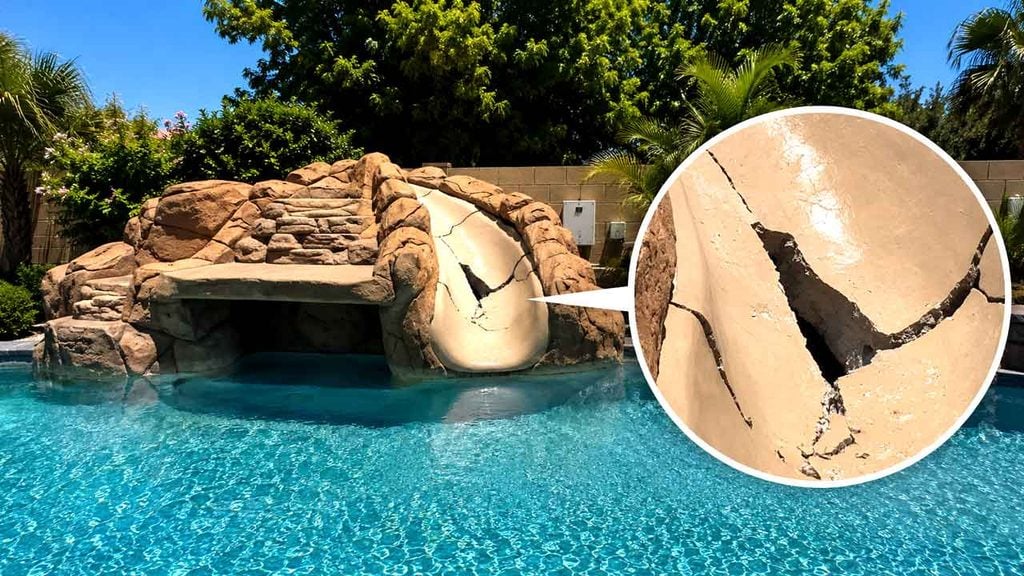
On artificial rock slides, homeowners should pay particular attention to the areas where the slide trough meets the surrounding rockwork. Lewis frequently sees consistent cracking develop along the inside and outside radiuses as the underlying reinforcement begins deteriorating.
In severe cases, gaps may become obvious, stairs may begin separating, or pieces of concrete may loosen or fall away.
His advice to homeowners is straightforward.
“Use your common sense. If it looks dangerous, it’s dangerous. It’s not perfect one day, and then it just falls apart. You can see the degradation over time.”
If cracking begins changing noticeably, sections are separating, concrete is falling away, or a step or walking surface feels compromised, the feature shouldn’t continue being used while everyone waits to see what happens next.
“Let’s stay off this. Let’s just be careful. Let’s call somebody to come and look at it,” Lewis said.
The challenge is that even an experienced contractor may not be able to determine the full condition of the reinforcement from the exterior.
“I don’t know until I open it up,” Lewis said.
On some inspections, Rockworks creates access openings specifically to examine the structure from inside. In one case, stairs had already failed, yet the adjoining slide still appeared remarkably sound. Once the structure was opened, Lewis discovered virtually none of the original reinforcing steel remained.
When a Repair Isn’t Really a Repair
Not every crack requires demolition. Rockworks routinely repairs and refinishes artificial rock features when the underlying structure remains viable.
The distinction is whether the problem is cosmetic or structural.
“When the slide is heaving, when you have chunks of concrete falling off, and you can look inside and there’s not a stitch of steel left, it needs to be torn down,” Lewis said.
That can leave homeowners facing a difficult financial decision. Some choose to remove the unsafe feature and replace it with simpler rockwork rather than reconstructing the original waterfall or slide. Others elect to demolish everything and build a new feature correctly.
What Lewis won’t do is disguise a known structural failure with a cosmetic repair.
He learned how problematic that can become through a project several years ago. Lewis inspected a slide where part of the surrounding rockwork had settled approximately three inches away from the trough. He advised that patching it wouldn’t solve the structural problem.
The homeowner nevertheless wanted it cosmetically repaired for the summer and signed a waiver acknowledging the repair wasn’t structural.
When the feature subsequently failed, the entire matter went before the Arizona Registrar of Contractors. According to Lewis, the pool company he was subcontracted to was ultimately required to correct the problem despite the homeowner’s waiver.
“You guys as contractors should know better,” Lewis recalled the ROC telling the pool builder. “You can’t be fixing things that you know are gonna fail, then ask the homeowner to take the responsibility.”
The experience changed the way Lewis approaches compromised structures.
“You couldn’t give me $100,000 to patch a job that I know it was gonna fall apart in six weeks,” he said. “It’s not ethical to do, and you’re still liable for it. I don’t want anybody getting hurt.”
What Proper Construction Looks Like
Avoiding those failures starts long before anyone applies the final texture and color that make concrete resemble natural stone.
It starts with engineering.
Rockworks spaces material behind the reinforcing steel so concrete can completely surround the structural rebar when gunite or shotcrete is applied. Lewis compares the concept to constructing a swimming pool shell, where reinforcing steel is elevated from the soil rather than lying directly against it.
“We make sure we encase all the structural rebar, so it has the strength that the engineering requires to hold up the load,” Lewis said.
On a recent San Tan Valley project, Rockworks used approximately 34 yards of shotcrete before the finish coat was applied. The grotto incorporated No. 4 rebar in a double mat, with the structure formed, poured and vibrated in an effort to ensure the reinforcement was completely encased.
The additional effort isn’t always obvious once the project is finished. In fact, that’s part of the problem when homeowners or even pool builders compare bids. Two completed artificial rock structures can look similar while being constructed very differently underneath.
Lewis said proper construction can require several additional days of labor compared with competing approaches.
“A lot of builders, again, people don’t know what they don’t know,” he said. “The price point ends up being more important than the structure itself because they don’t know if it’s being done incorrectly.”
For pool builders vetting a rockwork contractor, Lewis recommends asking specifically how the structure will be built, whether engineering requirements will be followed and how the reinforcing steel will be protected. He also photographs his projects during construction so there is a record of what’s behind the finished surface.
One project demonstrates what can happen when that attention to structure is combined with collaboration and ambitious design.
Working alongside Arizona pool builder Premier Paradise, Rockworks helped create an elaborate backyard featuring a perimeter-overflow pool, grotto, slide, jumping area and extensive artificial rockwork.

“The most important thing is we followed the engineering and built it correctly,” Lewis said.
The grotto lid was supported by engineered columns and heavily reinforced before the surrounding rockwork was constructed.
“The amount of steel and concrete they put in that lid, that thing is a helicopter landing pad on steroids,” Lewis said. “So he poured it, vibrated it, and then I came in and built my rock work around it and then did the texture coat. So it definitely was a collaboration between the two of us.”
Several years later, the feature continues to perform as intended.
“The homeowners are happy. To this day they don’t have any problems with it,” Lewis said.
That contrast—between a feature still being enjoyed years later and another only six years old with reinforcement crumbling into dust—illustrates why what’s underneath artificial rock matters as much as what homeowners see from the pool deck.
Waterfalls, grottoes and slides aren’t merely decorative sculptures. They’re engineered structures supporting substantial loads, often in environments where people climb, jump, sit and play.
For homeowners who already have one, visible deterioration shouldn’t be dismissed as simply an aging finish. Cracks that are widening or heaving, separating sections, failing stairs and loose concrete all warrant closer inspection.
For homeowners considering a new feature, the questions asked before construction ever even begins may prove even more important.
Ready to take a deeper dive?
Listen to our entire conversation with Jason Lewis of Rockworks Incorporated on the Pool Magazine Podcast.

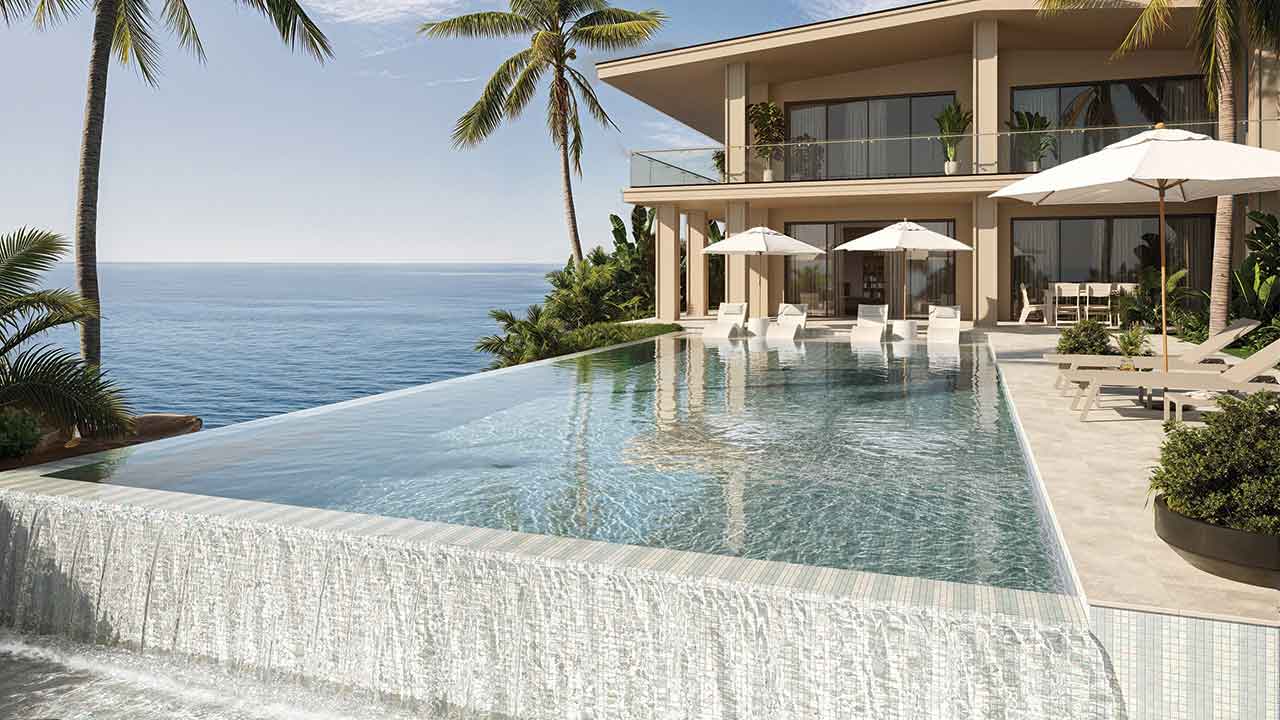
There is a point in luxury pool design where the materials stop functioning merely as finishes and begin defining the character of the space.
For Frank Vitori, co-founder of AquaBlu Mosaics and designer of the new Sand Pearl Series, the opportunity was to rethink some of the patterns currently influencing pool and architectural design without relying on the contrasting colors traditionally used to create them.
When Pool Magazine spoke with Vitori about the collection, he explained that the idea behind Sand Pearl began with a deceptively simple question: What if the pattern could be created by light instead of color?

“The concept behind Sand Pearl was to take patterns we’re seeing throughout contemporary design—checkerboards, stripes and offset stripes—and reinterpret them through finish and light,” Vitori explained. “Instead of using contrasting colors to define the pattern, we’re using the same color in matte and iridescent glass. As the light changes, the pattern reveals itself.”
That distinction is central to understanding Sand Pearl, the latest AquaBlu Signature Collection from AquaBlu Mosaics.
Rather than simply assembling existing tile into a new assortment, AquaBlu developed Sand Pearl as an original, coordinated design collection. Each colorway brings together monochromatic glass, complementary finishes, contemporary patterns, coordinating field tile and curated grout selections to create a complete material system for pools and architectural spaces.
It is a concept rooted in what Vitori describes as a quieter approach to luxury.
“Luxury doesn’t always need to announce itself,” Vitori said. “Sometimes it’s the detail you notice as you move through a space—the way a surface changes in the light or the way water completely transforms the material.”


Reinventing Pattern Through Light
Pattern is hardly new to tile.
Checkerboards, stripes and running patterns have appeared in architecture and interior design for generations. What has changed is how designers are using them.
As contemporary tile trends move toward more intentional patterns and sophisticated material combinations, Sand Pearl approaches those familiar geometries from a different direction.
The collection does not need a dark tile beside a light tile to create a checkerboard. It does not require two opposing colors to make a stripe visible.
Instead, matte and iridescent versions of the same color work together to create the pattern.
From certain angles, the distinction can appear subtle. Then sunlight moves across the installation, the viewing angle changes or water begins flowing over the surface, and individual sections of iridescent glass catch the light differently from their matte counterparts.
Suddenly, the pattern becomes more pronounced.
The effect allows a surface to remain monochromatic while still having considerable visual depth and movement. Rather than placing the emphasis on color contrast, Sand Pearl uses reflection itself as a design element.
That becomes particularly compelling in a swimming pool, where very little about the visual environment remains static.
Sunlight changes position throughout the day. Ripples continuously alter reflections. Water depth influences perceived color. Landscaping, coping, interior finishes and surrounding architecture all contribute additional tones and reflected light.
Sand Pearl was designed to interact with those variables rather than compete with them.
The collection draws its palette from sun-bleached beaches, shallow coastal water, sea glass and other subdued coastal tones, but the coastal influence provides the backdrop rather than defining the entire concept.
The real story is what happens when pattern, finish, and changing light intersect.
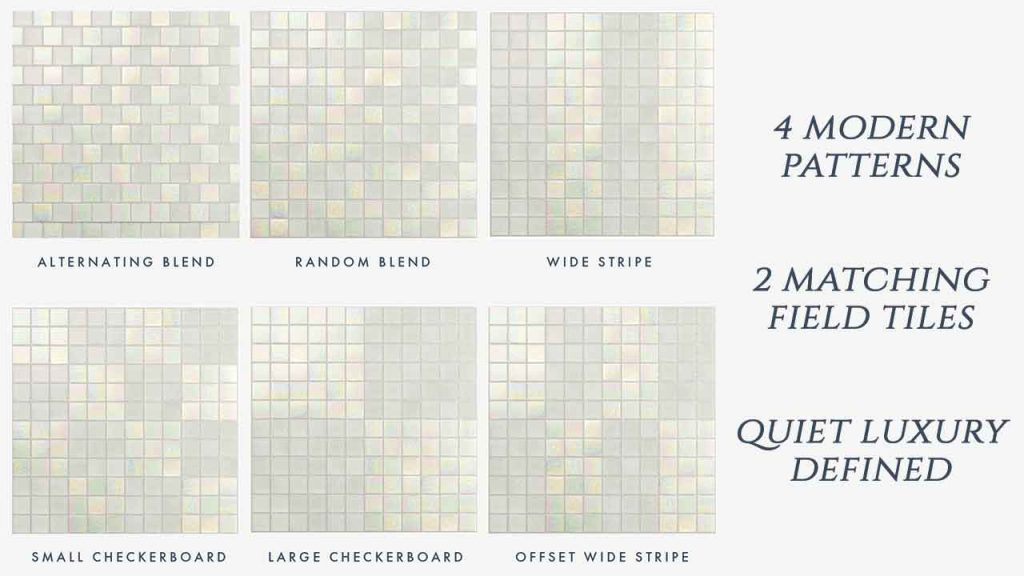
Contemporary Patterns, Reinterpreted
Sand Pearl takes several of today’s most recognizable tile patterns and reconstructs them using matte and iridescent finishes.
The checkerboard pattern provides perhaps the clearest demonstration of the concept. Instead of alternating contrasting colors, the pattern alternates finishes within the same color family. The checkerboard may appear subdued under one lighting condition and considerably more pronounced under another.
The striped pattern applies the same principle in a more linear composition, creating alternating bands of matte and reflective glass. It can introduce direction and rhythm across a waterline, raised spa, feature wall or other architectural surface without introducing another color into the palette.
The offset stripe pattern adds another level of movement by shifting that linear geometry, creating a more dynamic arrangement while retaining the collection’s monochromatic character.
These patterns are complemented by two coordinating field-tile formats: stacked and staggered.
That addition gives designers considerably more flexibility when specifying the collection across an entire project.
A checkerboard, stripe or offset stripe might be used to establish a focal point on a raised spa, water feature or architectural wall, while the coordinating stacked or staggered field tile can finish the surrounding space in the same color and material language.
Alternatively, the field tile can be carried across a larger surface where a quieter treatment is desired.
The result is not simply a selection of individual mosaics. It is a coordinated collection that allows designers to change pattern and visual intensity while maintaining continuity of color and material.

Six Coastal-Inspired Colorways
Sand Pearl is offered in six primary colorways—Marelle, Caspia, Brisa, Calista, Marea and Aurelia—ranging from luminous whites and soft sand tones to aqua, sea-glass greens and deeper coastal blues and grays.
Caspia provides one of the collection’s lightest treatments with a pearlescent white appearance suited to bright contemporary environments. Brisa moves toward tropical aqua, while Marea introduces softer sea-glass tones. Marelle and Calista bring cooler, deeper shades into the collection, while Aurelia introduces the warmth of sand and champagne.
The restrained palette is intentional.
Because the visual interest is being created through the relationship between matte and iridescent finishes, the colors themselves do not need to compete for attention. That allows designers to select a palette based on the architecture and surrounding environment while allowing changing light to bring the pattern forward.
Grout Becomes Part of the Design
AquaBlu has taken that coordination one step further by pairing Sand Pearl designs with curated Starlike PRO grout selections.
That is an important detail because grout can substantially change the appearance of a mosaic installation. With small-format glass tile in particular, grout becomes part of the visible composition rather than simply the material filling the joints.
For Sand Pearl, the grout selection is treated as another component of the design.
Each recommended grout is chosen to complement the intended color and pattern combination, helping maintain the collection’s monochromatic character rather than introducing an unintended grid or competing visual element.
The curated Starlike PRO grout options give designers and installers a defined starting point for achieving the intended finished appearance.
That level of coordination reinforces Sand Pearl’s position as an AquaBlu Signature Collection. The concept extends beyond selecting an attractive glass tile. Color, finish, pattern, field tile and grout are considered together as parts of the same visual system.
Designed for Water, Architecture and Quiet Luxury
The interaction between matte and iridescent glass becomes especially interesting when Sand Pearl enters an aquatic environment.
Water is constantly changing what we see.
Glass naturally reflects and refracts light differently than many conventional pool finishes. An iridescent surface introduces another variable because its appearance changes depending on viewing angle and illumination.
Combine those characteristics with moving water and a monochromatic pattern can behave differently from one moment to the next.
In an infinity-edge pool, the effect can help visually connect the tile with an ocean, lake or distant horizon. On raised spas, water walls, spillways and perimeter-overflow details, moving water continuously changes which portions of the pattern catch and return light.
Even a traditional waterline can become more dimensional because the pattern is not dependent on a fixed contrast between two colors.
The installation effectively changes throughout the day.
That ability gives pool builders and designers another way to create visual interest without adding more colors, decorative elements or competing materials to the project.
More Than a Waterline Tile
Although glass mosaic remains closely associated with swimming pool waterlines, Sand Pearl was developed for considerably broader use.
The collection can extend across pools and spas as well as kitchens, backsplashes and architectural feature walls, allowing designers to carry the same material language between indoor and outdoor environments.
That continuity has become increasingly relevant as homeowners treat outdoor living areas as extensions of the home.
Large sliding and folding glass doors have blurred the traditional boundary between interior and exterior spaces. Outdoor kitchens increasingly mirror their indoor counterparts. Pool houses, cabanas, fire features and covered entertaining areas are frequently designed as elements of a single architectural composition.
Sand Pearl’s coordinating patterns and field tiles make it possible to continue a color throughout those spaces while adjusting the intensity of the pattern according to the application.
A feature wall might employ the checkerboard or offset stripe as a stronger architectural statement. A surrounding surface could transition into stacked or staggered field tile. A raised spa or water feature could then reintroduce the pattern outside.
The material remains connected even as its role changes.
For pool builders and designers, glass mosaics also offer opportunities far beyond a six-inch waterline. Raised bond beams, vanishing edges, spillways, fountains, spas and other water features can become integral parts of the architecture when tile is allowed to play a larger role in the overall design.
Sand Pearl’s monochromatic approach makes that possible without requiring the tile to dominate the project.
Built for Aquatic Environments
Visual design is only part of the equation when specifying tile for a swimming pool.
Materials used in aquatic environments must tolerate constant water exposure, pool chemicals, temperature changes and, depending on the application, continuous submersion.
Sand Pearl is crafted in the United States and TCNA-tested for performance, positioning the collection for demanding aquatic installations as well as interior architectural applications.
Proper installation remains critical with any glass mosaic. Substrate preparation, setting materials, grout selection, expansion considerations and adherence to manufacturer installation requirements can ultimately matter just as much as the tile itself.
For homeowners considering glass, working with a qualified pool professional or experienced tile installer remains particularly important.

A Different Expression of Quiet Luxury
Perhaps the most interesting aspect of Sand Pearl is how naturally the collection fits within the broader movement toward quiet luxury in residential design.
Luxury does not necessarily have to announce itself.
Some of today’s most sophisticated swimming pools rely on relatively simple geometry, carefully selected materials and exceptional craftsmanship rather than an abundance of decorative features. Their visual interest comes from proportion, texture and the way materials respond to the surrounding environment.
Sand Pearl applies that philosophy directly to mosaic tile.
There is shimmer, but it is controlled.
There is pattern, but it does not depend on dramatic color contrast.
There is movement, but much of it comes from the environment itself.
A checkerboard can almost disappear before sunlight reveals it again. An iridescent stripe becomes more pronounced as the viewer changes position. Water moving across a raised spa can alter the appearance of an offset pattern from one second to the next.
What appears restrained on a sample board can become surprisingly dynamic once installed in the environment for which it was designed.
That is ultimately what distinguishes the collection.
Designed by Frank Vitori, co-founder of AquaBlu Mosaics, the AquaBlu Signature Collection reinterprets contemporary tile patterns by allowing finish, reflection, and changing light to create the contrast.
Read the Fall Issue of Pool Magazine

See more of our coverage in your search results
 Sponsored Advertisement
 Aiper Advances the Intelligent Pool Cleaning with Evolved AI and Solar Automation at PSP Expo 2026
 Pool Magazine Announces Strategic Partnership with MyEstimator.pro to Provide Real-Time Pool Pricing
 Solenis to Unveil Revolutionary Smart Pool Technology at PSP Expo
 Pool Corporation to Acquire Team Horner, Expanding Distribution Network in Florida
 PHTA Announces 2027 Board of Directors
 Poolwerx Opens Second Northeast Florida Store on Amelia Island
 Pool Industry Heads to New Orleans for the 2026 PSP Expo
 Why Pool Professionals Should Upgrade to a True 3 Inch Valve
 Announcing the 2025 Pentair Pool Pro Awards Winners
 Soake Pools Launches Dual Pool Packages
 Aquatics Veteran Natalie Hood Launches Natalie Hood & Associates, LLC
 Texas Pool Permits Down Third Straight Year In A Row
 Landmark Aquatic Offers LifeFloor Surfacing for Aquatic Facilities
 Landmark Aquatic Earns Three 2026 PHTA Awards of Excellence
 Sponsored Advertisement
Pool Magazine Podcast
 What’s Your Pool Company Really Worth? – Pool Magazine Podcast With Weld Valuations
 iGarden K Series Review: A Pool Pro Puts It to the Test
 Why Waiting Until Spring to Remodel Your Pool Could Cost You Time & Money
 Ready When You Are: The Changing Role of Automatic Pool Covers
 What’s Hot & Trending in Fire Pits and Fire Tables for 2026

 Pool News1 day ago
Pool Corporation to Acquire Team Horner, Expanding Distribution Network in Florida

 Pool News4 weeks ago
Sacred Geometry: Where Architecture, Mathematics and Mosaics Collide

 Pool News4 weeks ago
Anatomy of a Botched Remodel: What Sank the Lincoln Memorial Reflecting Pool Restoration?

 Pool Builder2 weeks ago
Historic Rain in Florida Takes Toll on Pool Job Sites

 Equipment Supplies4 weeks ago
iGarden K Series Review: What We Learned After Months in a Customer’s Pool

 Press Releases3 weeks ago
Watson’s Acquires Tampa Bay Spas, Enters Tampa Bay Market

 Pool News4 weeks ago
Landmark Aquatic Taps Britton Nielsen and Tim Garner to Lead Utah Growth

 Contractors and Builders4 weeks ago
What’s Hiding Beneath The Surface: Artificial Rock Features
You must be logged in to post a comment Login