





Pool News
Swimming Pools In The Movies – Our Favorite Pool Scenes

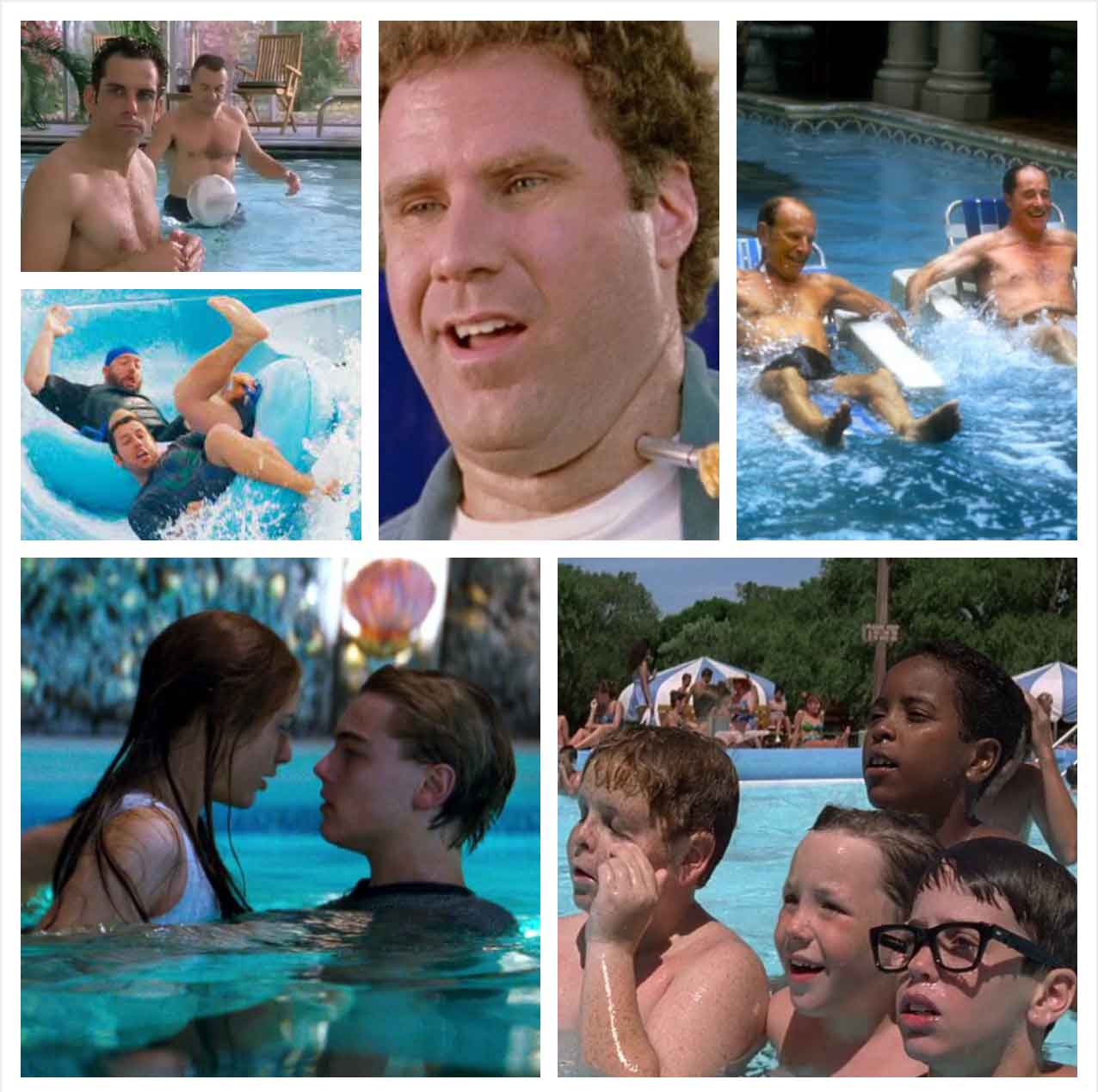
Swimming pools are a part of the fabric of our lives, our culture, and the movies we watch. Throughout the history of film, swimming pools, have played an important part on the silver screen. Consequently, actors have been taking the plunge as far back as the silent film era.
It should come as no surprise that of the 500,000 or so feature-length films in existence, that a fair percentage incorporate pools or swimming as a theme or central plot point. The world’s fascination with swimming pools dates back far greater than the advent of moving pictures. Charlie Chaplin made the swimming pool a focal piece of one of his films way back in 1917 and Hollywood has been following suit ever since.
Our 30 Favorite Film Scenes Featuring Swimming Pools
Today, we’re going to take a stroll down memory lane as we highlight some of the most memorable moments from film history featuring swimming pools. Let’s dive right in!

#1 – Cocoon
A pool played a central theme in the 1985 movie Cocoon. Extraterrestrials had a veritable fountain of youth in their swimming pool, something Jessica Tandy and Oscar winner, Don Ameche found irresistible. Cocoon was also a big movie for actors Steve Guttenberg and Brian Dennehy who spends half the film trying to keep them out of the pool without much success.
#2 – Cruel Intentions
The chemistry was undeniable between Ryan Phillippe and Reese Witherspoon in the 1999 film Cruel Intentions. Seduction lay at the heart of this swimming pool scene set at the often used Millenium Biltmore Hotel in Los Angeles which doubled for the Valmont Mansion in New York City.

#3 – Fast Times at Ridgemont High
Nobody can quite forget this swimming pool scene. Phoebe Cates has quite possibly one of the memorable pool scenes of all time in the 1984 classic Fast Times at Ridgemont High. The MPAA originally slapped the movie with an X-rating because of the blatant full-frontal nudity in the film. You won’t see the whole scene here though, because hey, we’re a family magazine.
#4 – Ferris Bueller’s Day Off
Matthew Broderick had quite possibly the best hooky day ever in the 1986 film Ferris Bueller’s Day Off. Alan Ruck’s character Cameron Frye looks for the bottom of the pool when he has a complete mental breakdown after seeing the odometer on his father’s car.
#5 – Poltergeist
One of the scariest swimming pool scenes in film history is in the 1982 horror film Poltergeist. JoBeth Williams looks genuinely horrified to be swimming in her unfinished pool with skeletons. Perhaps because she knew that studio used real human skeletons because it was too expensive and difficult to locate and shoot with synthetic ones.
#6 – Back To School
Who could ever forget Rodney Dangerfield in the campy ’86 comedy smash Back To School? Dangerfield goes for quite possibly the most memorable high dive of all time with his impossible “Triple Lindy” dive during the climax of the film.
#7 – Boogie Nights
Director Paul Thomas Anderson is a master of the long cut as evidence in the pool party scene in the 1997 film Boogie Nights. John C. Reilly’s character Reed Rothchild does the worst back flop in movie history while attempting a full front flip. Don’t try that at home kids.
#8 – Old School
A children’s pool party sets the unlikely stage for one of the funniest moments in film history in the 2003 comedy Old School. Try not to bust a gut when Will Ferrell’s character, Frank The Tank accidentally shoots himself in the neck with a tranquilizer gun before stumbling into the pool and blacking out.
#9 – National Lampoon’s Christmas Vacation
Chevy Chase spends the entire movie dreaming about how he’s going to spend his Christmas bonus. His plans involve building a swimming pool for the family but even his day dreams go awry in the 1989 classic National Lampoons Christmas Vacation.
#10 – Harold & Maude
Harold Chasen (played by Bud Cort) is obsessed with death in the 1971 dark rom-com classic Harold & Maude. Aside from driving a hearse and spending an inordinate amount of time attending funerals for people he doesn’t know, Harold is fond of faking elaborate suicides. So much to the extent that his own mother has built up an immunity to his shenanigans, as evidence to her ignoring Harold doing a dead mans float, in the swimming pool. She does the breaststroke, right past him and continues on as if he’s not even there.
#11 – The Graduate
Dustin Hoffman stars as 21-year-old Benjamin Braddock in the 1967 comedy cult classic The Graduate. One of the most memorable scenes involves a birthday gift Ben’s parents urge him to show off to his family and friends; a set of scuba diving gear they insist he demonstrate in the swimming pool. There was definitely some innovative cinematography in this film as evidence in the scene shot from the viewpoint of the inside of Ben’s diving mask.
#12 – Beverly Hills Cop II
Eddie Murphy reprised his role where he plays a fish out of water wisecracking, detective from Detroit in the hit 1987 sequel Beverly Hills Copy II. In this funny scene, Murphy is squatting in a tony mansion with a swimming pool and jacuzzi. In real life Eddie Murphy’s pool put’s this one to shame.
#13 – Lethal Weapon
One of the most famous action movie scenes involving a swimming pool was in the 1987 hit Lethal Weapon. Mel Gibson (Riggs) and Danny Glover (Murtaugh) played two crime-fighting detectives on a mission. Murtaugh’s mission was to stop the crooks without killing them while Riggs was on a mission to evidently ruin a perfectly good pool cover.
#14 – Meet The Parents
One of the funniest scenes in the 2000 smash hit Meet The Parents is when Ben Stiller (Greg Focker) is forced to attend a pool party at his fiance’s ex-boyfriend’s palatial home. Greg clearly isn’t much of a volleyball player but the hilarity really ensues when his competitive streak comes out of him. He attempts to rise to the occasion by spiking the ball as hard as he possibly can.
#15 – Gremlins
When you own a pet that multiplies after getting wet, you should probably keep it as far away from the swimming pool as possible. Especially, once it’s turned into a gremlin after eating a midnight snack. Watch this pool scene from the 1984 blockbuster, Gremlins.
#16 – A Nightmare on Elm Street 2
Nothing can ruin a pool party faster than Freddy Kreuger showing up. What a buzz kill! The razor-fingered slasher shows up just in time to put a damper on the festivities in the 1985 sequel Nightmare on Elm Street 2: Freddy’s Revenge. This wouldn’t be the last time that a pool scene would pop up in the Nightmare on Elm Street series, they used a swimming pool as a focal point of the film again in 2010 in the franchise reboot.
#17 – Anchorman
Will Ferrell’s hilarious 2004 comedy smash Anchorman: The Legend of Ron Burgundy has one particular pool scene at the very beginning of the movie that is very funny. Evidently he’s been going to the same pool party for the past 12 years and in no way is that depressing.
#18 – Caddyshack
Finding a floater in the pool is everyone’s worst nightmare come to life; depicted in this hilarious scene from 1980’s Caddyshack. Bill Murray plays quite possibly the funniest pool boy ever. We love a guy that isn’t scared to put a theory to the test right there on the spot. Incidentally, the scene involving a Baby Ruth candy bar being thrown in the pool was based on a true incident that occurred at Brian Doyle-Murray‘s high school.
#19 – Wall-E
In the 2008 animated film Wall-E, humanity has polluted the planet to the point where we’ve been forced to evacuate to an interstellar cruise ship. Evidently, it’s a pretty big ship because the folks that live there didn’t know there was a pool on board.
#20 – Romeo + Juliet
Two star-crossed lovers find themselves again in the 1996 film William Shakespeare’s Romeo + Juliet starring Leonardo DiCaprio and Claire Danes. Director Baz Luhrmann reimagined this famous scene from the play to occur poolside.
#21 – It’s a Wonderful Life
Perhaps the most iconic swimming pool scene of all time occurs in the 1946 Christmas classic, It’s a Wonderful Life. Definitely one of the more defining moments of the film is when George Bailey (Jimmy Stewart) and Mary Hatch (Donna Reed) are dancing and the floor suddenly opens to an inground swimming pool underneath them. Suddenly a dance party becomes a pool party and no one seems to mind one bit.
#22 – The Great Gatsby
The Great Gatsby by F. Scott Fitzgerald is an American classic novel reimagined in the 2013 film starring Leonardo DiCaprio. Swimming pools play a prevailing role throughout the film staged in the decadent Jazz age of Long Island. Ultimately, Gatsby would reach his end in a swimming pool, murdered by a jealous husband George Wilson (Jason Clarke).
#23 – National Lampoon’s Vacation
Chevy Chase stars in the 1983 hit National Lampoon’s Vacation. His character Clark Griswold has a nack for finding trouble and making bad decisions. Skinny dipping with Christie Brinkley in a motel pool was just one of them.
#24 – Oblivion
We have to say, Tom Cruise‘s sky apartment in 2013’s Oblivion, is pretty amazing. Having a swimming pool like this one would be very Hollywood. The premise of the film is a little weird and perhaps Roger Ebert said it best “Harper and Vica spend their days fixing drones, eating candelit dinners, and swimming in a glass-bottomed pool.” Hey, if that’s what it takes, sign us up.
#25 – The Sandlot
The Sandlot (1993) had one of the most memorable pool scenes in film history. Not because of the beauty of the swimming pool mind you, but because of what occurred poolside. Try this one at your local pool club and you’re immediately banned for life. We’re not condoning what Squints Palledorous did mind you, but it’s still a pretty cool pickup move nonetheless.
#26 – Grown Ups
Kevin James is hilarious as he takes one on the chin to debunk an old myth about peeing in the pool in 2010’s hit, Grown Ups. This one is just for entertainment value though, there really is no chemical that turns your urine blue when you pee in the pool. Then again, do you really want to take that chance to find out for yourself?
#27 – Rushmore
Bill Murray clearly has no qualms about cannon balling into a green pool in 1998’s sleeper hit Rushmore. In fact, he dives into the murky swimming pool with a cigarette still in his mouth, so it doesn’t really look like he’s going to let a lil algae disrupt his day.
#28 – The Jerk
Steve Martin‘s 1979 comedy classic The Jerk has one memorable pool scene where he beats up a pack of racist real estate investors. This wouldn’t be the first memorable scene of Martin’s career where he showcases his incredible martial arts skills. You can copy his legendary kung fu style from scenes in “Fake Purse Ninjas” in the movie Bowfinger.
#29 – The Swimmer
Burt Lancaster plays Ned Merrill in the 1968 classic, The Swimmer – based on a short story originally published by John Cheever in The New Yorker. The Swimmer tells the tale of a middle-aged man who lands in a friends backyard pool party. Merrill becomes fixated with the idea that there are so many swimming pools in the neighborhood, they could practically form a river. He becomes intent on swimming his way home but realizes that with every stroke comes disillusionment.
#30 – Home Alone 2: Lost In New York
Macaulay Culkin plays lovable Kevin McCallister in the smash sequel Home Alone 2: Lost in New York. Culkin always had a screen presence that belied his young age. In this scene, while staying at the posh Plaza Hotel, his character Kevin asks if any of the adults nearby would mind him working on his cannonballs. No one seems to mind. There is one thing though, that bathing suit looks a little big on him.
What Are Your Favorite Swimming Pool Scenes?
We’re happy you stopped in with us today to read about some of Hollywood’s most memorable swimming pool scenes. It’s a fact that with so many films out there, we’re bound to have missed a few that probably made your list. Let us know your favorite pool scenes in the comments, we may revise this article in the future to include some of your suggestions.







Pool News
Leslie’s Reportedly Prepares for Chapter 11 Bankruptcy as Possible Nasdaq Delisting Looms
The nation’s largest specialty pool retailer reportedly seen preparing to file for Chapter 11.
Leslie’s, Inc. (NASDAQ: LESL) is reportedly preparing to file for Chapter 11 bankruptcy protection as soon as next week, potentially handing control of the 63-year-old retailer to its lenders. The news comes as the company faces the prospect of being delisted from Nasdaq following a prolonged collapse in its share price.
According to September 24 reports from Bloomberg and The Wall Street Journal, Leslie’s is working toward a restructuring agreement that would transfer ownership to its creditors. Lenders are reportedly prepared to provide approximately $100 million in financing to keep the business operating through bankruptcy, while roughly $750 million in debt could be exchanged for equity.
For existing shareholders, the implications could be devastating. If the restructuring proceeds as reported, their investments could be substantially diluted or wiped out entirely.
Leslie’s has not formally announced a bankruptcy filing, but the possibility is hardly unexpected. In its August quarterly SEC filing, the company acknowledged substantial doubt about its ability to continue operating and warned that bankruptcy could become necessary if it was unable to restructure or refinance its debt.
The latest developments suggest that efforts to stabilize the business through store closures, lower prices and aggressive cost-cutting have not been enough to overcome its mounting financial problems.
A Second Trip to Wall Street That Could End in Bankruptcy
This isn’t Leslie’s first time as a publicly traded company.
After previously operating as a public company before being acquired by private equity, Leslie’s returned to Wall Street in October 2020, during an unprecedented boom in swimming pool construction and backyard spending.
With millions of Americans investing in pools, outdoor living and home improvements, the company appeared well positioned for continued growth.

Instead, the years that followed proved considerably more difficult.
As pandemic spending faded, inflation and higher interest rates squeezed household budgets. New-pool construction slowed, consumers became more selective about discretionary purchases, and the extraordinary demand that had fueled the industry began returning to normal.
Leslie’s was also facing growing competition from Walmart, Home Depot, Lowe’s, Amazon and numerous online pool supply retailers. Customers who once relied on their local pool store could now compare prices and purchase many of the same products without leaving home.
The company responded by closing 80 underperforming stores and one distribution center, reducing inventory and introducing lower prices to attract customers.
For a brief period, those efforts appeared to be working.
According to its second-quarter earnings report, revenue increased 4.3%, comparable sales improved 6.6%, and customer counts rose 8% compared with the previous year. Investors cautiously welcomed the improvement, hoping it signaled the beginning of a turnaround.
Unfortunately, that optimism proved short-lived.
Summer Sales Tell a Different Story
Leslie’s third-quarter earnings, released August 12, revealed that the company was still struggling during what should have been its strongest selling season.
Revenue declined 8.4% to $458.5 million, compared with $500.3 million during the same quarter a year earlier. Comparable sales fell 6.2%, while adjusted EBITDA dropped from $81.6 million to $55.7 million.
Gross margins also deteriorated, falling from 39.6% to 36.5%, illustrating the difficulty of maintaining profitability while lowering prices to compete for customers.
For the first nine months of fiscal 2026, Leslie’s reported a net loss of $87.7 million. Management subsequently withdrew its full-year financial guidance as the company explored alternatives to address its debt.
The problem wasn’t simply that Leslie’s was selling fewer pool supplies. It was that declining sales were making an already difficult financial situation considerably worse.
As of July 4, Leslie’s reported approximately $1.21 billion in total liabilities against $722.2 million in assets, including roughly $753 million in long-term debt.
Closing stores and reducing expenses can help preserve cash, but those measures alone cannot resolve a debt burden of that magnitude.
The reported restructuring would effectively exchange much of that debt for ownership of the company, giving Leslie’s an opportunity to continue operating without the same financial obligations hanging over its head.
For its existing shareholders, however, that opportunity could come at a substantial cost.
Nasdaq Delisting Could Be Next
Bankruptcy isn’t Leslie’s only immediate concern. The company also faces the prospect of being removed from Nasdaq, and the timing of its previous reverse stock split could accelerate that process.
Leslie’s completed a 1-for-20 reverse stock split in September 2025, consolidating every 20 existing shares into one in an effort to address its declining stock price. Split-adjusted trading began September 29, but the stock has since fallen back below Nasdaq’s $1 minimum bid-price requirement.
Normally, a company whose closing bid price remains below $1 for 30 consecutive business days receives 180 days to regain compliance. However, Nasdaq’s rules prohibit that grace period for companies that completed a reverse stock split within the preceding year.
Leslie’s reverse split became effective September 26, 2025, making the timing of its latest share-price decline particularly significant.
If Leslie’s has closed below $1 for 30 consecutive business days while that one-year reverse-split restriction remains in effect, it would not be eligible for Nasdaq’s ordinary compliance period. Under Nasdaq’s rules, staff would issue a Staff Delisting Determination rather than provide the usual 180-day period to regain compliance.
The company could request a hearing to appeal such a determination, although an appeal would not guarantee that its shares remain listed.
A Chapter 11 filing would create another potential obstacle. Nasdaq has discretionary authority to delist companies undergoing bankruptcy, particularly when a restructuring could eliminate existing shareholder equity.
As of September 24, a new Nasdaq delisting determination related to the company’s current share-price performance or reported bankruptcy preparations has not been publicly confirmed.
What Bankruptcy Would Mean for the Pool Industry
A Chapter 11 filing wouldn’t necessarily mean Leslie’s is going out of business.
The process allows companies to continue operating while restructuring their debts, renegotiating contracts and developing a plan to emerge from bankruptcy. The reported $100 million in financing could provide the cash necessary to pay employees, purchase inventory and keep stores open while the restructuring moves through court.
For pool owners, the immediate impact may be relatively limited. Leslie’s could continue selling chemicals, equipment and replacement parts while providing the water testing and technical advice that have long been central to its retail business.
For manufacturers and distributors, however, the implications could be considerably greater.
Leslie’s remains one of the industry’s largest retail distribution channels. A bankruptcy could force suppliers to renegotiate payment terms, reconsider credit arrangements and adjust inventory or production plans. Additional store closures could also affect manufacturers that depend heavily on the retailer to get their products in front of consumers.
Independent pool stores and competing retailers could potentially gain customers if Leslie’s reduces its footprint, particularly in markets where the company has historically maintained a strong presence. However, disruptions to supplier relationships and distribution could also create challenges for businesses throughout the industry.
The bigger question is how much of Leslie’s existing business will survive the restructuring. Its nationwide store network, established customer base and professional water testing services still have value, but those advantages haven’t been enough to offset declining sales and the company’s substantial debt.
Can Leslie’s Survive?
For Leslie’s, Chapter 11 could provide an opportunity to address financial problems that store closures and cost-cutting have been unable to resolve. Exchanging debt for equity could substantially reduce its obligations and allow the retailer to continue operating under new ownership.
That doesn’t mean the underlying challenges disappear. Leslie’s would still have to compete with big-box retailers and online sellers, rebuild customer traffic and find a way to operate profitably with a potentially smaller retail footprint.
For existing shareholders, the reported restructuring presents a different situation. If lenders take ownership in exchange for forgiving debt, there may be little or nothing left for current equity holders.
The coming days should provide a clearer picture of the company’s future. A formal bankruptcy filing would reveal the proposed restructuring terms, financing arrangements and any additional changes to its retail operations.
For the thousands of employees, manufacturers and suppliers that depend on Leslie’s, the immediate concern will be whether the company can maintain normal operations while reorganizing its finances.
For a retailer that has served American pool owners since 1963, the next chapter could look considerably different from the business that returned to Wall Street six years ago.


New department will expand technical support for reinforced PVC membrane systems across North America
RENOLIT has established a dedicated U.S. engineering department within its North American Pool business unit to support the continued growth of reinforced PVC membrane systems in the North American swimming pool market.
Led by Brandon Mays, the new department will serve as a technical link between architects, aquatic consultants, builders, installers, RENOLIT’s North American commercial team and the company’s engineering and manufacturing resources in Europe. It will provide project-specific technical support, including system recommendations, specification guidance, submittal packages, technical drawings, accessory selection, and installation details.

A primary focus for the department will be developing standardized construction details and installation guidelines that reflect North American construction methods, codes and field conditions. These resources are designed to help architects and aquatic consultants incorporate reinforced PVC membrane systems into project specifications with greater clarity and consistency, while giving builders and installers more complete guidance in the field.
The department will support commercial pool projects from the earliest design and specification stages through installation, helping project teams identify and address potential technical challenges before construction begins. It will also coordinate the adaptation and development of complete systems for the North American market — including membranes, terminations, transitions, drainage components and other accessories — and will contribute to installer training, technical education and the development of qualification standards and best practices, including research into North American testing, certification and code requirements for commercial aquatic facilities.
“For years, we have heard a consistent need from architects, consultants, builders and installers for stronger technical resources in North America,” said Tony Jordan, Business Development Manager. “The creation of this department is a direct response to that need and an important step in supporting the market’s long-term growth.”

Mays brings extensive experience in commercial aquatics, reinforced PVC membrane systems, and project coordination to his new role. He will collaborate closely with RENOLIT’s North American sales, business-development, training and customer-service teams while maintaining a direct technical connection with the company’s Pool engineering team headquartered in Spain. “My priority is to make technical support easier to access and more useful throughout the life of a project,” said Mays. “That means working closely with architects, consultants, builders and installers to develop solutions that are technically sound and practical to execute.”

The establishment of the engineering department reflects RENOLIT’s broader effort to advance reinforced PVC membranes as complete, engineered waterproofing systems rather than treating the membrane solely as a pool finish. By expanding its technical resources in the United States, RENOLIT aims to reduce uncertainty and construction risk while giving architects, builders, installers and facility owners greater confidence in how these systems are designed, specified and installed — representing the next stage of RENOLIT’s ongoing commitment to technical support, professional education and the long-term development of reinforced PVC membrane systems throughout North America.
More information about RENOLIT’s partnership and products can be found here:

New public resources focus on helping pool owners understand water-test results as a connected system rather than a collection of isolated numbers.
AvenBlu, a digital pool-care platform for homeowners and pool professionals, has expanded its free public resource library with a new Pool Chemistry Guide and a companion Pool Calculator designed to turn confusing test results into clearer next-step decisions.
For many homeowners, the hardest part of pool care begins after the test strip. They have numbers, but not context. AvenBlu’s latest launch is built around that gap, helping users understand how readings influence one another and what should be addressed first instead of simply handing them another chart of “good” numbers.

“A chlorine reading by itself doesn’t tell the entire story. We wanted to build something that helps people understand the context before they start adding products.” TY — AVENBLU
Moving Beyond Individual Test Numbers
The Pool Chemistry Guide explains the measurements homeowners encounter most often when testing residential water: free chlorine, combined chlorine, pH, total alkalinity, cyanuric acid, calcium hardness, salt, and water temperature.
Its core premise is simple: these readings are not independent pass-or-fail grades. They are connected signals. A pool may have chlorine that looks acceptable on paper while still underperforming because pH, stabilizer, temperature, recent swimmer load, or general water condition are pulling the system in another direction.
The guide also clarifies a distinction that often gets blurred in consumer-facing pool content: the difference between public-health baselines, commonly used industry operating methods, and AvenBlu’s own conservative planning recommendations.
Instead of encouraging users to chase every number at once, AvenBlu frames pool care as a deliberate sequence: test, interpret, correct, circulate, and retest.

- Explains why free chlorine needs CYA and pH context.
- Shows how alkalinity affects pH stability.
- Connects calcium, temperature, and balance to scale or aggressive water.
- Clarifies that saltwater pools still require complete chlorine and water-balance management.

For homeowners overwhelmed by conflicting online advice, that framing can reduce guesswork. For service providers, it can mean conversations start with better information and more realistic expectations.
From Education to Practical Pool Decisions
The chemistry hub connects directly with AvenBlu’s free Pool Calculator, which lets homeowners enter pool volume and current test results to better understand what those numbers mean and estimate conservative starting adjustments. The calculator is intentionally designed around a test-correct-circulate-retest workflow rather than encouraging several overlapping corrections at once.
- Test: Start with a current sample and a clear set of readings.
- Interpret: Read chlorine, pH, stabilizer, and balance together.
- Correct: Make one deliberate adjustment rather than several guesses.
- Circulate: Let water mix fully before treating old numbers like current reality.
- Retest: Use the new reading to choose the next move.
That same philosophy carries into issue diagnosis. For green water, cloudy water, strong chlorine odor, staining, scaling, rapidly disappearing chlorine, or unstable pH, AvenBlu presents symptoms as investigative clues rather than definitive diagnoses.
“The goal isn’t to make every number move at once. It’s to understand the relationships and make the next deliberate move.”
It also draws clear safety lines, advising homeowners to stop and seek appropriate help when facing fumes, spills, burns, major overdoses, uncertain chemical combinations, severe contamination, or circulation failures.

A Growing Pool-Care Knowledge Library
The Pool Chemistry Guide is part of a broader expansion of AvenBlu’s public educational resources. The goal is not to publish disconnected articles, but to create a connected user journey that mirrors the way real homeowners think about their pools.
Someone researching a strong chlorine odor can move from an issue-specific guide into broader chemistry education, then use a calculator or retesting workflow to evaluate their own pool. A homeowner dealing with scale can move from identifying the symptom to understanding how calcium, pH, alkalinity, temperature, and overall balance may contribute.
Pool Calculator
Helps homeowners enter pool volume and test results, understand what the numbers mean, and estimate conservative starting adjustments.
Pool Chemistry Guide
Explains chlorine, pH, alkalinity, stabilizer, calcium, salt, testing, water-balance interactions, and correction order in plain language.
Pool Care Guides
Issue-specific resources covering cloudy and green water, saltwater care, stain and scale clues, seasonal maintenance, retesting, and safety.

About AvenBlu
AvenBlu is a digital pool-care platform built to help homeowners better understand, manage, and maintain their pools while also giving pool professionals tools for business visibility, customer management, documentation, and ongoing service operations.
Its platform combines pool-care education, water-test interpretation, maintenance planning, troubleshooting resources, and professional-service connections in one system.
Read the Summer Issue of Pool Magazine

See more of our coverage in your search results
 Sponsored Advertisement
 Leslie’s Reportedly Prepares for Chapter 11 Bankruptcy as Possible Nasdaq Delisting Looms
 CCEI Taps Benoit Masse for Sales
 JED Pool Tools Offers New 14-Inch Pro Vacuum Head
 FSPA and PHTA Reunite Through Historic Affiliation
 RENOLIT Establishes U.S. Engineering Department for Pool Business
 Magic Plastics Redesigns MagicVac Cutting Freight Costs
 AvenBlu Launches Free Pool Chemistry Hub and Calculator

 GENESIS® Announces Maria Moscato As International Design & Wellness Faculty Advisor
 Pool Products: Concrete Countertop Solutions Products Will Help You Grow Your Business
 Can You Catch Monkeypox From Swimming Pools?
 Pool Pro Rudy Stankowitz, Joins Film Production
 GEHA and the Hunt Family Foundation Support Delaney 37 Foundation
 The Edge That Changed My Career: What My First Negative Edge Taught Me
 PHTA Standards Consensus Committee Appoints New Members
 Sponsored Advertisement
 Sponsored Advertisement
 Products3 weeks ago
5 Ways Jandy’s New AquaLink® EDGE™ Is Changing the Game for Pool Pros

 Pool Builder4 weeks ago
Ownership Group Acquires Shasta Pools, Announces Expansion Plans to Offer Complete Home Services

 Pool News4 weeks ago
Landmark Aquatic Earns Three 2026 PHTA Awards of Excellence

 Pool News4 weeks ago
WITI Announces 3rd Annual Walk for Water Safety

 Pool News2 weeks ago
Inside the 2026 Million Dollar Pool Design Challenge

 Manufacturer4 weeks ago
JED Pool Tools Unveils 2027 Catalog

 Pool Equipment4 weeks ago
RicoRock Introduces Compact 18-Inch Pool Waterfall

 Industry News3 weeks ago
Why Pools Matter: Pool Horizons Takes Its Message Global
You must be logged in to post a comment Login